August 6, 2026
How Global Aluminium Markets Price Risk Before a Single Tonne Moves
Commodity markets are never truly about the present. Every price quoted on the London Metal Exchange reflects a collective calculation of future scarcity, surplus, geopolitical uncertainty, and industrial appetite. Aluminium, the second most widely used metal on earth, is no exception. Before a single tonne reaches an automotive stamping plant in Germany or a packaging line in Southeast Asia, it has already passed through a sophisticated web of cash settlements, forward contracts, and warrant systems that translate global risk into a single number per tonne.
Understanding why the LME aluminium price falls to $3,559 per tonne on any given session requires far more than reading a daily price ticker. It demands an appreciation of market structure, inventory mechanics, regional pricing benchmarks, and the macro forces that sit beneath every trade.
When big ASX news breaks, our subscribers know first
How the LME Aluminium Pricing Architecture Actually Functions
Cash Settlement, Forward Contracts, and Why the Spread Tells the Real Story
The LME operates as the world's primary venue for base metals price discovery, and aluminium is among its most actively traded contracts. The exchange runs a dual-price system at any moment, publishing both a bid (the price at which a buyer is prepared to purchase) and an offer (the price at which a seller is prepared to sell). The gap between these two figures, known as the bid-offer spread, reflects market liquidity and trading confidence at a given moment.
Cash prices on the LME represent the cost of aluminium for immediate, two-business-day delivery. This is the benchmark most closely tied to physical market conditions. Forward contracts, by contrast, project pricing across future delivery windows, with the three-month contract serving as the LME's most liquid and widely referenced forward instrument. You can explore the full contract specifications directly on the LME aluminium page.
The relationship between cash and forward prices carries significant analytical weight:
- When cash prices exceed forward prices, the market is in backwardation, typically signalling tight near-term supply or strong immediate demand.
- When forward prices exceed cash prices, the market is in contango, usually indicating oversupply expectations or weak short-term demand.
- The December 2027 contract operates as a long-horizon signal, reflecting institutional views on where the aluminium market will be structurally positioned roughly 18 months out.
On May 7, 2026, the cash offer of $3,559 per tonne sat above the three-month offer of $3,510 per tonne, confirming a backwardated market structure. This is a technically significant detail that often gets overlooked in headline-level price reporting.
What the LME Asian Reference Price Represents
A less commonly discussed but strategically important benchmark is the LME Asian Reference Price. This is a separately calculated settlement figure derived from LME pricing during Asian trading hours, designed to serve as a relevant benchmark for buyers and sellers transacting across Asia-Pacific markets.
Its importance lies in the regional pricing dynamics it captures. Asian downstream processors, including those in China, South Korea, Japan, and Southeast Asia, often use this reference to price physical contracts and import arrangements rather than the London cash settlement, which reflects European-hour trading activity. On May 7, 2026, the Asian Reference Price settled at $3,493 per tonne, a decline of $29.50 from the prior session's $3,522.50 per tonne.
A Full Breakdown of May 7, 2026 LME Aluminium Price Movements
The session's price data paints a clear picture of sustained selling pressure across the entire forward curve, though with a notable divergence between near-term and longer-dated contracts.
| Contract Type | May 6, 2026 (USD/t) | May 7, 2026 (USD/t) | Change (USD/t) | % Change |
|---|---|---|---|---|
| Cash Bid | $3,596.00 | $3,558.50 | -$37.50 | -1.04% |
| Cash Offer | $3,597.00 | $3,559.00 | -$38.00 | -1.06% |
| 3-Month Bid | $3,544.50 | $3,509.00 | -$35.50 | -1.00% |
| 3-Month Offer | $3,545.50 | $3,510.00 | -$35.50 | -1.00% |
| Dec 2027 Bid | $3,140.00 | $3,125.00 | -$15.00 | -0.48% |
| Dec 2027 Offer | $3,145.00 | $3,130.00 | -$15.00 | -0.48% |
| Asian Ref. Price | $3,522.50 | $3,493.00 | -$29.50 | -0.84% |
Why the December 2027 Contract Declined at Half the Rate of Cash Prices
One of the more analytically revealing aspects of May 7's session is the divergence in the magnitude of declines across the forward curve. While the cash offer fell by $38 per tonne (approximately 1.06%), the December 2027 contracts declined by only $15 per tonne (approximately 0.48%). This is not a coincidence.
Longer-dated contracts are far less sensitive to short-term sentiment swings, news-driven selling, or technical stop-loss triggers. They reflect the views of participants with a structural time horizon, including smelters managing multi-year production economics, major industrial buyers securing long-term supply, and institutional investors making macro calls on industrial metals demand.
The fact that December 2027 contracts held up comparatively well suggests that longer-horizon market participants remain broadly constructive on aluminium's fundamental outlook, even as near-term traders were clearly in risk-reduction mode.
A shallow decline in long-dated forward contracts during a sharp cash price selloff is often a signal that the market views the weakness as cyclical rather than structural. Producers hedging multi-year output take note of this divergence when deciding whether to increase or reduce their forward sales programmes.
Contextualising the 1% Single-Day Drop
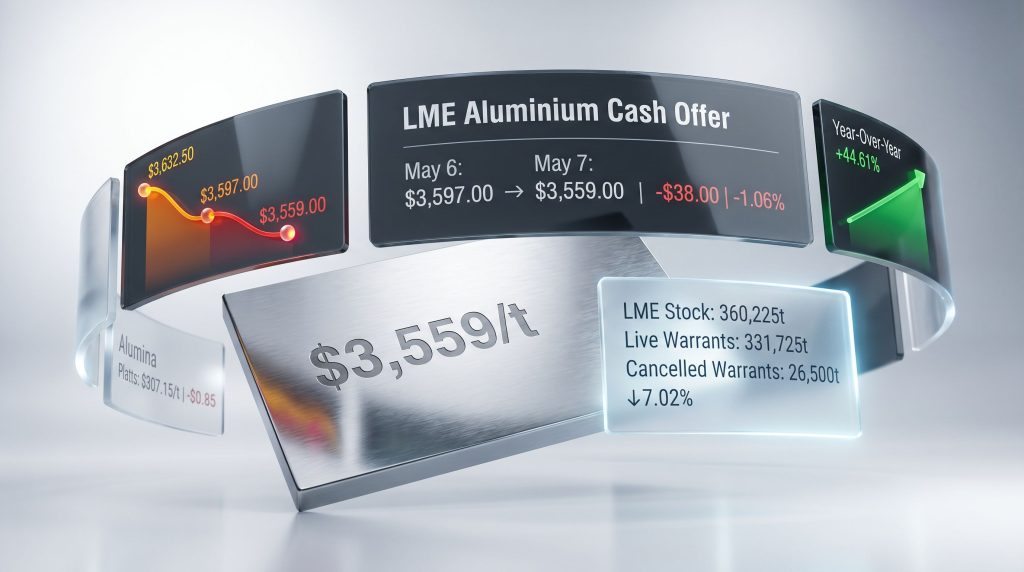
A $38 per tonne intraday decline in the cash offer may appear modest in percentage terms, but context matters enormously. Over three consecutive sessions from May 5 to May 7, 2026, the cash offer fell from $3,632.50 per tonne to $3,559 per tonne, a cumulative erosion of $73.50 per tonne or approximately 2.02%. Consecutive bearish sessions of this nature compound selling pressure, as algorithmic trading systems and technical momentum strategies trigger additional stop-loss orders once price thresholds are breached.
For comparison, the session on April 2, 2026 saw the cash offer fall 2.2% to $3,505 per tonne, which at the time represented the most aggressive single-day selloff in recent memory. The May 7 session did not match that intensity, but its continuation of a multi-day downtrend carries its own momentum implications. Furthermore, those tracking aluminium price history over longer timeframes will note that multi-session corrections of this kind are a recurring feature of LME trading cycles.
Putting $3,559 Per Tonne in Historical Perspective
How the Current Price Level Compares Across Multiple Time Horizons
| Timeframe | LME Aluminium Cash Offer (USD/t) | Change vs. May 7, 2026 |
|---|---|---|
| May 5, 2026 | $3,632.50 | -$73.50 (-2.02%) |
| May 6, 2026 | $3,597.00 | -$38.00 (-1.06%) |
| May 7, 2026 | $3,559.00 | Baseline |
| 1-Month Change | Approx. flat | +0.15% (marginal gain) |
| Year-Over-Year (vs. May 2025) | Significantly lower | +44.61% increase |
| April 2, 2026 (recent trough) | $3,505.00 | +$54.00 above recent low |
The 44.61% Year-Over-Year Gain Changes Everything About How You Read the Current Weakness
Short-term price volatility almost always obscures longer-term structural trends. The most important figure in the above table is not the day-over-day decline but the 44.61% year-over-year increase relative to May 2025 levels. This figure fundamentally reframes the narrative around the May 7 selloff.
A market that has appreciated by nearly 45% in 12 months has established a materially higher structural floor. Short-term corrections within such an uptrend are a normal feature of commodity markets, not evidence of trend reversal. Seasoned commodity investors and procurement managers understand that the appropriate analytical lens for a one-day decline must account for the multi-month trajectory.
The $54 per tonne buffer between the May 7 cash offer and the April 2 session low of $3,505 per tonne also provides meaningful context. The market has not returned to its recent trough despite several days of selling pressure, suggesting that physical demand or producer buying is providing a degree of underlying support.
Disclaimer: Historical price performance is not indicative of future price movements. All market analysis in this article reflects publicly available data from May 2026 and should not be construed as financial or investment advice.
LME Aluminium Inventory Dynamics: What the Numbers Reveal
Inventory Data: May 6 vs. May 7, 2026
| Inventory Metric | May 6, 2026 | May 7, 2026 | Change | % Change |
|---|---|---|---|---|
| Opening Stock (Total) | 362,725 t | 360,225 t | -2,500 t | -0.69% |
| Cancelled Warrants | 28,500 t | 26,500 t | -2,000 t | -7.02% |
| Live Warrants | 331,725 t | 331,725 t | 0 t | 0.00% |
Understanding Cancelled Warrants as a Leading Demand Indicator
Within the LME warehouse system, aluminium is stored against warrants, which are essentially ownership certificates for specific lots of metal held in approved storage facilities. These warrants come in two forms:
- Live warrants represent metal that is stored and available for sale or further financing arrangements.
- Cancelled warrants represent metal that has been earmarked by its owner for physical withdrawal from an LME-registered warehouse. Once cancelled, the warrant is in the process of being converted into a physical delivery.
The 7.02% single-day decline in cancelled warrants from 28,500 tonnes to 26,500 tonnes is analytically interesting precisely because it is a leading indicator. When cancelled warrants fall, it suggests that fewer market participants are currently requesting physical metal withdrawal. This can reflect reduced immediate physical demand, or alternatively, a decision by metal holders to cancel fewer warrants because price conditions make financing or storing the metal more attractive than delivering it.
Critically, live warrants held flat at 331,725 tonnes, indicating that no net new metal was being earmarked for delivery, nor was metal being returned to live warrant status in meaningful volume. This stability in live warrants, alongside declining total stocks, suggests a market that is drawing down inventory modestly but without the kind of aggressive physical demand surge that would typically accompany a supply squeeze.
The Analytical Puzzle: Falling Prices Alongside Declining Inventory
In a simplified model of commodity markets, declining inventory should support or lift prices by signalling tighter supply. Yet May 7 saw both falling inventory and falling prices, which presents a more complex picture.
Several explanations are plausible:
- Demand destruction: Physical offtake may be declining alongside inventory, meaning the drawdown reflects consumption that is already slowing.
- Speculative repositioning: Financial market participants may be reducing long positions regardless of physical market signals, driving paper prices lower independently of warehouse dynamics.
- Inventory drawdown lag: Inventory changes often lag price movements by days or weeks, meaning the current drawdown may reflect demand that was placed earlier in a higher-price environment.
- Regional mismatch: LME warehouses are concentrated in specific geographic locations, and a drawdown there may not reflect demand conditions in the regions where aluminium is actually consumed most intensively.
The Macro Forces Shaping Aluminium Price Momentum in May 2026
Geopolitical Supply Chain Disruption and the Strait of Hormuz Factor
One of the more structurally significant variables affecting global aluminium markets in 2026 is the disruption to shipping routes through the Strait of Hormuz. This critical maritime corridor handles a substantial portion of global energy trade, and any sustained blockade or threat to navigation there affects aluminum and alumina markets through multiple transmission channels.
Aluminium smelting is extraordinarily energy-intensive, consuming roughly 13 to 14 megawatt-hours of electricity per tonne of primary metal produced. Smelters in regions dependent on Middle Eastern energy inputs face direct cost pressures when energy supply chains are disrupted. Beyond energy costs, shipping route disruptions increase freight costs for bauxite and alumina shipments, compressing smelter margins further.
Geopolitical risk premiums have a complex relationship with commodity prices. In the short term, supply chain uncertainty tends to inflate prices as buyers rush to secure forward cover. Over a medium-term horizon, however, demand destruction caused by economic uncertainty and higher input costs can reassert downward pressure. In addition, aluminum and steel tariffs introduced by major economies have added further complexity to global pricing dynamics.
Supply chain risk and fundamental demand weakness can push aluminium prices in opposing directions simultaneously. Market participants who conflate geopolitical noise with structural supply shortfalls risk making costly procurement or hedging decisions based on sentiment rather than substance.
Manufacturing Sector Signals and the Demand-Side Equation
Aluminium's price trajectory is heavily anchored to the health of three primary consuming sectors:
- Automotive manufacturing, which uses aluminium extensively for lightweighting in vehicle bodies, engine components, and battery enclosures in electric vehicles.
- Construction and infrastructure, where aluminium features in curtain walling, roofing, window frames, and structural applications.
- Packaging, particularly beverage can production, which represents a substantial and relatively stable demand base.
Softening industrial output indicators in major consuming regions during Q2 2026 have contributed to demand-side caution among downstream buyers. When procurement managers believe prices may fall further, they tend to delay purchases and draw down existing inventory rather than entering the market, which itself compounds the downward price pressure.
Currency Dynamics and the USD Influence on LME Prices
LME aluminium is denominated in US dollars, which means that movements in the USD's exchange rate against other major currencies have a direct mechanical effect on the effective price paid by non-dollar buyers. A stronger USD makes LME-priced aluminium more expensive for buyers in euros, yen, or yuan, dampening demand and adding to downward price pressure. Risk-off episodes in broader financial markets, which typically strengthen the USD, therefore have a compounding effect on metals prices. Furthermore, US aluminium tariffs have introduced additional complexity into currency-adjusted procurement decisions for international buyers.
The next major ASX story will hit our subscribers first
Alumina Pricing and Its Importance to Smelter Economics
LME Alumina Platts Price: May 6 vs. May 7, 2026
| Date | Alumina Platts Price (USD/t) | Change |
|---|---|---|
| May 6, 2026 | $308.00 | Baseline |
| May 7, 2026 | $307.15 | -$0.85 (-0.28%) |
Why Alumina Is the Critical Cost Input for Primary Aluminium Production
Alumina (aluminium oxide, Al₂O₃) is the refined intermediate product derived from bauxite ore through the Bayer process. It serves as the essential feedstock for primary aluminium smelting via the Hall-Héroult electrolytic reduction process. The critical production ratio is approximately two tonnes of alumina required to produce one tonne of primary aluminium, making alumina the single largest material input cost for smelters worldwide. Understanding global bauxite production patterns is therefore essential context for assessing alumina availability and long-term smelter cost structures.
The marginal decline in the Platts alumina price from $308.00 to $307.15 per tonne on May 7 represents a modest but directionally meaningful softening of input costs. For a smelter producing 500,000 tonnes of primary aluminium annually and consuming approximately one million tonnes of alumina, even a $0.85 per tonne reduction in alumina costs translates to roughly $850,000 in annualised input cost savings, though this remains modest relative to the margin compression caused by the $38 per tonne decline in aluminium prices.
Reading the Alumina-to-Aluminium Price Ratio
A useful metric for assessing smelter margin health is the alumina-to-aluminium price ratio. Historically, the cost of alumina has represented roughly 14% to 20% of the prevailing aluminium price under normal market conditions. At current prices (alumina at $307.15 per tonne, aluminium at $3,559 per tonne), the ratio sits at approximately 8.6%, which suggests that alumina is currently cheap relative to aluminium by historical standards.
This relatively low ratio theoretically supports smelter profitability on the input cost side. However, energy costs, labour, carbon compliance costs, and freight expenses collectively determine whether a smelter remains economic. A ratio this low can also reflect structural oversupply in the alumina refining sector, which carries its own long-term implications for bauxite mine economics and refinery investment decisions.
Strategic Responses for Buyers, Sellers, and Producers
How Downstream Buyers Should Think About Current Pricing
For industrial buyers of aluminium including automotive manufacturers, construction firms, and packaging companies, the current price environment presents a nuanced strategic question. The LME aluminium price falls to $3,559 per tonne while remaining 44.61% above year-ago levels, which means the market is cheaper than it was days ago but historically expensive relative to the 2025 baseline.
Practical considerations for downstream buyers include:
- Evaluating whether the current three-session pullback represents a tactical buying window within a structural uptrend.
- Using LME three-month forward contracts to lock in prices against further downside while maintaining exposure to potential recovery.
- Distinguishing between the LME benchmark price and physical market premiums, which reflect regional supply-demand conditions and are often the more relevant figure for actual procurement.
Risk Management Tools for Producers
For primary aluminium producers, the current backwardated market structure (cash above forward) creates a specific set of hedging considerations. When cash prices trade above forward prices, selling forward production at lower levels than spot may appear unattractive. However, the December 2027 contract's relative resilience at $3,130 per tonne on the offer side provides a meaningful floor for producers evaluating multi-year hedge programmes.
Smelters operating near their cost-of-production thresholds should monitor the cash price closely relative to their all-in cost base, including energy, alumina, carbon, and logistics, to determine at what level production curtailment becomes the economically rational response. Consequently, the top aluminium miners are amongst those most closely watching these forward curve dynamics to calibrate output decisions.
What Sophisticated Market Participants Watch Beyond the Headline Price
Experienced aluminium market participants track a set of indicators that rarely appear in headline coverage but carry significant analytical weight:
- Cancelled warrant trends as a leading indicator of near-term physical delivery demand.
- The LME Asian Reference Price as a real-time signal of regional demand strength or weakness.
- The cash-to-three-month spread to assess whether the market is tightening (backwardation deepening) or loosening (contango developing).
- The alumina-to-aluminium price ratio as a proxy for smelter margin health and potential production adjustment signals.
- LME on-warrant stock levels in specific warehouses, particularly those in Asia, which can signal regional tightness even when global totals appear comfortable.
Frequently Asked Questions: LME Aluminium Prices
What Is the LME Aluminium Cash Offer Price?
The LME cash offer price represents the price at which aluminium can be purchased for immediate two-business-day delivery on the London Metal Exchange. On May 7, 2026, this settled at $3,559 per tonne, down $38 from the previous session's close of $3,597 per tonne.
Why Did LME Aluminium Prices Fall on May 7, 2026?
The decline reflected a continuation of bearish momentum across the forward curve, with the cash offer falling approximately 1.06% amid broader market selling pressure. Contributing factors include geopolitical supply chain uncertainty, softening demand signals from key industrial consuming sectors, technical momentum selling following a multi-session downtrend, and potential currency headwinds related to USD strength.
What Are LME Cancelled Warrants?
Cancelled warrants represent aluminium stored in LME-approved warehouses that has been formally earmarked by its owner for physical withdrawal. A decline in cancelled warrants, as observed on May 7 (down 7% to 26,500 tonnes), can indicate reduced immediate physical demand or a shift in financing and storage strategies by metal holders.
How Does the LME 3-Month Price Differ From the Cash Price?
The three-month price reflects the cost of aluminium for delivery approximately three months forward. On May 7, 2026, the three-month offer stood at $3,510 per tonne, compared to the cash offer of $3,559 per tonne, confirming a backwardated market structure where near-term prices exceed forward prices.
Is the Current Aluminium Price High by Historical Standards?
Despite the recent pullback, aluminium prices remain approximately 44.61% higher than levels recorded in May 2025, indicating that the market has undergone a significant structural repricing over the past 12 months. The current correction should be understood within this broader context.
What Is the LME Asian Reference Price?
The LME Asian Reference Price is a benchmark calculated during Asian trading hours for use by buyers and sellers transacting in Asia-Pacific markets. On May 7, 2026, it settled at $3,493 per tonne, down $29.50 from the prior session.
Key Takeaways: LME Aluminium Market Snapshot for May 7, 2026
- Cash offer settled at $3,559/t, down $38 (1.06%) from May 6, extending a three-session bearish run.
- 3-month contracts declined by $35.50/t to $3,510/t, maintaining a backwardated market structure where spot prices exceed forward prices.
- December 2027 forward contracts fell a more modest $15/t, indicating that long-horizon market participants retain structural confidence in aluminium's price outlook.
- LME total inventory declined by 2,500 tonnes to 360,225 tonnes, while live warrants held flat at 331,725 tonnes.
- Cancelled warrants dropped 7% to 26,500 tonnes, signalling reduced near-term physical withdrawal demand from LME warehouses.
- Alumina Platts price eased marginally to $307.15/t, providing modest input cost relief for primary aluminium smelters.
- Year-over-year, aluminium prices remain approximately 44.61% above May 2025 levels, confirming that the current weakness is a short-term correction within a structurally elevated price environment.
Readers seeking ongoing coverage of global aluminium market dynamics, LME pricing mechanisms, and supply chain developments can explore industry resources available through the AL Circle news platform, which provides dedicated reporting on primary aluminium price movements and market intelligence.
Want to Stay Ahead of the Next Major ASX Mineral Discovery?
While global aluminium markets reward those who understand the signals beneath the headline price, Discovery Alert's proprietary Discovery IQ model does the same for ASX mineral discoveries — scanning daily announcements in real time and delivering actionable alerts before the broader market reacts. Explore historic discoveries and the returns they generated, then begin your 14-day free trial to ensure you're positioned when the next significant find is announced.