June 11, 2026
The Hidden Architecture of Global Aluminium Pricing: Why the LME Benchmark Shapes Trillions in Industrial Trade
Few pricing mechanisms carry as much silent influence over global manufacturing as the settlement prices published each day by the London Metal Exchange. Automotive factories, aerospace suppliers, beverage producers, and construction firms across six continents adjust procurement budgets, hedge risk, and negotiate supplier contracts against a single daily number. Understanding how that number is formed, what it is currently signalling, and where it may be heading is essential intelligence for anyone operating within, or investing in, the industrial economy.
The LME aluminium price and inventories data released on April 29, 2026 delivered a nuanced picture: spot prices climbed modestly, longer-dated contracts gained ground, but the Asian Reference Price and on-warrant inventory levels both declined, raising questions about the durability of near-term momentum and the regional distribution of demand.
When big ASX news breaks, our subscribers know first
How the LME Became the World's Aluminium Price Anchor
The London Metal Exchange's dominance as a global pricing reference did not emerge by accident. It developed over more than a century of standardisation, regulatory acceptance, and liquidity accumulation that competing exchanges on the Shanghai Futures Exchange (SHFE) and COMEX have struggled to replicate outside their domestic jurisdictions.
The core pricing architecture for physical aluminium globally operates on an LME Basis + Regional Premium model. This means the cash or three-month LME settlement price forms the immovable baseline, while a geographic surcharge is layered on top to reflect the realities of logistics, local supply imbalances, and infrastructure costs. Regional premiums typically range from approximately $80 per tonne to $300 per tonne, depending on the destination market, freight dynamics, and prevailing stockpile conditions.
The structural comparison across the three major exchanges reveals important distinctions:
| Exchange | Primary Role | Settlement Currency | Global Acceptance |
|---|---|---|---|
| LME (London) | Global benchmark, physical delivery | USD | Universal |
| SHFE (Shanghai) | China domestic pricing | CNY | Primarily domestic |
| COMEX (Chicago) | US futures hedging | USD | North American focus |
The SHFE trades enormous volumes and reflects Chinese domestic supply-demand conditions, but physical contracts outside China rarely reference SHFE prices directly. This creates a persistent information gap where China industrial demand dynamics influence global supply but are not always cleanly reflected in LME pricing — a divergence that becomes particularly visible during periods of Chinese policy intervention or production disruption.
Current LME Aluminium Price Snapshot: April 29, 2026
The April 29 session delivered broad-based gains across cash and futures contracts, reversing the modest softness observed on April 28. The full pricing picture across contract maturities is summarised below:
| Contract Type | Previous Level (USD/t) | April 29 Level (USD/t) | Change (USD/t) | % Change |
|---|---|---|---|---|
| Cash Bid | $3,599.00 | $3,603.50 | +$4.50 | +0.13% |
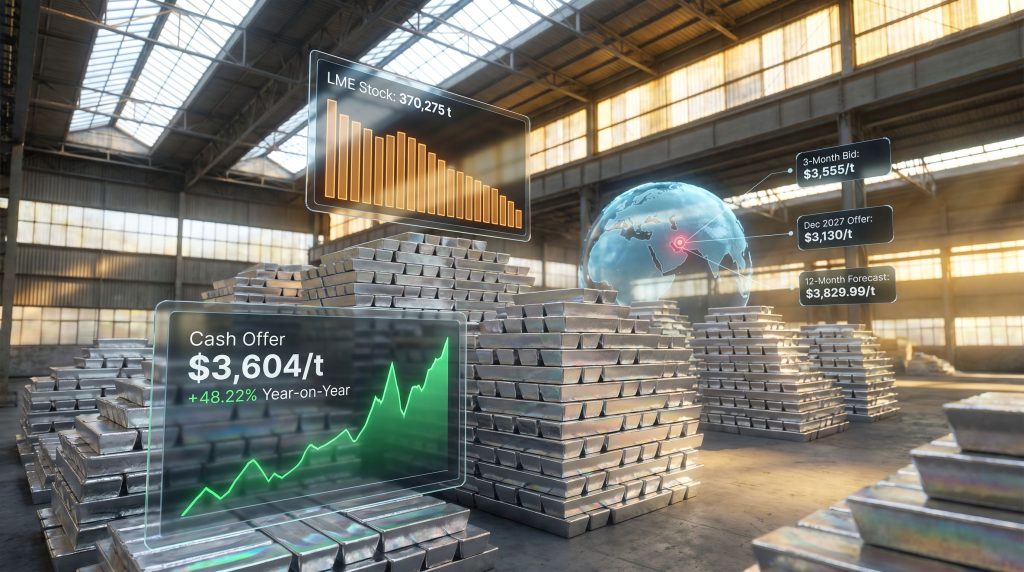
| Cash Offer | $3,600.00 | $3,604.00 | +$4.00 | +0.11% |
| 3-Month Bid | $3,535.00 | $3,555.00 | +$20.00 | +0.60% |
| 3-Month Offer | $3,537.00 | $3,556.00 | +$19.00 | +0.53% |
| Dec 2027 Bid | $3,100.00 | $3,125.00 | +$25.00 | +0.80% |
| Dec 2027 Offer | $3,105.00 | $3,130.00 | +$25.00 | +0.80% |
Source: AL Circle, April 30, 2026
Several dynamics within this table are worth examining beyond the headline movement. The three-month contracts gained significantly more in absolute and percentage terms than the cash contracts, with a $20/t rise on the bid versus only $4.50/t on the cash bid. This disproportionate forward gain suggests that market participants are pricing in continued tightness over the near-to-medium term rather than simply responding to an immediate spot squeeze.
The December 2027 contracts registered the highest percentage gain of the session at +0.80%, with both bid and offer rising by $25/t. This is a meaningful signal from longer-dated market participants who are positioning for sustained structural support well into 2027, despite those contracts trading at a significant discount to spot at approximately $3,127.50 on average.
Understanding the Contango Structure
The current price curve from cash ($3,603.50) through three-month ($3,555.00) to December 2027 ($3,125.00) describes a contango market structure, where forward prices sit below spot levels. This is not inherently bearish. In aluminium markets, a contango structure typically reflects:
- The cost of carrying physical inventory over time, including financing, storage, and insurance
- Market expectations that current supply tightness will gradually ease as new production comes online
- An incentive for warehouse holders to store metal rather than deliver it immediately into a rising spot market
The spread between cash and three-month contracts of approximately $48.50/t and the further discount to December 2027 of approximately $478.50/t from cash suggests that while the market anticipates some price moderation over a 20-month horizon, participants do not expect a dramatic supply surplus in the near term. Furthermore, LME trading volumes in recent months have reinforced confidence in the exchange's liquidity and price discovery function.
Twelve-Month Price Trajectory: A Market Transformed
The single most striking data point in the current LME aluminium price and inventories picture is the year-on-year price appreciation of 48.22% compared to the equivalent period in 2025. This is not a number that emerges from ordinary supply-demand oscillation. It reflects a fundamental repricing of aluminium's scarcity value driven by intersecting structural forces.
Working backwards from the April 29 cash offer of $3,604/t, the implied April 2025 price level would sit at approximately $2,431/t, representing an era of comparatively subdued pricing that the market has decisively left behind.
Monthly price momentum over the 30-day period to April 29 held within a 3.12% to 3.56% range, indicating a consistent and relatively controlled upward trajectory rather than a speculative spike. This kind of sustained monthly momentum, maintained over a full year, suggests the rally has deep structural roots rather than being driven primarily by short-term positioning. You can track the latest real-time movements via Trading Economics' aluminium data, which provides an accessible overview of historical and current price trends.
Aluminium futures remained above $3,550 per tonne in late April 2026, trading near a four-year high, with ongoing supply-side risks in the Middle East cited as a factor sustaining elevated price levels. (AL Circle, April 30, 2026)
The four-year high reference is particularly significant for historical context. The last comparable price period would have coincided with the extreme commodity market disruption of 2022, triggered by the Russian invasion of Ukraine and associated sanctions that constrained global energy and aluminium supply chains. The current period of elevated pricing has reached those same thresholds through a different but comparably serious set of supply-side stresses.
The Asian Reference Price Divergence: A Market Sending Mixed Signals
One of the more technically nuanced developments within the April 29 session was the sharp divergence between the standard LME three-month price and the LME 3-Month Asian Reference Price.
| Metric | Previous Level (USD/t) | April 29 Level (USD/t) | Change |
|---|---|---|---|
| LME 3-Month Asian Reference Price | $3,538.50 | $3,488.50 | -$50.00 (-1.41%) |
| Standard LME 3-Month Offer | $3,537.00 | $3,556.00 | +$19.00 (+0.54%) |
The divergence is stark: while the standard three-month contract gained $19/t, the Asian Reference Price fell $50/t, creating an intraday gap expansion of approximately $67.50/t between the two pricing mechanisms.
The LME Asian Reference Price is calculated using prices prevailing during Asian trading hours, reflecting demand signals from the region's physical buyers and traders rather than the European and American session activity that typically dominates the standard LME settlement. A meaningful decline in this reference price while the standard price is rising implies that Asian buyers are stepping back from the market or reducing forward commitment at current levels.
This carries significant weight given that Asia, driven overwhelmingly by China, accounts for the majority of global primary aluminium consumption. A softening of the Asian reference signal does not automatically indicate a broader demand collapse, but it does introduce a counterweight to the otherwise bullish price narrative and warrants monitoring across subsequent sessions.
LME Aluminium Inventory Data: A Market in Progressive Tightening
While price movements capture headlines, the inventory picture provides the underlying structural context that gives those price movements meaning. The April 29 inventory data continued a pattern of gradual but persistent stock reduction:
| Inventory Metric | Previous Level | April 29 Level | Change | % Shift |
|---|---|---|---|---|
| Opening Stock | 372,700 t | 370,275 t | -2,425 t | -0.65% |
| Live Warrants | ~335,000 t | 331,675 t | -3,325 t | -1.00% |
| Cancelled Warrants | 35,275 t | 36,525 t | +1,250 t | +3.54% |
Source: AL Circle, April 30, 2026
Each of these three metrics tells a different part of the same story:
- Opening stock declining to 370,275 tonnes indicates that more aluminium is leaving LME-registered warehouses than entering them on a daily basis
- Live warrants falling by 3,325 tonnes reflects a reduction in the volume of metal that remains freely available for trading within the LME system
- Cancelled warrants rising by 3.54% to 36,525 tonnes is arguably the most operationally significant data point, as cancelled warrants represent metal that has been earmarked for physical withdrawal from warehouses, effectively removing it from tradeable supply
The Cancelled Warrant Mechanism Explained
Cancelled warrants are a concept widely understood by commodity professionals but often overlooked by broader investment audiences. When a warrant is cancelled on the LME, it signals that a registered owner of warehouse metal has initiated the withdrawal process. That metal is no longer available for purchase through the exchange and will typically exit the LME system within a few business days to be delivered to an industrial consumer or moved to off-exchange storage.
A rising cancelled warrant figure therefore functions as a leading indicator of accelerating physical demand. The 3.54% single-session rise observed on April 29 suggests that industrial buyers are actively pulling metal out of LME warehouses to meet near-term consumption needs, a behaviour consistent with the tight spot pricing observed in cash contracts. For further context on how such inventory movements intersect with shifts across aluminum and alumina markets, recent analysis highlights how upstream disruptions compound exchange-level stock drawdowns.
The Broader Inventory Drawdown: A Two-Year Structural Shift
The daily changes described above must be understood within a dramatically larger context. LME aluminium stocks exceeded 1.1 million tonnes in May 2024. By late April 2026, total opening stock had declined to approximately 370,275 tonnes, representing a reduction of more than 66% in under two years.
To translate this into operational terms:
- At May 2024 inventory levels, the global market had a comfortable buffer of exchange-registered stock available to absorb demand shocks
- The progressive drawdown through 2024 and 2025 steadily eroded that buffer
- The further decline from approximately 416,775 tonnes in March 2026 to sub-370,000 tonnes by late April represents an acceleration of the drawdown trajectory
- At current withdrawal rates, the structural tightening of LME-registered supply is becoming increasingly difficult to reverse without significant new production or demand destruction
A decline of more than 66% in LME aluminium inventories over less than two years points to a physical market that is absorbing supply faster than it can be replenished through normal smelting and logistics cycles.
The next major ASX story will hit our subscribers first
What Is Driving the Structural Decline in Inventories?
Several reinforcing factors are operating simultaneously to suppress the recovery of LME aluminium stocks.
Supply-Side Constraints:
- Geopolitical disruption in the Middle East, specifically the continued blockage of the Strait of Hormuz, has introduced meaningful logistical friction and risk premiums into global aluminium supply chains
- Primary aluminium smelting is one of the most energy-intensive industrial processes in existence, consuming approximately 13 to 14 megawatt-hours per tonne of aluminium produced. Elevated global energy costs, particularly in Europe, have constrained smelter throughput and made new capacity uneconomical in high-cost regions
- Chinese smelter dynamics, including periodic capacity restrictions related to energy management and environmental compliance targets, reduce the volume of metal available for export into global exchange inventories
Demand-Side Recovery:
- Automotive sector demand, particularly from electric vehicle manufacturing, has created structural aluminium intensity growth. EVs use significantly more aluminium per vehicle than internal combustion equivalents, with estimates suggesting between 200 and 250 kilograms per EV versus approximately 150 kilograms in conventional vehicles
- Infrastructure spending programmes across the United States, European Union, and several Asian economies have sustained construction-related aluminium demand through the 2025-2026 period
- Packaging demand, driven by the secular shift from plastic toward aluminium in beverage and food sectors, has contributed a steady baseload consumption increase
In addition, the aluminium tariff impact introduced through 2025 policy changes has redirected global trade flows, adding further complexity to how supply reaches exchange-registered warehouses.
The Alumina Price Connection: Upstream Pressure on Smelter Economics
The LME Alumina Platts price on April 29 stood at $307.40 per tonne, a figure that provides critical context for understanding smelter profitability and, by extension, the capacity for new primary aluminium supply to enter the market.
Alumina is the intermediate product between bauxite ore and primary aluminium metal. Producing one tonne of aluminium requires approximately two tonnes of alumina through the Bayer Process refinery stage. At $307.40/t for alumina and a cash aluminium price of $3,604/t, the raw alumina input cost represents approximately 17% of the aluminium sale price before accounting for energy, labour, and capital costs.
A rising alumina price compresses smelter margins, particularly for higher-cost producers, and can deter capacity expansions or maintenance restarts that would otherwise add supply to the market. The alumina price trajectory therefore functions as a leading indicator of smelter investment appetite and, in turn, the medium-term supply outlook for primary aluminium. Consequently, understanding the production strategies of the top aluminium producers globally becomes increasingly important when assessing how quickly supply-side relief might materialise.
LME Aluminium Price Forecast: The Forward Curve and Analytical Projections
Current analytical projections for LME aluminium pricing through the balance of 2026 and into the 12-month forward window reflect the structural tightness visible in both price and inventory data:
| Forecast Horizon | Projected Price (USD/t) |
|---|---|
| End of Q2 2026 | $3,643.69 |
| 12-Month Forward | $3,829.99 |
Note: Price forecasts are analytical projections and are inherently speculative. Actual market prices may differ materially from projected levels due to unforeseen geopolitical, macroeconomic, or supply-side developments. These figures should not be construed as financial advice.
The Q2 2026 target of $3,643.69/t implies a modest additional gain from current cash levels of approximately 1.1%, suggesting analysts anticipate continued but decelerating momentum through the quarter end.
The 12-month forward projection of $3,829.99/t represents a more substantial appreciation of approximately 6.3% from current cash offer levels, implying that the structural supply-demand imbalance is expected to persist and deepen through mid-2027 before any meaningful market rebalancing.
Key Upside Risks to These Projections:
- Escalation of Middle Eastern geopolitical tensions further constraining supply logistics
- European smelter curtailments driven by renewed energy price spikes
- Accelerated EV adoption rates driving faster-than-expected aluminium demand growth
- Unexpected Chinese export restrictions on primary aluminium
Key Downside Risks:
- Demand softening in Asia, as partially indicated by the diverging Asian Reference Price
- Inventory restocking from non-LME sources entering the registered warehouse system
- USD strengthening making USD-denominated aluminium more expensive for non-US buyers
- Chinese production expansion driven by new capacity approvals
How Downstream Industries Manage LME Aluminium Price Exposure
For industrial buyers, the LME aluminium price and inventories data is not merely an indicator to observe — it is the mechanism through which procurement costs are actively managed. The principal tools available include:
- Fixed-Price Forward Contracts: Locking in a purchase price for future delivery using LME three-month or longer-dated contracts as the basis
- Floating-Price Contracts with Premium Caps: Accepting LME price movements but negotiating a ceiling on the regional premium component
- Options Strategies: Purchasing call options to cap upside price exposure while retaining the ability to benefit from price declines
- Inventory Buffer Management: Holding strategic stocks of aluminium semi-fabricated inputs to reduce sensitivity to short-term spot price spikes
The automotive sector, which operates on multi-year model cycles and cannot easily pass through raw material cost increases to consumers on short timescales, is particularly sophisticated in its use of LME-linked hedging instruments. The EV manufacturing ramp has made this hedging discipline even more critical, given the higher aluminium content per vehicle and the longer production planning horizons required for battery platform development. For real-time reference, the LME's official aluminium page provides the most authoritative source of contract specifications, settlement prices, and warehouse data.
Frequently Asked Questions: LME Aluminium Price and Inventories
What is the current LME aluminium cash offer price?
As of April 29, 2026, the LME aluminium cash offer price stood at $3,604.00 per tonne, representing a gain of $4.00/t or 0.11% from the previous session close of $3,600.00/t.
How are LME aluminium inventories measured and reported?
LME inventories are reported daily in tonnes and broken into three components: total opening stock (all metal in registered warehouses), live warrants (metal available for trading), and cancelled warrants (metal queued for physical withdrawal). The difference between opening stock and live warrants represents cancelled warrants already in the withdrawal process.
What does a rise in cancelled warrants indicate for aluminium supply?
A rise in cancelled warrants signals that registered owners are withdrawing physical metal from LME warehouses, typically to satisfy industrial consumption needs. This reduces the tradeable supply available to the exchange and is generally interpreted as a tightening signal for near-term physical market availability.
How does the Asian Reference Price differ from the standard LME 3-month price?
The LME 3-Month Asian Reference Price is derived from prices prevailing during Asian trading hours, reflecting regional buyer and seller activity. It can diverge meaningfully from the standard LME settlement, which incorporates European and American session activity, particularly when regional demand signals differ from the broader global trend.
What factors most influence LME aluminium price movements?
The primary drivers include global smelter production volumes, energy cost trends (given aluminium's extreme energy intensity), geopolitical events affecting supply logistics, Chinese domestic production and export policy, and demand levels across automotive, construction, packaging, and aerospace sectors.
How do LME aluminium futures contracts work for physical buyers?
Physical buyers typically enter into supply agreements priced at LME cash or three-month settlement prices plus a negotiated regional premium. The LME futures contract is used as a hedging instrument rather than as a direct delivery vehicle, with most physical delivery occurring through bilateral contracts that reference, but do not directly use, the exchange's logistics infrastructure.
Key Takeaways: LME Aluminium Price and Inventory Summary for April 29, 2026
-
Cash offer reached $3,604/t, reflecting a modest but consistent upward trend in spot pricing with a $4/t session gain
-
3-month futures climbed to $3,556/t, with December 2027 contracts gaining 0.80% to $3,130/t, signalling sustained forward market confidence
-
Asian Reference Price fell $50/t to $3,488.50/t, diverging sharply from Western market momentum and flagging potential regional demand softness
-
Total LME opening stock declined to 370,275 tonnes, extending a drawdown from over 416,000 tonnes in March 2026 and more than 1.1 million tonnes in May 2024
-
Cancelled warrants rose 3.54% to 36,525 tonnes, a leading indicator of accelerating physical delivery demand pulling metal out of the exchange system
-
Year-on-year price appreciation of 48.22% reflects a structurally tighter market environment compared to April 2025 conditions
-
12-month price projection of $3,829.99/t suggests continued structural support for aluminium valuations, subject to the material risks outlined above
-
LME alumina Platts price of $307.40/t on April 29 indicates ongoing upstream cost pressure that constrains smelter margin expansion and new supply investment
Readers seeking broader context on global aluminium market dynamics, pricing mechanisms, and supply chain developments may find additional value in industry publications available through the AL Circle news platform, which regularly covers LME aluminium price and inventories updates, inventory data, and downstream sector analysis.
Want to Capitalise on the Next Major ASX Mineral Discovery Before the Market Moves?
Discovery Alert's proprietary Discovery IQ model delivers real-time alerts on significant ASX mineral discoveries — instantly translating complex commodity data across 30+ sectors into clear, actionable investment insights for both short-term traders and long-term investors. Explore how historic discoveries have generated substantial returns on Discovery Alert's dedicated discoveries page, and begin your 14-day free trial today to position yourself ahead of the market.