
August 9, 2026
The Invisible Architecture Behind Aluminium's Price Surge
Commodity markets rarely move in straight lines, but when physical supply is removed from a market faster than it can be replaced, price signals become unusually clear. The global aluminium market is currently experiencing precisely this kind of structural disruption, one where the mechanics of supply removal, constrained alternatives, and shrinking exchange inventories are converging to push the LME aluminium price above $3,600 per tonne in a way that many market participants are struggling to fully contextualise.
Understanding why this matters requires looking past the daily price ticker and examining the underlying architecture of global aluminium supply, the geography of production, and the market mechanics that translate physical shortages into sustained price pressure. Furthermore, aluminium premiums across key regional markets are adding another layer of complexity to an already strained pricing environment.
When big ASX news breaks, our subscribers know first
Why Physical Supply Removal Is Different From a Cost Shock
Not all commodity price rallies are created equal. The distinction between a cost-driven price increase and a physical supply removal is critical for understanding both the severity and the expected duration of the current aluminium rally.
When energy costs rise sharply, as they did during the European smelting crisis triggered by the Russia-Ukraine conflict in 2022, aluminium producers face margin compression. Some reduce output, some curtail operations, but the underlying production capacity remains intact. Prices rise, but the system retains the ability to rebalance once energy costs normalise or smelters adjust their hedging strategies.
Physical supply removal is fundamentally different. When a smelter stops producing entirely due to force majeure, geopolitical disruption, or infrastructure failure, the tonnes that were scheduled to reach the market simply do not arrive. No amount of financial hedging or energy cost adjustment can substitute for missing metal. This is the category of disruption the market is navigating in mid-2026, and it explains why the price response across the LME aluminium forward curve has been so consistent.
What the LME Price Data Reveals About Market Conviction
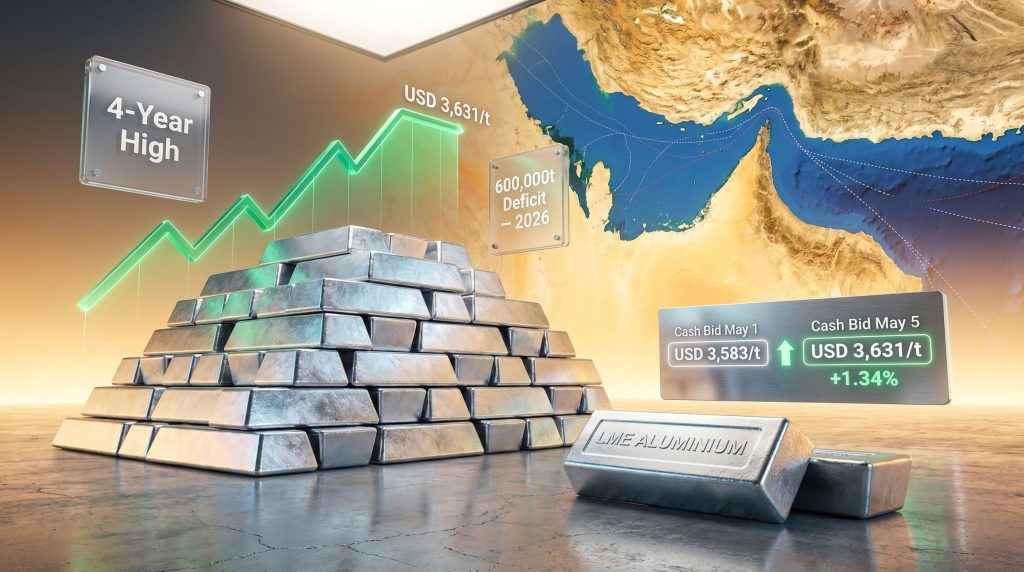
The trading session data from May 1 through May 5, 2026, tells a story of broad-based market conviction rather than speculative noise. When prices rise consistently across cash, three-month, and long-dated contracts simultaneously, it signals that participants across the full spectrum of the market are repricing their assumptions about future supply availability.
| Contract | May 1 Bid | May 5 Bid | Change |
|---|---|---|---|
| Cash Bid | USD 3,583/t | USD 3,631/t | +1.34% |
| Cash Offer | USD 3,584/t | USD 3,632/t | +1.34% |
| 3-Month Bid | USD 3,522/t | USD 3,562/t | +1.14% |
| 3-Month Offer | USD 3,523/t | USD 3,563/t | +1.14% |
| Dec 2027 Bid | USD 3,107/t | USD 3,142/t | +1.13% |
| Dec 2027 Offer | USD 3,112/t | USD 3,147/t | +1.13% |
Source: AL Circle, May 6, 2026
The Asian Reference Price, which reflects LME pricing adjusted for Asian market trading hours, closed at USD 3,589 per tonne on May 5, representing a 1.9% gain from the May 1 closing figure of USD 3,522 per tonne. This was the strongest single-session gain across all contract types and reflects the particular sensitivity of Asian downstream manufacturers to near-term physical availability.
The relatively smaller percentage gains on December 2027 contracts compared to cash prices suggest the market is not pricing in a permanent structural change, but it is also not pricing in a quick resolution. The forward curve is flattening in a way consistent with mild backwardation, where cash prices command a premium over forward delivery, a configuration that historically signals near-term physical scarcity. LME aluminium prices dropping after previous record surges demonstrate just how volatile these conditions can be.
Understanding Backwardation as a Supply Signal
Backwardation is one of the most reliable real-time indicators of physical market stress. In a normally functioning aluminium market, forward prices trade at a premium to spot prices due to carrying costs, financing, insurance, and warehouse fees. When this relationship inverts and spot prices exceed forward prices, it means buyers are willing to pay a premium to access metal immediately rather than wait for future delivery.
The current LME aluminium structure, with cash bids above three-month bids, represents exactly this configuration. It is a market telling participants that metal available today is worth more than metal available in three months, and that assessment is reflected in real trading decisions, not just sentiment surveys.
The Inventory Picture: Reading the Numbers Carefully
LME warehouse inventory data provides one of the most transparent windows into physical market tightness, but interpreting it correctly requires understanding what each metric actually measures.
| Inventory Metric | May 1 | May 5 | Change |
|---|---|---|---|
| Opening Stock | 367,050 tonnes | 364,752 tonnes | -0.63% |
| Live Warrants | 332,600 tonnes | 331,925 tonnes | -0.20% |
| Cancelled Warrants | 36,525 tonnes | 30,800 tonnes | -15.67% |
Source: AL Circle, May 6, 2026
Warrant Mechanics Explained: LME warrants represent legal ownership titles to specific parcels of metal stored in LME-approved warehouses. Live warrants are available for trading and can change hands on the exchange. Cancelled warrants represent metal that has been formally earmarked for physical withdrawal and removal from the warehouse network. A rising cancelled warrant count typically signals that physical buyers are pulling metal off exchange, a leading indicator of tightening supply. A falling count can temporarily ease drawdown pressure but does not reverse declining total inventory levels.
The 15.67% decline in cancelled warrants from 36,525 tonnes to 30,800 tonnes between May 1 and May 5 is the most statistically significant single data point in this dataset. While it may seem counterintuitive that a sharp fall in cancelled warrants could coexist with a price rally, the explanation lies in the overall inventory picture. Total opening stock has fallen below 365,000 tonnes, and the underlying trend of inventory depletion remains firmly intact.
A reduced cancelled warrant count may simply reflect a short-term pause in withdrawal activity rather than any genuine easing of demand. With total stocks sitting well below the 400,000-tonne threshold that market participants widely monitor as a signal of physical tightness, the overall supply picture has not materially changed. The European billet premium surge amid conflict further illustrates how exposed downstream markets remain when inventory buffers thin to these levels.
GCC Supply Disruptions and the Geography of Aluminium Production
The Gulf Cooperation Council region occupies a position in global aluminium supply that is frequently underestimated by market participants focused primarily on China and Russia. GCC-based smelting operations benefit from access to cost-competitive energy, strategic proximity to growing Asian and European markets, and significant long-term investment in primary smelting infrastructure.
Production disruptions across this region carry consequences that extend well beyond their immediate volume impact. The Strait of Hormuz functions as the primary maritime corridor for both raw material imports into GCC smelters, particularly alumina and bauxite, and for finished aluminium exports flowing to global buyers. Any disruption to transit through this chokepoint creates simultaneous pressure on input supply chains and output distribution networks. In addition, alumina market pressures have compounded the upstream vulnerability of producers reliant on this corridor.
Force majeure declarations in commodity markets carry specific contractual significance. When a producer invokes force majeure, it is released from its delivery obligations under existing contracts, forcing buyers to seek replacement tonnes on the open market at prevailing spot prices. When multiple producers in the same region declare force majeure simultaneously, the volume of replacement buying concentrated into an already tight market can create price dislocations that are disproportionate to the underlying supply reduction.
Downstream buyers in automotive manufacturing, aerospace, construction, and packaging are particularly vulnerable to this dynamic because their procurement timelines are typically structured around forward contract delivery schedules rather than spot market purchasing.
The China Constraint: Why the World's Largest Producer Cannot Simply Fill the Gap
A standard market response to supply disruption is for alternative producers to increase output. In the aluminium market, the logical source of incremental supply would be China, which accounts for roughly half of global primary aluminium production. However, the structure of Chinese domestic policy effectively prevents this market-clearing mechanism from operating.
China maintains a domestic production ceiling on primary aluminium smelting, a policy enforced through energy consumption regulations and environmental targets rather than direct output quotas. This ceiling prevents Chinese producers from simply ramping up output in response to rising international prices, regardless of the economic incentive to do so. Consequently, China industrial demand dynamics remain largely decoupled from the international supply shortfall currently driving LME pricing.
The consequence is that the world's most powerful potential swing producer is effectively locked out of the role when GCC supply falls away. The global market therefore has fewer self-correcting mechanisms than its aggregate production scale might suggest, which amplifies the price impact of regional supply disruptions.
The LME and Shanghai Futures Exchange (SHFE) price divergence during this period is instructive. SHFE aluminium contracts, which reflect domestic Chinese supply and demand dynamics, have been partially insulated from the GCC disruption because Chinese producers and consumers operate within a largely self-contained supply system. The premium emerging on LME prices relative to SHFE effectively represents a geopolitical risk premium being applied to internationally traded metal, the price of accessing supply outside China's production boundary.
Arbitrage between LME and SHFE is constrained by China's export policies and associated logistics costs, which limits the ability of Chinese domestic production to flow into LME-eligible warehouse networks and suppress the LME price premium.
The next major ASX story will hit our subscribers first
Sector-Level Exposure: Which Industries Face the Greatest Pressure
Sustained LME aluminium prices above $3,600 per tonne create differentiated impacts across downstream industries depending on their ability to substitute materials, pass costs through to end customers, or hedge their input cost exposure. Furthermore, aluminium and steel tariffs introduced in recent years have already compressed the margin available to many downstream processors, leaving them more exposed than usual to this latest round of price pressure.
Automotive and Electric Vehicles
Aluminium's role in vehicle manufacturing has expanded significantly as manufacturers pursue lightweighting strategies to improve fuel efficiency and extend EV battery range. Battery enclosures, structural frame components, and thermal management systems all rely heavily on aluminium, and these applications have relatively few immediate substitutes. Margins for original equipment manufacturers are already compressed by elevated battery material costs, and sustained aluminium price pressure adds another layer of cost complexity.
Aerospace and Defence
Aerospace-grade aluminium alloys are engineered to precise specifications that cannot be casually substituted. Demand in this sector is relatively price-inelastic over short time horizons, meaning aerospace buyers will continue purchasing at elevated prices rather than defer critical program schedules. The cost impact flows through to new program budgeting and contract renegotiation cycles rather than immediate volume reduction.
Construction and Energy Infrastructure
Aluminium is embedded throughout commercial construction in curtain walling, roofing systems, and glazing. Energy transition infrastructure, including solar panel mounting frames and electrical transmission components, represents a growing demand category that is particularly price-sensitive given the public and regulated nature of project financing.
Packaging
Aluminium beverage cans and food packaging represent a high-volume, relatively price-sensitive segment. Producers in this category have historically passed input cost increases to brand owners and ultimately consumers. Persistent aluminium price elevation at current levels would contribute measurably to broader consumer goods inflation.
Price Scenarios and Key Variables to Monitor
The trajectory of LME aluminium prices from current levels depends on the interaction of three primary variables, none of which has shown clear signs of resolution as of early May 2026.
Scenario Framework:
| Scenario | Price Range | Key Trigger |
|---|---|---|
| Baseline (Consolidation) | USD 3,500-3,650/t | Disruptions persist without escalation |
| Bull Case | USD 3,650-4,000/t | Extended GCC shutdowns or wider corridor disruption |
| Bear Case (De-escalation) | USD 3,200-3,500/t | Partial smelter restart; supply deficit persists |
Important Disclaimer: Price scenario projections involve significant uncertainty and are based on analyst assessments of supply-demand conditions as understood at the time of writing. These should not be construed as financial advice. Commodity prices are subject to rapid change based on geopolitical developments, policy decisions, and market forces that cannot be reliably predicted.
The alumina input cost signal provides an additional layer of context. LME Alumina Platts pricing closed at USD 308 per tonne on May 5, a modest 0.52% decline from the May 1 level of USD 309.6 per tonne. The relative stability of alumina prices, compared to the sharper move in primary aluminium, suggests the current price driver is concentrated in finished metal availability rather than raw material cost pressure. This is consistent with the physical supply removal narrative rather than a cost-push inflation dynamic.
Five Indicators That Will Define the Next Price Move
For procurement professionals, industrial manufacturers, and commodity market participants tracking this situation, the following variables represent the most actionable monitoring priorities:
- LME Cancelled Warrant Trends – A sustained reversal higher in cancelled warrants would signal renewed physical withdrawal pressure and support further price gains
- GCC Smelter Restart Announcements – Any confirmed restart timeline from a major affected facility would materially shift the near-term supply narrative
- Strait of Hormuz Transit Data – Real-time shipping data and diplomatic developments remain the primary macro catalyst driving the geopolitical premium in LME pricing
- China Production Policy Signals – Any indication of policy flexibility around domestic output ceilings would represent the most significant potential supply-side relief valve available to the global market
- LME Alumina Platts Divergence – If alumina prices begin rising sharply, it signals that upstream disruption is beginning to compound finished metal tightness, a scenario that would accelerate price escalation
The Deeper Signal: What Declining Inventories Below 400,000 Tonnes Actually Mean
The significance of LME aluminium inventories falling below 400,000 tonnes is not arbitrary. At this level, the ratio of exchange-held inventory to global annual consumption becomes critically thin, meaning the buffer available to absorb unexpected demand spikes or supply interruptions has been substantially eroded.
In a global market producing approximately 70 million tonnes annually, total LME warehouse stocks below 365,000 tonnes represent less than two days of global output. This does not mean all global aluminium flows through LME warehouses, but it does mean that the exchange's price discovery mechanism is operating with a very shallow physical backstop, which historically amplifies price volatility in both directions.
When the market eventually rebalances, whether through smelter restarts, demand destruction at higher price levels, or policy adjustments in major producing nations, the reversal could be equally sharp. Buyers currently paying spot premiums to secure immediate metal availability should be building this potential downside into their procurement cost modelling. Indeed, major aluminium producers with diversified geographic footprints are best positioned to weather these conditions, as their ability to redirect supply across regions provides a degree of insulation unavailable to single-geography operators.
The current LME aluminium price above $3,600 per tonne is not a market overshoot driven by speculative excess. It is a measured response to genuine physical scarcity, constrained alternative supply, and declining exchange inventories. Whether it proves to be a temporary dislocation or the beginning of a sustained repricing depends on variables that remain, for now, beyond the market's control.
Want to Track the Next Major Commodity Discovery Before the Market Moves?
Discovery Alert's proprietary Discovery IQ model delivers real-time alerts on significant ASX mineral discoveries, instantly translating complex commodity data into actionable investment opportunities — explore the historic returns major discoveries have generated and begin your 14-day free trial to position yourself ahead of the market.