May 14, 2026
New Zealand's Energy Infrastructure Challenge
New Zealand's energy landscape faces significant transformation as declining domestic gas production intersects with growing electricity demand volatility. The nation's LNG import plans in New Zealand represent a strategic response to energy security vulnerabilities that have emerged from over-reliance on hydroelectric generation and diminishing Taranaki basin output. Furthermore, the US natural gas forecast demonstrates how global supply dynamics influence regional energy planning decisions across multiple markets.
The Pacific region's energy security dynamics increasingly require sophisticated import diversification frameworks capable of managing both seasonal demand fluctuations and long-term supply reliability. Advanced economies recognise that renewable energy expansion must be coupled with flexible backup systems to maintain grid stability during periods of variable generation capacity.
When big ASX news breaks, our subscribers know first
New Zealand's Energy Vulnerability Framework
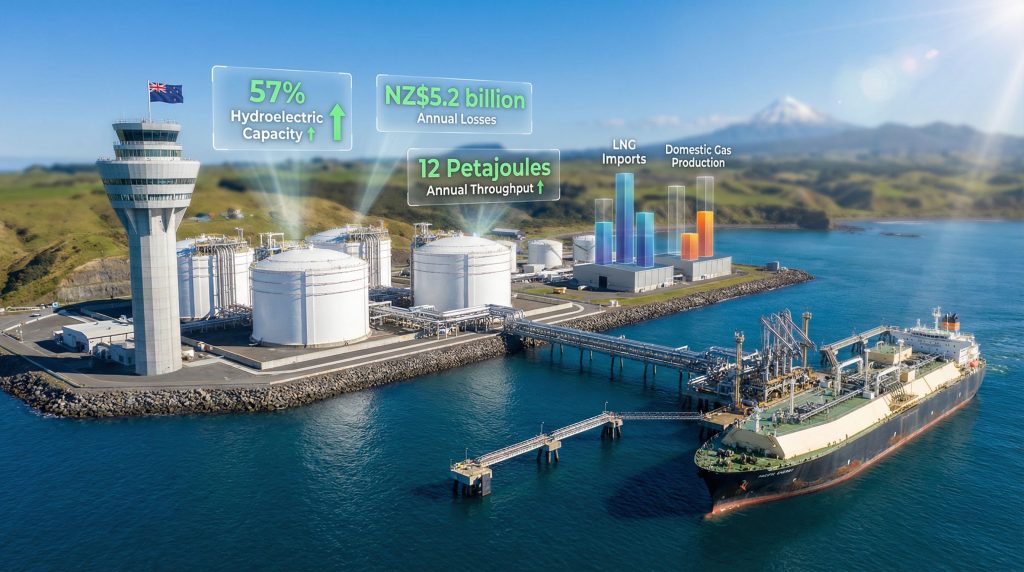
New Zealand's electricity generation system demonstrates both the promise and peril of renewable energy dependency. With hydroelectric power comprising approximately 57% of total generation capacity, the nation has achieved remarkable clean energy penetration whilst simultaneously creating dangerous exposure during hydrological volatility. The Taranaki basin's declining natural gas output has eliminated traditional backup options, leaving the electricity sector increasingly reliant on high-emission coal and diesel generation during dry periods.
Independent economic analysis commissioned by the New Zealand government revealed that higher energy prices resulted in a NZ$5.2 billion GDP loss during calendar year 2025. This macroeconomic impact extended beyond direct energy costs to affect manufacturing competitiveness, employment stability, and overall economic recovery from recent inflationary pressures. The cascade effect demonstrated how energy security failures create systemic economic vulnerabilities across multiple sectors.
Current natural gas pricing reflects this supply-demand imbalance, with contracts trading at approximately NZ$3.22 per gigajoule as of February 2026. These elevated pricing levels, combined with limited domestic production flexibility, have forced policymakers to examine strategic import alternatives previously considered economically unviable.
Critical Infrastructure Dependencies
The nation's renewable energy infrastructure creates unique operational challenges during extended dry periods when hydroelectric reservoirs reach critically low levels. Traditional backup systems rely on fossil fuel generation that contradicts climate commitments whilst generating substantially higher operational costs. Consequently, this infrastructure configuration necessitates strategic planning for import-based supply diversification.
Gas Industry Co analysis emphasises that declining indigenous gas supplies require immediate strategic intervention. As CEO David Prentice explained, imported LNG provides mission-critical energy security and reliability whilst supporting renewable energy expansion objectives. The flexible backup capability enables renewable electricity generation scaling without compromising grid stability during peak demand periods or hydrological constraints.
Strategic LNG Import Implementation
LNG import plans in New Zealand centre on establishing terminal infrastructure within the established Taranaki energy hub, leveraging existing pipeline networks and port facilities. Energy Minister Simon Watts characterised this development as a critical step to strengthen energy security whilst supporting economic growth objectives. The government aims to finalise commercial contracts by mid-2026, with operational capacity targeted for 2027-2028.
The proposed facility design emphasises seasonal import flexibility rather than continuous throughput operations. This strategic approach aims to minimise exposure to spot market volatility by concentrating purchases during optimal pricing windows. However, the terminal's location in Taranaki provides access to established gas distribution infrastructure whilst creating construction and operational employment opportunities within New Zealand's traditional energy sector region.
Financial Structure and Consumer Impact
The LNG terminal project employs industry-wide cost distribution through electricity consumption levies, spreading infrastructure investment across the entire consumer base. Government analysis indicates that terminal construction will require investment exceeding NZ$800 million, excluding ongoing fuel procurement costs. This compares to alternative gas storage and liquid fuel infrastructure estimated at approximately NZ$300 million.
Despite higher capital requirements, the LNG option provides operational flexibility unavailable through domestic storage alternatives. The infrastructure investment creates long-term strategic optionality for import volume adjustments based on domestic production trends and renewable energy expansion rates. In addition, consumer impact modelling suggests household energy costs will incorporate modest levy components to finance the national energy security infrastructure.
Pacific Supply Chain Transformation
Australia's established LNG export infrastructure positions leading producers for potential supply relationships with New Zealand's import facility. Santos (ASX:STO), with a market capitalisation of $22.51 billion as of February 2026, and Woodside Energy (ASX:WDS) represent the most likely initial suppliers given their existing Pacific shipping capabilities and production capacity.
The New Zealand import demand may also provide crucial support for the Papua LNG project, which has experienced delays in reaching final investment decision during 2026. This project's development timeline could accelerate with confirmed long-term purchase agreements from New Zealand's import facility, creating regional supply chain synergies across the Pacific basin. Furthermore, examining Australia energy exports challenges provides context for how regional supply dynamics affect strategic planning decisions.
Regional Market Dynamics
Pacific LNG markets have historically focused on Asian demand centres, particularly Japan, South Korea, and China. New Zealand's entry as a strategic importer introduces additional demand flexibility whilst potentially stabilising regional pricing during periods of Asian market volatility. The seasonal import strategy may create complementary demand patterns that optimise supplier capacity utilisation across different customer requirements.
Australian producers benefit from proximity advantages including shorter shipping distances, established maritime routes, and operational familiarity with Pacific weather patterns. These logistical advantages translate to lower transportation costs and enhanced supply reliability compared to alternative global suppliers located in the Middle East or United States.
Economic Impact Analysis and Projections
The Sense Partners analysis demonstrating NZ$5.2 billion in GDP losses during 2025 provides quantitative foundation for LNG import investment justification. This economic impact extended beyond direct energy costs to encompass reduced industrial productivity, employment instability, and constrained business investment decisions. Energy Minister Simon Watts noted that these impacts meant fewer jobs, lower wages, and slower economic recovery during challenging inflationary periods.
Boston Consulting Group research commissioned by major electricity companies Contact, Genesis, Mercury, and Meridian concluded that well-functioning domestic gas markets remain preferable to import-dependent systems. However, the analysis acknowledged that LNG import plans in New Zealand may serve as prudent backstop measures if domestic gas supply decline continues at current rates. For instance, understanding global oil price rally insights helps contextualise energy market volatility affecting import planning decisions.
Comparative Infrastructure Investment Analysis
The government's comparative analysis demonstrates that whilst LNG infrastructure requires higher initial investment, it provides operational flexibility unavailable through alternative approaches. Domestic storage solutions remain constrained by declining indigenous gas production, whilst renewable acceleration requires longer development timelines and significant additional capital investment.
Key infrastructure options include:
• LNG Import Terminal: NZ$800M+ capital investment, operational by 2027-2028, high import volume adjustment capability
• Gas Storage + Liquid Fuels: NZ$300M investment, operational by 2026-2027, limited to domestic production levels
• Accelerated Renewable Build: NZ$2B+ investment, operational by 2030+, weather-dependent reliability
Technical Infrastructure Challenges and Solutions
New Zealand's geographic and geological characteristics present unique engineering challenges for LNG import infrastructure development. Seismic activity considerations require specialised terminal design and safety protocols exceeding standard international specifications. Marine infrastructure must accommodate variable weather conditions and seasonal operational constraints that affect import scheduling flexibility.
The proposed Taranaki location provides access to existing gas pipeline networks whilst requiring substantial port infrastructure upgrades to handle large LNG carrier vessels. Integration with current gas distribution systems necessitates technical modifications to ensure compatibility with imported gas specifications and quality requirements.
Why Are Regulatory Changes Necessary?
Special enabling legislation has been proposed to expedite approval processes for LNG import infrastructure, including fast-track consent procedures that bypass standard environmental review timelines. These regulatory adaptations aim to accelerate project development whilst maintaining essential safety and environmental protection standards.
Industry levy collection mechanisms require new regulatory frameworks to ensure equitable cost distribution across electricity consumers. Import safety and quality standards must align with international protocols whilst addressing New Zealand's specific operational requirements and environmental conditions.
The next major ASX story will hit our subscribers first
Alternative Strategy Evaluation
Government analysis compared LNG imports against alternative energy security strategies, revealing complex tradeoffs between cost, timeline, and operational flexibility. Whilst gas storage combined with liquid fuel backup requires lower initial investment, these solutions remain fundamentally constrained by domestic production limitations and declining resource availability.
The accelerated renewable energy expansion option offers long-term sustainability benefits but requires substantially higher capital investment and extended development timelines. Weather-dependent renewable generation cannot provide the same reliability assurance as dispatchable LNG-fired generation during extended dry periods or peak demand events. Consequently, studying energy transition challenges across different jurisdictions provides valuable perspective on strategic planning approaches.
What Role Does Domestic Exploration Play?
Recent policy shifts have reopened offshore exploration opportunities that could potentially restore domestic gas production levels. However, successful discoveries typically require 5-7 years for development and production startup, making immediate import capabilities essential for energy security maintenance during the transition period.
The combination of LNG import capability and renewed domestic exploration creates strategic optionality for long-term energy supply management. Import infrastructure provides immediate security whilst domestic development progresses, with operational flexibility to adjust import volumes based on indigenous production recovery.
Investment Market Implications and Opportunities
LNG import plans in New Zealand create significant investment opportunities across multiple Pacific region companies and sectors. Beyond direct suppliers like Santos and Woodside Energy, the infrastructure development requires specialised engineering, construction, and logistics services with proven LNG facility experience.
Maritime shipping companies specialising in LNG transport may benefit from additional Pacific route demand, whilst port infrastructure developers gain opportunities for terminal construction and ongoing operational management. The government-backed nature of the project provides unusual stability for infrastructure investors typically concerned about regulatory and political continuity risks.
Regional Energy Investment Flow Effects
New Zealand's entry into Pacific LNG import markets signals broader regional energy infrastructure expansion potential. The successful development of import terminal capabilities could attract additional investment in complementary facilities across the Pacific, strengthening Australia-New Zealand energy trade relationships and creating economies of scale for regional suppliers.
Investment flows into Australian LNG production capacity may accelerate based on confirmed long-term purchase agreement potential from New Zealand importers. This demand certainty provides development risk reduction for marginal projects whilst supporting capacity expansion at existing facilities.
Risk Assessment and Scenario Planning
Primary execution risks for New Zealand's LNG import plans include technical delivery challenges associated with complex marine infrastructure development in seismically active conditions. Construction cost escalation represents significant financial exposure given global inflation trends and specialised equipment requirements for LNG terminal development.
Supplier concentration risks emerge from heavy reliance on Australian gas sources, potentially creating vulnerability during regional supply disruptions or export policy changes. Political continuity risks affect long-term project viability across electoral cycles, particularly given the substantial public investment required for infrastructure development.
How Do Global Markets Affect Project Economics?
International LNG market dynamics could significantly impact project economics through Asian demand growth affecting supplier availability and shipping cost volatility influencing delivered gas prices. Geopolitical tensions disrupting established Pacific trade routes represent additional supply security risks requiring contingency planning and supply source diversification.
Climate policy evolution may accelerate decarbonisation timelines that could shorten LNG terminal economic life, requiring flexible operational models accommodating reduced gas demand over time. Potential conversion to hydrogen import capability or integration with carbon capture systems may become necessary for long-term facility viability.
Future Strategic Scenarios
Successful domestic gas exploration could transform New Zealand's LNG import facility from primary supply source to strategic backup infrastructure. This scenario evolution would reduce import volumes and operational intensity whilst maintaining energy security through supply diversification capability. Export opportunities might develop if domestic production eventually exceeds national demand requirements.
Accelerating renewable energy deployment combined with improved storage technologies could reduce LNG import requirements more rapidly than current projections suggest. The terminal infrastructure provides strategic optionality to accommodate various future energy system configurations whilst ensuring immediate energy security during the renewable energy transition period.
The Pacific region's broader energy infrastructure development may create additional synergies and cost-sharing opportunities that improve project economics. Regional cooperation on LNG import infrastructure could reduce individual country investment requirements whilst strengthening collective energy security across Pacific economies facing similar domestic resource constraints.
Disclaimer: This analysis contains forward-looking projections based on current government policy announcements and industry analysis. Energy infrastructure investments involve substantial risks including regulatory changes, cost escalation, and market volatility. Readers should conduct independent research and seek professional investment advice before making financial decisions related to energy sector investments.
Want to Capitalise on Energy Infrastructure Opportunities?
Discovery Alert's proprietary Discovery IQ model delivers real-time alerts on significant ASX mineral and energy discoveries, instantly empowering subscribers to identify actionable opportunities ahead of the broader market. Begin your 14-day free trial today and secure your market-leading advantage as energy infrastructure developments create new investment possibilities across the Pacific region.