June 13, 2026
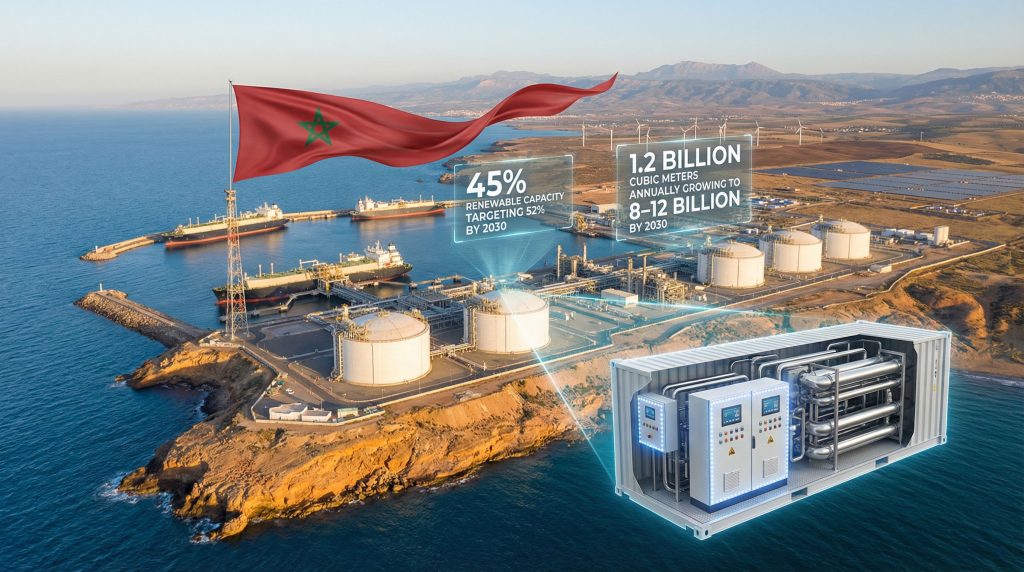
Morocco's approach to energy infrastructure reflects broader global trends as countries navigate complex decisions around large-scale projects in volatile commodity markets. The kingdom's recent pause in its LNG terminal development exemplifies how strategic planning can balance immediate energy needs with long-term financial sustainability. Morocco's LNG import strategy reset represents a sophisticated response to changing market conditions rather than project abandonment.
Understanding Morocco's Strategic Energy Pivot
Morocco's energy security framework has reached a critical inflection point as the country balances ambitious decarbonisation targets with growing industrial demand for reliable baseload power. The suspension of tenders for the Nador West Med LNG terminal in early 2026 reflects sophisticated strategic planning rather than project abandonment, positioning the kingdom for more adaptable infrastructure deployment.
The proposed terminal represented significant scale, with designed capacity of approximately 5 billion cubic metres annually – substantially exceeding current national consumption of roughly 1 billion cubic metres per year. This dramatic capacity expansion raised fundamental questions about demand forecasting accuracy and optimal infrastructure sizing for emerging gas markets.
Furthermore, Morocco's renewable energy transition adds complexity to gas infrastructure planning. With renewable capacity targeting 52% of total generation by 2030, natural gas price trends indicate that gas serves dual functions as both bridge fuel during the transition and grid stabilisation resource for intermittent renewable sources. This creates sophisticated planning requirements that traditional large-scale terminal models struggle to accommodate efficiently.
When big ASX news breaks, our subscribers know first
Global Market Dynamics Reshaping Import Economics
LNG Supply Expansion Pressuring Project Economics
Global LNG supply capacity has experienced unprecedented expansion, fundamentally altering the economics of import infrastructure investment. Multiple major projects from the United States, Qatar, and Mozambique have added substantial capacity to global markets, creating oversupply conditions that benefit importers through improved pricing but complicate long-term infrastructure justification.
Key capacity additions include:
- US Gulf Coast expansions: Multiple trains from Corpus Christi, Calcasieu Pass, and other facilities
- Qatar North Field expansion: Massive capacity increases from the world's largest non-associated gas field
- African supply growth: Mozambique's Coral FLNG and planned onshore developments
This supply abundance creates both opportunity and challenge for importers like Morocco. While spot pricing benefits from increased competition, the abundance makes it difficult to justify large-scale infrastructure investments based on supply scarcity arguments that previously drove terminal development.
Financing Conditions and Risk Assessment
Rising global interest rates have significantly impacted energy infrastructure financing, particularly for capital-intensive projects in developing markets. The cost of capital for large-scale LNG terminals has increased substantially, making phased development approaches more attractive from a financial perspective.
Financial factors influencing Morocco's LNG import strategy reset include:
- Higher financing costs: Increased debt service requirements for large-scale projects
- Extended payback periods: Longer time horizons for capital recovery in volatile price environments
- Enhanced due diligence: More stringent lender requirements for demand forecasting and offtake agreements
- Currency risk considerations: Exchange rate volatility affecting project returns
Consequently, the shift towards more conservative financial modelling reflects lessons learned from energy infrastructure projects that struggled during previous commodity cycles. However, companies exploring capital raising methods must emphasise cash flow sustainability over maximum capacity deployment.
Energy Transition Goals and Gas Infrastructure Integration
Renewable Energy Scaling and Grid Stability Requirements
Morocco's renewable energy development has achieved significant momentum, with solar and wind projects across multiple regions contributing to grid diversification. However, achieving the 52% renewable target by 2030 requires sophisticated grid management capabilities that natural gas-fired generation can provide through dispatchable power during periods of low renewable output.
| Energy Source | Current Share (%) | 2030 Target (%) | Growth Required |
|---|---|---|---|
| Renewables | 37 | 52 | +15 percentage points |
| Natural Gas | <5 | 15-20 | Substantial expansion |
| Coal | 35 | 20-25 | Significant reduction |
| Oil Products | 23 | 8-13 | Major decline |
The integration challenge requires gas infrastructure that can rapidly scale up and down to complement renewable generation patterns. Traditional large-scale terminals struggle with this flexibility requirement, making modular approaches more technically appropriate for Morocco's specific grid characteristics.
Industrial Development and Energy Demand Drivers
Morocco's industrial development strategy focuses on energy-intensive manufacturing in designated zones, particularly around Mohammedia and Kenitra. These industrial clusters represent significant gas demand potential, with projected consumption growth to 8-12 billion cubic metres by 2027-2030.
Industrial sectors driving gas demand growth:
- Petrochemicals and fertilisers: Process heat and feedstock requirements
- Steel and aluminium: High-temperature applications replacing coal
- Cement production: Fuel switching from petroleum coke and coal
- Power generation: Combined cycle plants for grid stability
- Desalination facilities: Energy for water security infrastructure
This industrial demand profile supports infrastructure investment but requires phased capacity deployment that matches industrial project development timelines rather than immediate large-scale capacity availability.
Alternative Infrastructure Models and Development Approaches
Floating Storage and Regasification Units (FSRUs)
Floating LNG import solutions offer substantial advantages for markets with uncertain demand growth trajectories. FSRUs provide modular capacity deployment that can scale incrementally while reducing upfront capital exposure and construction risk.
FSRU advantages for Morocco's context:
- Shorter deployment timelines: 18-24 months vs. 4-6 years for land-based terminals
- Lower initial capital requirements: $200-400 million vs. $1-2 billion for equivalent fixed capacity
- Operational flexibility: Seasonal demand management and emergency supply capability
- Reduced permitting complexity: Marine vs. extensive land-based environmental reviews
Multiple FSRU operators, including Excelerate Energy, Golar LNG, and regional specialists, have demonstrated successful deployment across emerging markets. The technology has matured significantly, with typical vessel capacity ranging 0.5-4.0 billion cubic metres annually depending on configuration requirements.
Phased Development and Scalability
Phased infrastructure approaches allow demand realisation to guide capacity expansion, reducing the risk of stranded assets while maintaining supply security. This model particularly suits Morocco's situation where industrial demand growth depends on successful project development and economic conditions.
Phased development framework:
- Phase 1 (2027-2028): Single FSRU deployment for immediate capacity needs
- Phase 2 (2029-2030): Additional floating or modular capacity based on demand realisation
- Phase 3 (2030+): Potential fixed terminal development if demand justifies permanent infrastructure
This approach enables Morocco to maintain supply optionality while avoiding premature commitment to large-scale infrastructure that might exceed actual demand growth.
Enhanced Private Sector Participation Models
Risk-Sharing and Commercial Frameworks
Morocco's evolving approach emphasises improved risk allocation between public and private sectors, moving away from traditional state-led development towards market-driven solutions. This transition requires sophisticated contractual frameworks that balance public policy objectives with commercial viability.
Key elements of enhanced private sector participation:
- Performance-based contracts: Payment tied to availability and operational metrics
- Competitive procurement processes: Multiple bidders for capacity provision
- Transparent pricing mechanisms: Market-based tariff structures
- Regulatory clarity: Established frameworks for permitting and operations
The Office National des Hydrocarbures et des Mines (ONHYM) has initiated reforms to transition towards more commercial operations while maintaining strategic oversight of energy security strategies. This evolution creates opportunities for international energy companies to participate across the gas value chain.
Investment Structures and Financing Models
Modern energy infrastructure projects increasingly rely on sophisticated financing structures that distribute risks among multiple stakeholders. Moreover, Morocco's approach can benefit from international best practices in project finance and public-private partnerships.
Emerging financing approaches include:
- Infrastructure funds: Long-term capital from pension funds and sovereign wealth funds
- Multilateral development banks: African Development Bank and World Bank support
- Export credit agencies: Government-backed financing for equipment suppliers
- Green bonds: ESG-focused capital for low-carbon gas applications
Regional Integration and Trans-African Infrastructure
Morocco-Nigeria Gas Pipeline Development
The proposed trans-African pipeline connecting Nigeria's abundant gas reserves to North African markets represents one of the continent's most ambitious energy infrastructure projects. With estimated costs around $20-25 billion, the pipeline would fundamentally alter regional gas market dynamics.
Pipeline project characteristics:
- Length: Approximately 5,600 kilometres
- Capacity: Potential for 30+ billion cubic metres annually
- Routing challenges: Security concerns in Mali and Burkina Faso regions
- Timeline uncertainty: Feasibility studies ongoing, commercial decisions pending
In addition, Morocco's position as the northern terminus creates significant strategic value, potentially transforming the country from gas importer to transit hub for European markets. However, project complexity and geopolitical risks require careful evaluation of financing and construction timelines.
Mediterranean Energy Hub Potential
Morocco's geographic position between African supply sources and European demand markets creates opportunities for regional energy hub development. The existing Maghreb-Europe Gas Pipeline infrastructure provides technical foundation for expanded operations.
Hub development components:
- Storage facilities: Underground storage for seasonal demand management
- Interconnection infrastructure: Enhanced pipeline connections to Spain and Portugal
- Trading capabilities: Market-making functions for regional gas flows
- Value-added services: Processing, blending, and logistics support
This hub concept requires coordination with European Union energy security policies and alignment with regional decarbonisation objectives, creating complex but potentially lucrative development opportunities.
The next major ASX story will hit our subscribers first
Investment Opportunities Across the Gas Value Chain
Upstream and Midstream Infrastructure Development
Morocco's gas sector reset creates multiple investment entry points beyond traditional terminal development. The distributed approach to infrastructure deployment requires various specialised capabilities and capital commitments.
Investment segments include:
- Storage infrastructure: Salt caverns and depleted reservoir development
- Pipeline networks: Distribution systems connecting industrial zones
- Compression facilities: Pressure management for efficient gas flow
- Metering and control systems: Digital infrastructure for network optimisation
Each segment offers different risk-return profiles, enabling investors to select opportunities matching their capital requirements and technical expertise.
Technology and Digital Infrastructure
Modern gas infrastructure increasingly relies on advanced technologies for optimisation and safety management. Morocco's development approach creates demand for cutting-edge solutions across multiple applications.
Technology investment opportunities:
- Advanced regasification systems: High-efficiency heat exchangers and process optimisation
- Grid management software: Real-time demand forecasting and supply optimisation
- Environmental monitoring: Emissions tracking and compliance systems
- Cybersecurity solutions: Protection for critical energy infrastructure
These technology investments often require lower capital commitments while offering opportunities for recurring revenue through service contracts and system upgrades.
Energy Security Framework Evolution
Supply Diversification and Risk Management
Morocco's LNG import strategy reset reflects broader evolution towards supply diversification rather than dependence on single large-scale sources. This approach enhances energy security while maintaining commercial flexibility.
Diversification strategies include:
- Multiple supplier relationships: Avoiding over-reliance on single producing regions
- Flexible contract structures: Spot purchases combined with medium-term agreements
- Strategic storage capabilities: Buffer stocks for supply disruption scenarios
- Alternative fuel options: Maintaining flexibility between LNG, pipeline gas, and renewable alternatives
Strategic Insight: Morocco's measured approach to gas infrastructure development demonstrates how emerging markets can leverage current oversupply conditions to negotiate better terms while avoiding premature capital commitments that might constrain future flexibility.
Economic Competitiveness and Industrial Development
Reliable, competitively priced natural gas supply enables Morocco to compete effectively in energy-intensive manufacturing sectors. Furthermore, navigating energy transition challenges creates opportunities to align infrastructure costs with industrial competitiveness requirements.
Competitiveness factors:
- Pricing transparency: Clear, market-based pricing mechanisms
- Supply reliability: Assured availability during peak industrial demand periods
- Scalability: Infrastructure that grows with industrial development
- Integration efficiency: Seamless connections between gas supply and industrial applications
Comparative Regional Analysis
Morocco's flexible approach contrasts with neighbouring countries that have pursued different infrastructure strategies, each reflecting specific domestic circumstances and market conditions.
| Country | Infrastructure Approach | Current Capacity | Primary Focus | Development Model |
|---|---|---|---|---|
| Morocco | Flexible/Modular | Limited (imports via Spain) | Domestic consumption | Public-Private |
| Egypt | Large-Scale Terminals | 12+ bcm/year | Export orientation | State-Led |
| Algeria | Pipeline-Focused | 60+ bcm/year production | Export revenues | State-Controlled |
| Tunisia | Import-Dependent | 2-3 bcm/year | Energy security | Mixed |
This comparison illustrates how different strategic approaches reflect varying resource endowments, market positions, and policy priorities across North Africa.
Implementation Timeline and Strategic Roadmap
Near-Term Infrastructure Development (2026-2028)
Morocco's immediate focus involves establishing foundational capacity while maintaining strategic flexibility for future expansion. This period emphasises regulatory framework completion and initial commercial deployments.
Priority actions include:
- Regulatory framework finalisation: Gas sector law implementation and permitting procedures
- FSRU deployment preparation: Site selection and commercial negotiations
- Industrial zone connection planning: Pipeline routes and capacity requirements
- Market structure development: Competition frameworks and pricing mechanisms
Medium-Term Expansion (2029-2032)
The medium-term phase focuses on capacity scaling based on demonstrated demand growth and industrial development progress. Infrastructure investments during this period should reflect actual market conditions rather than projected scenarios.
Development priorities:
- Incremental capacity additions: Additional FSRU units or modular land-based facilities
- Storage infrastructure: Underground storage for seasonal demand management
- Regional interconnections: Enhanced pipeline connections for import diversification
- Industrial integration: Direct connections to major consumption centres
What Are the Strategic Implications for Market Development?
Morocco's LNG import strategy reset represents sophisticated energy planning that prioritises long-term sustainability and commercial viability over rapid infrastructure deployment. This approach creates a more resilient foundation for sustained gas market development while avoiding common pitfalls of premature large-scale investments.
Investment Perspective: The strategic pause creates multiple entry points across the gas value chain, offering more diversified risk-return profiles than single large-scale projects while enabling participation in Morocco's energy transition at various scales and timeframes.
The flexible infrastructure model may influence similar strategic assessments across North Africa, as other importing countries evaluate optimal approaches to gas infrastructure development. In an environment of global oversupply and evolving energy transition policies, markets face increasing pressure to consider tariffs impact investment decisions carefully.
For international investors and energy companies, Morocco's evolving strategy demonstrates how patient capital deployment and strategic flexibility can create superior long-term returns. This contrasts with large-scale infrastructure commitments that may struggle with changing market conditions, as evidenced by recent developments in the global energy sector.
The kingdom's measured approach positions it to benefit from continued LNG market development while maintaining optionality for future energy system evolution. This includes potential integration with North African pipeline networks and expanded renewable energy deployment that could reduce long-term gas demand growth.
Investment decisions in Morocco's evolving gas sector should consider the dynamic nature of global energy markets, regulatory frameworks, and technological developments. This analysis provides general market insights and should not be considered as specific investment advice. Potential investors should conduct thorough due diligence and consult qualified advisors before making investment commitments.
Looking to Capitalise on Emerging Energy Infrastructure Opportunities?
Discovery Alert provides instant notifications on significant ASX mineral discoveries, including energy transition materials and critical minerals, powered by its proprietary Discovery IQ model. Explore how major mineral discoveries can lead to substantial market returns by visiting Discovery Alert's dedicated discoveries page, showcasing historic examples of exceptional outcomes, and begin your 14-day free trial today to position yourself ahead of the market.