August 25, 2026
The Economic Architecture of LNG Market Disruption
The global liquefied natural gas sector operates within an intricate web of economic dependencies that expose fundamental vulnerabilities in international energy markets. The LNG supply chain crisis has demonstrated how geopolitical tensions escalate beyond regional boundaries, triggering cascading effects through supply chains that extend far beyond immediate conflict zones. Traditional economic models that once predicted comfortable oversupply scenarios have proven inadequate when confronted with concentrated production systems.
Current market dynamics reveal how quickly established equilibrium can collapse when critical infrastructure nodes face disruption. The transformation from projected LNG oversupply to acute shortage conditions demonstrates the fragility of energy systems built around efficiency optimization rather than resilience planning. Furthermore, this shift represents more than temporary market volatility; it signals fundamental structural weaknesses in global energy networks.
Infrastructure Concentration Creates Multiplied Vulnerabilities
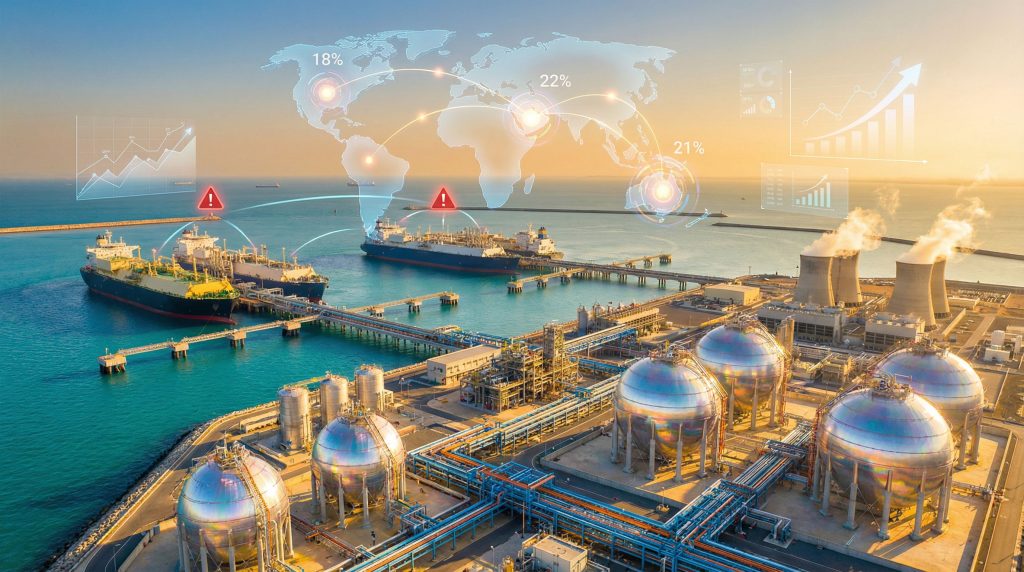
Modern LNG production exhibits dangerous clustering patterns that concentrate enormous market power within limited geographic regions. Qatar's control over approximately 15% of global LNG capacity illustrates how single-facility disruptions can generate disproportionate worldwide impact. When combined with similar concentration levels across other major producing regions, the global system operates with minimal redundancy.
LNG Production Risk Analysis:
| Region | Market Share | Infrastructure Vulnerability | Recovery Timeline |
|---|---|---|---|
| Qatar | 15%+ | High geopolitical exposure | Several years |
| Australia | 20%+ | Low political risk | Moderate |
| United States | 18%+ | Domestic stability | Short-term |
| Russia | 8%+ | Sanctions exposure | Extended |
The economic implications of this concentration become evident during crisis periods. QatarEnergy's force majeure declaration in late March 2026 affected buyers across multiple continents simultaneously. The declaration specifically impacted purchasers in Italy, China, Belgium, and South Korea, illustrating how contractual interdependencies amplify geographic risk in the LNG supply chain crisis.
How Supply Chain Bottlenecks Multiply Economic Impact
Transportation infrastructure represents another critical vulnerability layer within global energy networks. Maritime chokepoints control significant percentages of global flows, creating multiplicative risk factors when combined with production facility disruptions. Consequently, the strategic importance of routes like the Strait of Hormuz becomes magnified during periods when alternative supply sources face concurrent constraints.
Nearly 50 Qatari LNG tankers sitting idle across the Persian Gulf demonstrate how transportation assets become stranded during supply disruptions, creating secondary economic losses beyond immediate production impacts.
Storage limitations across importing regions exacerbate these transportation constraints. Unlike crude oil markets, which benefit from substantial strategic reserves and commercial storage capacity, LNG systems operate with minimal buffer inventory. This structural limitation forces immediate consumption adjustments when supply disruptions occur, eliminating flexibility to smooth price volatility.
The April 2026 ceasefire negotiations highlight how transportation bottlenecks extend beyond pure logistics into complex geopolitical arrangements. Even temporary shipping route disruptions create lasting economic effects as buyers reassess long-term contract structures. Additionally, natural gas trends demonstrate the interconnected nature of energy markets during crisis periods.
What Economic Forces Are Reshaping Global Energy Security
Demand destruction mechanisms operate through measurable price elasticity responses that demonstrate the limits of LNG market resilience. Asian LNG imports declined to 20.6 million tons in March 2026, representing an 8.6% annual drop that marked the sharpest demand decline since December 2020. This dramatic reduction illustrates how elevated pricing triggers rapid fuel-switching behavior among major industrial economies.
Key Market Disruption Statistics:
• LNG prices surged 80% since February 28, 2026
• Asian import volumes fell to levels not seen since pandemic lockdowns
• Force majeure declarations affected multiple continental markets simultaneously
• Recovery timelines extend to "several years" according to industry estimates
The International Gas Union's analysis reveals that Asian countries face their second major supply crisis within four years, creating cumulative financial stress on importing economies. This observation suggests that recurring supply disruptions have asymmetric impacts across economies with different financial reserves and diversification capabilities, similar to oil price movements during geopolitical tensions.
Japan's response exemplifies how major importing nations prioritise energy security over environmental commitments during crisis conditions. A Japanese Ministry of Industry official stated the necessity to increase coal-fired power plant operations while conserving LNG fuel, demonstrating clear price thresholds at which coal becomes the preferred alternative despite climate considerations.
How Are Regional Economies Adapting to Supply Disruptions
Asian markets demonstrate varying adaptive strategies based on their industrial structures and energy mix capabilities. Japan's decision to cancel a long-term LNG supply contract with U.S. Commonwealth LNG in April 2026, despite current supply constraints, suggests that cost considerations and supply reliability concerns outweigh simple availability. However, this decision also reflects broader concerns about tariff impacts on markets affecting long-term energy procurement strategies.
Regional Adaptation Mechanisms:
- Emergency fuel switching to coal-fired power generation
- Strategic reserve releases to manage short-term supply gaps
- Contract renegotiation to include force majeure protections
- Alternative supplier diversification beyond traditional sources
The International Energy Agency's November 2025 World Energy Outlook projected data centre investments reaching $580 billion for 2025, exceeding expected $540 billion in oil and gas industry investment. This projection illustrates how new demand centres in information technology create additional pressure on existing energy infrastructure during the ongoing LNG supply chain crisis.
European markets exhibit different adaptation patterns, with continental buyers focusing on infrastructure investments for alternative import routes and domestic production capacity. For instance, the uncertainty surrounding supply chains has prompted European buyers to reassess their dependency on traditional suppliers and explore new partnerships.
Long-Term Structural Transformation of Energy Markets
The current disruption represents more than a temporary supply issue. It signals fundamental restructuring of global energy economics where market participants must reassess risk models, diversification strategies, and long-term planning assumptions. Traditional hub-and-spoke distribution models face questioning as economies prioritise supply chain resilience over pure economic efficiency. Moreover, OPEC production impact decisions increasingly influence LNG market dynamics as energy sources compete for market share.
Market structure evolution suggests that distributed production networks may command premium valuations despite higher per-unit costs. The reputation damage to Qatar as a historically reliable supplier extends beyond immediate contract performance to long-term buyer confidence in concentrated production systems. Furthermore, energy transition challenges faced by major economies highlight the complexity of balancing security with sustainability objectives.
What Future Market Dynamics Will Emerge
Future Market Dynamics:
• Long-term contracts increasingly incorporate force majeure protections
• Spot market premiums for reliable suppliers suggest permanent pricing shifts
• Investment patterns prioritise geographic distribution over economic optimisation
• Alternative energy projects gain relative attractiveness during fossil fuel price spikes
Pricing mechanism changes reflect these structural adjustments, with long-term contract structures evolving to include alternative supply provisions and enhanced security guarantees. The 30% volatility experienced in European futures markets demonstrates how supply chain disruptions create multiplicative price movements through derivatives markets as traders adjust risk premiums.
The current crisis underscores the economic trade-offs between efficiency and resilience in global energy systems. As market participants adapt to new realities of supply chain vulnerability and geopolitical uncertainty, the industry faces fundamental questions about optimal market structure. Additionally, Australia's position in the global gas market highlights the regional implications of these structural changes.
This analysis is based on market developments and industry commentary available as of April 2026. Energy markets remain highly volatile, and readers should consult current market data and professional advisors for investment decisions.
Ready to Capitalise on Energy Market Volatility?
Discovery Alert's proprietary Discovery IQ model delivers real-time alerts on significant ASX mineral discoveries that could benefit from the current energy transition and supply chain disruptions affecting global markets. As traditional energy sources face unprecedented challenges, major mineral discoveries in critical materials essential for renewable energy infrastructure present compelling investment opportunities. Start your 14-day free trial today to position yourself ahead of the market during this period of energy sector transformation.