July 22, 2026
The Traceability Trap: Why LNG Sanctions Are Harder to Outrun Than Crude Oil Rules
When energy traders and sovereign buyers think about sanctions risk, the instinct is often to reach for well-worn workarounds: rerouted cargoes, opaque intermediaries, altered documentation. For crude oil, this approach has demonstrated a degree of operational effectiveness, creating what analysts describe as a shadow fleet ecosystem. India rejects sanctioned Russian LNG cargoes in a way that fundamentally differs from how it has managed Russian crude shipments, and understanding why reveals as much about logistics as it does about geopolitics.
LNG is not a fungible liquid that can be blended at a refinery to obscure origin. It is a cryogenic commodity transported in purpose-built vessels, tracked continuously through satellite-based Automatic Identification System (AIS) data, and processed through port documentation regimes that leave detailed institutional paper trails. This structural reality, more than any diplomatic principle, explains the distinction India has drawn.
Understanding why this distinction matters requires looking at both the mechanics of LNG trade and the specific sanctions architecture that has made 2025 and 2026 a pivot point for Asian LNG buyers. Furthermore, the trade war impact on oil prices adds another layer of complexity to the energy procurement calculus facing major importing nations.
When big ASX news breaks, our subscribers know first
The Technical Asymmetry Between LNG and Crude Oil Sanctions Exposure
The difference in sanctions risk between LNG and crude oil is not arbitrary. It is a product of physical and logistical realities that shape what buyers can plausibly deny.
Crude oil cargoes can be transferred between vessels at sea, a practice known as ship-to-ship (STS) transfer, which is legal under most jurisdictions but frequently used to obscure cargo origin. A cargo loaded in a Russian port can be transferred to a non-sanctioned vessel in international waters, relabelled through intermediary paperwork, and discharged at a destination terminal without clear provenance.
LNG tankers, however, operate very differently:
- Cryogenic cargo requires specialised containment and cannot be casually transferred between vessels at sea without purpose-built ship-to-ship infrastructure, which is rare and highly visible
- LNG tankers are among the most heavily monitored vessels in the global fleet due to insurance requirements, port state control obligations, and the value of their cargo
- Satellite-based AIS tracking captures vessel movements continuously, and data providers including LSEG compile this into detailed voyage histories that are commercially accessible
- Cargo documentation at LNG terminals, including bill-of-lading records, shipper declarations, and customs manifests, creates layered audit trails that are difficult to retroactively alter
This structural traceability makes it significantly harder for LNG buyers to claim plausible deniability on sanctioned shipments. Unlike crude oil, where origin ambiguity can be manufactured at relatively low cost, LNG origin concealment requires institutional deception at multiple points in the supply chain, each of which creates legal exposure for terminal operators, buyers, and financiers.
Washington's 2025 tightening of sanctions on the Russian LNG sector brought this asymmetry into sharp focus for Asian buyers. For Indian entities operating with dollar-denominated financing, correspondent banking relationships with U.S.-linked institutions, and long-term trade relationships with Western counterparties, the compliance calculus shifted decisively. Consequently, the broader geopolitical landscape for commodities has made compliant procurement strategies a commercial imperative rather than merely a diplomatic gesture.
The Kunpeng Incident: A Stranded Cargo and Its Geopolitical Signal
What Happened With the Kunpeng?
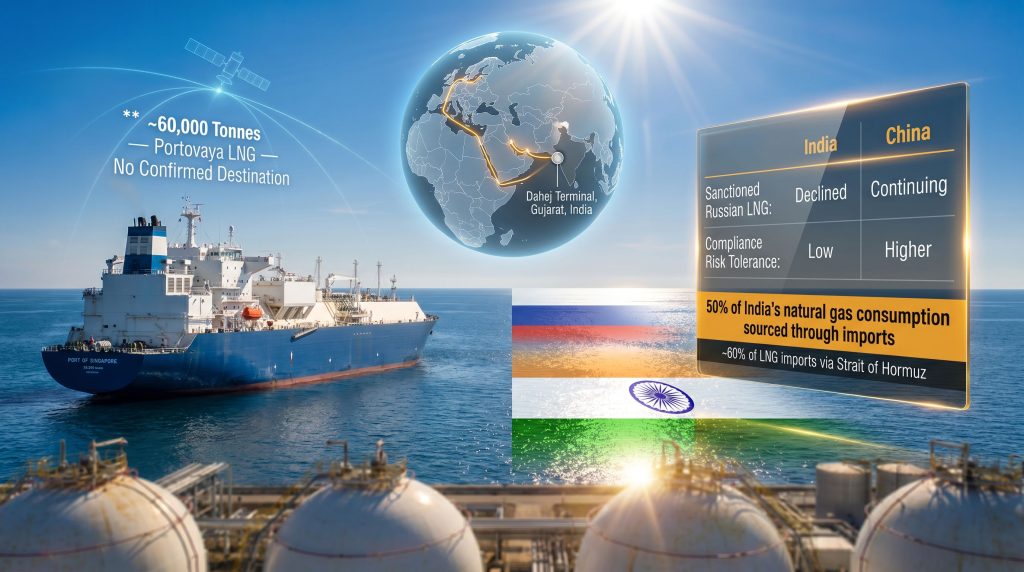
The clearest expression of India's changed posture is the case of the LNG tanker Kunpeng, a 138,200-cubic-metre vessel that loaded approximately 60,000 tonnes of LNG at Russia's Portovaya facility on the Baltic Sea — a plant that has been placed under U.S. sanctions as part of the broader effort to restrict revenue flows to Russia's energy sector.
Portovaya LNG is a relatively small but symbolically significant facility. It fed directly into the Nord Stream 1 pipeline infrastructure before sanctions reshaped European energy markets, and its continued operation as an export facility for non-European markets placed it squarely in the crosshairs of Washington's 2025 enforcement escalation.
| Cargo Detail | Data Point |
|---|---|
| Vessel Name | Kunpeng |
| Vessel Capacity | 138,200 cubic metres |
| Estimated Cargo Volume | ~60,000 tonnes LNG |
| Origin Facility | Portovaya LNG Plant, Baltic Sea |
| Sanctions Status of Origin | U.S.-sanctioned facility |
| Intended Destination | Dahej LNG Terminal, Gujarat, India |
| Destination Indicated | Mid-April 2026 |
| Status as of May 13, 2026 | Drifting near Singaporean waters, no confirmed discharge point |
| Tracking Source | LSEG Shipping Data |
What makes this case particularly instructive is that the cargo carried documentation presenting it as non-Russian in origin. LSEG shipping data, combined with vessel tracking and cargo provenance analysis, identified the true origin regardless. India's decision to refuse discharge at Dahej LNG Terminal in Gujarat was therefore not made on the basis of incomplete information but on confirmed knowledge of the cargo's sanctioned origin.
The Dahej terminal, operated by Petronet LNG Limited, is one of India's largest LNG import facilities. A rejection at that level of the supply chain is not a routine commercial decision. It reflects institutional risk assessment at the highest levels of India's energy procurement architecture.
As of 13 May 2026, the Kunpeng remained near Singaporean waters without broadcasting a confirmed final destination, according to LSEG shipping data. A stranded LNG cargo of 60,000 tonnes represents significant capital exposure, and the inability to find an alternative discharge point speaks to the narrowing window for sanctioned Russian LNG in Asian markets.
Diplomatic Channels: What India Told Russia Directly
High-Level Engagement Between New Delhi and Moscow
India's position was not communicated solely through cargo rejection. High-level diplomatic engagement between New Delhi and Moscow has accompanied the commercial decisions, providing a structured channel through which India has articulated both its constraints and its continued interest in permissible Russian energy trade.
Russian Deputy Energy Minister Pavel Sorokin met with Indian Petroleum and Natural Gas Minister Hardeep Singh Puri on 30 April 2026. Crucially, this was Sorokin's second visit to India within a two-month window, a frequency that signals the significance both sides are placing on the energy relationship. The discussions covered sanctioned projects including Portovaya LNG and Arctic LNG 2, as well as frameworks for future supply arrangements.
Further talks between the two countries were anticipated for June 2026, suggesting an ongoing negotiation process rather than a closed door.
Several dimensions of these diplomatic exchanges carry strategic weight:
- India's Ministry of External Affairs has clarified that New Delhi did not request a U.S. sanctions waiver for Russian LNG, distinguishing this category of trade from crude oil imports where a temporary waiver was extended in the context of Middle East supply disruptions
- Russia's negotiating agenda extends beyond LNG to include long-term supply agreements covering fertilisers, including potash, phosphorus, and urea, indicating Moscow's interest in deepening the bilateral trade relationship across multiple commodity categories
- The willingness to continue high-frequency ministerial contact despite the LNG impasse suggests both sides see value in preserving the commercial relationship within whatever boundaries compliance requires
India's decision not to seek an LNG sanctions waiver is notable given the precedent set for crude oil. It suggests that New Delhi views LNG from sanctioned Russian facilities as a categorically different risk, one where the traceability constraints and compliance exposure are too significant to manage through diplomatic relief mechanisms alone.
India and China: A Widening Gap in Sanctions Risk Appetite
The contrast between Indian and Chinese responses to sanctioned Russian LNG is one of the more consequential divergences in global energy trade dynamics in 2026. Both countries are major buyers of Russian crude oil. Both have economic incentives to access discounted Russian energy. However, their approaches to sanctioned LNG have diverged sharply.
| Factor | India | China |
|---|---|---|
| Sanctioned Russian LNG purchases | Declined | Continuing |
| Russian crude oil imports | Ongoing at high volumes | Ongoing at high volumes |
| Crude oil waiver status | Temporary waiver in place | Not applicable |
| LNG compliance risk tolerance | Low | Higher across categories |
| Sanctions waiver requested for LNG | No, per Ministry of External Affairs | Not applicable |
| Diplomatic posture toward U.S. sanctions | Cautious alignment | Independent stance |
China's continued purchasing of both sanctioned and non-sanctioned Russian LNG reflects a broader strategic posture in which Beijing maintains independent decision-making authority on trade relationships irrespective of U.S. sanctions designations. Chinese state-owned energy enterprises have demonstrated consistent willingness to absorb secondary sanctions risk in ways that Indian buyers are not positioned to replicate.
For India, the risk calculus is sharper. Indian refiners and LNG terminal operators maintain significant relationships with U.S.-linked financial institutions, Western insurers, and technology providers. The potential for secondary sanctions exposure through those channels creates a compliance ceiling that limits how far Indian entities can deviate from U.S. enforcement expectations. This divergence has long-term implications for how Russia calibrates its Asian energy pivot, particularly given the wider global trade impact of tariffs reshaping supplier-buyer relationships across commodity markets.
Energy Security Under Pressure: The Hormuz Dimension
How Does the Strait of Hormuz Affect India's LNG Options?
The timing of India's LNG rejection cannot be separated from the energy security context in which it occurred. The U.S.-Israeli military confrontation with Iran, which commenced on 28 February 2026, introduced significant disruption to shipping movements through the Strait of Hormuz — a chokepoint through which an estimated 60 percent of India's LNG imports were transiting prior to the conflict.
The scale of India's Hormuz exposure is striking:
- Imports meet approximately 50 percent of India's total natural gas consumption
- Around 60 percent of those LNG imports were transiting the Strait of Hormuz before the Iran conflict began
- More than half of India's crude oil supply also moved through the same waterway
This creates a compound vulnerability. Supply disruptions through Hormuz compress the pool of available LNG for Indian terminals at precisely the moment when sanctioned Russian supply is being rejected, non-sanctioned Russian supply is largely pre-committed to European long-term contracts, and Middle Eastern supply chains face physical disruption.
The strategic bind is compounded further by a crude oil waiver that addresses one dimension of the problem but does not extend to LNG. Prime Minister Modi's push for domestic fuel conservation in this environment reflects a demand management response to a supply-side problem that cannot be resolved quickly through normal procurement channels. In addition, the broader tariff-driven economic disruption is adding cost pressure to alternative LNG procurement routes.
The next major ASX story will hit our subscribers first
The Non-Sanctioned Russian LNG Problem
India has made clear through diplomatic channels that it remains interested in purchasing Russian LNG from facilities that are not subject to U.S. sanctions. This is a meaningful distinction in principle, but it runs into structural constraints that limit its practical effect.
The core problem is volume availability. Russian LNG from non-sanctioned facilities is predominantly committed to long-term European supply contracts negotiated before the 2022 sanctions landscape transformed the market. The legal and commercial complexity of redirecting committed supply to new buyers is substantial.
The result is what might be described as a structural gap: India signals willingness to purchase permissible Russian LNG, but the commercially accessible volumes from those sources are limited. Arctic LNG 2, the other major Russian LNG project referenced in India-Russia diplomatic discussions, faces its own sanctions complications. Like Portovaya, it has been designated under U.S. sanctions, placing it outside the permissible purchase window for buyers seeking compliance certainty. Furthermore, developments around Venezuela tariffs and oil markets illustrate how sanctions designations are increasingly reshaping the entire global supply landscape, not just Russian energy trade.
What the Kunpeng Rejection Tells Investors About LNG Market Structure
For market participants tracking the evolution of global LNG trade, the Kunpeng incident and India's broader sanctions positioning offer several structural insights that extend beyond the immediate geopolitical story.
Sanctions enforcement technology is outpacing circumvention techniques. The fact that India identified the Kunpeng's true origin despite documentation presenting it as non-Russian demonstrates that cargo traceability infrastructure, powered by satellite monitoring and AIS data aggregation, has become sufficiently sophisticated to undermine many documentation-based origin-masking strategies that have worked for crude oil.
The India-China divergence is a structural feature, not a temporary posture. The compliance asymmetry between Indian and Chinese buyers reflects underlying differences in financial system integration, geopolitical alignment, and institutional risk tolerance that are unlikely to converge in the near term.
Russia's LNG pivot to Asia has binding constraints. The narrative of Russian LNG seamlessly redirecting from European to Asian markets underestimates both the sanctions enforcement capability and the compliance risk tolerance of the largest Asian buyers.
Middle East supply disruptions create asymmetric pressure. Hormuz disruptions tighten India's supply options at the same time as compliance constraints eliminate certain supply sources. This is constructive for LNG prices in compliant-supply markets and for non-Russian LNG producers in Australia, Qatar, and the United States.
Frequently Asked Questions: India and Sanctioned Russian LNG
What Is Portovaya LNG and Why Is It Subject to U.S. Sanctions?
Portovaya LNG is a Russian liquefied natural gas production facility situated on the Baltic Sea. Washington placed it under sanctions as part of a broader strategy to limit revenue flows to Russia's energy sector, particularly in response to the ongoing conflict in Ukraine. U.S. sanctions on the Russian LNG sector were escalated in early 2025.
Why Is LNG Harder to Obscure Than Crude Oil When Sanctions Enforcement Is Involved?
Crude oil can be routed through intermediate ports, blended, or transferred between vessels at sea in ways that create documentary ambiguity about origin. LNG requires specialised cryogenic tankers that are among the most heavily monitored vessels in the global fleet, must be processed through purpose-built terminals with detailed documentation requirements, and are continuously tracked through satellite-based AIS systems.
Is India Still Purchasing Russian Energy Overall?
Yes. India remains a major buyer of Russian seaborne crude oil, with those imports continuing at high volumes under a temporary sanctions waiver introduced to manage supply disruptions linked to the Iran conflict. India rejects sanctioned Russian LNG cargoes specifically because those transactions carry a different and higher compliance risk profile than crude oil procurement.
What Is Arctic LNG 2?
Arctic LNG 2 is a major Russian LNG development project in the Arctic region that has been designated under U.S. sanctions. Like Portovaya, it falls outside the permissible purchase category for buyers seeking to avoid sanctions exposure, and it was among the projects discussed in India-Russia diplomatic meetings during April and May 2026.
Could India Obtain a Sanctions Waiver Specifically for Russian LNG?
India's Ministry of External Affairs has indicated that no waiver was requested for sanctioned Russian LNG. A temporary waiver was extended for crude oil imports in the context of the Iran conflict-related supply disruptions, but this relief has not been extended to LNG from sanctioned Russian facilities, and India has not pursued that avenue.
Key Takeaways: What India's LNG Stance Signals for Global Energy Trade
- LNG traceability technology is structurally more robust than crude oil origin-masking techniques, creating a compliance ceiling for sanctioned-cargo purchases that grows harder to breach as satellite and data systems mature
- India has drawn a deliberate distinction between pragmatic crude oil procurement under waiver and higher-risk sanctioned LNG transactions, reflecting the deeper integration of Indian financial institutions into dollar-denominated compliance frameworks
- The India-China compliance divergence represents a durable structural split in how Asia's two largest economies engage with Russian energy sanctions, with significant long-term implications for Russia's LNG export strategy
- Hormuz supply disruptions intensify India's energy security pressures without expanding the available pool of compliant LNG supply, creating upward pressure on non-Russian LNG pricing in the near term
- Russia's non-sanctioned LNG volumes are largely pre-committed to European long-term contracts, leaving India with limited practical access to permissible Russian supply regardless of diplomatic willingness
- The Kunpeng incident functions as a case study in how sophisticated cargo traceability systems can identify sanctioned supply despite deliberate documentation misdirection, with implications for any buyer or trader considering similar circumvention strategies
Disclaimer: This article is intended for informational purposes only and does not constitute financial, investment, or legal advice. References to geopolitical events, sanctions frameworks, and market conditions reflect information available as of publication and are subject to change. Readers should conduct independent due diligence before making any investment or commercial decisions based on the information presented here.
Want to Capitalise on the Commodity Disruptions Reshaping Global Energy Markets?
As sanctions regimes, supply chain fractures, and geopolitical flashpoints continue to redraw the map for energy and resource markets, Discovery Alert's proprietary Discovery IQ model cuts through the complexity — delivering real-time alerts on significant ASX mineral discoveries so subscribers can identify actionable opportunities the moment they emerge. Explore how historic discoveries have generated substantial returns on Discovery Alert's dedicated discoveries page, and begin your 14-day free trial today to position yourself ahead of the market.