
August 5, 2026
Understanding LNG Supply Chain Vulnerabilities in Geopolitical Hotspots
Energy markets operate through complex interdependencies that can amplify localised disruptions into global supply crises. The liquefied natural gas sector exemplifies this vulnerability, where geographic concentration of production facilities creates systemic risks that extend far beyond regional boundaries. When critical maritime chokepoints become contested zones, the resulting middle east conflict lng supply loss can reshape energy flows across continents and fundamentally alter market dynamics for years to come. Furthermore, understanding these energy security strategies becomes essential for global market stability.
Critical Infrastructure Concentration in High-Risk Zones
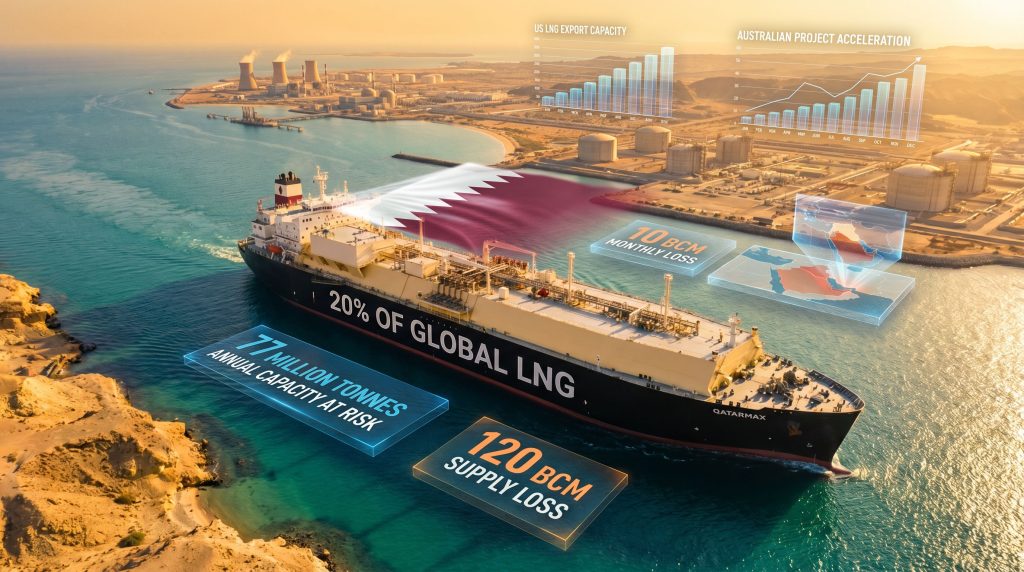
The Strait of Hormuz represents one of the most significant bottlenecks in global energy infrastructure. This narrow waterway, barely 21 miles wide at its narrowest point, serves as the sole maritime route for LNG exports from Qatar and the United Arab Emirates. When this passage becomes impassable due to conflict, approximately 10 billion cubic metres of LNG supply vanishes from global markets each month, creating immediate shortages that ripple through international energy networks.
Qatar's integrated LNG infrastructure demonstrates how production concentration amplifies disruption risks. The nation's North Field, containing approximately 900 trillion cubic feet of recoverable natural gas reserves, feeds directly into coastal liquefaction facilities that depend entirely on Strait of Hormuz transit for global delivery. This creates what analysts term a single point of failure scenario, where damage to either the production infrastructure or the transit route produces identical supply loss outcomes.
The United Arab Emirates faces similar vulnerabilities through its Das Island and Ruwais facilities. These installations process natural gas from offshore fields and onshore reserves, but their export capacity relies completely on safe passage through regional waters. The geographic proximity of these facilities to potential conflict zones means that even limited military actions can effectively isolate substantial LNG production capacity from international markets.
Infrastructure Interdependencies and Cascading Effects
Modern LNG operations require seamless coordination between upstream production, midstream processing, and downstream logistics. Qatar's integrated approach links wellhead operations directly to export terminals through dedicated pipeline networks and processing facilities. When any component of this system faces disruption, the entire production chain experiences reduced throughput or complete shutdown.
The technical complexity of LNG operations amplifies repair timelines following infrastructure damage. Liquefaction facilities operate under extreme conditions, requiring specialised equipment and expertise that may not be readily available during conflict periods. Industry analysis suggests that major facility damage could require four-year repair periods, during which production capacity remains offline and alternative suppliers must compensate for the missing volumes.
Iran's South Pars field shares geological formations with Qatar's North Field, creating potential for cross-border production impacts during regional conflicts. While Iran's LNG export capacity remains limited compared to Qatar and the UAE, disruptions to shared reservoir management or processing infrastructure could affect production optimisation across the entire field complex. Moreover, these disruptions often coincide with broader global trade tensions that complicate market responses.
When big ASX news breaks, our subscribers know first
Quantifying the 120 BCM Supply Loss: Breaking Down the Numbers
The scale of potential LNG supply disruption from Middle East conflicts extends far beyond immediate monthly losses. According to the International Energy Agency, cumulative supply losses could reach 120 billion cubic metres between 2026 and 2030, representing approximately 15% of expected global LNG supply during this critical growth period for international gas markets. This middle east conflict lng supply loss calculation incorporates multiple disruption scenarios and their compound effects.
Monthly Disruption Mechanics
Each month that the Strait of Hormuz remains closed to LNG transit generates approximately 10 bcm in supply losses from the combined reduction of Qatari and Emirati exports. This figure reflects both countries' current production capacity and their complete dependence on the strait for international deliveries. The March-April 2026 closure period demonstrated this calculation methodology, with combined losses totalling 20 bcm over two months of disrupted operations.
The mathematical precision of these projections reflects the binary nature of strait closure impacts. Unlike production declines that might affect output gradually, maritime chokepoint closures create immediate and complete disruption to export capacity. LNG carriers cannot utilise alternative routes from Persian Gulf production facilities, meaning that closure translates directly into lost supply without partial mitigation options.
Facility Damage and Reconstruction Timelines
Beyond transit disruptions, direct attacks on production infrastructure could generate more severe and longer-lasting supply impacts. Qatar's LNG facilities face particular vulnerability due to their coastal location and strategic importance. Industry assessments suggest that major facility damage could reduce Qatar's output by nearly 70 bcm through 2030, assuming standard four-year reconstruction periods for complex liquefaction infrastructure.
These reconstruction estimates account for several critical factors:
• Specialised equipment procurement timelines for liquefaction trains and associated processing systems
• Expert personnel availability during active conflict periods when international contractors may avoid the region
• Supply chain disruptions affecting delivery of replacement components and materials
• Permitting and safety certification processes that may experience delays during emergency reconstruction efforts
The North Field East expansion project represents another dimension of supply loss calculation. Originally scheduled to add substantial export capacity during the 2026-2030 period, project delays attributable to regional instability could reduce cumulative LNG supply by approximately 20 bcm over five years. This figure reflects lost growth capacity rather than destroyed existing infrastructure, but contributes equally to overall market shortage calculations.
Supply Growth Interruption Analysis
LNG market projections for the 2026-2030 period assumed substantial capacity additions from Middle Eastern producers, particularly Qatar's ambitious expansion programmes. The conflict-related disruptions effectively pause this supply growth timeline, forcing global markets to operate with constrained capacity precisely when demand growth was expected to accelerate across Asian and European markets.
The timing of these disruptions amplifies their market impact. Global LNG demand was projected to grow by approximately 4-5% annually during this period, driven by coal-to-gas switching in Asia and European efforts to reduce Russian pipeline gas dependence. The simultaneous occurrence of demand growth and supply constraint creates a fundamental imbalance that cannot be resolved through existing spare capacity or short-term demand destruction.
Market Rebalancing Mechanisms: Who Fills the Gap?
When major LNG suppliers experience disruption, global markets must rapidly identify alternative sources or reduce demand to maintain equilibrium. The 120 bcm cumulative loss from Middle East conflicts represents a supply gap that existing producers cannot easily fill, given current capacity utilisation rates and expansion timelines across other LNG-producing regions. Additionally, these dynamics often influence broader oil price rally dynamics and related US natural gas forecasts.
United States LNG Export Response Capacity
The United States operates the world's most flexible LNG export system, with multiple facilities capable of increasing utilisation rates during supply emergencies. However, American LNG plants already operate at high capacity factors, typically exceeding 90% utilisation during peak demand periods. This limits the ability to generate substantial additional volumes without completing expansion projects already under development.
Existing US facilities could potentially contribute an additional 10-15 bcm annually through optimisation and reduced maintenance schedules, but this represents a fraction of the projected Middle East supply loss. More substantial contributions would require acceleration of planned expansion projects, which typically require 3-5 years from final investment decision to commercial operation.
The economics of US LNG exports also create limitations during supply shortage periods. American producers typically operate under long-term contracts with fixed pricing formulas, limiting their ability to redirect volumes from existing customers to markets offering premium prices during shortage periods. Spot market volumes provide more flexibility but represent a smaller portion of total US export capacity.
Australian Project Acceleration Potential
Australia maintains several LNG projects in various development phases that could potentially advance their timelines to offset Middle East supply losses. The Scarborough project, Browse development, and additional trains at existing facilities represent substantial capacity additions if development can be accelerated.
However, Australian LNG projects face their own constraints:
• Complex regulatory approval processes that cannot be substantially shortened without compromising safety standards
• Limited specialised construction resources that are already committed to existing projects
• Financing requirements that may increase during global supply shortage periods
• Infrastructure limitations at ports and processing facilities that constrain simultaneous development of multiple projects
The lead times for major Australian LNG developments typically range from 5-7 years, meaning that even aggressive acceleration efforts would not address immediate supply gaps during the 2026-2030 period.
Alternative Supplier Limitations
Russian LNG projects, particularly Arctic LNG 2 and Novatek expansions, could theoretically contribute to global supply rebalancing. However, ongoing sanctions and geopolitical tensions limit Russian LNG access to European and some Asian markets, reducing the effective global impact of Russian capacity additions.
African LNG developments in Mozambique and Nigeria represent longer-term supply solutions but face significant development challenges. Political instability in Mozambique has already delayed major projects, while Nigerian developments struggle with infrastructure limitations and regulatory uncertainty.
The global LNG shipping fleet also creates constraints on market rebalancing. During supply shortages, charter rates increase substantially, and vessel availability becomes limited. This can prevent efficient utilisation of available production capacity and create additional costs that ultimately impact end-user prices.
Regional Impact Assessment: Winners and Losers
The middle east conflict lng supply loss creates dramatically different outcomes across global regions, with some markets facing severe shortages while others may benefit from diverted cargoes or accelerated domestic alternatives. The geographic distribution of impacts depends on existing contract structures, alternative supply access, and demand flexibility within different economies. Furthermore, effective market volatility hedging strategies become crucial during these periods.
Asian Market Vulnerabilities and Adaptations
Asian economies demonstrate the highest vulnerability to Middle East LNG disruptions due to their heavy dependence on Qatari and Emirati supplies under long-term contracts. Japan, South Korea, and China collectively import approximately 60% of Qatar's LNG production, creating direct exposure to supply reductions when Strait of Hormuz transit becomes impossible.
Demand destruction mechanisms in Asia operate primarily through industrial fuel switching and temporary production curtailments. Steel mills, petrochemical plants, and power generators maintain capability to substitute coal, fuel oil, or alternative feedstocks when LNG prices spike above economic thresholds. However, these substitutions often increase carbon emissions and operational costs, creating economic drag across energy-intensive industries.
China's strategic position differs significantly from other Asian importers due to its expanding pipeline gas imports from Russia and Central Asia. The Power of Siberia pipeline system provides approximately 38 bcm annually of pipeline gas that partially offsets LNG import requirements. During LNG shortage periods, China can optimise its gas portfolio by maximising pipeline utilisation and reducing LNG imports more readily than countries dependent entirely on seaborne supplies.
Industrial switching capabilities vary substantially across Asian economies:
• Japan: Limited fuel switching due to post-Fukushima nuclear constraints and environmental commitments
• South Korea: Moderate flexibility through increased coal utilisation and accelerated renewable deployment
• China: High flexibility through domestic coal resources and pipeline gas alternatives
• India: Significant switching potential but with substantial economic and environmental costs
European Strategic Response Mechanisms
European LNG markets face a complex calculus during Middle East supply disruptions. While Europe imports smaller volumes from Qatar and the UAE compared to Asian buyers, the continent's ongoing effort to reduce Russian gas dependence has increased LNG import requirements precisely when global supply faces constraints.
Storage optimisation strategies become critical during extended supply shortages. European gas storage capacity, approximately 100 bcm across the continent, provides temporary buffering capability but cannot substitute for sustained supply reductions. Storage management during shortage periods requires careful balancing of injection and withdrawal schedules to maintain supply security through peak demand seasons.
Norway's pipeline gas system offers Europe's most reliable alternative to LNG imports during shortage periods. The Norwegian Continental Shelf can increase production temporarily, though sustainable increases require field development investments that take several years to implement. Enhanced pipeline utilisation can provide 10-15 bcm of additional annual supply but requires coordination across multiple field operators and pipeline systems.
Emergency demand curtailment protocols represent Europe's primary tool for managing severe supply shortages. Industrial users typically face the first curtailment requirements, followed by commercial users, with residential heating maintaining highest priority. These protocols can reduce gas demand by 15-20% temporarily but create significant economic disruption across affected sectors.
Regional Price Differential Evolution
Middle East conflict LNG supply loss creates substantial price differentials across global markets based on each region's alternative supply access and demand flexibility. Asian markets typically experience the highest price increases due to limited alternative supplies and inflexible demand patterns, while regions with substantial pipeline gas access or demand destruction capability face more moderate impacts.
Historical analysis of previous supply disruptions indicates that Asian LNG prices can reach 2-3 times normal levels during major shortage periods, while European gas prices increase by 50-100% depending on storage levels and weather conditions. These price differentials drive LNG cargo diversions when contractual terms permit, but long-term contracts limit the volumes available for reallocation.
Investment and Infrastructure Implications
Sustained Middle East conflict fundamentally alters global LNG investment priorities and infrastructure development strategies. Supply security concerns increasingly compete with cost optimisation in investment decisions, driving capital allocation toward geographically stable production regions and supply chain diversification initiatives.
Risk Premium Evolution in Project Finance
LNG project financing in politically sensitive regions now incorporates substantially higher risk premiums to account for potential supply disruptions. Financial institutions assess not only traditional commercial risks but also geopolitical scenarios that could affect project viability over 20-30 year operating periods.
Political risk insurance markets have evolved to address LNG-specific vulnerabilities, including coverage for:
• Transit route disruption insurance for projects dependent on contested maritime passages
• Infrastructure reconstruction coverage for facilities in potential conflict zones
• Contractual performance protection when force majeure events prevent delivery obligations
• Revenue stream insurance to maintain cash flows during extended supply disruptions
These insurance products increase project development costs by 5-15% but have become essential for securing debt financing in higher-risk regions. The availability and pricing of political risk insurance effectively determines which projects can access international capital markets.
Technology Investment Acceleration
Supply chain vulnerabilities drive increased investment in LNG technologies that reduce geographic concentration risks. Floating LNG (FLNG) systems gain particular attention due to their ability to relocate during security threats and their reduced onshore infrastructure requirements.
FLNG technology offers several advantages during conflict periods:
• Mobility capability allows production units to relocate to safer waters
• Reduced coastal infrastructure limits vulnerable fixed assets
• Distributed production prevents single-point-of-failure scenarios
• Accelerated development timelines compared to traditional onshore facilities
Small-scale LNG infrastructure investment also accelerates as buyers seek supply diversification through multiple smaller sources rather than large-scale imports from concentrated production regions. Distributed supply networks prove more resilient during localised conflicts but require higher per-unit infrastructure investment.
Strategic Buyer Participation Trends
LNG buyers increasingly participate directly in upstream development projects to secure long-term supply access outside traditional trading relationships. Strategic equity participation allows buyers to maintain supply access even when spot markets experience severe shortages.
Japanese and South Korean utilities lead this trend through:
• Direct equity stakes in LNG development projects across multiple regions
• Offtake agreement bundling with development financing participation
• Technology partnership arrangements that provide preferential supply access
• Long-term service contracts that create operational dependencies favourable to supply security
European buyers adopt similar strategies but face greater regulatory constraints on overseas investment and state aid rules that limit direct government participation in energy infrastructure development.
Long-Term Market Structure Evolution
Middle east conflict lng supply loss accelerates fundamental changes in global energy market structure that extend far beyond the immediate 2026-2030 disruption period. These changes reshape energy procurement strategies, technology development priorities, and international cooperation frameworks in ways that persist long after specific conflicts resolve.
Energy Transition Acceleration Mechanisms
Supply security concerns drive acceleration of energy transition investments as countries seek to reduce dependence on volatile international LNG markets. Industrial decarbonisation programmes receive enhanced political and financial support when positioned as energy security measures rather than purely environmental initiatives.
Hydrogen economy development gains momentum as an alternative to LNG imports for industrial applications. While hydrogen production currently requires substantial energy inputs, the technology provides pathway independence from international gas markets that proves attractive during supply shortage periods.
Key hydrogen development accelerations include:
• Electrolysis capacity expansion for domestic hydrogen production using renewable energy
• Industrial hydrogen applications in steel production, chemical processes, and high-temperature manufacturing
• Hydrogen storage infrastructure to provide seasonal energy storage capability
• International hydrogen trading frameworks to diversify supply sources beyond traditional gas producers
Renewable energy investment surges as utilities seek alternatives to gas-fired power generation during LNG shortage periods. Solar, wind, and battery storage projects receive accelerated permitting and enhanced financing support when framed as energy security infrastructure rather than environmental compliance measures.
Geopolitical Alliance Formation
Energy supply disruptions drive formation of new international cooperation frameworks designed to enhance collective energy security. These arrangements extend beyond traditional military alliances to encompass energy-specific cooperation mechanisms.
Strategic partnership evolution includes:
• Regional energy reserve sharing agreements for emergency supply allocation
• Coordinated infrastructure development to create redundant supply pathways
• Technology transfer partnerships for energy security-related technologies
• Joint procurement mechanisms to enhance negotiating leverage with suppliers
The United States, Australia, and Canada explore enhanced cooperation frameworks for LNG supply security to Allied nations, potentially including preferential access arrangements during global shortage periods. These arrangements require careful structuring to comply with international trade rules while providing meaningful supply security benefits.
European Union energy cooperation deepens through expanded gas storage sharing, coordinated LNG procurement, and joint infrastructure development programmes. The bloc's experience with Russian gas supply disruption provides institutional frameworks that can address LNG shortage scenarios.
Regional Hub Development Strategies
Supply chain resilience drives investment in regional LNG hub facilities designed to provide storage, redistribution, and supply security functions. These hubs reduce dependence on direct supply chains from potentially unstable production regions.
Singapore expands its role as an Asian LNG trading and storage hub, with increased storage capacity and enhanced ship-to-ship transfer capabilities. The facility provides buffering capacity for Asian markets and enables more flexible cargo allocation during supply disruptions.
Rotterdam develops enhanced LNG import and redistribution capability to serve European markets during pipeline gas supply constraints. The facility combines large-scale storage with inland distribution infrastructure to optimise supply security across the continent.
Egyptian LNG infrastructure gains strategic importance as a potential alternative to Persian Gulf supplies for European and Asian markets. Egypt's geographic position enables LNG re-export operations that bypass traditional chokepoint risks.
The next major ASX story will hit our subscribers first
Risk Management Framework for Stakeholders
Effective management of Middle East conflict LNG supply loss requires comprehensive risk frameworks that address both immediate supply disruptions and longer-term market volatility. Different stakeholder categories face distinct risk profiles and require tailored management approaches based on their operational flexibility and strategic alternatives.
Industrial User Portfolio Strategies
Energy-intensive industries develop sophisticated portfolio management approaches to maintain operational continuity during LNG supply disruptions. Fuel diversification strategies become essential components of operational risk management rather than optional cost optimisation measures.
Multi-fuel capability development includes:
• Dual-fuel burner systems that can switch between natural gas, fuel oil, and alternative feedstocks
• Process flexibility modifications that accommodate different energy input characteristics
• Strategic fuel inventory management with increased storage capacity for alternative fuels
• Supplier diversification programmes across multiple LNG sources, pipeline gas, and alternative energy forms
Manufacturing facilities in petrochemicals, steel, and cement industries invest in flexible production systems that can adjust output levels during energy price spikes while maintaining core operational capability. These investments typically increase capital costs by 10-20% but provide operational continuity during supply shortage periods.
Financial hedging strategies evolve to address LNG price volatility through:
• Long-term price collar contracts that limit both upside and downside price exposure
• Physical storage arrangements that provide short-term supply security during price spikes
• Cross-commodity hedging that balances natural gas exposure with alternative fuel positions
• Force majeure insurance coverage for supply disruption impacts on production schedules
Government Policy Framework Development
National governments develop comprehensive policy responses to manage LNG supply security while maintaining economic competitiveness and environmental commitments. Emergency allocation protocols provide mechanisms for prioritising limited LNG supplies during severe shortage periods.
Strategic reserve establishment programmes create government-managed LNG storage capacity to buffer against supply disruptions. These programmes require substantial capital investment but provide policy tools for managing energy security during international crises.
Key strategic reserve components include:
• Underground storage facilities with 30-90 day supply capacity for critical industrial users
• LNG import terminal reservations that guarantee access during shortage periods
• Flexible release mechanisms that can rapidly deploy reserves during supply emergencies
• International coordination agreements for reserve sharing during widespread disruptions
Regulatory flexibility frameworks enable rapid supplier switching and alternative fuel utilisation during emergency periods. These frameworks pre-approve environmental and safety modifications that would normally require extended permitting processes.
Financial Institution Risk Assessment
Banks and investors develop enhanced risk assessment methodologies for LNG-related exposures, incorporating geopolitical scenario analysis into standard credit and project evaluation processes. Political risk modelling becomes integral to energy infrastructure financing decisions.
Enhanced due diligence frameworks include:
• Transit route vulnerability assessment for LNG export projects
• Alternative supply scenario modelling for LNG import-dependent borrowers
• Force majeure clause analysis in LNG supply contracts and project documents
• Insurance coverage verification for political and operational risk exposures
Credit facilities for LNG-exposed companies incorporate covenant structures that adjust borrowing capacity based on energy price volatility and supply security metrics. These arrangements provide flexibility during shortage periods while maintaining lender protection.
Market Outlook: Scenarios for Recovery and Adaptation
Recovery from Middle East conflict LNG supply loss depends on multiple interconnected factors that operate over different timescales and create various potential pathways back to market equilibrium. Understanding these scenarios enables stakeholders to develop appropriate strategic responses and investment timing decisions.
Diplomatic Resolution and Infrastructure Repair Pathways
Optimistic recovery scenarios assume diplomatic conflict resolution within 12-18 months, enabling immediate restart of LNG transit through the Strait of Hormuz and gradual infrastructure reconstruction where facilities sustained damage. Under this pathway, monthly supply losses cease once maritime passage reopens, though facility damage could require 2-4 years for complete restoration.
Infrastructure repair timelines depend critically on damage severity and reconstruction resource availability. Modular LNG facility design enables more rapid restoration compared to traditional integrated facilities, potentially reducing repair periods from four years to 18-24 months for major damage scenarios.
Intermediate scenarios involve partial conflict resolution that enables intermittent LNG transit but maintains elevated security risks. This pathway creates ongoing supply volatility rather than complete shortage, requiring market adaptation to unpredictable cargo availability and substantially higher transportation insurance costs.
Extended conflict scenarios assume continued transit disruption for 3-5 years, forcing permanent market restructuring around alternative supply sources and demand destruction. This pathway accelerates energy transition investments and creates lasting changes to global LNG trade patterns.
Alternative Supply Development Acceleration
New LNG project development acceleration provides the primary mechanism for offsetting sustained Middle East supply losses. United States expansion projects offer the most realistic near-term capacity additions, with potential for 20-30 bcm of additional annual capacity by 2028-2029 if development timelines can be compressed.
Project acceleration mechanisms include:
• Regulatory fast-tracking for projects with pre-approved environmental assessments
• Modular construction techniques that reduce field assembly requirements
• Enhanced contractor coordination to prevent resource bottlenecks across multiple projects
• Government loan guarantee programmes that reduce financing costs and timeline uncertainties
Australian project advancement faces greater technical and regulatory constraints but could contribute 15-25 bcm annually by 2030 under aggressive development scenarios. Browse and Scarborough projects represent the largest near-term opportunities but require sustained high LNG prices to justify acceleration costs.
African LNG development provides longer-term supply potential but cannot address immediate shortage scenarios due to infrastructure limitations and political stability concerns in key production regions.
Demand Response and Market Adaptation
Industrial demand destruction provides immediate mechanism for balancing supply shortages with reduced consumption. Historical analysis indicates that sustained LNG prices above $15-20/mmbtu can reduce industrial demand by 10-15% through fuel switching and production curtailment.
Demand response patterns vary significantly across regions and industrial sectors:
• Power generation: High switching flexibility to coal, oil, or renewable alternatives
• Industrial heating: Moderate switching capability with efficiency and cost implications
• Petrochemical feedstock: Limited switching options but potential for production reduction
• Residential heating: Very low short-term flexibility but high political sensitivity
Efficiency improvement acceleration offers medium-term demand reduction potential. Industrial energy efficiency investments typically require 2-3 years to implement but can provide 5-10% demand reduction in energy-intensive sectors.
Technology breakthrough scenarios could dramatically alter demand patterns if hydrogen production costs decline rapidly or industrial electrification accelerates beyond current projections. However, these scenarios require sustained high energy prices and supportive policy frameworks to achieve meaningful scale within the 2026-2030 timeframe.
Price Recovery and Market Normalisation
LNG price normalisation depends on the speed and completeness of supply restoration versus demand adaptation measures. Rapid supply recovery scenarios could see prices return to pre-conflict levels within 6-12 months of transit restoration, particularly if storage inventories can be rebuilt quickly.
Gradual recovery patterns create extended periods of elevated price volatility as markets balance limited supply additions against recovering demand. This scenario typically results in prices 20-40% above historical norms for 2-3 years following initial supply restoration.
Structural market change scenarios involve permanent shifts to higher price equilibrium levels due to:
• Increased risk premiums incorporated into long-term contracts
• Enhanced storage and security infrastructure costs built into supply chains
• Diversified supply portfolios that sacrifice cost optimisation for supply security
• Accelerated alternative energy adoption that reduces total LNG demand growth rates
Long-term contract renegotiation pressures emerge during extended shortage periods as buyers seek more flexible terms and suppliers demand higher baseline prices to compensate for political risks. These contract structure changes can persist well beyond immediate supply crisis resolution.
According to industry experts, global energy markets face unprecedented challenges that require coordinated international responses to maintain stability and security of supply chains.
Important Investment Disclaimer: This analysis contains forward-looking statements and projections that involve significant uncertainties. Energy market investments carry substantial risks including political instability, regulatory changes, technological developments, and market volatility. Past performance does not guarantee future results. Readers should conduct independent research and consult qualified advisors before making investment decisions. The scenarios presented are analytical frameworks rather than predictions or investment recommendations.
Want to Stay Ahead of Energy Market Disruptions?
Discovery Alert's proprietary Discovery IQ model delivers real-time notifications on significant ASX mineral discoveries that could reshape global supply chains during energy transitions. With LNG markets facing unprecedented volatility, savvy investors are turning to critical minerals and energy security opportunities that benefit from supply chain diversifications and energy infrastructure investments. Start your 14-day free trial today to identify actionable investment opportunities before market disruptions create the next wave of commodity winners.