July 10, 2026
The Geometry of Risk: How Global LNG Supply Chains Are Tested at Their Narrowest Point
Every complex system has a point of maximum fragility. In global energy infrastructure, that point is a strip of water approximately 21 nautical miles wide at its narrowest navigable channel, separating the Omani coastline from Iranian territorial waters. The Strait of Hormuz is not merely a geographic feature — it is the load-bearing joint of the world's LNG supply architecture, and when LNG vessels transit the Strait of Hormuz under threat, the reverberations travel instantly to spot markets in Tokyo, Seoul, and Dhaka.
Understanding what actually happens when LNG vessels transit the Strait of Hormuz under elevated threat conditions requires moving beyond headline risk assessments. The real story lies in the granular decision-making of vessel masters, the actuarial calculations of war risk underwriters, and the cascading downstream effects felt by energy-importing nations thousands of kilometres from the conflict zone.
When big ASX news breaks, our subscribers know first
Why the Strait of Hormuz Has No Viable Substitute
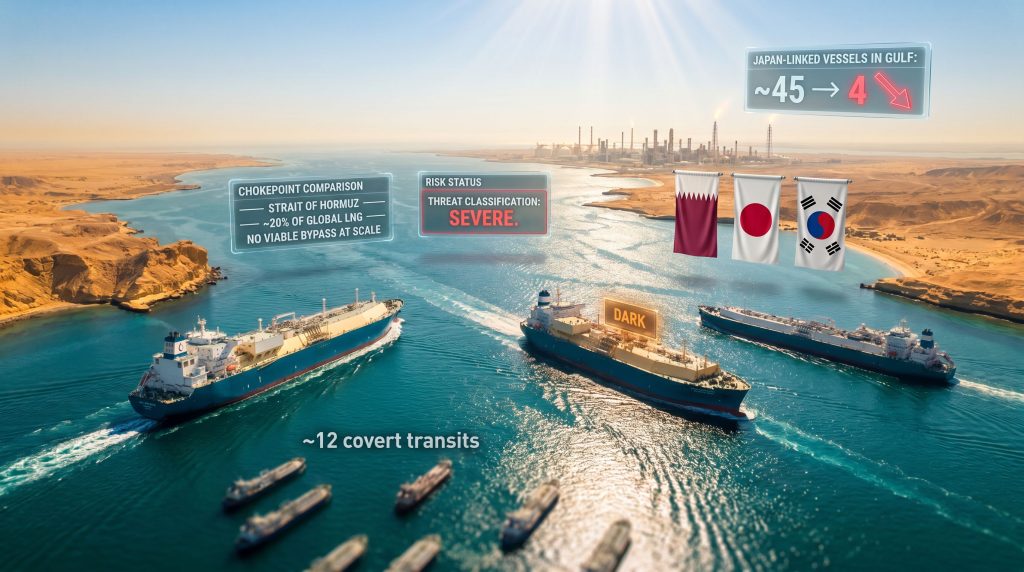
The physical geography of the Strait is deceptively simple. Two shipping lanes — each roughly 3 kilometres wide — carry an estimated 20 percent of global LNG trade in each direction annually, making it the single most consequential chokepoint in the liquefied natural gas supply chain. Qatar's Ras Laffan industrial complex, the origin point for the world's largest volume of LNG exports, has no alternative exit.
The UAE's Das Island terminal faces the same structural constraint. Both are geographically locked into Hormuz dependence with no commercially viable overland bypass or alternative maritime corridor at any meaningful scale. Furthermore, this constraint directly shapes the global LNG supply outlook in ways that market participants frequently underestimate.
This stands in stark contrast to other critical maritime chokepoints, where partial rerouting options exist:
| Chokepoint | Daily Energy Volume | Viable Bypass Route | Risk Classification |
|---|---|---|---|
| Strait of Hormuz | ~20% of global LNG | None at scale | Critical |
| Strait of Malacca | ~25% of seaborne trade | Lombok/Sunda Straits | Moderate |
| Suez Canal | ~12% of global trade | Cape of Good Hope | High |
| Bab-el-Mandeb | ~10% of oil trade | Suez diversion | High |
The absence of any bypass option for Hormuz is not a temporary engineering gap — it reflects the fundamental topology of the Persian Gulf, which is essentially a closed basin with a single oceanic exit. This is a structural reality that cannot be resolved through infrastructure investment on any near-term commercial or political timeline.
How Shipping Operators Make Transit Decisions During Active Conflicts
The operational logic governing whether an LNG vessel transits the Strait of Hormuz during a period of elevated geopolitical risk is far more layered than public reporting typically conveys. Vessel masters and fleet managers work through a multi-variable decision matrix before committing to or aborting a transit.
The Operational Decision Matrix
Key variables assessed before each transit decision include:
- Cargo status: Ballast (empty) vessels present a fundamentally different risk profile than laden carriers. An empty LNG tanker carries significantly less financial exposure per voyage, which means operators of ballast vessels may accept higher threat environments that a laden carrier would decline.
- War risk insurance classification: When maritime threat levels reach a formal "severe" designation, war risk surcharges are automatically triggered, adding substantial cost to any cargo delivery. Underwriters at Lloyd's and within the P&I club network effectively set the boundaries of commercial navigability.
- Flag state advisories: The nationality of a vessel's flag state shapes the guidance received by vessel masters. Japanese-flagged or Japanese-linked operators, for instance, received direct engagement from the Japan Ministry of Land, Infrastructure, Transport and Tourism during the most recent escalation period.
- Charter party obligations: Long-term supply contracts may contain force majeure provisions, but invoking them carries reputational and financial consequences that operators weigh carefully before diverting or aborting a transit.
- Real-time threat intelligence: Platforms such as Kpler and LSEG provide near-continuous cargo tracking, but their utility diminishes when vessels elect to disable their AIS transponders — a practice that has become increasingly common during conflict periods.
The AIS Blackout Phenomenon
One of the least publicly understood aspects of LNG transit risk management is the deliberate deactivation of Automatic Identification System transponders. According to reporting from Baird Maritime, during the most recent period of heightened Hormuz tensions, an estimated 12 LNG cargoes exited the strait with their AIS transponders switched off. This practice, colloquially described as going "dark," creates a genuine intelligence gap in cargo tracking infrastructure.
"Transponder deactivation is a rational security response in conflict-adjacent waters — it reduces a vessel's detectable signature. However, it simultaneously creates complications for cargo insurance underwriting, port-of-destination planning, and spot market pricing, since buyers cannot confirm delivery timelines for cargo they cannot track."
From an insurance underwriting perspective, operating dark in a declared war risk zone introduces additional liability considerations, particularly around whether a vessel was operating within the bounds of its navigational warranty at the time of any incident.
Fleet Behavior During the Escalation Period: A Non-Uniform Response
The fleet-level response to Hormuz threat escalation was not a simple binary of transit or divert. Ship-tracking data from Kpler and LSEG revealed a spectrum of operator behaviour that reflects the heterogeneous risk tolerances, commercial pressures, and flag state environments across the global LNG shipping industry.
- Vessels that reversed course: Three QatarEnergy-operated LNG carriers — Al Ghariya, Duhail, and Al Ruwais — aborted inbound transits toward Ras Laffan after the threat environment reached severe classification.
- Vessels that proceeded: At least five ballast LNG tankers entered the strait in subsequent days, including the GasLog Shanghai, controlled by Greek shipping company GasLog, alongside QatarEnergy-linked carriers Al Samriya, Al Dafna, Al Gattara, and Al Rayyan.
- Vessels that transited covertly: An estimated 12 laden LNG cargoes exited via Hormuz with transponders disabled, representing a significant volume of supply that moved outside the visibility of conventional tracking infrastructure.
- Broader energy shipping exposure: The risk calculus extended beyond LNG, with an Indian Very Large Crude Carrier also reversing course off the Omani coast during the same period.
The diversity of these responses is itself analytically significant. It demonstrates that there is no industry-wide consensus threshold at which operators uniformly halt Hormuz transits — individual commercial judgement, cargo status, and operator risk culture all produce materially different outcomes under identical threat conditions.
Japan's Fleet Drawdown: The Human Dimension of Supply Chain Risk
The scale of Japan's maritime exposure to the Hormuz escalation was made unusually visible through the direct public disclosures of Japan's Transport Minister Yasushi Kaneko, who confirmed at a news conference on July 10 that 22 Japan-linked vessels — including six large crude oil tankers — had successfully exited the Strait of Hormuz between July 7 and July 9, leaving only four vessels remaining in the Gulf.
The human dimension of this drawdown is striking. According to a spokesperson for the Japanese Shipowners' Association, the number of Japan-linked vessels in the Gulf fell from approximately 45 at the onset of the conflict, carrying around 1,100 crew members, to just four vessels with approximately 100 crew members. This represents a 91 percent reduction in Japanese maritime personnel exposure within days — a pace of withdrawal that reflects both the severity of the perceived threat and the operational capacity of major Japanese shipping operators to execute rapid fleet repositioning.
"The Japanese government's unusual transparency in disclosing precise vessel and crew counts during an active conflict period reflects the degree to which energy supply security anxiety has become a matter of direct public concern in import-dependent economies."
This level of official disclosure is atypical for maritime security situations and signals a shift toward greater governmental accountability on energy logistics. Consequently, the Asian LNG import pressures facing Japan and its neighbours have never been more politically visible.
Qatar and the UAE: Differential Exposure at the Export End
As the world's largest LNG exporter, Qatar faces the most concentrated exposure to any Hormuz disruption scenario. Ras Laffan's entire export capacity is effectively contingent on unrestricted strait access, and there is no secondary export infrastructure that could substitute for this pathway within any operationally relevant timeframe.
The downstream consequences of fleet disruption materialised quickly. QatarEnergy reportedly halved its scheduled 2026 LNG deliveries to Bangladesh — a direct supply reduction for one of the world's most energy-import-dependent economies. The attack on the Qatari LNG tanker Al Rekayyat, which raised explosion risk concerns near the strait, intensified fleet-wide caution across QatarEnergy's carrier network.
The UAE's ADNOC, operating through its Das Island terminal, represents a secondary but structurally similar exposure point. ADNOC's expanding energy partnership with South Korea creates a direct line of downstream vulnerability in Asian import markets — any sustained interruption to Das Island departures would cascade through Korean utility procurement timelines and spot purchasing programmes.
The next major ASX story will hit our subscribers first
How Markets Price Hormuz Risk: Insurance, Spot Benchmarks, and Force Majeure
The financial transmission mechanism from physical Hormuz disruption to delivered energy costs operates through two primary channels: war risk insurance surcharges and Asian LNG spot price movements as measured by the Japan-Korea Marker (JKM) benchmark.
When maritime threat classifications reach severe levels, war risk premiums are applied on top of standard hull and cargo insurance, increasing the delivered cost of each cargo regardless of whether the cargo itself is physically disrupted. This cost is ultimately borne by import-dependent utilities and industrial buyers, compressing margins for entities operating under fixed-price supply agreements. In addition, the resulting gas price volatility extends well beyond the immediate conflict zone, affecting pricing dynamics across interconnected global markets.
The precedent established by Houthi maritime attacks in the Red Sea during 2024 and 2025 is directly relevant to current Hormuz risk pricing. That episode demonstrated that sustained threat environments in critical maritime corridors produce durable changes to insurance pricing frameworks — war risk zones once established tend to persist in underwriting models well beyond the active conflict period, creating a structural cost uplift on affected trade routes.
The tension between long-term contracted LNG supply and force majeure provisions becomes acute during genuine conflict-level disruptions. Contracted buyers have legal expectations of delivery; sellers facing genuine transit impossibility may invoke force majeure, but the reputational and arbitration costs of doing so create strong commercial incentives to attempt delivery through alternative means — including the AIS-dark transits described above — before formally declaring supply failure.
Reuters data confirms that the first confirmed commercial LNG transit following any diplomatic resolution of a Hormuz crisis carries outsized market signal value. In this context, the movement of a Petronet-linked carrier through the strait in the period following a US-Iran peace signal functioned as a normalisation indicator, providing the market with a reference point for assessing whether the commercial risk premium had actually diminished.
Three Scenarios for Hormuz Disruption and Their Market Consequences
Scenario-based analysis provides a more useful framework for understanding Hormuz risk than binary open/closed assessments.
Scenario 1: Partial Disruption with Elevated Risk Premiums
Operators proceed on a case-by-case basis, accepting war risk surcharges for high-priority cargoes. Cargo volumes are reduced but not eliminated. Asian spot prices experience a moderate spike, typically absorbed within weeks as risk premiums normalise. Historical precedent from the 2019 Gulf tanker incidents suggests this scenario produces a 10–20 percent JKM premium above pre-incident levels.
Scenario 2: Extended Fleet Withdrawal and Rerouting
A majority of commercial operators suspend Hormuz transits pending diplomatic resolution. Qatar curtails deliveries to contracted buyers, and force majeure declarations become probable. Atlantic Basin producers — US Gulf Coast exporters, Australian LNG terminals, and West African suppliers — benefit from demand diversion as Asian buyers seek non-Hormuz supply. The additional voyage time and bunker fuel cost of routing Qatar LNG around the Cape of Good Hope to Asian markets would add approximately 15–20 days of transit time per round voyage, materially increasing delivered cargo costs.
Scenario 3: Full Closure and Systemic Supply Chain Rupture
A complete suspension of commercial LNG transit through Hormuz would effectively neutralise Qatar's export capacity for the duration. Japan, South Korea, Bangladesh, India, and Pakistan would face the most acute import-side consequences. Emergency strategic reserve drawdowns would be activated across Northeast Asia, while US Gulf Coast and Australian LNG would attract sharp spot price premiums. However, the broader supply chain disruption risks at a global level would compound these pressures considerably across multiple industries simultaneously.
The Concentration Risk at the Heart of Global LNG Architecture
The repeated stress-testing of the Hormuz corridor exposes a fundamental design flaw in how global LNG supply chains have been constructed over the past three decades. The relentless commercial logic of cost optimisation has systematically underinvested in geographic supply diversification, routing an ever-larger share of global LNG volume through a single 21-mile navigational corridor.
This concentration risk is structurally different from equivalent vulnerabilities in pipeline gas networks, where supply can be rerouted through interconnected grid infrastructure. LNG supply chains are point-to-point systems: cargo loaded at Ras Laffan is destined for a specific regasification terminal, and the only physical path from the loading point to the open ocean runs through Hormuz. There is no LNG equivalent of the European gas grid's east-west switching capability.
"The economics of LNG supply chain design have historically optimised for cost per unit delivered under normal conditions, not for resilience under conflict conditions. This creates a systematic underpricing of chokepoint risk that only becomes visible when geopolitical stress materialises — at which point remediation options are extremely limited."
For LNG-importing nations, the policy implication is clear: strategic reserve capacity, supply portfolio diversification toward non-Hormuz producers, and investment in demand-side flexibility are not optional enhancements to energy security policy. They are the primary buffers against a risk that cannot be engineered away at the source. Furthermore, the broader global trade war impacts already reshaping commodity flows make this diversification imperative even more urgent for governments across Asia and beyond.
Frequently Asked Questions: LNG Vessels and Hormuz Transit Risk
What happens to LNG prices when the Strait of Hormuz is disrupted?
When LNG vessels transit the Strait of Hormuz under constrained conditions, or when transit is perceived as materially riskier, Asian LNG spot prices as measured by the Japan-Korea Marker typically rise as buyers compete for alternative supply from Atlantic Basin producers. War risk insurance surcharges simultaneously increase delivered cargo costs independent of physical supply interruption.
Why do some LNG tankers deactivate their tracking transponders?
AIS transponder deactivation reduces a vessel's detectable profile in contested waters, providing a degree of operational security against targeting. While this is a rational response to active conflict environments, it creates complications for cargo tracking, insurance underwriting, and port planning — and may trigger regulatory scrutiny depending on the flag state's navigational warranty requirements.
Which countries are most vulnerable to a Hormuz LNG disruption?
Ranked by structural import dependence and limited alternative supply access:
- Japan — highest absolute LNG import volume with significant Gulf supply exposure
- South Korea — long-term contracted supply from Gulf producers creates delivery obligation risk
- Bangladesh — limited strategic reserve capacity and direct QatarEnergy delivery curtailment already documented
- Pakistan and India — growing spot market dependence on Gulf LNG with constrained alternative supply pipelines
Can Qatar reduce its Hormuz dependency?
In practical terms, no — not within any commercially or politically relevant near-term timeframe. The capital cost, engineering complexity, and timeline required to construct any meaningful alternative export infrastructure, whether a trans-Arabian pipeline or an alternative LNG loading terminal outside the Gulf, means that Qatar's Hormuz dependency is structurally locked in regardless of the geopolitical risk environment. This is perhaps the single most important and least publicly understood constraint on Gulf LNG supply security.
For additional coverage of Middle Eastern energy markets, maritime trade dynamics, and regional infrastructure developments, Zawya's Energy and Projects sections at zawya.com provide ongoing reporting from across the MENA region.
Want to Know Which ASX Energy and Resources Discoveries Could Benefit From Global Supply Chain Disruptions?
Discovery Alert's proprietary Discovery IQ model scans ASX announcements in real time, instantly identifying significant mineral discoveries and actionable investment opportunities — the same way structural risks like Hormuz concentration have historically driven outsised returns in energy and resources equities. Start your 14-day free trial today, or explore how historic discoveries have delivered remarkable market returns to investors who acted early.