July 10, 2026
The Geopolitics of Dependency: Why the Kirkuk–Ceyhan Pipeline Defines Iraq–Turkey Relations
Pipeline infrastructure rarely operates in a political vacuum. Across the Middle East, crude export corridors have historically functioned as leverage instruments, negotiating chips, and fiscal lifelines simultaneously. Few examples illustrate this dynamic more sharply than the Kirkuk–Ceyhan pipeline, which connects northern Iraq's oil fields to Turkey's Mediterranean export terminal at Ceyhan. The recent Turkey Iraq oil pipeline deal extension, confirmed at the final-stage signing phase by Turkish Energy Minister Alparslan Bayraktar during an official visit to Baghdad, encapsulates everything complex and consequential about bilateral energy diplomacy in 2026.
This is not a story about a routine contract renewal. It is, furthermore, a window into how two economically interdependent nations navigate unresolved legal disputes, competing fiscal pressures, and the structural limits of transit-state relationships.
When big ASX news breaks, our subscribers know first
What Makes the Kirkuk–Ceyhan Corridor So Strategically Significant
The Kirkuk–Ceyhan pipeline stretches roughly 970 kilometres from northern Iraq through Turkish territory before terminating at the port of Ceyhan on Turkey's eastern Mediterranean coastline. Constructed in the 1970s and expanded over subsequent decades, the pipeline has long served as one of Iraq's principal crude export arteries, second in national importance only to the southern terminals near Basra.
What distinguishes this corridor from Iraq's southern export infrastructure is its geographic specificity. Landlocked production zones in northern Iraq, including fields operated within the Kurdistan Region, have no viable alternative export route that does not pass through Turkish territory. This asymmetry creates a structural dependency that shapes every negotiation between Ankara and Baghdad.
Ceyhan itself functions as more than a pipeline terminus. It is a major crude loading hub servicing tanker routes into the Mediterranean and onward to European refineries. The terminal's throughput directly influences the volume of Iraqi crude available to non-Russian supply chains, a factor that has gained considerable attention among European energy planners in the years following the 2022 energy shock. Understanding oil geopolitics and logistics helps contextualise why this corridor commands such strategic weight.
Pipeline transit agreements in the Middle East rarely reflect purely commercial logic. The pricing of transit fees, the governance of volume allocations, and the conditions under which flows can be suspended all carry geopolitical weight that transcends their nominal financial value.
How a $1.5 Billion Arbitration Ruling Paralysed the Pipeline for 2.5 Years
The immediate trigger for the extended pipeline shutdown was an international arbitration court ruling that found Turkey liable for $1.5 billion in damages owed to Iraq. The ruling stemmed from Turkey's receipt of unauthorised Iraqi crude exports during the period spanning 2014 to 2018, a timeframe during which the Kurdistan Regional Government (KRG) was exporting oil independently through the pipeline without Baghdad's explicit authorisation.
The legal and diplomatic fallout was significant. Baghdad had long disputed the KRG's right to export oil unilaterally, and the arbitration outcome validated Iraq's federal government position. Turkey, having accepted and processed those flows, was found to share responsibility for the revenue diverted away from the federal treasury.
Ankara's response was to resist extending the pipeline agreement under conditions it viewed as commercially and legally disadvantageous. Without a renewed framework that addressed the arbitration liability, Turkey lacked the incentive to formalise continued operations. According to reporting from Kurdistan 24, Turkey's rejection of the extension was explicitly tied to these ongoing arbitration disputes. The pipeline consequently remained offline for approximately 2.5 years, creating a prolonged supply gap that constrained Iraq's northern export capacity and strained federal budget projections.
Flows eventually resumed in late 2025, following a period of diplomatic engagement between the two governments. The resumption was conditional and fragile, with the existing pipeline agreement set to expire on July 27, 2026, creating urgency for a formal extension to be concluded before that deadline.
Breaking Down the 12-Month Extension Agreement
Turkish Energy Minister Alparslan Bayraktar confirmed during his Baghdad visit that both governments had brought a one-year extension framework to its final stage, with signing expected within days of the announcement. Iraq Oil Minister Basim Mohammed was the primary Iraqi counterpart in those discussions, and Iraqi Prime Minister Ali al-Zaidi also engaged with Bayraktar during the visit, signalling high-level political backing for the process on the Iraqi side.
The core terms of the Turkey Iraq oil pipeline deal extension are summarised below:
| Agreement Dimension | Detail |
|---|---|
| Extension Duration | 12 months |
| Previous Agreement Expiry | July 27, 2026 |
| Crude Destination | Port of Ceyhan, eastern Mediterranean |
| Negotiation Status at Announcement | Final stage, signing imminent |
| Turkish Ministerial Confirmation | Energy Minister Alparslan Bayraktar |
| Iraqi Counterpart | Oil Minister Basim Mohammed |
The choice of a 12-month framework rather than a comprehensive long-term accord carries its own meaning. Short-term extensions in pipeline diplomacy typically reflect a situation where both parties require the operational and financial continuity the pipeline provides, but remain divided on the legal architecture of a permanent settlement.
When bilateral pipeline agreements default to rolling short-term renewals, it is rarely a sign of strategic alignment. More often, it signals that the underlying disputes are too complex or politically sensitive to resolve within the immediate negotiating window, and that both parties prefer managed ambiguity over failed talks.
In this case, the unresolved $1.5 billion arbitration liability remains the central obstacle. Until Turkey either settles that award or reaches a negotiated arrangement with Baghdad over how it will be addressed, any permanent pipeline agreement must grapple with a financial overhang that complicates every commercial term on the table. These dynamics also intersect meaningfully with broader trade war oil markets pressures reshaping energy diplomacy globally.
The Kurdistan Dimension: A Second, Parallel Agreement
What makes the governance of this pipeline corridor particularly intricate is the existence of a separate, distinct agreement covering crude flows originating from the Kurdistan Region of Iraq. That arrangement, brokered with U.S. diplomatic involvement, governed the resumption of KRG oil exports through the same pipeline corridor and came into effect in September 2025, with an expiry date of December 31, 2025 unless extended.
The practical implication is that the Kirkuk–Ceyhan pipeline operates under two overlapping legal and commercial frameworks simultaneously:
- The federal Iraqi agreement, now extended for 12 months, governing Baghdad's sovereign export rights through the corridor
- The Kurdistan-specific arrangement, separately negotiated and separately administered, covering KRG-origin crude
This dual-track structure introduces political risk at multiple levels. Baghdad and Erbil maintain an often contentious relationship over oil revenue sharing and export authority. Disruptions to either agreement can affect throughput at Ceyhan regardless of the status of the other. International oil companies operating in the Kurdistan Region are particularly exposed to this governance complexity, as their ability to monetise production depends on both tracks remaining operational.
Iraq's Fiscal Exposure and Why the Pipeline Cannot Be Allowed to Fail
Iraq's dependence on crude revenues is among the most acute of any major oil-producing nation. Oil export income accounts for more than 90% of federal government revenue, meaning that any extended disruption to export capacity translates almost directly into budget shortfalls, reduced public sector wage payments, and constrained infrastructure investment.
The 2.5-year shutdown of the Kirkuk–Ceyhan pipeline was not merely a diplomatic inconvenience. It represented a sustained reduction in Iraq's northern export capacity at a time when the country was also managing OPEC+ production quota obligations. The combination of constrained volumes and fixed budget commitments created fiscal pressure that Baghdad was poorly positioned to absorb. Consequently, OPEC market influence on quota decisions added another layer of complexity to Iraq's already strained production environment.
Restoring and now extending flows through the pipeline directly supports Iraq's ability to meet its export targets. While the southern Basra terminals handle the bulk of Iraqi crude exports, the northern Ceyhan route provides a critical secondary channel that is particularly important for production from fields geographically distant from the Persian Gulf coast.
The next major ASX story will hit our subscribers first
Scenario Analysis: Three Pathways When the Extension Expires
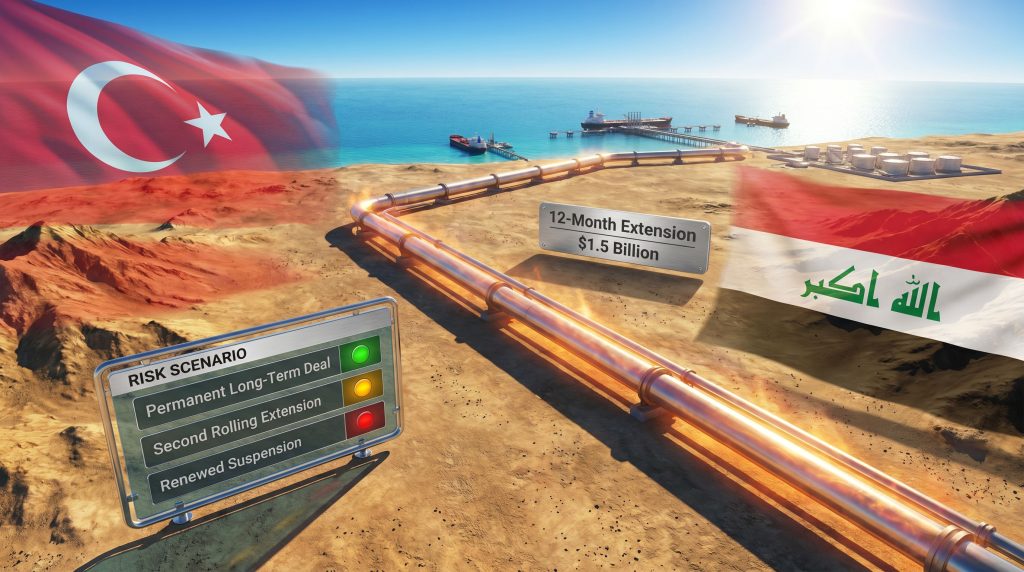
The 12-month extension buys time but resolves nothing structurally. As the new expiry date approaches in mid-2027, three realistic scenarios emerge:
| Scenario | Probability | Key Trigger | Market Impact |
|---|---|---|---|
| Permanent Long-Term Deal | Moderate | Arbitration settlement reached | Positive — price stability, investor confidence |
| Second Rolling Extension | High | Disputes unresolved but flows maintained | Neutral — operational continuity, uncertainty persists |
| Renewed Suspension | Low-to-Moderate | Arbitration escalation or political rupture | Negative — supply disruption, upward price pressure |
Scenario 1: A Comprehensive Agreement would require Turkey and Iraq to resolve or formally defer the arbitration liability question, agree on transit fee structures, establish volume guarantees, and create a governance framework durable enough to survive changes in government on both sides. This outcome is achievable but demands political will and legal creativity that has not yet been demonstrated.
Scenario 2: Another Rolling Extension is statistically the most likely near-term outcome, consistent with the pattern seen across similar bilateral pipeline relationships globally. While this preserves cash flows for both parties, it carries the long-term risk of institutional drift, where infrastructure investment decisions are deferred and operational standards gradually erode under perpetual short-term uncertainty.
Scenario 3: Renewed Suspension would most likely be triggered by an escalation in the arbitration dispute, a sharp deterioration in Turkey–Iraq diplomatic relations, or a domestic political shift in either country that makes the current ministerial-level engagement unsustainable. Global crude markets would register such a disruption as a meaningful supply-side risk, particularly given the volume of European refinery demand served through Ceyhan. In such an event, oil price movements could face significant upward pressure across Mediterranean-linked benchmarks.
European Energy Security and the Strategic Weight of Ceyhan
The port of Ceyhan occupies a specific and meaningful place in European energy supply planning. Following the 2022 energy disruption caused by the curtailment of Russian oil sanctions and pipeline flows into Europe, Mediterranean-origin crude became a more actively sought alternative for refiners across Southern and Central Europe. Ceyhan's throughput, sourced from Iraqi and Azerbaijani fields, forms part of that diversification calculus.
Stable operation of the Turkey Iraq oil pipeline deal extension therefore carries implications that extend beyond the bilateral relationship. For European buyers, continued Ceyhan access represents one of several non-Russian supply lines that reduce exposure to geopolitical risk concentrated further east. Any renewed suspension of Kirkuk–Ceyhan flows would tighten Mediterranean crude availability and add modest but directionally meaningful upward pressure to regional oil prices. For further context, Upstream Online's analysis provides a detailed breakdown of how the two countries have been at loggerheads over this agreement's future.
Frequently Asked Questions
What is the Turkey–Iraq oil pipeline deal extension?
It is a 12-month agreement between Turkey and Iraq to maintain the continued flow of crude oil through the Kirkuk–Ceyhan pipeline, reached ahead of the July 27, 2026 expiry of their prior arrangement.
Why was the pipeline offline for 2.5 years?
An international arbitration court ruled that Turkey owed $1.5 billion in damages to Iraq for receiving unauthorised Kurdish crude exports between 2014 and 2018. The diplomatic fallout from this ruling prevented a new agreement from being formalised, resulting in the extended suspension.
What is Ceyhan and why does it matter?
Ceyhan is Turkey's principal Mediterranean crude export terminal. It serves as the endpoint of the Kirkuk–Ceyhan pipeline and is a key loading point for tankers supplying European and broader international refiners.
Who confirmed the extension?
Turkish Energy Minister Alparslan Bayraktar confirmed during an official visit to Baghdad that the 12-month extension had reached its final stage, with the signing expected within days of the announcement.
Is there a separate deal for Kurdistan Region oil?
Yes. A distinct arrangement, brokered with U.S. diplomatic involvement, governs crude flows originating from the Kurdistan Region through the same pipeline infrastructure, with its own separate expiry timeline.
Will Turkey and Iraq conclude a permanent agreement?
No permanent deal has been reached. The 12-month extension is a temporary framework that preserves operational continuity while negotiations over a comprehensive long-term accord continue.
What the Extension Signals and What It Does Not Resolve
The Turkey Iraq oil pipeline deal extension is best understood as an act of shared fiscal pragmatism rather than a resolution of the underlying disputes. Both governments need the revenue this pipeline generates. Iraq's budget arithmetic depends on it. Turkey's positioning as a regional energy transit hub is strengthened by it.
However, the $1.5 billion arbitration liability has not been settled. The dual-track governance structure covering federal Iraqi and Kurdistan Region oil flows has not been rationalised. Turkey's leverage as the sole viable transit state for landlocked northern Iraqi production has not diminished.
The next 12 months represent a genuine, time-bounded opportunity to move beyond rolling extensions toward a durable commercial framework. Whether the political will and legal ingenuity required to achieve that outcome can be assembled before the clock runs out again remains the defining question for one of the Middle East's most consequential oil corridors.
This article is intended for informational purposes only and does not constitute financial, legal, or investment advice. Forward-looking statements and scenario projections reflect analytical assessments based on publicly available information and are subject to material uncertainty. Readers should conduct independent research before making decisions based on any content presented here.
Want to Stay Ahead of the Next Major Commodity Discovery Before the Market Moves?
While geopolitical shifts reshape global oil corridors, Discovery Alert's proprietary Discovery IQ model scans ASX announcements in real time, instantly identifying significant mineral discoveries across more than 30 commodities and translating complex data into clear, actionable insights — explore historic discovery returns on Discovery Alert's discoveries page to see what early positioning can deliver, and start your 14-day free trial today to secure your market-leading advantage.