June 29, 2026
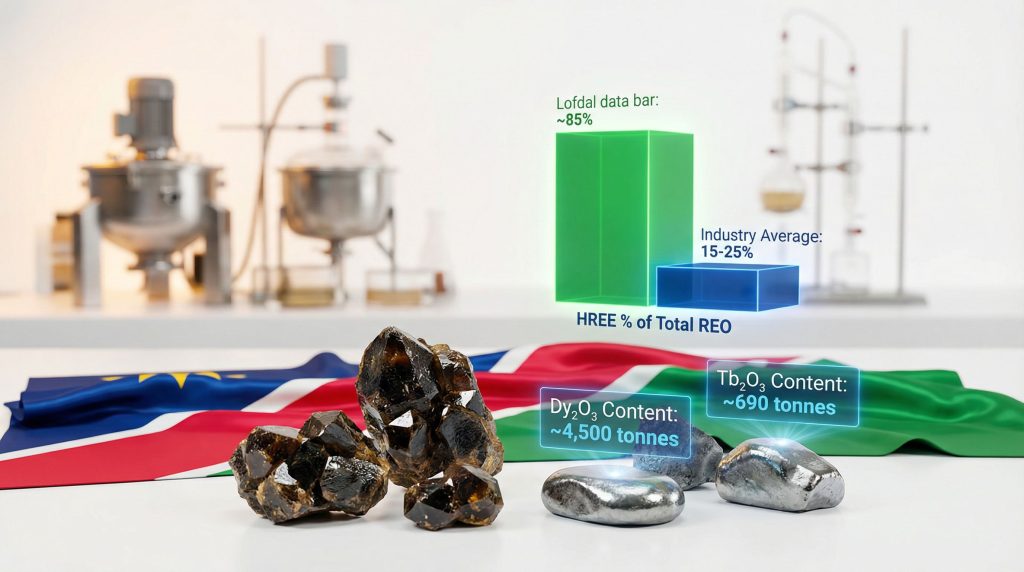
The Namibia Lofdal rare earth project represents one of the most strategically significant heavy rare earth element developments globally, positioned to address critical minerals energy security concerns through its exceptional dysprosium and terbium concentration. This xenotime-hosted deposit demonstrates an 85% heavy rare earth element composition that substantially exceeds industry averages, while maintaining low thorium content that simplifies processing requirements and reduces operational costs.
What Makes the Lofdal Project a Strategic Heavy Rare Earth Asset?
Understanding Heavy Rare Earth Elements in Modern Technology
Heavy rare earth elements constitute approximately 5-10% of global rare earth production yet command significantly higher economic value due to their irreplaceable role in critical applications. Dysprosium and terbium additions to neodymium-iron-boron (NdFeB) permanent magnet alloys improve magnetic coercivity retention by 15-25% at elevated temperatures, a fundamental requirement for high-performance motor applications.
The technical significance extends beyond simple performance enhancement. These elements enable magnetic materials to maintain their properties above 200°C, preventing demagnetization in electric vehicle motors and wind turbine generators operating under extreme thermal conditions. Tesla Model 3 and Model Y motors utilize high-temperature permanent magnets requiring dysprosium content, while Siemens and GE offshore wind turbines depend on HREE-enhanced magnets for reliability in corrosive, high-temperature marine environments.
Key Technical Properties:
- Dysprosium enhances coercivity retention, allowing motors to operate efficiently at elevated temperatures
- Terbium provides oxidation resistance and improves Curie temperature thresholds
- Both elements are irreplaceable in applications requiring sustained performance under thermal stress
- Recovery optimization directly impacts permanent magnet manufacturing economics
Namibia's Position in the Global Critical Minerals Landscape
Namibia's mining sector contributes approximately 11-13% of national GDP, establishing a foundation of regulatory expertise and operational infrastructure that supports complex mineral development projects. Furthermore, the nation's existing mining framework encompasses diamonds, uranium, and various base metals, creating institutional knowledge that translates effectively to rare earth element operations.
The strategic positioning within southern Africa provides logistical advantages for global supply chain integration. In addition, Namibia's political stability relative to regional comparators, combined with established bilateral trade relationships with major economies, positions the country as a reliable partner for critical minerals strategy agreements.
Strategic Advantages:
- Established mining regulatory framework with proven operational expertise
- Existing infrastructure supporting large-scale mineral operations
- Political stability and transparent governance structures
- Strategic location for efficient global logistics integration
Technical Advantages of Xenotime-Hosted Mineralization
Xenotime (yttrium phosphate) mineralization presents distinct processing advantages compared to other HREE host minerals such as euxenite or complex carbonate systems. The mineral's crystalline structure enables more efficient extraction of target elements while minimizing complex separation requirements that characterize many rare earth deposits globally.
The simplified mineralogy reduces process design complexity, potentially lowering capital expenditure requirements and operational costs. Additionally, xenotime-hosted deposits typically exhibit lower radioactive element concentrations, reducing regulatory compliance costs and environmental management complexity associated with mining permitting basics.
When big ASX news breaks, our subscribers know first
How Does Lofdal's Resource Profile Compare to Global Heavy REE Deposits?
Dysprosium and Terbium Concentration Analysis
The Namibia Lofdal rare earth project demonstrates exceptional heavy rare earth element concentration, with approximately 4,500 tonnes of contained dysprosium oxide and 690 tonnes of terbium oxide within the current resource estimate. Most significantly, heavy rare earth elements comprise approximately 85% of total rare earth oxide content, substantially exceeding industry standard compositions.
HREE Composition Comparison
| Project | Dy₂O₃ Content | Tb₂O₃ Content | HREE % of Total REO | Location |
|---|---|---|---|---|
| Lofdal | ~4,500 tonnes | ~690 tonnes | ~85% | Namibia |
| Industry Average | Variable | Variable | 15-25% | Various |
| Mount Weld | Lower | Lower | ~20% | Australia |
This composition profile presents substantial economic advantages. An 85% heavy rare earth element content significantly exceeds typical deposit compositions that average 15-25% HREE content, meaning Lofdal's profile demonstrates 3.4 to 5.7 times higher favorability ratios. This concentration minimizes light rare earth element byproduct generation, reducing processing complexity and eliminating dependency on volatile LREE markets for project economics.
The exceptional HREE concentration reduces process design complexity while eliminating market dependency risks associated with light rare earth element byproducts that characterize most global deposits.
Resource Estimation Methodology and Confidence Levels
Modern resource estimation for rare earth deposits requires sophisticated geological modeling that accounts for complex mineralization patterns and grade continuity variations. The Lofdal project benefits from extensive drilling programs that establish grade continuity across multiple geological zones, supporting resource classification confidence levels.
Resource estimation methodology typically incorporates:
- Geostatistical modeling using advanced interpolation techniques
- Geological domain modeling to account for mineralization controls
- Statistical validation through cross-validation and visual inspection
- Compliance with international reporting standards (JORC, SAMREC, or NI 43-101)
Low Thorium Content: Processing Advantages Explained
Thorium presence in rare earth deposits creates significant operational challenges, including radioactive material handling requirements, enhanced environmental controls, and complex waste management protocols. However, low thorium content deposits demonstrate substantial economic advantages through reduced regulatory compliance costs and simplified processing infrastructure requirements.
Processing Cost Implications:
- Reduced radiation protection equipment and facility design requirements
- Simplified waste management and disposal protocols
- Lower environmental remediation liability and bonding requirements
- Streamlined permitting processes and operational approvals
What Are the Key Technical Milestones in Lofdal's Development Timeline?
Pre-Feasibility Study Progress and Expected Outcomes
Namibia Critical Metals appointed Niels Verbaan as Vice President of Metallurgy effective May 2026, signaling acceleration toward definitive feasibility study development. Verbaan brings over 25 years of metallurgical process development experience, particularly in rare earth elements, having most recently served as Senior Director at SGS Lakefield.
The appointment timing suggests pre-feasibility study findings are being formalized for bankability assessment, indicating technical work has progressed sufficiently to warrant specialized metallurgical leadership. Consequently, Darrin Campbell, President of Namibia Critical Metals, emphasized that Verbaan's expertise materially strengthens their ability to deliver a robust, financeable DFS while positioning Lofdal for development with high technical confidence.
Pre-Feasibility Focus Areas:
- Resource optimization and mine planning development
- Process design validation and cost estimation
- Infrastructure requirements and capital expenditure analysis
- Environmental impact assessment and permitting pathway
Definitive Feasibility Study Framework
The progression toward definitive feasibility study execution represents the critical pathway from technical concept to bankable project development. Furthermore, DFS completion requires comprehensive engineering design, detailed cost estimation, and financial modeling that satisfies institutional investment criteria for project financing.
Key DFS components include:
- Detailed mine planning and production scheduling
- Process plant engineering and equipment specification
- Infrastructure development and logistics optimization
- Environmental management and social impact planning
- Financial modeling and sensitivity analysis
Pilot Testing Programs and Metallurgical Optimization
Verbaan's appointment specifically addresses pilot programmes and process improvement for the Namibia Lofdal rare earth project, with particular focus on improving recovery of dysprosium and terbium. His scope encompasses metallurgical testing protocols, process design optimization, and pilot programme execution.
SGS Lakefield, Verbaan's previous employer, maintains global recognition for rare earth metallurgical test work programs and process development for unconventional ore types. This expertise directly applies to optimizing recovery rates for target elements while minimizing processing costs and environmental impacts associated with mining sustainability transformation initiatives.
Pilot Testing Objectives:
- Leaching efficiency and kinetics optimization
- Separation and purification circuit development
- Recovery rate validation for dysprosium and terbium
- Process water recycling and environmental management
- Scaling parameters for commercial-scale operations
How Does the JOGMEC Partnership Structure Benefit Project Development?
Japanese Strategic Metals Security Initiative
The Japan Organisation for Metals and Energy Security (JOGMEC) partnership reflects Japan's strategic imperative to diversify critical mineral supply chains beyond traditional Chinese sources. JOGMEC operates under Japan's Ministry of Economy, Trade and Industry (METI) mandate, focusing specifically on securing stable rare earth metal supplies through long-term international partnerships.
Japan's historical dependency on Chinese rare earth imports (exceeding 90% for heavy rare earth elements) created strategic vulnerabilities that became apparent during periodic supply restrictions. JOGMEC's participation in the Namibia Lofdal rare earth project signals government-level commitment to supply chain diversification and critical minerals security.
JOGMEC Strategic Objectives:
- Develop non-Chinese rare earth supply sources
- Secure long-term supply agreements for Japanese manufacturers
- Support technological development in rare earth processing
- Strengthen bilateral relationships with resource-rich nations
Funding Phases and Equity Distribution Model
JOGMEC can secure up to 50% ownership stake by investing approximately CAD $23 million (USD $16.6 million) through a structured three-phase investment program. This phased approach aligns capital deployment with technical milestone achievement, providing risk mitigation for both parties while ensuring adequate funding for project development.
Investment Structure
| Phase | JOGMEC Investment | Cumulative Investment | Equity Stake | Milestone Alignment |
|---|---|---|---|---|
| Phase 1 | CAD $3M (USD $2.1M) | CAD $3M | 40% | Pre-feasibility completion |
| Phase 2 | CAD $7M (USD $5M) | CAD $10M | 40% | Pilot testing and DFS initiation |
| Phase 3 | CAD $13M (USD $9.4M) | CAD $23M | 50% | DFS completion and financing |
The phased structure incentivizes technical milestone achievement before capital deployment escalation. Furthermore, JOGMEC maintains reassessment opportunities before Phase 3 commitment, while Namibia Critical Metals secures staged funding aligned with development progression.
Current Ownership Distribution:
- Namibia Critical Metals: 95%
- Local Namibian stakeholders: 5%
- Post-JOGMEC Phase 3: JOGMEC 50%, NCM 45%, Local 5%
Toyota Tsusho's Role in Downstream Integration
Toyota Tsusho Corporation's expected participation through JOGMEC creates direct downstream market linkages for Lofdal production. As a trading arm of Toyota Group, Toyota Tsusho maintains extensive supply chain relationships with permanent magnet manufacturers, electric vehicle producers, and renewable energy companies requiring heavy rare earth elements.
This integration provides market certainty for project economics while ensuring supply chain security for Japanese manufacturing operations. Additionally, Toyota Tsusho's involvement establishes direct pathways from mine production to end-user applications, reducing market risk and supporting long-term commercial viability.
What Infrastructure and Operational Factors Support Project Viability?
Mining License Framework and Regulatory Certainty
The Lofdal project maintains full permitting status with a 25-year mining licence in place, providing regulatory certainty that supports long-term investment planning. This licensing framework eliminates permitting risk from project development timelines while establishing operational parameters for commercial production.
Namibian mining legislation provides clear frameworks for:
- Environmental compliance and monitoring requirements
- Local content and community benefit obligations
- Royalty structures and taxation frameworks
- Export licensing and international trade facilitation
Hybrid Power Solutions for Remote Operations
Remote mining operations require reliable power generation systems that balance cost efficiency with operational reliability. Hybrid renewable energy systems combining solar, wind, and backup generation provide sustainable power solutions while reducing operational costs and environmental impacts.
Namibia's solar irradiation levels rank among the world's highest, providing exceptional potential for solar power integration. In addition, wind resources in coastal regions offer complementary renewable generation, while battery storage systems enable 24-hour operations independent of grid connections.
Water Resource Management in Arid Environments
Water management in arid mining environments requires sophisticated recycling systems and conservation strategies. Modern rare earth processing facilities achieve water recycling rates exceeding 85-90% through advanced treatment and recovery technologies.
Water Management Strategies:
- Closed-loop processing circuits minimizing fresh water consumption
- Tailings dewatering systems maximizing water recovery
- Groundwater monitoring and sustainable extraction practices
- Emergency water storage and backup supply systems
Strip Ratio Analysis and Mining Economics
Strip ratio calculations determine the relationship between waste rock removal and ore extraction, directly impacting mining costs and project economics. Favourable strip ratios reduce mining costs while enabling selective mining techniques that optimise ore grade delivery to processing facilities.
Metallurgical testing programmes validate processing parameters that influence mining selectivity requirements, establishing optimal balance between mining costs and processing efficiency.
How Do Market Dynamics Influence Lofdal's Commercial Prospects?
Global HREE Supply Chain Vulnerabilities
Heavy rare earth element supply chains demonstrate significant concentration risk, with Chinese operations dominating global production and processing capacity. This concentration creates price volatility and supply security concerns for manufacturers requiring consistent HREE availability for critical applications.
Recent supply chain disruptions highlighted vulnerabilities in rare earth dependent industries, including:
- Electric vehicle motor manufacturing delays
- Wind turbine production constraints
- Defence systems component shortages
- Consumer electronics supply interruptions
Electric Vehicle and Wind Energy Demand Projections
Global electric vehicle adoption trajectories project substantial increases in permanent magnet motor demand, directly translating to heavy rare earth element consumption growth. Wind energy expansion programmes worldwide require large quantities of dysprosium and terbium for generator permanent magnet systems.
Demand Growth Drivers:
- Electric vehicle sales projections indicating 20-30% annual growth through 2030
- Offshore wind capacity additions requiring high-performance permanent magnets
- Industrial motor efficiency mandates driving permanent magnet adoption
- Consumer electronics miniaturisation requiring advanced magnetic materials
Geopolitical Factors in Critical Minerals Sourcing
Critical mineral supply chain security has become a strategic priority for major economies, influencing government policies and international trade relationships. Supply diversification initiatives support non-Chinese rare earth development through investment incentives, bilateral agreements, and strategic partnerships.
Recent policy developments include resource security legislation, critical minerals stockpiling programmes, and international cooperation frameworks designed to reduce supply chain concentration risks.
The next major ASX story will hit our subscribers first
What Role Does Metallurgical Leadership Play in Project Success?
Rare Earth Processing Expertise Requirements
Rare earth element processing requires specialised expertise in complex hydrometallurgical processes, separation chemistry, and purification techniques. The appointment of experienced metallurgical leadership directly impacts process optimisation, cost reduction, and production efficiency outcomes.
Niels Verbaan's 25-year career in metallurgical process development, particularly rare earth elements, provides critical expertise for Lofdal development. His experience with SGS Lakefield, recognised globally for rare earth process development, ensures access to proven technologies and best practices.
Recovery Optimization for Heavy REE Elements
Heavy rare earth element recovery optimisation requires sophisticated understanding of separation chemistry and process kinetics. Dysprosium and terbium extraction from xenotime mineralisation involves complex leaching protocols and selective separation techniques that maximise recovery while minimising processing costs.
Recovery Optimisation Focus Areas:
- Leaching chemistry optimisation for maximum extraction efficiency
- Separation circuit design for high-purity product development
- Process conditions optimisation reducing energy consumption
- Waste minimisation and environmental impact reduction
Process Design Considerations for Commercial Viability
Commercial-scale process design must balance recovery efficiency with operating cost optimisation while ensuring product quality specifications for end-user applications. Process design decisions made during development phases significantly impact long-term operational economics and competitive positioning.
Critical design considerations include equipment selection, automation levels, environmental controls, and maintenance requirements that influence both capital expenditure and operating cost structures.
How Does Lofdal Address Critical Minerals Security Concerns?
Non-Chinese HREE Supply Development
The Namibia Lofdal rare earth project represents strategic importance for global supply chain diversification beyond Chinese sources. Western nations and allies prioritise critical mineral supply security through investment in alternative sources and processing capacity development.
Lofdal's development contributes to global HREE supply diversification while providing market alternatives for manufacturers seeking supply chain resilience and risk mitigation strategies.
Strategic Partnership Models for Resource Security
The JOGMEC partnership model demonstrates how resource security concerns drive international cooperation and investment frameworks. Strategic partnerships between resource developers and end-user nations create aligned incentives for project success while ensuring market access and supply security.
This model provides templates for future critical mineral development projects, establishing frameworks that balance commercial viability with strategic resource security objectives.
Technology Transfer and Local Capacity Building
International partnerships in critical mineral development often incorporate technology transfer and local capacity building requirements that create long-term benefits for host countries. These elements support sustainable development while building domestic expertise in advanced mineral processing technologies.
Local capacity building initiatives may include:
- Technical training programmes for local workforce development
- University partnerships for research and development collaboration
- Technology transfer agreements supporting domestic capabilities
- Supply chain development supporting local business opportunities
What Are the Key Risk Factors and Mitigation Strategies?
Technical Processing Challenges
Rare earth element processing presents complex technical challenges including separation efficiency optimisation, product purity achievement, and waste management. These challenges require specialised expertise and proven technologies to ensure commercial success.
Risk mitigation strategies include:
- Comprehensive pilot testing programmes validating process parameters
- Expert personnel recruitment and retention strategies
- Technology partnerships with established process development organisations
- Conservative design approaches ensuring operational reliability
Market Price Volatility Management
Heavy rare earth element prices demonstrate significant volatility influenced by supply disruptions, demand fluctuations, and geopolitical factors. Price risk management requires sophisticated strategies and financial instruments that provide revenue stability during price cycles.
Price Risk Mitigation Approaches:
- Long-term supply agreements with fixed or collar pricing mechanisms
- Product diversification across multiple end-use applications
- Financial hedging instruments managing price exposure
- Flexible production capacity enabling response to market conditions
Environmental and Social Considerations
Mining operations in arid environments require comprehensive environmental management systems and community engagement strategies. Environmental risks include water resource impacts, dust generation, and ecosystem disturbance that require proactive mitigation measures.
Social considerations encompass community consultation, local employment opportunities, and benefit sharing arrangements that ensure sustainable relationships with local stakeholders.
How Will Lofdal Impact Namibia's Mining Sector Development?
Economic Contribution Projections
The Namibia Lofdal rare earth project represents potential significant economic contributions to national GDP, export revenue, and government taxation income. Critical mineral operations typically generate higher value-per-tonne compared to traditional mineral commodities, creating substantial economic multiplier effects.
Economic impact categories include:
- Direct employment in mining and processing operations
- Indirect employment in supporting industries and services
- Government revenue through royalties, taxation, and licensing fees
- Foreign exchange earnings supporting currency stability
Skills Development and Technology Transfer
Advanced mineral processing operations require sophisticated technical skills and operational expertise that create long-term capacity building opportunities for local workforces. Technology transfer initiatives establish domestic capabilities in high-value mineral processing technologies.
Skills development programmes may encompass:
- Technical training in metallurgical and chemical processes
- Engineering and maintenance capability development
- Environmental management and safety protocol training
- Business and administrative skills enhancement
Integration with Existing Mining Infrastructure
Namibia's established mining sector provides infrastructure foundations that support new project development while reducing capital requirements and operational costs. Existing infrastructure includes transportation networks, power systems, communication networks, and support services.
Integration opportunities reduce development timelines and costs while leveraging proven operational frameworks and regulatory compliance systems that support successful project implementation.
Disclaimer: This analysis contains forward-looking statements and projections based on current market conditions and available information. Rare earth element markets demonstrate significant volatility, and actual outcomes may differ materially from projections. Investment decisions should be made based on comprehensive due diligence and professional advice. Technical processing challenges and market risks may impact project development timelines and commercial viability.
Looking to Capitalise on Critical Minerals Opportunities?
Discovery Alert instantly identifies significant ASX mineral discoveries using its proprietary Discovery IQ model, helping investors stay ahead of market-moving announcements in rare earth elements, critical minerals, and strategic commodities sectors. Explore why historic discoveries can generate substantial returns by examining past market successes, then begin your 14-day free trial today to position yourself ahead of the market.