
August 14, 2026
The Grid Reliability Problem That Capacity Targets Cannot Solve
There is a fundamental misconception embedded in how most energy transition progress is measured. When governments and industry analysts celebrate renewable capacity milestones, they are measuring installed potential, not delivered reliability. A solar panel generates power only when the sun shines. A wind turbine produces electricity only when wind flows at sufficient velocity. Neither cares whether a steel furnace, an aluminium smelter, or a hospital needs power at 8 PM on a still, cloudy evening.
This is the central problem facing long-duration energy storage in India's energy transition, and it is a problem that is becoming structurally more acute with every gigawatt of new renewable capacity added to the grid.
India crossed a historic threshold at the end of 2025, with non-fossil energy sources accounting for 51.93% of total installed generation capacity, reaching 266.788 GW out of a total installed base of 513,730 MW, according to data published by India's Press Information Bureau. On paper, this is a landmark achievement. In practice, it represents the moment at which the grid's reliability vulnerability becomes impossible to defer.
The more variable renewable energy penetrates the system, the more critical storage becomes. Yet India's storage infrastructure remains embryonic relative to the scale of the challenge it must address.
When big ASX news breaks, our subscribers know first
Understanding the Mismatch Between Renewable Generation and Industrial Demand
Solar generation in India typically peaks between 10 AM and 3 PM. Industrial electricity demand, by contrast, runs continuously across three shifts, with residential and commercial peaks adding further load pressure during evening hours between 6 PM and 10 PM. This temporal mismatch is not merely inconvenient; it is structurally incompatible with a grid that lacks sufficient storage.
Without a mechanism to capture midday solar surpluses and release them during evening and overnight demand windows, two outcomes follow. First, excess renewable generation is curtailed, representing a direct economic loss on already-committed capital expenditure. Second, evening and overnight demand is met by thermal generation, actively undermining the decarbonisation rationale for building renewable capacity in the first place.
Grid stability research consistently identifies 30 to 40% variable renewable energy (VRE) penetration as the threshold beyond which frequency management becomes significantly more complex without corresponding flexibility mechanisms. India, in several high-penetration states including Tamil Nadu, Rajasthan, and Gujarat, is already operating in or approaching this zone. The national grid is moving into territory where storage is not an optional enhancement but a technical prerequisite for system stability.
A capacity milestone measures what a grid can generate under ideal conditions. A reliability milestone measures what a grid will deliver under all conditions. India has achieved the former without yet securing the latter.
Quantifying India's Storage Deployment Gap
The numbers describing India's storage shortfall are striking in their scale. Furthermore, the battery raw materials market dynamics are adding additional complexity to India's ability to close this gap quickly.
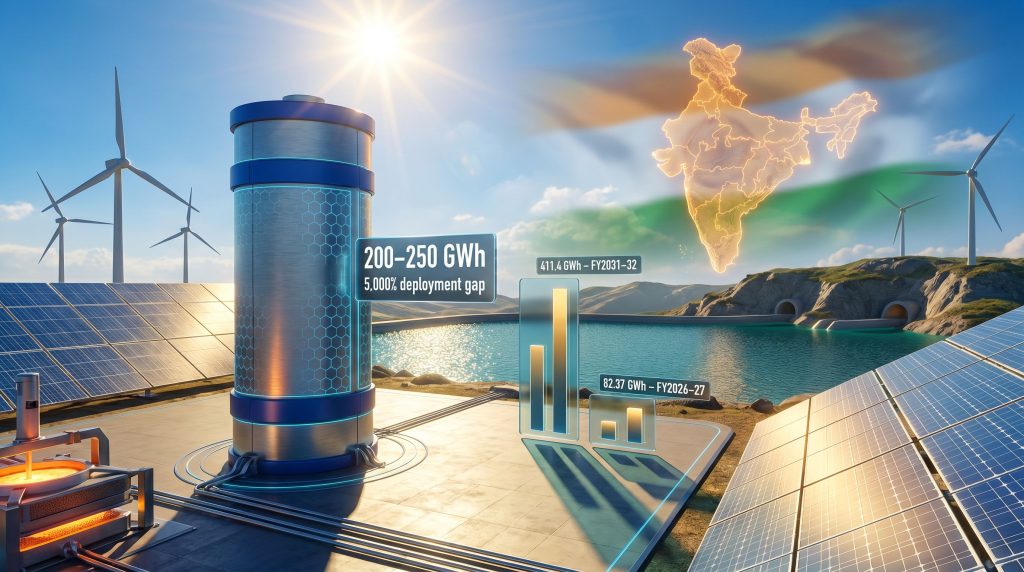
India's stated objective is to meet 4% of total electricity demand through grid-scale storage by 2030, translating to a requirement of 200 to 250 GWh of deployed capacity. As of May 2025, the reality is considerably more modest:
| Storage Metric | Figure (May 2025) |
|---|---|
| BESS capacity auctioned | ~12.8 GWh |
| BESS capacity operational | ~219 MWh |
| 2030 deployment target | 200-250 GWh |
| Implied deployment gap | >5,000% shortfall |
The gap between auctioned and operational capacity is itself revealing. Of the 12.8 GWh auctioned, only a fraction has been commissioned, pointing to execution bottlenecks in project development, financing, and equipment procurement that must be resolved before deployment can accelerate meaningfully.
What the National Electricity Plan Projects
India's Central Electricity Authority (CEA) has outlined storage requirements across planning horizons in the National Electricity Plan (NEP) 2023, presenting a phased buildout trajectory:
| Planning Horizon | Total Storage Required | Pumped Storage (PSP) | Battery Storage (BESS) |
|---|---|---|---|
| FY2026-27 | 82.37 GWh | 47.65 GWh | 34.72 GWh |
| FY2031-32 | 411.4 GWh | 175.18 GWh | 236.22 GWh |
| 2047 (long-range) | ~2,380 GWh | — | — |
These projections are driven by renewable capacity expansion targets. The CEA anticipates India's renewable installed base growing from approximately 350 GW by FY2026-27 to nearly 616 GW by FY2031-32, with wind and solar together contributing approximately 486 GW of that combined figure.
The Critical Distinction Between Power Capacity and Energy Duration
One of the most consequential and least-discussed dimensions of India's storage challenge is the difference between power capacity targets (measured in GW) and energy duration targets (measured in GWh). India requires at least 60 GW of grid energy storage capacity by 2030, including 42 GW or 208 GWh of battery systems.
A 2-hour lithium-ion battery system can satisfy a power capacity target without satisfying the energy duration requirement. This distinction matters enormously for grid planning because:
- Short-duration systems address evening peak demand windows of 2 to 4 hours
- Multi-day renewable generation gaps require storage systems capable of discharging over 12 to 100 hours
- Seasonal imbalances between renewable generation and demand can only be addressed by chemical storage vectors such as green hydrogen
Without duration-differentiated targets in policy frameworks, India risks building a storage portfolio that appears to meet GW objectives while remaining inadequate for the actual reliability requirements of a renewable-dominant grid.
What Long-Duration Energy Storage Actually Means for Grid Planning
Long-duration energy storage refers to technologies capable of discharging stored electricity over periods exceeding four hours, with some systems designed for multi-day or seasonal operation. This distinguishes LDES from the standard lithium-ion battery systems currently dominating grid-scale storage deployments, which are optimised for 2 to 4 hour discharge cycles.
The LDES technology landscape encompasses four distinct categories, each suited to different grid functions and timescales:
| Storage Duration | Technology Category | Primary Grid Application |
|---|---|---|
| 2-4 hours | Lithium-ion BESS | Evening peak demand shifting |
| 6-12 hours | Flow batteries, advanced BESS | Overnight renewable smoothing |
| 12-100 hours | Pumped hydro, liquid air energy storage | Multi-day balancing, ancillary services |
| Seasonal | Green hydrogen, ammonia | Long-range supply security |
The Four Technology Families and Their Indian Deployment Prospects
Electrochemical systems, particularly flow batteries using vanadium redox or iron-based chemistries, offer a key structural advantage over lithium-ion: energy capacity (how many hours the system can discharge) can be scaled independently of power capacity (how many megawatts it can deliver). This modularity makes flow batteries especially suited to industrial co-location applications where both power reliability and energy duration are critical. Flow batteries also offer cycle lives exceeding 10,000 cycles, substantially longer than the 4,000 to 6,000 cycles typical of lithium-ion systems.
Mechanical systems include pumped hydro storage (PSP), which remains the most established and cost-competitive LDES technology globally, and liquid air energy storage (LAES). LAES operates by cooling air to cryogenic temperatures, storing it as liquid, then re-expanding it to drive a turbine when electricity is needed. Its co-location compatibility with industrial gas infrastructure makes it particularly interesting for India's electricity-intensive manufacturing base.
Thermal systems, including molten salt storage, are most commonly paired with concentrated solar power (CSP) installations and provide a cost-effective means of extending solar generation into evening hours.
Chemical systems, most notably green hydrogen and ammonia, represent the only currently viable pathway for seasonal storage at scale, bridging periods of months-long renewable generation surplus or deficit.
A policy paper developed through the BEE-TERI Centre for Excellence for Energy Transition, supported by India's Ministry of Power and Bloomberg Philanthropies, specifically highlights flow batteries and LAES as priority candidates for pilot deployment in India, noting their potential to diversify the country's storage technology base and support round-the-clock renewable energy integration. Alekhya Dutta of The Energy and Resources Institute (TERI) has characterised LDES as the missing element in India's quest for continuous clean power delivery.
Until approximately 2027, 2-hour battery systems are projected to dominate India's deployed storage mix, primarily serving evening peak demand. This makes the current period the critical window for establishing LDES policy frameworks, financing structures, and technology pilots that will enable the transition to longer-duration systems in the early 2030s.
Why Aluminium and Other Electricity-Intensive Industries Face an Urgent Storage Problem
Among all industrial sectors exposed to India's evolving grid dynamics, aluminium smelting presents perhaps the most acute case study in power dependency.
The Hall-Héroult process, which converts alumina into primary aluminium through electrolytic reduction, has three characteristics that make it uniquely vulnerable to grid intermittency:
- It is a continuous process that cannot be interrupted without significant operational and financial consequences, including damage to pot cells and costly restart procedures
- It draws 70 to 90% of its total energy consumption in electrical form, making electricity cost the dominant variable in smelter economics
- It operates at industrial scale, meaning even short duration power interruptions or voltage fluctuations affect large capital assets simultaneously
Electricity typically represents 35 to 45% of total aluminium production cost. This means that energy cost volatility, which is directly amplified by a grid relying on variable renewables without storage buffers, compresses or expands smelter margins in ways that can determine the commercial viability of entire facilities.
How LDES Transforms the Industrial Energy Cost Structure
Shubhra Thakur, Director of Policy and Markets for the Asia-Pacific region at the LDES Council, has explained how long-duration energy storage in India's energy transition changes the economic calculus for electricity-intensive industries. The mechanism operates through four sequential steps:
- Excess renewable energy generated during off-peak periods, particularly midday solar surplus, is captured and stored rather than curtailed
- Stored energy is dispatched during high-demand or high-price periods, smoothing the effective electricity cost for industrial consumers over time
- A continuous, reliable power supply becomes technically achievable for processes that cannot tolerate interruption, removing the need for expensive thermal backup contracts
- Price arbitrage between low-cost renewable generation windows and peak tariff periods reduces the effective blended electricity cost for large industrial users
For aluminium smelters, this model is transformative. It converts the intermittency of solar and wind from a liability into an asset by enabling operators to source renewable electricity at marginal generation cost during surplus periods and store it for use during price peaks. The result is lower average electricity cost, reduced exposure to thermal fuel price volatility, and a credible pathway to green aluminium production credentials that are increasingly demanded by downstream customers in Europe and North America.
The combination of continuous power requirements, high electricity cost exposure, and growing green product premiums makes the aluminium sector one of the most compelling early adopters of long-duration energy storage in India's industrial base.
The Policy Architecture: Where India Stands and Where Gaps Remain
India has built a meaningful foundational policy framework for energy storage deployment, though several critical structural gaps remain unaddressed. In addition, the broader questions of critical minerals and energy security are closely intertwined with how effectively India can execute its storage ambitions.
Existing Policy Instruments
The current policy environment includes a range of measures designed to stimulate storage investment:
- Legal recognition of standalone Energy Storage System (ESS) projects as a distinct asset class, enabling independent project financing
- Energy Storage Obligations (ESOs) imposed on electricity distribution utilities, creating mandatory procurement demand
- Transmission charge waivers for qualifying storage projects, improving project-level economics
- Eligibility for standalone storage assets to participate in day-ahead power markets
- Viability Gap Funding (VGF) of Rs 37.6 billion, covering up to 40% of capital costs for qualifying BESS projects
- Renewable Purchase Obligations (RPOs) requiring utilities to source at least 43% of energy from renewables by 2030, structurally driving demand for storage as a reliability enabler
The Policy Gaps That Are Constraining LDES Deployment
Despite this framework, the LDES Council and TERI have identified structural deficiencies that are limiting investment and project development, particularly for long-duration systems. According to IEEFA's analysis of India's battery storage boom, getting execution right remains the central challenge:
- No duration-specific storage targets: Current policy frameworks measure storage requirements in GW and GWh without distinguishing between 2-hour and 12-hour or longer systems, creating no market incentive for developers to build LDES over short-duration alternatives
- Absence of bankable revenue mechanisms: LDES projects require long-tenor contracts to structure project financing, but no dedicated revenue certainty framework exists for systems operating beyond 4 hours
- Limited concessional capital access: The scale of investment required for LDES deployment exceeds what commercial financing alone can mobilise, and concessional finance pathways remain underdeveloped
- No LDES-specific procurement mandates: Unlike solar and wind generation, which benefit from dedicated auction frameworks, LDES has no equivalent procurement architecture
The distinction between capacity targets and duration targets is not a technical nuance. It is the difference between a grid that achieves 24-hour clean power delivery and one that remains structurally dependent on thermal generation for multi-hour reliability gaps, regardless of how much renewable capacity is installed.
The next major ASX story will hit our subscribers first
The Scale of India's Long-Term LDES Requirement
The full scale of India's long-duration energy storage challenge comes into focus only when viewed across multi-decade planning horizons. TERI research, developed through the BEE-TERI Centre for Excellence for Energy Transition with support from India's Ministry of Power and Bloomberg Philanthropies, projects that India will require approximately 2,023 GW of LDES capacity by 2070 as part of its comprehensive storage portfolio.
This figure contextualises the current 219 MWh operational base within a trajectory that requires expansion by several orders of magnitude over the coming four to five decades. It also underscores the importance of establishing robust policy and financing frameworks now, rather than waiting until the full scale of the storage requirement becomes operationally critical.
Renewable Expansion as the Demand Driver
The storage requirement is not a fixed target; it scales with renewable penetration. As India's installed renewable base expands toward the milestones outlined in the NEP, the volume of curtailed energy and frequency of grid instability events will grow non-linearly without corresponding LDES deployment. The surge in critical minerals demand driven by this expansion further compounds supply chain pressures across the storage technology spectrum:
| Renewable Capacity Milestone | Projected Timeline |
|---|---|
| ~177 GW (mid-2023 baseline) | Historical reference |
| ~350 GW | FY2026-27 |
| ~486 GW (wind and solar combined) | FY2031-32 |
| ~596-616 GW (total renewable) | FY2031-32 |
Each successive milestone increases both the opportunity cost of curtailed generation and the grid stability risk of inadequate flexibility resources, reinforcing the urgency of accelerating LDES deployment in parallel with renewable capacity addition.
Investment Signals and Private Sector Momentum
Private capital is beginning to engage with India's storage opportunity, though deployment remains early-stage relative to the scale of eventual market requirements.
Godawari Power and Ispat Limited has committed Rs 50 crore to its subsidiary for the establishment of a 20 GWh Battery Energy Storage System manufacturing plant in its first phase, representing one of the more significant early-stage BESS manufacturing investments by an Indian industrial conglomerate. This move signals confidence in long-term domestic storage demand, while also reflecting a strategic calculation that domestic manufacturing will capture a greater share of value than pure project development.
The LDES Council and the National Solar Energy Federation of India (NSEFI) formalised a Memorandum of Understanding in August 2025 to coordinate the deployment of renewable energy and storage technologies, adding institutional momentum to market development efforts.
The Cost Deflation Tailwind
One of the most compelling structural arguments for accelerating LDES investment is the trajectory of global storage costs. Over the past decade, global energy storage costs have fallen by approximately 90%, a deflation curve comparable to the cost reductions observed in solar photovoltaic panels between 2010 and 2020.
This creates a specific strategic window. Policy frameworks and procurement pipelines established during the current period of rapidly falling costs will lock in project economics at or near the bottom of the cost curve, delivering substantially better value than equivalent infrastructure committed at higher historical cost points. Furthermore, renewable energy in mining and other industrial sectors is similarly benefiting from this cost deflation dynamic, reinforcing the broader investment case.
The convergence of declining technology costs, VGF support covering up to 40% of capital expenditure, mandatory Energy Storage Obligations on distribution utilities, and India's 500 GW renewable target represents an unusual alignment of demand signals that structurally de-risks early-stage LDES investment relative to historical benchmarks. Investors should note that all investment decisions carry risk, and forward projections regarding cost trajectories, policy outcomes, and market demand are subject to change.
Frequently Asked Questions About Long-Duration Energy Storage in India
What is long-duration energy storage and how does it differ from standard grid batteries?
Long-duration energy storage describes technologies capable of storing and releasing electricity over periods exceeding four hours, with some systems designed for multi-day or seasonal operation. Standard lithium-ion battery systems currently deployed at grid scale are optimised for 2 to 4 hour discharge cycles, making them effective for shifting evening peak demand but insufficient for bridging extended periods of low renewable generation. LDES technologies, including flow batteries, pumped hydro, liquid air energy storage, and green hydrogen systems, are specifically engineered for these longer discharge requirements.
Why does long-duration energy storage matter specifically for India's aluminium sector?
Aluminium smelting consumes 70 to 90% of its total energy in electrical form through an electrolytic reduction process that requires continuous, uninterrupted power supply. Grid intermittency associated with variable renewable energy sources directly threatens smelter operational continuity and cost stability. LDES provides a reliable buffer between renewable generation variability and industrial load requirements, enabling smelters to source clean electricity at lower average cost while eliminating dependence on thermal backup contracts.
How far behind is India on its storage deployment targets?
As of May 2025, India had auctioned approximately 12.8 GWh of battery storage capacity, of which only around 219 MWh was operational. Against a 2030 target of 200 to 250 GWh, this represents a deployment shortfall exceeding 5,000%, indicating that the pace of commissioning must accelerate dramatically and consistently across every remaining year of this decade.
What government incentives currently support LDES development in India?
The current framework includes Viability Gap Funding of Rs 37.6 billion covering up to 40% of capital costs, transmission charge waivers, Energy Storage Obligations on distribution utilities, legal recognition of standalone storage projects, and day-ahead market participation eligibility. However, duration-specific procurement targets and bankable long-term revenue mechanisms specifically designed for LDES systems remain absent from the policy architecture.
What is India's long-term LDES capacity requirement?
Research conducted through the BEE-TERI Centre for Excellence for Energy Transition, supported by India's Ministry of Power and Bloomberg Philanthropies, projects that India will require approximately 2,023 GW of LDES capacity by 2070, a figure that illustrates both the multi-decade scale of the infrastructure challenge and the importance of beginning foundational investment and policy work now.
From Capacity Addition to Reliability Engineering: The Next Phase of India's Energy Transition
India's renewable energy programme has successfully navigated its first phase: installing generation capacity at scale. Wind, solar, and hydro now collectively exceed fossil fuel generation in terms of installed base, a milestone that would have seemed aspirational a decade ago.
The second phase is structurally more complex. It requires shifting the planning objective from megawatts installed to megawatt-hours reliably delivered, a distinction that demands entirely different infrastructure, policy instruments, and financing models. Consequently, mining electrification and decarbonisation trajectories will increasingly depend on how effectively India resolves this reliability challenge. Achieving this transition will require:
- Duration-differentiated storage procurement frameworks that create market incentives for LDES alongside short-duration battery systems
- Bankable, long-term revenue certainty mechanisms that allow LDES project developers to access project finance at commercially viable rates
- Integration of storage capacity planning into renewable energy zone development, ensuring storage co-location where generation surpluses are largest
- Development of a domestic LDES manufacturing ecosystem to reduce import dependency, improve supply chain resilience, and capture the industrial employment benefits of storage technology production
The costs of inaction are not hypothetical. Grid curtailment losses, thermal backup dependency costs, and competitiveness erosion in electricity-intensive industries are present-tense economic losses that compound annually as renewable penetration deepens without corresponding storage deployment. The RMI's research on catalysing energy storage in India underscores that the structural and financial barriers require coordinated intervention across government, industry, and capital markets to resolve at the necessary pace.
Long-duration energy storage in India's energy transition is not a supplementary feature of a future clean grid. It is the load-bearing infrastructure upon which the reliability, affordability, and industrial competitiveness of that grid fundamentally depends. The technologies exist, the cost trajectories are favourable, and the policy building blocks are in place. What remains is the acceleration of implementation at the pace the energy transition demands.
This article contains forward-looking statements, projections, and market analysis based on publicly available information and research as of the date of publication. Projections regarding storage costs, capacity targets, deployment timelines, and policy outcomes are subject to change. Nothing in this article constitutes financial or investment advice. Readers should conduct independent due diligence before making investment decisions.
Want to Stay Ahead of the Next Major Minerals Discovery Driving the Energy Transition?
Discovery Alert's proprietary Discovery IQ model delivers real-time alerts on significant ASX mineral discoveries — including the critical minerals and battery raw materials powering India's long-duration energy storage buildout — turning complex market data into actionable investment insights. Explore how historic discoveries have generated substantial returns on Discovery Alert's dedicated discoveries page, and begin your 14-day free trial today to position yourself ahead of the market.