May 20, 2026
Carbon-based crystalline structures have captured the attention of materials scientists for decades, with diamond representing the pinnacle of hardness across industrial applications. Recent developments in high-pressure synthesis techniques have unlocked new pathways for creating materials that challenge fundamental assumptions about atomic arrangements and mechanical properties. Advanced laboratory conditions now enable researchers to explore theoretical crystal structures that were previously confined to meteorite samples and academic speculation, with lonsdaleite synthetic diamond representing a breakthrough in materials engineering.
What Makes Lonsdaleite Synthetic Diamond Superior to Traditional Diamond?
The exceptional properties of lonsdaleite synthetic diamond stem from its unique hexagonal crystal lattice arrangement, which fundamentally alters how carbon atoms bond and distribute mechanical stress throughout the material structure. This atomic configuration represents a departure from the cubic lattice system found in conventional diamond, creating enhanced resistance to deformation and improved thermal stability.
Understanding the Hexagonal Crystal Advantage
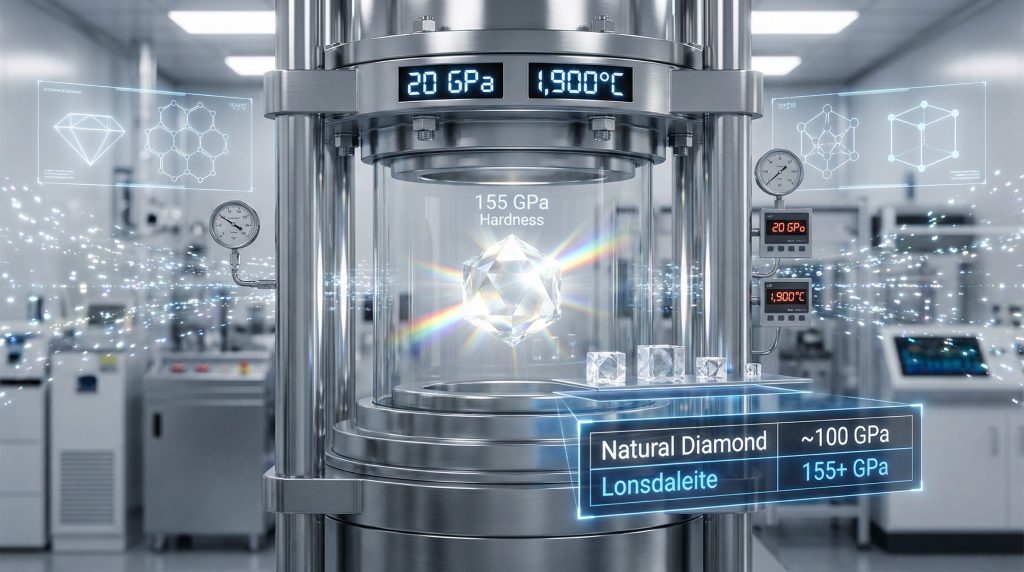
Researchers at Jilin University demonstrated that hexagonal diamond achieves 155+ GPa hardness, representing a remarkable 40-58% improvement over natural diamond's approximately 100 GPa rating. This enhancement results from the hexagonal lattice structure's superior ability to distribute mechanical forces across the crystalline matrix.
The hexagonal arrangement organises carbon atoms in a Wurtzite-type structure, where the same tetrahedral bonds present in cubic diamond follow a different sequential pattern. This subtle but crucial difference creates pathways for stress propagation that resist deformation more effectively than the conventional face-centered cubic arrangement.
Key structural differences include:
• Atomic spacing variations that enhance load distribution
• Modified bond angles that strengthen crystal stability
• Improved resistance to crack propagation under stress
• Enhanced thermal conductivity properties
Comparative Hardness Analysis
| Material | Hardness (GPa) | Crystal Structure | Formation Method |
|---|---|---|---|
| Natural Diamond | ~100 | Cubic | Geological processes |
| Lonsdaleite | 155+ | Hexagonal | High-pressure synthesis |
| Tungsten Carbide | 15-20 | Hexagonal | Industrial sintering |
| Silicon Carbide | 25-30 | Various | Chemical vapor deposition |
Thermal Stability Enhancements
Lonsdaleite synthetic diamond exhibits superior oxidation resistance at elevated temperatures compared to conventional diamond. This thermal stability advantage opens applications in high-temperature environments where traditional diamond begins to degrade through oxidative processes.
The hexagonal structure's enhanced thermal properties result from:
• Modified phonon transport characteristics
• Reduced thermal expansion coefficients
• Improved heat dissipation pathways
• Greater resistance to thermal shock
When big ASX news breaks, our subscribers know first
How Do Scientists Manufacture Lonsdaleite in Laboratory Settings?
The synthesis of lonsdaleite synthetic diamond requires extreme conditions that replicate the pressures found during planetary collisions. Scientists at Jilin University developed a controlled transformation process that converts graphite into hexagonal diamond using precisely calibrated pressure and temperature parameters.
High-Pressure High-Temperature (HPHT) Synthesis Protocol
The manufacturing process demands extraordinary laboratory conditions:
Pressure Requirements:
- 20 gigapascals (200,000 times atmospheric pressure)
- Sustained pressure maintenance for extended periods
- Specialised equipment for gigapascal-range generation
Temperature Parameters:
- 1,300-1,900°C operational range
- Precise thermal control systems
- Coordinated heating with pressure application
Processing Duration:
- 10-hour transformation cycles
- Gradual phase transition monitoring
- Real-time structural verification
Starting Material:
- Ultra-pure graphite single crystals
- Highly ordered carbon layer arrangement
- Minimal impurity contamination
Manufacturing Process Details
The transformation begins with carefully prepared graphite samples featuring well-aligned crystalline structures. Under the applied 20 GPa pressure and elevated temperatures, the graphite's layered carbon arrangement undergoes a phase transition where atomic bonds reorganise from the planar graphite configuration into the three-dimensional hexagonal diamond lattice.
This process differs fundamentally from conventional diamond synthesis, which typically produces cubic crystal structures. The specific pressure-temperature conditions favour hexagonal arrangement over the thermodynamically stable cubic form, requiring precise parameter control throughout the synthesis cycle.
Current Production Capabilities
Laboratory synthesis currently produces samples measuring approximately 1.5 millimetres across, representing a significant achievement given the historical limitation to microscopic meteorite samples. This scale enables:
• Direct mechanical property testing
• Comprehensive structural analysis
• Spectroscopic characterisation
• Industrial application evaluation
Quality Control and Verification
Researchers employ multiple analytical techniques to confirm hexagonal structure formation:
• Spectroscopic analysis for atomic arrangement verification
• Mechanical testing for hardness measurements
• Structural characterisation using advanced microscopy
• Contamination assessment to ensure phase purity
What Industrial Applications Could Benefit from Hexagonal Diamond Technology?
The superior mechanical and thermal properties of lonsdaleite synthetic diamond position this material for applications across industries that currently rely on conventional diamond's extreme characteristics. Furthermore, enhanced hardness and thermal stability could extend equipment life while enabling new technological capabilities, particularly as industry innovation trends emphasise advanced materials solutions.
Cutting and Drilling Tool Enhancement
Industrial Cutting Applications:
- Advanced abrasive coatings for extended tool life
- High-speed machining operations
- Precision manufacturing equipment
- Aerospace component fabrication
Oil and Gas Drilling Operations:
- Deep-well drilling in extreme conditions
- Enhanced drill bit performance
- Extended operational life in harsh environments
- Improved drilling efficiency
The oil and gas industry particularly stands to benefit from lonsdaleite's enhanced properties, as deep-well operations encounter extreme pressure and temperature conditions that challenge conventional diamond-coated tools.
Electronics and Thermal Management Systems
High-Performance Semiconductors:
- Superior heat dissipation properties
- Enhanced thermal interface materials
- Advanced power electronics applications
- High-temperature semiconductor designs
Thermal Management Applications:
- Heat spreaders for electronic components
- Thermal interface materials for processors
- Power electronics for renewable energy systems
- Automotive electrification components
The electronics industry faces increasing demands for materials capable of managing extreme heat generation in advanced semiconductor designs. Lonsdaleite's enhanced thermal properties and oxidation resistance could enable higher-performance, higher-temperature electronic systems.
Emerging Technology Integration
Aerospace and Defense:
- Components requiring exceptional durability
- High-stress mechanical applications
- Extreme environment operations
- Advanced coating systems
Medical Device Manufacturing:
- Precision surgical instruments
- Advanced cutting tools
- Biocompatible coating applications
- High-precision manufacturing equipment
Quantum Technology Applications:
- Specialised semiconductor applications
- Advanced materials research
- Precision measurement equipment
- Superconductor development research
Why Has Lonsdaleite Production Remained Theoretical Until Recently?
For more than six decades following its theoretical proposal in the early 1960s, lonsdaleite synthetic diamond remained beyond the reach of laboratory synthesis capabilities. The convergence of advanced pressure systems, improved materials science understanding, and enhanced analytical capabilities finally enabled controlled production, as noted by researchers at Washington University.
Historical Research Limitations
Natural Sample Constraints:
- Microscopic quantities in meteorite samples
- Contamination with other carbon phases
- Insufficient material for direct testing
- Mixed crystalline structures
Natural lonsdaleite samples discovered in meteorites provided tantalising evidence of the material's existence but remained inadequate for comprehensive property characterisation. These samples typically measured micrometers in scale and contained multiple carbon phases, preventing isolation of pure hexagonal diamond.
Technology Infrastructure Gaps:
• Limited pressure generation capabilities below 20 GPa requirements
• Inadequate temperature control systems for sustained high-heat conditions
• Insufficient analytical equipment for structural verification
• Lack of understanding regarding optimal synthesis pathways
Breakthrough Enabling Factors
Advanced Pressure Systems:
The development of equipment capable of reliably generating and maintaining 20 GPa pressures represents decades of high-pressure physics advancement. Modern laboratory systems can sustain these extreme conditions for the extended periods required for complete phase transformation.
Materials Science Progress:
Enhanced understanding of carbon phase diagrams and transition pathways provided roadmaps for identifying optimal pressure-temperature conditions. This theoretical foundation enabled researchers to target specific synthesis parameters rather than relying on trial-and-error approaches.
Analytical Capabilities:
Advanced characterisation methods including sophisticated spectroscopy, electron microscopy, and diffraction techniques allow precise identification and confirmation of hexagonal diamond formation in synthesised samples.
Thermodynamic Challenges
The synthesis process must overcome fundamental thermodynamic preferences:
• Cubic diamond stability under most pressure-temperature conditions
• Graphite transformation pathways requiring specific starting materials
• Phase competition between different carbon structures
• Kinetic barriers to hexagonal structure formation
How Does Lonsdaleite Formation Relate to Planetary Science?
The laboratory synthesis of lonsdaleite synthetic diamond provides unprecedented insights into planetary collision processes and early solar system formation. Natural lonsdaleite formation in meteorites offers mineralogical evidence of the extreme conditions present during celestial impact events.
Meteorite Impact Processes
Dwarf Planet Collision Dynamics:
Meteorites containing lonsdaleite originate from the interiors of shattered dwarf planets, where collision forces generated the extreme pressures necessary for hexagonal diamond formation. These impact events created transient pressure conditions exceeding 20 GPa across substantial volumes of planetary material.
Carbon Transformation Pathways:
During planetary collisions, existing graphite deposits within dwarf planet cores experienced rapid pressure and temperature increases. The shock wave propagation through these carbon-rich regions created conditions favourable for lonsdaleite formation over the cubic diamond typically produced in terrestrial high-pressure environments.
In addition, metamorphic transformation insights help explain how extreme pressure conditions during impact events can fundamentally alter mineral structures.
Research Applications in Astrogeology
Impact Crater Analysis:
Understanding lonsdaleite formation mechanisms enables more accurate interpretation of terrestrial impact crater characteristics. The presence or absence of hexagonal diamond in crater materials provides constraints on impact velocities and energy transfer during collision events.
Solar System Formation Insights:
• Early planetary accretion processes
• Collision frequency during system formation
• Pressure-temperature conditions in planetary cores
• Chemical evolution of carbon-bearing bodies
Planetary Interior Studies:
Laboratory lonsdaleite synthesis conditions help constrain the pressure and temperature regimes present within early solar system bodies. This information contributes to models of planetary differentiation and core formation processes.
Implications for Asteroid Research
The controlled production of lonsdaleite synthetic diamond enables calibration of analytical techniques used in asteroid and meteorite studies. Researchers can now compare synthetic samples with natural meteorite specimens to better understand the formation history of carbon-bearing celestial bodies.
Research Applications Include:
• Meteorite composition analysis
• Impact event reconstruction
• Planetary formation modeling
• Asteroid mining feasibility studies
What Are the Current Production Limitations and Future Scaling Prospects?
Despite the breakthrough achievement in laboratory synthesis, lonsdaleite synthetic diamond production faces significant challenges in transitioning from research-scale samples to industrial quantities. Current limitations span equipment requirements, cost considerations, and quality control protocols.
Manufacturing Scale Challenges
Sample Size Restrictions:
Current production capabilities yield samples measuring approximately 1.5 millimetres across, sufficient for research characterisation but inadequate for most industrial applications. Scaling to larger sample sizes requires:
• Enhanced pressure vessel designs
• Improved thermal management systems
• Extended processing time optimisation
• Quality uniformity across larger volumes
Equipment Requirements:
The specialised high-pressure equipment necessary for 20 GPa generation represents substantial capital investment. Industrial scaling would require:
• Multi-chamber production systems
• Automated processing controls
• Quality monitoring infrastructure
• Maintenance and safety protocols
Cost-Effectiveness Analysis
Production Economics:
| Factor | Laboratory Scale | Industrial Scale Projection |
|---|---|---|
| Equipment Cost | $500K-$1M | $5M-$15M |
| Energy Requirements | High | Very High |
| Production Rate | mg/cycle | kg/day potential |
| Quality Control | Manual | Automated required |
Market Viability Considerations:
Commercial success depends on demonstrating cost-performance advantages over conventional diamond in specific applications. Industries with extreme performance requirements may justify premium pricing for enhanced properties.
Quality Consistency Requirements
Structural Purity Challenges:
• Preventing cubic diamond contamination during synthesis
• Maintaining hexagonal structure uniformity
• Controlling impurity incorporation
• Ensuring reproducible mechanical properties
Process Optimisation Needs:
• Synthesis parameter standardisation
• Quality metrics development
• Batch-to-batch consistency protocols
• Scalable characterisation methods
Commercial Development Timeline
Near-term Developments (2-5 years):
- Process optimisation research
- Pilot-scale production evaluation
- Application-specific testing programmes
- Intellectual property development
Medium-term Prospects (5-10 years):
- Industrial prototype systems
- Niche market penetration
- Cost reduction initiatives
- Quality standardisation protocols
Long-term Potential (10+ years):
- Broad industrial adoption
- Competitive cost structures
- Diverse application markets
- Supply chain integration
The next major ASX story will hit our subscribers first
Investment Implications and Market Development
The emergence of lonsdaleite synthetic diamond synthesis capabilities presents both opportunities and uncertainties for materials technology investors. Market development will likely follow a progression from specialised niche applications to broader industrial adoption as production scales and costs improve, according to CSIRO research on diamond synthesis.
Technology Transfer Potential
Research Institution Partnerships:
Universities and research institutions developing lonsdaleite synthesis technologies represent potential licensing opportunities for industrial manufacturers. The specialised knowledge required for high-pressure synthesis creates barriers to entry that could protect early market participants.
Manufacturing Integration Strategies:
• Existing diamond tool manufacturers adapting production capabilities
• High-pressure equipment suppliers expanding into synthesis systems
• Materials companies developing application-specific formulations
• Technology licensing agreements between research and industry
Market Dynamics Considerations
Supply Chain Implications:
Lonsdaleite production requires specialised equipment and expertise, potentially concentrating initial manufacturing capabilities among a limited number of participants. This concentration could create supply security considerations for industries adopting the technology.
However, sustainable mining transformation initiatives may accelerate adoption as industries seek advanced materials solutions that reduce environmental impact.
Competitive Landscape Evolution:
Traditional diamond tool manufacturers may need to invest in new synthesis capabilities to remain competitive as lonsdaleite properties enable superior performance in critical applications.
Risk Factors for Consideration:
• Production scaling uncertainties
• Alternative materials competition
• Application development timelines
• Regulatory approval requirements
Industry Adoption Pathways
Early Adopter Applications:
Industries with extreme performance requirements and premium pricing tolerance will likely drive initial market development. Aerospace, defense, and specialised manufacturing sectors represent primary targets for early commercialisation efforts.
Market Penetration Strategy:
Successful commercialisation will require demonstrating clear performance advantages that justify cost premiums over conventional diamond solutions. This evidence base must be developed through extensive application testing and validation programmes.
Furthermore, as critical minerals energy trends continue to evolve, lonsdaleite synthetic diamond may play an increasingly important role in advanced energy applications requiring exceptional material properties.
Disclaimer: This analysis discusses emerging technology in early research stages. Investment decisions should consider the speculative nature of laboratory-scale developments and the uncertainties associated with commercial scaling timelines. Production capabilities, cost structures, and market adoption rates remain subject to significant technical and commercial risks.
Ready to Capitalise on Next-Generation Materials Breakthroughs?
Discovery Alert's proprietary Discovery IQ model identifies significant ASX mineral discoveries that could fuel advanced materials development, from critical minerals to innovative mining technologies. Stay ahead of emerging market opportunities by exploring major discovery outcomes and begin your 14-day free trial today to position yourself for the next materials revolution.