June 19, 2026
The Engineering Reality Behind Restarting a Dormant Uranium Processing Plant
Restarting a uranium mine is not like flipping a switch. When a sulphuric acid leach facility sits idle for more than a decade, every system that once operated at steady state must be rebuilt, recalibrated, and requalified from scratch. Reagent lines corrode. Instrumentation drifts out of calibration. Radiation protocols must be reinstated. And critically, the nuclear fuel supply chain demands formal product qualification before a single pound of uranium can change hands commercially.
This is the engineering environment that frames the Lotus Resources Kayelekera production ramp-up currently underway at one of Africa's most significant uranium operations. Understanding why this restart is technically challenging requires moving beyond headline production numbers and examining the interdependent systems that must all perform simultaneously before a mine reaches what the industry calls steady-state throughput.
When big ASX news breaks, our subscribers know first
What Makes Kayelekera Operationally Significant
Kayelekera sits in the Karonga District of northern Malawi, and its operational history provides a credibility foundation that few restart projects can match. Between 2009 and 2014, the mine produced approximately 11 million pounds of uranium, establishing it as a proven, commercially viable operation before low uranium prices forced it into care and maintenance.
Lotus Resources (ASX: LOT) holds an 85% interest in Kayelekera and a 100% stake in the Letlhakane Uranium Project in Botswana. Together, the two assets represent a combined mineral resource base approaching 165 million pounds of uranium, comprising roughly 46 million pounds at Kayelekera and approximately 114 million pounds at Letlhakane. This dual-asset structure positions Lotus as both a near-term producer and a company with a substantial development pipeline.
The strategic backdrop matters here. The broader uranium market dynamics shaping western utility procurement have tightened structurally in recent years, with demand for fuel by nuclear power plants outpacing the rate at which new and restarted production is entering the market. Furthermore, the ban on Russian uranium imports introduced by the US Senate has accelerated this structural tightening, pushing utilities to seek alternative supply sources. African uranium supply, particularly from politically stable jurisdictions with established operational track records, consequently occupies a meaningful position in this context.
Kayelekera was restarted in August 2025, on time and within budget, making it one of the few uranium operations globally to have successfully transitioned from extended care and maintenance back to active production within the current market cycle.
How the Kayelekera Processing Circuit Actually Functions
The Sulphuric Acid Leach Process: Step by Step
At its core, Kayelekera uses a conventional sulphuric acid agitated leach process to extract uranium from ore. The sequence runs as follows:
- Mined ore is transported from the open pit to a run-of-mine (ROM) stockpile adjacent to the processing facility.
- Ore is fed into the milling circuit and reduced to a target particle size to maximise mineral surface area for leaching.
- Ground ore enters the leach circuit, where sulphuric acid dissolves uranium from the host rock matrix in large agitated tanks.
- The resulting uranium-bearing solution, known as pregnant liquor solution, passes through solvent extraction and ion exchange circuits to concentrate and purify the uranium.
- Uranium is precipitated from solution, filtered, and dried to produce uranium oxide concentrate, the commercially traded product known as U₃O₈.
- The finished concentrate is packaged, sampled for quality assurance, and prepared for dispatch to a licensed uranium conversion facility.
Sulphuric acid is not merely a process reagent in this circuit — it is the operational lifeblood. The leach circuit requires acid in substantial volumes, consumed continuously throughout production. Any disruption to acid supply directly suppresses throughput, which is precisely what occurred during the earlier months of Kayelekera's ramp-up and which the company worked systematically to resolve during the March 2026 quarter.
Recovery Rate: The Number That Drives Output
Recovery rate measures the proportion of uranium in the ore feed that is successfully extracted during processing. Kayelekera recorded a recovery rate of 82.1% during its ramp-up phase. While this figure represents solid performance for an operation in early-stage restart, experienced uranium metallurgists understand that incremental improvements to reagent dosing protocols, leach retention time, and temperature management can push recovery progressively closer to the steady-state benchmark achievable at this type of operation.
The relationship between ore grade, tonnage throughput, and recovery rate is multiplicative. Small improvements across all three variables compound into meaningfully higher pound output at the production level.
Production Metrics: What the March 2026 Quarter Data Reveals
The March 2026 quarterly results document the most significant operational step-change since the restart commenced:
| Metric | December 2025 Quarter | March 2026 Quarter | Change |
|---|---|---|---|
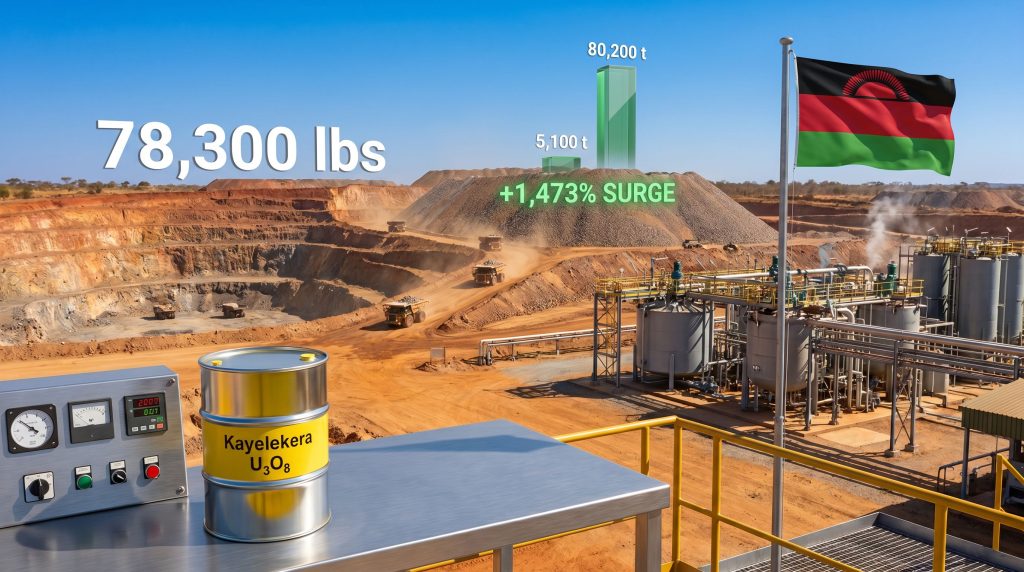
| Ore Mined (tonnes) | 5,100 | 80,200 | +1,473% |
| Ore Milled (tonnes) | ~85,600* | 119,800 | +40% |
| Uranium Produced (lbs) | Not disclosed | 78,300 | N/A |
| Total Material Movement (tonnes) | Not disclosed | 537,000 | N/A |
| ROM Stockpile at Quarter End | Not disclosed | >200,000 tonnes | N/A |
| Active Mining Fronts | 1-2 | 3 | Expanded |
Estimated from contextual data for comparison purposes
The expansion from 5,100 tonnes of ore mined in December 2025 to 80,200 tonnes in March 2026 — a greater than fourteen-fold increase — signals that mining operations have achieved genuine operational momentum. This is not incremental progress. It reflects the systematic commissioning of additional mining fronts and the build-up of a meaningful ore inventory that now insulates the processing plant from short-term mining rate variability.
What 78,300 Pounds Means Against the Annual Target
All 1,000,000 pounds of Lotus Resources' contracted uranium deliveries for calendar year 2026 are scheduled for the second half of the year. Kayelekera's Q1 production of 78,300 pounds contributes to inventory build ahead of these deliveries rather than fulfilling contracted volumes directly. The company's steady-state annual production target sits at approximately 2.4 million pounds, meaning the current run rate still has considerable distance to cover before nameplate capacity is consistently achieved.
The ROM stockpile exceeding 200,000 tonnes at quarter end represents more than two months of plant throughput at current milling rates. This buffer is strategically important because it allows processing operations to maintain continuity even if mining encounters short-term disruptions during the transition to fresh ore feed.
Operational Disruptions in Q1 2026 and the Engineering Response
Sulphuric Acid Supply: The Logistics Vulnerability Exposed
Sourcing sulphuric acid in a landlocked country via long-haul road transport through Zambia creates an inherent supply chain fragility that became a production constraint during the early ramp-up phase. These uranium supply challenges are not unique to Kayelekera — however, Lotus responded by broadening its supplier base to include South African sources, reducing single-corridor dependency and diversifying the logistics network. By quarter end, on-site acid inventory had been restored to near storage capacity.
The longer-term solution is more structurally significant. Kayelekera operates an on-site acid plant capable of producing sulphuric acid directly from elemental sulphur. When this facility is fully commissioned, it will substantially reduce both the volume of acid requiring road transport and the associated logistics cost, improving supply security and the operation's overall cost profile simultaneously. The rebuild of this plant was completed during the quarter, with hot commissioning scheduled for the June 2026 quarter.
Instrumentation Replacement and Data Integrity
Scheduled replacement of leach circuit instrumentation during March 2026 caused a temporary throughput interruption. More notably, this process led the company to identify discrepancies in previously reported mined grade and recovery data, which were subsequently retracted. A formal remediation plan was implemented. Critically, uranium production volumes and ore milled figures were confirmed as unaffected and remained consistent with prior disclosures.
This episode illustrates a principle that experienced mining engineers understand well: the accuracy of process measurement systems is not a secondary concern in uranium operations. Grade control data and recovery metrics feed directly into production forecasting, offtake planning, and regulatory reporting. Investing in robust instrumentation is not optional overhead — it is a foundational operational requirement. The company's transparent handling of the discrepancy, and its formal remediation response, reflects appropriate disclosure practice.
Interruptions to plant throughput extended into April 2026, with management indicating that improved output is expected in May and June as conditions stabilise ahead of the targeted June 2026 quarter inflection point.
Leadership and Technical Capability: Who Is Now Running Kayelekera
One of the most consequential changes during the March 2026 quarter was the strengthening of site leadership with two experienced appointments:
| Role | Individual | Experience Profile |
|---|---|---|
| General Manager | Gustav Du Toit | 30 years across African mine operations; most recently General Manager of Barrick's Central and East African operations |
| Processing Manager | Sarel Malan | 25+ years in mining; 15 years specialised in uranium processing at Paladin and CGN Uranium, spanning pre- and post-commissioning through to steady-state production |
The combined 55+ years of experience these two individuals bring is particularly relevant because uranium processing expertise is genuinely scarce globally. Unlike gold or base metals processing, uranium operations require technical personnel who understand radiation management protocols, reagent behaviour in acid leach circuits, and the stringent product quality requirements imposed by conversion facilities. Sarel Malan's background specifically at Paladin, an operator with significant African uranium production experience, means his knowledge base maps directly to the operational environment at Kayelekera.
Beyond site leadership, Lotus invested in several supporting capability improvements during the quarter:
- Upgrades to processing plant instrumentation and process control systems.
- Expansion of critical spare parts inventory to reduce maintenance-related downtime risk.
- Award of a specialist third-party contract for on-site laboratory management, including investment in equipment and personnel training.
- Growth in engineering and metallurgical team capacity alongside the mining expansion.
The on-site laboratory serves a critical function often underappreciated by those outside the industry. Every decision about reagent dosing, circuit adjustment, and ore blending is informed by real-time analytical data from this facility. Outsourcing its management to a specialist operator improves data reliability and creates operational independence between production management and analytical verification.
The next major ASX story will hit our subscribers first
Product Acceptance: Why the Orano CE Milestone Is Commercially Decisive
How Uranium Moves From Mine to Reactor
Uranium concentrate cannot flow directly from a mine to a nuclear power plant. The nuclear fuel supply chain requires the following sequence:
U₃O₈ Concentrate → Conversion Facility (UF₆) → Enrichment Plant → Fuel Fabrication → Nuclear Reactor
Conversion facilities are licensed, regulated, technically specialised, and very few in number globally. Each facility maintains its own product qualification standards and must formally accept uranium from any new production source before it will process that material. This creates a gatekeeping function that junior and emerging uranium producers must navigate before their product enters the commercial supply chain.
The Three Western Conversion Facilities
| Facility | Operator | Location | Lotus Accreditation Status |
|---|---|---|---|
| Orano Chimie-Enrichissement | Orano | France | Formally accepted (Q1 2026) |
| ConverDyn | ConverDyn | United States | In progress |
| Cameco Port Hope | Cameco | Canada | In progress |
Formal acceptance by Orano CE during the March 2026 quarter is commercially significant for a reason that goes beyond simple delivery logistics. When a uranium producer holds an account at one western conversion facility, it gains the ability to swap or exchange product between converters. This means that Orano CE acceptance, in effect, provides delivery flexibility across all of Lotus's contracted sales, not just those specifically directed to France. The practical implication is that contracted delivery commitments can be fulfilled even before the Canadian and American accreditations are completed.
First Shipment Logistics
Kayelekera's planned export route runs from the mine site through Zambia and then to the Port of Walvis Bay in Namibia. This routing requires export and transit permits across three jurisdictions: Malawi, Zambia, and Namibia. First shipment timing remains subject to the completion of these permitting processes. Walvis Bay is the preferred export option for southern African uranium producers due to its established bulk mineral handling infrastructure and its positioning on the South Atlantic shipping corridor.
Capital Projects and Balance Sheet: The Infrastructure Behind the Ramp-Up
Infrastructure Investments Underway
Two capital projects beyond the core restart programme deserve particular attention for their long-term operational significance:
Grid Power Connection: Current power supply at Kayelekera relies substantially on diesel generation, which carries meaningful cost implications at the scale required for continuous processing plant operation. Grid connection works progressed materially during Q1 2026, with initial component shipments arriving on site and substation construction commencing at both the Karonga and Kayelekera locations. Global shipping disruptions are being monitored as a potential risk to component delivery timelines. When completed, the grid connection will reduce operating costs and improve power supply reliability.
Tailings Storage Facility (TSF) Expansion: The TSF is an engineered containment structure that safely manages processed mine residues in accordance with environmental and regulatory requirements. The north wall raise is on track for completion before additional storage capacity is operationally required, maintaining regulatory compliance margins. TSF capacity planning must stay ahead of cumulative production volumes for both environmental and licensing reasons.
Total capital expenditure across the restart programme, powerline, TSF, and sustaining items during the March 2026 quarter was US$11.9 million.
Financial Position: A$85 Million Cash at Quarter End
| Financial Metric | Value |
|---|---|
| Cash Balance (unaudited, Q1 2026 end) | A$85 million |
| Prior Quarter Cash (Dec 2025) | A$56.2 million |
| Equity Placement Completed | A$76 million |
| Share Purchase Plan | A$3 million |
| Q1 2026 Capital Expenditure | US$11.9 million |
The A$28.8 million net increase in cash during the quarter reflects the A$76 million equity placement and A$3 million Share Purchase Plan, offset by Q1 capital deployment. The equity raise was structured to avoid significant debt dependency through the product qualification phase, ramp-up period, and first delivery milestone. Inventory financing discussions are described as being at an advanced stage, designed to align with first shipment timing.
Contracted vs. Uncontracted Production Strategy
The company's sales structure reflects a deliberate balance between cash flow certainty and exposure to uranium price appreciation:
- 35% of production volumes contracted through 2029, providing revenue visibility and underpinning operational cost coverage.
- 65% of production volumes uncontracted, preserving substantial exposure to uranium spot and term price movements.
- All 1,000,000 pounds of 2026 contracted commitments are scheduled for delivery in the second half of calendar year 2026.
This 35/65 split is not a sign of difficulty in securing offtake. In a uranium market where supply constraints are structural and utility demand continues to grow, retaining 65% of production as uncontracted inventory represents a calculated positioning strategy to capture upside from price appreciation rather than locking away future revenue at current contract terms.
The divergence between spot and term uranium prices has made this kind of portfolio structure increasingly attractive for producers who can afford to wait, and Lotus's A$85 million cash position provides the runway to do exactly that.
The Path to Steady State and What Comes Next
June 2026 Quarter: The Inflection Point
Management has indicated that the June 2026 quarter is expected to be the period during which operations trend toward steady-state throughput. Several converging developments support this expectation:
- Acid plant hot commissioning, reducing external reagent supply dependency.
- Transition to predominantly fresh ore feed, shifting away from legacy stockpile material.
- Grade and recovery optimisation continuing to improve pound output per tonne processed.
- Plant utilisation stabilising above the 80% benchmark achieved during the second half of February 2026.
The transition from stockpile to fresh ore feed is technically notable. Stockpile ore, which may have been surface-exposed for years, can behave differently in the leach circuit compared to freshly mined material. Moisture content, oxidation state, and particle characteristics all influence reagent consumption and dissolution kinetics. Kayelekera's metallurgical team will need to manage these variables carefully as the feed blend transitions during Q2 2026.
Furthermore, Kayelekera comeback production has demonstrated that the operational groundwork laid during the restart phase is now translating into measurable output gains, a trend that is expected to accelerate through the second half of 2026 as leadership, infrastructure, and reagent supply all converge at scale.
According to Mining Weekly, Lotus confirmed it is well covered on both diesel and reagents as production continues to ramp up, a reassurance that addresses two of the most operationally sensitive input variables for a remote, landlocked uranium processing facility.
Letlhakane: The Second Growth Pillar
| Milestone | Target Timing |
|---|---|
| Phase 2 Infill Drilling Completion | Later in 2026 |
| Updated Mineral Resource Estimate | Following Phase 2 drilling |
| Preliminary Feasibility Study | First half of 2027 |
Letlhakane's 114 million pound resource base represents a potential second major production platform. The Preliminary Feasibility Study targeted for H1 2027 implies a multi-year development horizon, meaning Kayelekera will remain the sole production asset for the foreseeable future. The drilling programme currently underway is designed to improve resource definition and support the technical and economic analysis required for a development decision.
In addition, investors tracking the Lotus Resources Kayelekera production ramp-up should note that the uranium market dynamics underpinning the company's uncontracted sales strategy are evolving rapidly. With Letlhakane potentially adding over 114 million pounds to the production pipeline in the coming years, Lotus's overall strategic positioning in the uranium supply landscape may look considerably different by the end of the decade.
This article contains forward-looking statements based on management guidance and quarterly reports filed by Lotus Resources Limited (ASX: LOT). Production targets, financial projections, and development timelines are subject to operational, regulatory, and market risks. This content does not constitute financial or investment advice. Readers should conduct their own due diligence and seek independent professional advice before making any investment decisions.
Want to Stay Ahead of the Next Major ASX Mineral Discovery?
Discovery Alert's proprietary Discovery IQ model delivers real-time alerts on significant ASX mineral discoveries, transforming complex data across more than 30 commodities into clear, actionable insights for both short-term traders and long-term investors — explore Discovery Alert's discoveries page to understand how historic discoveries have generated substantial returns, and begin your 14-day free trial today to position yourself ahead of the broader market.