June 27, 2026
The development of low-carbon ammonia bunkering represents a pivotal transformation in maritime fuel systems, addressing both environmental imperatives and operational requirements across global shipping networks. Traditional marine fuels have dominated ocean transport for over a century, but mounting regulatory pressure and environmental imperatives are driving unprecedented innovation in alternative fuel technologies. Among emerging solutions, low-carbon ammonia bunkering has emerged as a critical pathway for achieving zero-emission maritime operations, combining proven chemical properties with scalable production capabilities.
Understanding Low-Carbon Ammonia as a Marine Fuel Solution
Defining Low-Carbon Ammonia as a Marine Fuel Solution
Low-carbon ammonia bunkering refers to the supply chain infrastructure and operational protocols required to deliver ammonia fuel to vessels equipped with dual-fuel engine systems capable of combusting ammonia for propulsion. Unlike conventional marine fuels derived from petroleum products, ammonia produces zero carbon emissions at the point of combustion, making it an attractive alternative for shipowners seeking to comply with International Maritime Organization emissions reduction targets.
The fundamental distinction between low-carbon ammonia and traditional marine gas oil lies in the production methodology rather than the combustion process itself. While marine gas oil generates approximately 3.2 tonnes of CO2 per tonne of fuel consumed, ammonia's carbon intensity depends entirely on its production pathway. This creates a critical classification system where green ammonia (produced via renewable-powered electrolysis) achieves near-zero lifecycle emissions, while blue ammonia (produced from natural gas with carbon capture) reduces emissions by 85-95% compared to conventional fuels.
Recent industry developments demonstrate accelerating commitment to low-carbon ammonia bunkering infrastructure. The collaboration formalised between major fertilizer producer CF Industries, global trading firm Trafigura, and marine fuel supplier TFG Marine through a memorandum of understanding represents the most significant institutional commitment to ammonia marine fuel supply chains. This agreement specifically targets the US Gulf Coast and northwest Europe, two regions with established ammonia production capacity and strategic positioning within global shipping networks.
The Maritime Industry's Decarbonisation Imperative
Maritime transport accounts for approximately 3% of global greenhouse gas emissions, handling over 90% of international trade by volume. The International Maritime Organization's strategy to achieve net-zero emissions by 2050 creates regulatory pressure that extends beyond voluntary commitments to mandatory compliance frameworks. These targets necessitate alternative fuel adoption across approximately 60,000 commercial vessels operating in international waters.
Furthermore, current regulatory frameworks include the Energy Efficiency Existing Ship Index (EEXI) and Carbon Intensity Indicator (CII) ratings, which establish baseline performance requirements for existing fleets. However, achieving IMO 2050 net-zero targets requires fuel solutions that eliminate carbon emissions entirely rather than incrementally improving efficiency metrics. This regulatory environment creates market demand for zero-emission fuels like low-carbon ammonia bunkering, particularly for long-haul shipping routes where battery technology remains impractical due to weight and energy density constraints.
In addition, the economic implications extend beyond compliance costs to include potential carbon pricing mechanisms, fuel availability guarantees, and insurance considerations for vessels operating alternative fuel systems. Early adopters of ammonia fuel technology position themselves to capture regulatory advantages while spreading development costs across longer operational timelines.
How Ammonia Bunkering Differs from Traditional Marine Fuel Supply
Traditional marine fuel bunkering involves transferring liquid hydrocarbon fuels at ambient temperature through established pipeline networks connecting shore-based storage facilities to vessel fuel tanks. This process relies on decades of standardised equipment, safety protocols, and crew training programmes optimised for petroleum-based products with well-understood combustion characteristics and environmental hazard profiles.
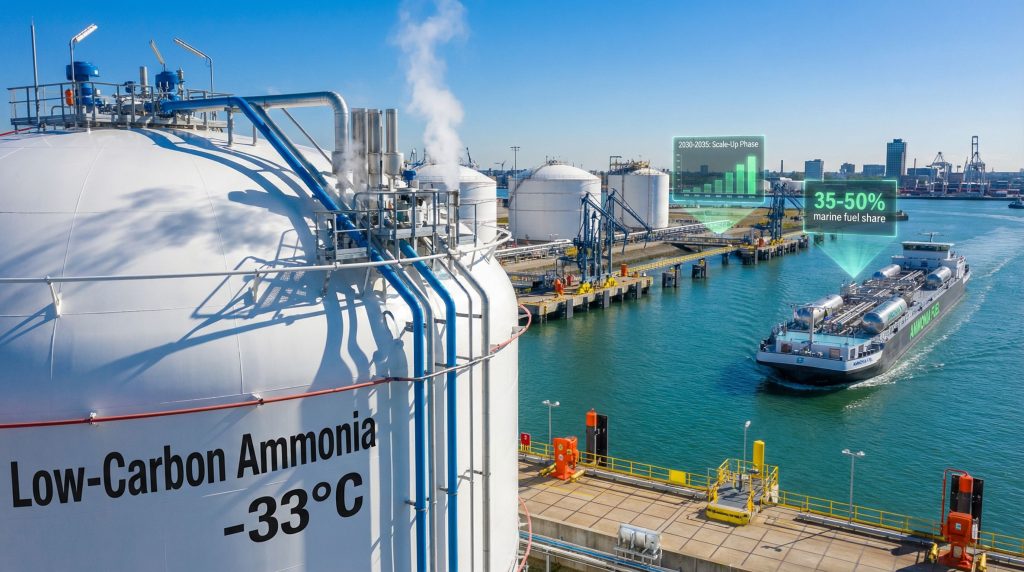
Ammonia bunkering requires fundamentally different infrastructure specifications due to ammonia's cryogenic storage requirements at -33°C and its toxic properties that demand specialised safety protocols. Transfer operations must incorporate vapour recovery systems to prevent atmospheric releases, continuous leak detection monitoring throughout bunkering zones, and emergency response capabilities specifically designed for ammonia exposure incidents rather than hydrocarbon spills.
The logistics complexity extends to vessel scheduling and port operations planning. Ammonia's lower energy density of 12.7 MJ/L compared to marine gas oil's 35.9 MJ/L means vessels require more frequent bunkering stops or larger fuel storage capacity, directly impacting cargo space allocation and route optimisation strategies. This energy density differential creates operational trade-offs that shipping companies must evaluate alongside fuel cost premiums and infrastructure availability.
When big ASX news breaks, our subscribers know first
Low-Carbon Ammonia Production Pathways for Marine Applications
Green vs. Blue Ammonia Production Pathways
Green ammonia production utilises renewable electricity to power electrolysis systems that split water molecules into hydrogen and oxygen, subsequently combining the hydrogen with nitrogen through the Haber-Bosch synthesis process. This pathway achieves near-zero carbon intensity when powered by wind, solar, or hydroelectric sources with minimal embedded carbon footprints. However, green ammonia production faces scalability constraints due to renewable energy availability and electrolyser manufacturing capacity limitations.
Blue ammonia production leverages existing natural gas infrastructure and industrial ammonia facilities whilst incorporating carbon capture and storage (CCS) technology to reduce emissions. CF Industries' planned Louisiana facility demonstrates this approach, designed to capture up to 95% of CO2 emissions from a 1.4 million tonnes per year ammonia production facility scheduled for 2030 operation. This specification substantially exceeds typical carbon capture rates in industrial applications, reducing carbon intensity from approximately 1.5-2.0 tonnes CO2 per tonne of ammonia to 0.075-0.15 tonnes CO2 per tonne of ammonia.
The production pathway selection carries implications beyond carbon intensity metrics. Moreover, green ammonia requires dedicated renewable energy allocation that competes with grid decarbonisation priorities, while blue ammonia depends on geological carbon storage verification and regulatory acceptance of CCS permanence guarantees. Economic considerations include renewable energy procurement costs, carbon capture infrastructure amortisation, and regulatory incentive monetisation through tax credits and carbon offset markets, aligning with broader decarbonisation benefits across industrial sectors.
Carbon Intensity Metrics and Certification Standards
Carbon intensity measurement in ammonia production encompasses lifecycle assessment methodologies that account for energy inputs, process emissions, and upstream supply chain impacts. Traditional grey ammonia production generates 1.5 to 2.0 tonnes of CO2 per tonne of ammonia, establishing the baseline against which low-carbon alternatives are measured. Blue ammonia with 95% carbon capture achieves approximately 0.075 to 0.15 tonnes CO2 per tonne of ammonia, whilst green ammonia powered by renewable electricity approaches near-zero emissions.
Certification frameworks remain under development by regulatory bodies and industry organisations seeking to establish transparent benchmarking standards. The verification process must address production methodology documentation, energy source verification, carbon capture permanence validation, and supply chain traceability requirements. Current industry practices include third-party verification agencies that audit production facilities and issue certificates enabling low-carbon claims for commercial transactions.
CF Industries' strategy of monetising greenhouse gas abatement efforts through tax credits and carbon credits demonstrates how production economics increasingly factor regulatory incentive mechanisms beyond commodity price differentials. This approach suggests future low-carbon ammonia bunkering cost structures will reflect carbon pricing mechanisms, creating complex interdependencies with shipping carbon markets, carbon credit valuations, and tax policy frameworks.
Integration with Renewable Energy Infrastructure
Low-carbon ammonia production requires substantial renewable energy capacity allocation, creating competition with grid decarbonisation initiatives and industrial electrification programmes. Green ammonia facilities typically require 28-35 MWh of renewable electricity per tonne of ammonia produced, necessitating dedicated renewable energy projects or long-term power purchase agreements with wind and solar developers.
The geographic distribution of optimal renewable resources influences ammonia production location decisions and subsequent transportation logistics to bunkering hubs. Coastal regions with excellent wind resources and proximity to shipping routes offer advantages for integrated production and bunkering facilities, while inland renewable resources may require additional transportation infrastructure to reach marine fuel terminals.
Furthermore, blue ammonia production integration focuses on carbon capture infrastructure rather than renewable energy procurement. Facilities must develop geological storage agreements, CO2 transportation systems, and monitoring frameworks to ensure permanent carbon sequestration. The economic viability depends on carbon credit pricing, regulatory permanence requirements, and geological storage capacity availability in proximity to production facilities, reflecting broader challenges facing the Canada energy transition.
Technical Infrastructure Requirements for Ammonia Bunkering
Storage and Handling System Specifications
Ammonia bunkering infrastructure demands cryogenic storage systems capable of maintaining -33°C temperatures whilst managing boil-off gas recovery and pressure relief operations. Shore-based terminals require insulated tank systems with specialised materials compatible with liquid ammonia's corrosive properties under cryogenic conditions. These systems must incorporate continuous circulation pumps, automated temperature monitoring, and vapour recovery equipment to minimise atmospheric emissions during storage periods.
| Parameter | Marine Gas Oil | Low-Carbon Ammonia |
|---|---|---|
| Storage Temperature | Ambient | -33°C |
| Energy Density (MJ/L) | 35.9 | 12.7 |
| Carbon Emissions | High | Zero (at point of use) |
| Toxicity Level | Low | High (requires specialised handling) |
Transfer system specifications include cryogenic-rated piping with thermal expansion joints, automated flow control valves, and emergency shutdown systems activated by leak detection sensors. Port terminals must install vapour recovery networks capable of capturing ammonia gas releases during transfer operations and either re-liquefying recovered vapour or routing it to industrial users. The infrastructure investment extends beyond terminal equipment to include specialised loading arms, hose connections rated for cryogenic service, and vessel mooring systems designed for extended bunkering operations.
Vessel-side modifications require installation of cryogenic fuel tanks integrated with dual-fuel engine systems capable of combusting both ammonia and conventional backup fuels. Tank insulation systems must maintain cryogenic temperatures during extended voyages whilst incorporating pressure relief systems that safely vent boil-off gas overboard when necessary. Engine room ventilation systems require enhancement to prevent ammonia accumulation in enclosed spaces, with continuous gas detection monitoring throughout fuel storage and distribution areas.
Safety Protocols and Risk Management Frameworks
Ammonia's toxicity profile creates fundamentally different safety requirements compared to conventional marine fuel handling. Ammonia gas is heavier than air and can accumulate in low-lying spaces, creating exposure hazards that require continuous atmospheric monitoring in engine rooms, pump rooms, and fuel storage compartments. Emergency response protocols must address ammonia exposure treatment, including immediate medical intervention procedures and evacuation protocols for affected personnel.
Fire suppression systems require specific rating for liquid cryogenic ammonia fires, which behave differently than hydrocarbon fuel fires. Water spray systems designed for ammonia incidents focus on vapour suppression and cooling rather than combustion suppression, requiring specialised nozzle configurations and pressure specifications. Port emergency response planning must coordinate with local fire departments and medical facilities to ensure appropriate treatment capabilities for ammonia exposure incidents.
Personal protective equipment specifications include self-contained breathing apparatus rated for ammonia environments, chemical-resistant clothing systems, and emergency eyewash stations positioned throughout bunkering areas. Crew training requirements extend beyond standard marine fuel handling to include ammonia-specific hazard recognition, exposure prevention protocols, and emergency response procedures. These safety investments represent significant operational cost increases but are essential for regulatory approval and insurance coverage.
Port Infrastructure Adaptation Requirements
Existing port infrastructure adaptation involves significant capital expenditure for cryogenic handling capabilities, with costs varying substantially between new terminal construction and existing facility retrofitting. Ports with established LNG bunkering infrastructure possess some cryogenic expertise but require ammonia-specific equipment modifications due to different temperature requirements and toxicity considerations.
| System Component | Modification Type | Cost Impact |
|---|---|---|
| Fuel Storage | Cryogenic tanks required | High |
| Engine Systems | Dual-fuel conversion | Medium-High |
| Safety Equipment | Enhanced ventilation/detection | Medium |
| Crew Training | Specialised certification | Low-Medium |
Environmental permitting processes require comprehensive risk assessments addressing atmospheric emissions, groundwater protection, and emergency response capabilities. Regulatory authorities evaluate ammonia handling protocols, leak detection systems, and community safety measures before approving bunkering operations. This approval process can extend project timelines by 12-18 months beyond typical marine fuel terminal development schedules.
Integration with existing port vessel traffic management systems requires coordination protocols for low-carbon ammonia bunkering operations, including dedicated berthing areas, specialised tugboat assistance, and extended transfer timeframes. Port authorities must develop ammonia-specific operational procedures that address weather restrictions, emergency evacuation procedures, and coordination with other port activities during bunkering operations.
Global Port Leadership in Ammonia Bunkering Development
Port of Rotterdam's Pioneering Infrastructure Programmes
The Port of Rotterdam currently operates at Port Readiness Level 6 within the seven-stage PRL assessment system, positioning it as the most advanced European port for ammonia bunkering capability. This achievement reflects systematic infrastructure development including pilot bunkering programmes designed to validate safety protocols before commercial deployment. Rotterdam's approach demonstrates the multi-year development pathway required for ammonia bunkering readiness, with commercial operations targeted for 2030-2033.
Rotterdam's progression leverages the Netherlands' established ammonia handling expertise from industrial and fertiliser sectors, combined with its position as Europe's largest port and strategic location within major shipping routes. The port's existing LNG bunkering infrastructure provides foundational cryogenic handling capabilities that can be adapted for ammonia applications, though significant modifications remain necessary for ammonia-specific requirements.
The Port Readiness Level (PRL) system evaluates ammonia bunkering capability across seven stages, from initial concept (PRL 1) to full commercial deployment (PRL 7). Rotterdam currently operates at PRL 6, with commercial readiness expected by 2030-2033.
Investment commitments from Rotterdam port authority include dedicated ammonia storage terminals, specialised transfer equipment, and enhanced safety systems designed for toxic gas handling. The port's development strategy emphasises coordination with existing industrial users of ammonia, enabling shared infrastructure utilisation and economies of scale across fertiliser, chemical, and marine fuel applications.
Strategic Regional Hub Development
The CF Industries, Trafigura, and TFG Marine collaboration specifically targets the US Gulf Coast and northwest Europe as initial deployment regions, reflecting strategic positioning within existing ammonia production and global shipping networks. This geographic focus demonstrates industry recognition that low-carbon ammonia bunkering development will concentrate in established ammonia-handling regions before expanding to other maritime hubs.
US Gulf Coast advantages include proximity to CF Industries' Donaldsonville plant in Louisiana, currently the largest ammonia and nitrogen production facility globally. This existing infrastructure provides production capacity that can be redirected toward marine fuel applications without requiring entirely new manufacturing facilities. The region's established ammonia export infrastructure for fertiliser markets offers logistics networks that can be adapted for marine fuel distribution.
Northwest European ports benefit from established ammonia import infrastructure serving industrial and agricultural markets, creating existing handling expertise and storage capacity. The region's regulatory alignment with European Union maritime decarbonisation policies provides policy support for alternative fuel infrastructure investment, whilst established shipping routes connecting to major global trade lanes offer immediate market opportunities for ammonia-fuelled vessels.
Strategic Partnership Models for Infrastructure Development
TFG Marine's specialised role in the three-party collaboration demonstrates the emergence of dedicated marine fuel companies focused specifically on alternative fuel bunkering rather than traditional general cargo terminal operations. TFG Marine, with Trafigura holding a 75% ownership stake, concentrates on last-mile delivery systems and establishing ammonia bunkering hubs across strategic port locations.
This partnership structure illustrates multi-stakeholder value chain integration: CF Industries provides production capacity and low-carbon certification capabilities, Trafigura offers global trading networks and market access, whilst TFG Marine delivers specialised bunkering infrastructure and operational expertise. The coordinated approach addresses production, trading, and delivery requirements through dedicated expertise rather than attempting vertical integration within individual companies.
Additionally, industry partnerships focus on stakeholder engagement and bunkering logistics planning as foundational activities, suggesting that port development requires coordinated industry initiatives rather than individual port authority investments. This collaborative approach enables risk sharing across multiple participants whilst leveraging specialised expertise from production, trading, and marine fuel sectors, providing valuable energy security insights for supply chain resilience.
Critical Safety Considerations for Ammonia Marine Operations
Toxicity Risk Management and Emergency Response
Ammonia's acute toxicity represents the primary safety challenge distinguishing it from conventional marine fuels, which present primarily combustion and explosion hazards. Even small leaks or spills can create immediate health risks requiring specialised emergency response protocols, medical treatment capabilities, and evacuation procedures fundamentally different from hydrocarbon fuel incidents.
Continuous atmospheric monitoring systems must be installed throughout vessels and port facilities to detect ammonia concentrations before they reach hazardous levels. Detection equipment requires calibration for ammonia-specific sensors with automatic alarm systems connected to emergency response protocols. Port facilities need strategically positioned emergency eyewash stations, medical treatment areas, and communication systems enabling immediate coordination with local healthcare facilities experienced in ammonia exposure treatment.
Personal protective equipment specifications include self-contained breathing apparatus specifically rated for ammonia environments, chemical-resistant clothing systems, and emergency respiratory protection readily accessible throughout bunkering operations. Training programmes must address ammonia exposure symptoms, immediate treatment protocols, and evacuation procedures that account for ammonia's tendency to accumulate in low-lying areas due to its density characteristics.
International Maritime Organization Guidelines and Compliance
International Maritime Organization guidelines for ammonia marine fuel operations remain under active development as regulatory frameworks adapt to alternative fuel technologies. Current provisional guidelines address vessel design standards, crew certification requirements, and operational procedures, but comprehensive regulations are still being finalised through international consultation processes.
Vessel certification requirements include demonstration of dual-fuel engine capabilities, cryogenic fuel storage system compliance, and enhanced safety equipment installation. Flag state authorities must approve ammonia fuel systems before vessels can operate commercially, creating potential delays for early adopters whilst regulatory frameworks are standardised across jurisdictions.
Port state control inspections will require specialised expertise to evaluate ammonia fuel systems, necessitating inspector training programmes and updated inspection protocols. Insurance providers are developing coverage frameworks for ammonia-fuelled vessels, with premium structures reflecting the additional risks associated with toxic fuel handling compared to conventional marine fuels.
Crew Training and Certification Requirements
Specialised certification programmes are being developed to address ammonia fuel handling, requiring crew members to complete training modules covering toxicity awareness, emergency response procedures, and operational safety protocols specific to cryogenic ammonia systems. These requirements extend beyond existing marine fuel handling certifications to include hazardous material handling credentials.
Training curricula must address ammonia's unique properties including its density characteristics, exposure symptoms, and appropriate response procedures for different types of incidents. Practical training components include proper use of personal protective equipment, operation of ammonia detection systems, and coordination with shore-based emergency response teams during bunkering operations.
Certification renewal requirements ensure crew competency is maintained through regular refresher training and practical assessments. The specialised nature of low-carbon ammonia bunkering fuel handling may create crew recruitment challenges as the industry scales, potentially requiring enhanced compensation packages and career development programmes to attract qualified personnel.
Ammonia-Fuelled Vessel Technology and Performance Characteristics
Engine Technology and Dual-Fuel Capabilities
Modern ammonia-capable marine engines utilise dual-fuel technology enabling operation on both ammonia and conventional backup fuels, providing operational flexibility during the infrastructure development phase. These engines require specialised combustion chamber designs to accommodate ammonia's different flame characteristics and ignition properties compared to conventional marine fuels.
Trafigura currently has four ammonia-fuelled gas carriers (MGCs) on order, with all deliveries scheduled by 2028, demonstrating near-term vessel availability aligned with infrastructure development timelines. These vessels represent concrete fleet commitment from a major global trading firm, indicating confidence in ammonia fuel viability for marine applications beyond theoretical development phases.
Engine efficiency optimisation for ammonia fuel requires sophisticated control systems managing fuel injection timing, combustion air mixing, and exhaust gas treatment to minimise nitrogen oxide emissions whilst maintaining power output comparable to conventional fuels. Advanced engine management systems automatically adjust operational parameters based on fuel type selection, enabling seamless transitions between ammonia and backup fuels during voyages.
Vessel Design Modifications and Space Requirements
Cryogenic fuel storage systems require substantial vessel design modifications including insulated tank installations, specialised piping networks, and enhanced ventilation systems throughout fuel-related compartments. Tank placement must balance weight distribution, thermal insulation requirements, and accessibility for maintenance operations whilst maximising cargo space utilisation.
Fuel system integration involves installing ammonia supply lines from storage tanks to engine rooms with appropriate thermal expansion joints, automatic shutoff valves, and continuous leak detection monitoring. Ventilation systems require enhancement to prevent ammonia accumulation in enclosed spaces, with forced ventilation maintaining positive pressure differentials that direct any leaks toward safe venting areas.
Safety system installations include enhanced fire suppression equipment rated for cryogenic ammonia incidents, emergency fuel dump systems enabling rapid tank venting in emergency situations, and communication systems providing continuous monitoring of fuel system status from bridge operations. These modifications represent significant capital investment beyond conventional vessel construction costs.
Operational Range and Bunkering Frequency Implications
Ammonia's energy density of 12.7 MJ/L compared to marine gas oil's 35.9 MJ/L creates a 65% reduction in energy density that directly impacts vessel operational range and cargo capacity trade-offs. Vessels require either more frequent bunkering stops or larger fuel storage installations, both of which affect operational economics and route planning strategies.
| Timeline | Market Milestone | Expected Capacity |
|---|---|---|
| 2025-2027 | Pilot Operations | Limited commercial trials |
| 2028-2030 | Early Commercial | Regional route coverage |
| 2030-2035 | Scale-Up Phase | Major shipping lanes |
| 2035-2050 | Full Deployment | 35-50% marine fuel share |
Route optimisation requires coordination with low-carbon ammonia bunkering hub availability, potentially concentrating initial adoption on shorter regional routes with established infrastructure before expanding to trans-oceanic services. Shipping schedules must accommodate extended bunkering times due to cryogenic transfer requirements and enhanced safety protocols during fuel transfer operations.
Fleet planning considerations include vessel assignment strategies that match ammonia-capable ships with routes offering reliable bunkering infrastructure, backup fuel availability for emergency situations, and coordination with cargo scheduling to optimise fuel efficiency across different operational profiles.
The next major ASX story will hit our subscribers first
Market Dynamics Driving Ammonia Bunkering Adoption
Regulatory Pressures and IMO 2050 Net-Zero Targets
The International Maritime Organization's commitment to achieving net-zero greenhouse gas emissions by 2050 creates mandatory compliance frameworks extending beyond voluntary environmental commitments to legally binding emissions reduction requirements. These targets necessitate alternative fuel adoption across the global commercial fleet, with interim reduction milestones creating near-term pressure for early alternative fuel deployment.
Current regulatory instruments including the Energy Efficiency Existing Ship Index (EEXI) and Carbon Intensity Indicator (CII) establish baseline performance requirements, but achieving 2050 net-zero targets requires fuel solutions that eliminate emissions entirely rather than incrementally improving efficiency metrics. This regulatory trajectory creates market certainty for zero-emission fuels like low-carbon ammonia bunkering, particularly for shipping segments where electrification remains impractical due to weight and energy density constraints.
Regional regulatory initiatives including European Union emissions trading system expansion to maritime transport and potential carbon border adjustment mechanisms create additional compliance costs for vessels operating conventional fuels. These policy frameworks provide economic incentives for alternative fuel adoption through carbon pricing mechanisms that improve the relative competitiveness of low-carbon ammonia compared to conventional marine fuels.
Economic Incentives and Carbon Pricing Mechanisms
CF Industries' strategy of monetising greenhouse gas abatement efforts through tax credits and carbon credits demonstrates how production economics increasingly incorporate regulatory incentive mechanisms beyond traditional commodity pricing. This approach creates complex interdependencies between ammonia production costs, carbon credit market values, and tax policy frameworks that influence fuel pricing structures.
Carbon pricing mechanisms in shipping markets are evolving through emissions trading systems, fuel levy proposals, and carbon offset requirements that create direct economic advantages for zero-emission fuels. Early market development may require carbon price supports or regulatory mandates to bridge cost competitiveness gaps during infrastructure development phases.
Furthermore, investment incentive programmes including government subsidies for alternative fuel infrastructure, loan guarantee programmes for vessel retrofitting, and research development grants for technology advancement reduce capital barriers for early adopters. These support mechanisms enable first-mover investments whilst spreading development costs across multiple stakeholders through public-private partnership structures, supporting broader investment strategies across the energy transition.
Shipowner Investment Strategies and Fleet Planning
Fleet investment strategies must balance alternative fuel technology adoption with operational flexibility during infrastructure development phases. Dual-fuel capable vessels provide operational security through conventional fuel backup systems whilst positioning fleets for alternative fuel adoption as infrastructure availability expands across global shipping routes.
The timing of vessel orders requires coordination with infrastructure development timelines to ensure fuel availability aligns with delivery schedules. Trafigura's commitment to four ammonia-fuelled gas carriers delivered by 2028 demonstrates strategic coordination between fleet investment and expected infrastructure readiness timelines in target operational regions.
Investment payback calculations must incorporate carbon compliance costs, fuel price differentials, potential operational restrictions in emissions control areas, and insurance premium variations between conventional and alternative fuel vessels. Long-term fleet planning requires scenario analysis addressing different rates of infrastructure deployment and regulatory framework evolution across global shipping markets.
Industry Value Chain Development and Partnership Models
Fertiliser Producers Expanding into Marine Fuel Markets
Traditional ammonia producers possess established manufacturing infrastructure, technical expertise, and global distribution networks that can be redirected toward marine fuel applications with appropriate modifications. CF Industries' Donaldsonville facility represents this strategic pivot, utilising existing production capacity whilst developing low-carbon certification capabilities specifically for marine fuel markets.
The 1.4 million tonnes per year ammonia project with 95% CO2 capture demonstrates how fertiliser producers can leverage industrial-scale infrastructure for marine fuel supply whilst maintaining core agricultural market service. This dual-market approach enables economies of scale across applications whilst providing revenue diversification opportunities during maritime fuel market development phases.
Production capacity allocation between fertiliser and marine fuel markets requires flexible manufacturing systems capable of responding to seasonal demand variations in agriculture whilst meeting consistent marine fuel supply commitments. Strategic inventory management and production scheduling become critical capabilities for producers serving both market segments simultaneously, reflecting broader manufacturing strategies within green metals leadership initiatives.
Trading Firms and Logistics Partnership Models
Global trading firms like Trafigura provide essential market access and risk management capabilities connecting ammonia producers with end-user shipping companies through established commodity trading networks. These firms possess global logistics expertise, customer relationships, and financial resources necessary for developing new fuel supply chains across multiple geographic regions.
Trading firm involvement enables producers to focus on manufacturing optimisation whilst delegating market development, customer service, and logistics coordination to specialised trading operations. This division of capabilities allows each participant to leverage core competencies whilst sharing development risks across multiple stakeholders.
Recent industry partnerships demonstrate integrated value chain development, combining ammonia production capabilities, global trading networks, and specialised marine fuel delivery systems to establish end-to-end supply chains.
Financial risk management becomes critical as trading firms manage price volatility, credit exposure, and supply chain disruptions across global ammonia markets serving both traditional and marine fuel applications. Sophisticated hedging strategies and inventory management systems enable consistent fuel supply availability despite commodity market fluctuations.
Shipping Companies and Fuel Supply Agreements
Long-term fuel supply agreements provide revenue certainty for infrastructure investment whilst guaranteeing fuel availability for shipping companies committed to alternative fuel vessel operations. These agreements typically include minimum volume commitments, price adjustment mechanisms, and force majeure provisions addressing infrastructure development delays or operational disruptions.
Contract structures must address fuel quality specifications, delivery scheduling flexibility, and backup fuel availability during infrastructure maintenance or emergency situations. Quality assurance protocols ensure low-carbon ammonia meets certification standards required for emissions compliance reporting and environmental claims validation.
Geographic coverage agreements coordinate fuel availability across shipping routes with infrastructure development timelines, potentially requiring initial concentration on specific trade lanes before expanding to global route coverage. Strategic partnership development enables shipping companies to influence infrastructure location decisions whilst providing demand certainty for facility investment planning.
Economic Challenges and Investment Requirements
Capital Expenditure for Infrastructure Development
Low-carbon ammonia bunkering infrastructure development requires substantial capital investment across production facilities, port terminals, and vessel modifications. Shore-based terminal construction costs vary significantly between new facility development and existing infrastructure retrofitting, with cryogenic handling requirements representing the largest cost component relative to conventional fuel terminals.
Production facility investments include carbon capture and storage infrastructure, renewable energy procurement systems, and specialised ammonia synthesis equipment optimised for low-carbon production pathways. The CF Industries $4 billion Blue Point facility demonstrates the scale of investment required for commercial-scale low-carbon ammonia production targeting marine fuel applications.
Port infrastructure adaptation costs depend on existing facility capabilities, with LNG-capable ports possessing some cryogenic expertise but requiring ammonia-specific modifications for toxicity management and different temperature requirements. New terminal construction provides opportunities for optimised design but requires higher capital investment compared to facility retrofitting approaches.
Fuel Cost Competitiveness and Pricing Dynamics
Current ammonia fuel cost premiums reflect small-scale production, limited infrastructure availability, and regulatory compliance requirements that differ significantly from conventional marine fuel cost structures. Production cost competitiveness improves through economies of scale, but infrastructure development costs must be recovered through fuel pricing mechanisms during initial deployment phases.
Carbon pricing integration creates complex fuel cost structures incorporating production pathway carbon intensity, regulatory credit values, and emissions compliance costs that vary across different shipping markets and regulatory jurisdictions. These factors create pricing volatility beyond traditional commodity market fluctuations affecting long-term contract negotiations.
Fuel cost parity with conventional marine fuels may require carbon pricing levels of $100-150 per tonne CO2 or direct regulatory mandates for alternative fuel adoption. Economic competitiveness improves through technology advancement, infrastructure scaling, and regulatory framework evolution, but timeline uncertainty creates investment risk for early infrastructure development.
Risk Allocation in Long-Term Supply Contracts
Long-term fuel supply agreements must allocate risks including infrastructure development delays, fuel quality variations, regulatory framework changes, and force majeure events affecting fuel availability or vessel operations. Contract structures typically share these risks across producers, trading firms, and shipping companies based on each participant's ability to manage specific risk categories.
Infrastructure development risk allocation includes construction delays, regulatory approval processes, and technology performance guarantees that affect fuel availability timing. Producers typically retain manufacturing risk whilst sharing infrastructure development risk with trading partners and customers through minimum volume commitments and milestone-based contract activation.
Regulatory risk management addresses potential changes in emissions compliance requirements, fuel certification standards, and safety regulations affecting operational procedures. Contract provisions include adjustment mechanisms for regulatory compliance cost changes whilst maintaining base pricing structures for predictable cost components.
Future Market Scaling and Global Route Development
Regional Hub Development Strategies
Low-carbon ammonia bunkering hub development follows established maritime fuel supply patterns, concentrating initially in major shipping route intersections with existing ammonia handling infrastructure before expanding to secondary ports serving regional trade routes. The strategic focus on US Gulf Coast and northwest Europe demonstrates industry recognition of infrastructure development economics and operational risk management.
Hub development strategies prioritise ports with existing ammonia import or export infrastructure serving fertiliser and industrial markets, enabling shared infrastructure utilisation and economies of scale across multiple applications. This approach reduces infrastructure investment requirements whilst leveraging established operational expertise and regulatory approval frameworks.
Geographic expansion planning coordinates infrastructure development with shipping route priorities, vessel deployment schedules, and regional regulatory framework development. Strategic hub placement enables vessels to maintain operational flexibility across multiple trade routes whilst ensuring fuel availability throughout planned operational areas.
Trade Flow Implications and Supply Chain Reconfiguration
Low-carbon ammonia marine fuel development may redirect existing ammonia trade flows from traditional fertiliser export routes toward emerging bunkering hub locations. Current ammonia trade patterns concentrate exports from US Gulf, Middle East, and Trinidad to markets in Europe, Asia, and South America, providing established logistics networks that can be adapted for marine fuel applications.
Supply chain reconfiguration requires coordination between fertiliser market service and marine fuel demand, potentially creating seasonal allocation challenges as agricultural demand peaks during planting seasons whilst shipping fuel demand remains relatively consistent throughout the year. Strategic inventory management and production scheduling become critical for managing dual-market service requirements.
Trade flow evolution depends on the relative development of production facilities, infrastructure availability, and vessel adoption rates across different geographic regions. Early concentration in established ammonia-handling regions may gradually expand toward distributed production networks serving regional shipping markets with dedicated marine fuel production facilities.
Timeline for Commercial Deployment and Market Penetration
Commercial ammonia bunkering deployment follows a staged development pathway beginning with pilot operations (2025-2027) enabling safety protocol validation and operational procedure refinement before scaling to early commercial operations (2028-2030) serving regional shipping routes with established infrastructure.
However, the scale-up phase (2030-2035) targets major shipping lane coverage as infrastructure networks expand and vessel availability increases through both new construction and retrofit programmes. This phase requires coordination between infrastructure development, fleet conversion timelines, and regulatory framework implementation across multiple jurisdictions.
Full deployment (2035-2050) projects ammonia achieving 35-50% marine fuel market share through comprehensive infrastructure networks, established operational procedures, and regulatory frameworks supporting widespread adoption. This projection depends on successful technology demonstration, cost competitiveness achievement, and policy support for maritime decarbonisation objectives.
Market penetration rates depend on infrastructure investment levels, regulatory implementation timelines, and technology advancement speeds that reduce operational costs and complexity. Early success in pilot programmes and regional deployment creates momentum for accelerated scaling, whilst infrastructure delays or technical challenges may extend development timelines beyond current projections. Furthermore, as demonstrated by initiatives like the Pilbara clean fuel bunkering hub, regional developments are gaining momentum across multiple maritime hubs worldwide.
Disclaimer: This analysis involves forecasts, projections, and speculative assessments based on current industry developments and announced plans. Actual market development may differ significantly from these projections due to regulatory changes, technological advancement rates, infrastructure investment levels, and unforeseen market dynamics. Investment decisions should incorporate comprehensive risk assessment and professional consultation regarding specific operational requirements and market conditions.
Ready to Navigate the Future of Clean Maritime Investment?
Discover how significant maritime decarbonisation announcements impact ASX-listed companies before the broader market recognises these transformative opportunities through Discovery Alert's powerful discovery tracking system. Powered by the proprietary Discovery IQ model, Discovery Alert delivers instant notifications on ASX mineral discoveries that fuel clean energy technologies, enabling informed investment decisions as maritime industries transition toward low-carbon fuel solutions like ammonia bunkering.