August 26, 2026
The construction industry faces an unprecedented challenge: maintaining the world's infrastructure demands while drastically reducing carbon emissions. Traditional Portland cement production represents one of the most energy-intensive industrial processes, requiring kiln temperatures exceeding 1,450°C and generating massive quantities of CO₂ through both fuel combustion and chemical reactions. As global cement consumption approaches 5 billion tonnes annually, the urgency for low-carbon concrete alternatives has never been more critical.
Modern engineering solutions are emerging to address this challenge through innovative material science, alternative production methods, and carbon capture integration. These technologies promise to transform how the construction industry approaches sustainable building while maintaining the structural integrity and durability that concrete applications demand. Furthermore, the mining sector's electrification & decarbonisation initiatives provide valuable insights for industrial emission reduction strategies that can be adapted across industries.
What Makes Concrete Production Carbon-Intensive?
The Cement Manufacturing Challenge
Portland cement production involves heating limestone, silica, alumina, and iron oxide to temperatures reaching 1,450°C in rotary kilns. This extreme temperature requirement drives the formation of tricalcium silicate (C₃S) and dicalcium silicate (C₂S), the primary binding compounds that give Portland cement its strength characteristics.
The chemical transformation of calcium carbonate (CaCO₃) to calcium oxide (CaO) releases approximately 0.52 tonnes of CO₂ per tonne of clinker produced. This process emission cannot be eliminated through energy efficiency improvements alone, as it represents a fundamental chemical reaction necessary for traditional cement production.
Alternative calcination processes operating at 700-900°C offer significant energy reductions but produce different materials, such as metakaolin from calcined clay or activated supplementary cementitious materials (SCMs). These lower-temperature processes achieve 44% temperature reduction compared to Portland cement kilns while maintaining material reactivity for concrete applications.
Global Scale of the Problem
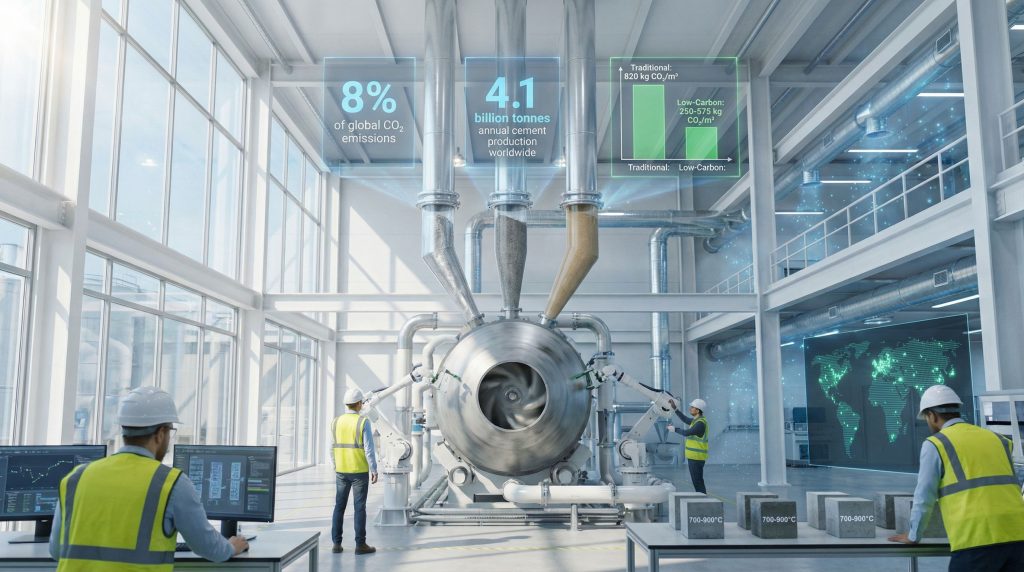
The cement industry produces approximately 4.1 billion tonnes annually worldwide, with projections indicating growth to 5 billion tonnes within the next decade. This expansion primarily stems from infrastructure development in Asia and other emerging economies, where urbanisation drives construction demand.
Cement manufacturing accounts for 8% of global anthropogenic CO₂ emissions, making it the third-largest industrial emission source after energy and agriculture sectors. The construction industry as a whole contributes 39% of total building-related carbon emissions when including material manufacturing, transportation, and on-site activities.
Geographic variations in production efficiency create additional complexity. Dry-process kilns, predominant in developed nations, consume approximately 20% less energy than wet-process facilities still operating in some developing regions, highlighting the importance of technology transfer and modernisation.
Table: Traditional vs. Low-Carbon Concrete Emission Profiles
| Production Method | CO₂ Emissions (kg/tonne) | Temperature Required (°C) | Energy Intensity |
|---|---|---|---|
| Portland Cement | 820-900 | 1,450 | High |
| SCM Blends | 400-650 | 700-900 | Medium |
| Alternative Cements | 150-300 | Variable | Low-Medium |
Process Emissions Breakdown
Understanding cement's carbon footprint requires distinguishing between energy-related and process-related emissions:
- Process emissions (50-60%): Chemical decomposition of limestone during calcination
- Fuel combustion (35-40%): Energy required for kiln heating and material processing
- Electricity and transportation (5-10%): Auxiliary operations and logistics
Energy-intensive clinker production represents the largest controllable emission source, accounting for approximately 60% of concrete's total carbon footprint. This concentration creates opportunities for significant emission reductions through clinker substitution with SCMs or alternative binding systems.
The industry's capital-intensive nature, with production facilities operating for 30-40 years, means that technological transitions require substantial investment commitments and long-term planning strategies.
When big ASX news breaks, our subscribers know first
How Do Supplementary Cementitious Materials Reduce Carbon Emissions?
Industrial Waste Stream Integration
Fly ash from coal power generation represents the most established SCM application, typically replacing 20-30% of Portland cement in concrete mixes. Global coal combustion produces approximately 900 million tonnes of fly ash annually, with current utilisation rates reaching 56% worldwide.
Quality variations depend on coal type and combustion conditions. ASTM C618 classifies fly ash as Class C (from subbituminous coal with higher lime content) or Class F (from bituminous coal with high silica content). Class F fly ash provides purely pozzolanic properties, while Class C may exhibit some self-cementing characteristics.
Ground granulated blast-furnace slag (GGBFS) from steel production offers another significant SCM source, with global production reaching 80-100 million tonnes annually. Utilisation rates vary dramatically by region: Europe achieves over 80% utilisation, while North America and Asia show lower adoption rates.
Silica fume from silicon metal manufacturing, though representing smaller volumes, provides the highest reactivity among SCMs. Containing 85-98% amorphous silica, it typically replaces 5-15% of cement due to its potency and premium pricing (2-4 times the cost of fly ash or calcined clay).
Calcined Clay Technologies
Limestone Calcined Clay Cement (LC³) methodology represents one of the most promising SCM innovations. The process involves heating kaolinite clay at 700°C to produce metakaolin, significantly lower than Portland cement's temperature requirements.
The dehydroxylation reaction converts kaolinite (Al₂O₃·2SiO₂·2H₂O) to metakaolin (Al₂O₃·2SiO₂), dramatically increasing reactivity. Commercial operations achieving 96% kaolinite conversion efficiency demonstrate the technology's technical maturity.
Calcined clay can replace up to 40% of Portland cement without compromising structural performance, exceeding typical fly ash replacement rates. This higher substitution rate translates to proportionally greater emission reductions while maintaining concrete quality standards. The development of such sustainable alternatives aligns with broader energy transition strategies being implemented across industrial sectors.
Quality control parameters include particle size distribution, chemical composition, and amorphous content. Consistent feedstock quality ensures predictable pozzolanic activity and concrete performance across commercial applications.
Performance Characteristics of SCM Blends
Supplementary cementitious materials undergo pozzolanic reactions with calcium hydroxide produced during Portland cement hydration. This secondary reaction proceeds slower than primary cement hydration, creating characteristic strength development patterns:
- 7-day strength: Typically 70-85% of Portland cement control
- 28-day strength: Generally equivalent to or exceeding control mixes
- 90-day strength: Often 105-110% of Portland cement concrete
This extended strength development reflects the time-dependent nature of pozzolanic reactions and the formation of additional calcium silicate hydrate (C-S-H) gels with refined microstructure.
Durability enhancements result from pore structure refinement and reduced calcium hydroxide content. SCM-blended concretes typically demonstrate:
- 30-50% reduction in chloride ion penetration
- Enhanced resistance to alkali-silica reaction at replacement levels exceeding 30%
- Improved long-term strength gain continuing to 1-2 years
- Superior sulfate resistance in harsh exposure environments
Featured Snippet Optimisation:
Low-carbon concrete reduces CO₂ emissions by 30-70% through supplementary cementitious materials (SCMs), alternative cement chemistries, and carbon capture technologies, while maintaining equivalent structural performance to traditional Portland cement concrete.
What Are the Most Effective Alternative Cement Technologies?
Electrochemical Production Methods
Electrochemical cement production represents a theoretical pathway to zero-emission cement manufacturing. The process uses electrical energy to form calcium silicates without CO₂ release, potentially achieving less than 100 kg CO₂/tonne when powered by renewable electricity.
Current commercial status remains limited to research facilities and pilot plants in Germany and the United Kingdom. No industrial-scale electrochemical cement production exists as of 2026, with technical challenges including:
- High electricity consumption requirements
- Electrode stability and replacement costs
- Process scalability to commercial production volumes
- Integration with renewable energy grid fluctuations
Economic viability depends heavily on electricity costs and carbon pricing mechanisms. Initial projections suggest competitiveness requires electricity costs below $0.03-0.05 per kWh combined with carbon prices exceeding $100 per tonne CO₂. These technological developments benefit from renewable energy advancements that continue to reduce electricity costs globally.
Carbon Mineralisation Approaches
CO₂ injection during concrete mixing permanently sequesters carbon dioxide within the concrete matrix. Technologies like CarbonCure inject 5-15 kg CO₂ per cubic meter of concrete, achieving both carbon storage and strength enhancement through accelerated carbonation reactions.
The mineralisation process converts CO₂ to calcium carbonate crystals, providing permanent carbon storage verified through:
- Thermogravimetric analysis (TGA) for carbonate quantification
- X-ray diffraction (XRD) for mineral phase identification
- Long-term stability testing under various exposure conditions
- Third-party verification protocols for carbon accounting
Real-time monitoring systems track injection parameters including CO₂ flow rates, pressure levels, and mixing duration. Quality assurance protocols ensure consistent carbonate formation while maintaining workability requirements for construction applications.
Bio-Based Cement Alternatives
Biological cement production explores microorganisms' ability to precipitate calcium carbonate through metabolic processes. Bacterial calcium carbonate precipitation offers controlled mineralisation under ambient conditions, eliminating high-temperature processing requirements.
Algae-grown limestone substitutes provide renewable calcium sources through controlled cultivation systems. These bio-based approaches face scalability challenges related to:
- Production volumes sufficient for commercial concrete demand
- Cost competitiveness with traditional materials
- Quality consistency across biological production cycles
- Integration with existing concrete manufacturing infrastructure
Mycelium-based binding agents represent emerging research directions, though current applications focus primarily on non-structural materials and packaging applications rather than structural concrete elements.
How Does Carbon Capture Integration Work in Concrete Production?
Point-Source Capture Systems
Cement plants represent ideal candidates for carbon capture due to high CO₂ concentrations in flue gases (15-30% CO₂ compared to 3-4% in power plant emissions). Post-combustion capture using amine-based solvents can achieve 85-95% capture efficiency from kiln exhaust streams.
Capture system components include:
- Flue gas conditioning and particulate removal
- Absorption towers with chemical solvents
- Solvent regeneration through thermal swing processes
- CO₂ compression and dehydration for transport
Energy penalties for capture systems consume approximately 15-25% additional energy compared to unabated cement production. This energy requirement can increase overall emissions unless supplied by low-carbon electricity or waste heat recovery systems.
Economic viability thresholds require carbon prices of $75-125 per tonne CO₂ depending on capture technology and energy costs. Government incentives and regulatory mandates significantly influence commercial deployment timelines. For further insights on the latest industry developments, the global innovation expo showcases emerging carbon capture technologies.
Utilisation During Concrete Mixing
Captured CO₂ finds immediate utilisation through injection into fresh concrete during mixing operations. Injection parameters require precise control:
- Pressure range: 2-6 bar for optimal dissolution
- Timing: Early in mixing cycle before initial setting
- Duration: 30-120 seconds depending on batch size
- Temperature control: Maintained below 25°C to prevent rapid carbonation
Chemical reaction monitoring ensures complete CO₂ mineralisation without compromising concrete properties. Advanced control systems adjust injection rates based on real-time pH measurements and conductivity changes during mixing.
Equipment modifications for existing concrete plants include CO₂ storage tanks, injection nozzles, pressure regulation systems, and automated control interfaces. Retrofit costs typically range $50,000-200,000 per mixing plant depending on capacity and automation level.
Permanent Carbon Storage Verification
Long-term carbon storage verification requires comprehensive testing protocols to confirm permanent mineralisation. Standard test methods include:
- ASTM C1747: Standard test method for determining potential resistance to degradation of pervious concrete by freeze-thaw action
- ISO 14040: Life cycle assessment principles and framework
- RILEM TC 230: Recommendations for testing carbonation resistance
Third-party verification organisations provide independent assessment of carbon storage claims, essential for carbon credit markets and environmental accounting. Monitoring requirements extend to 25-50 years for permanent storage verification in structural applications.
Environmental monitoring encompasses groundwater quality, soil chemistry, and atmospheric emissions throughout concrete service life. These comprehensive assessments support regulatory approval and public acceptance of carbon utilisation technologies.
What Are the Technical Performance Standards for Low-Carbon Concrete?
Structural Engineering Requirements
Low-carbon concrete must meet identical structural performance standards as conventional Portland cement concrete. Compressive strength specifications typically range from 25-50 MPa for most structural applications, with testing conducted at standard ages:
- 7 days: Early strength development assessment
- 28 days: Standard design strength verification
- 90 days: Long-term strength progression evaluation
Flexural strength characteristics become particularly important for highway paving and industrial flooring applications. Low-carbon concrete formulations often demonstrate 5-15% higher flexural strength compared to conventional mixes due to refined microstructure from pozzolanic reactions.
Elastic modulus values influence structural design calculations for deflection and stress analysis. SCM-blended concretes typically exhibit elastic moduli within ±10% of conventional concrete at equivalent compressive strengths, maintaining compatibility with existing design codes.
Creep behaviour under sustained loading requires evaluation for structural elements subjected to permanent loads. Long-term testing programmes extending 2-5 years provide data for design coefficient determination and structural safety factor calculations.
Durability and Longevity Metrics
Chloride penetration resistance directly impacts reinforced concrete lifespan in marine and de-icing salt environments. ASTM C1556 rapid chloride penetration testing demonstrates that SCM-blended concretes achieve 30-60% lower chloride permeability compared to Portland cement controls.
Freeze-thaw cycle performance becomes critical in cold climate applications. ASTM C666 testing protocols evaluate concrete durability through 300 freeze-thaw cycles, with acceptable performance requiring less than 5% reduction in dynamic modulus.
Alkali-silica reaction (ASR) mitigation represents a significant durability consideration. SCM incorporation at replacement levels exceeding 30% typically provides sufficient alkali binding to prevent deleterious expansion in reactive aggregate systems. These developments reflect broader mining innovation trends focusing on sustainable material development.
Carbonation depth progression affects reinforcement protection in concrete structures. While accelerated carbonation occurs in some low-carbon concrete formulations, proper mix design and adequate concrete cover maintain acceptable protection levels throughout design service life.
Table: Performance Comparison Matrix
| Property | Traditional Concrete | Low-Carbon Concrete | Test Standard |
|---|---|---|---|
| 28-day Strength | 25-40 MPa | 25-45 MPa | ASTM C39 |
| Chloride Resistance | Moderate | Enhanced | ASTM C1556 |
| Workability | Standard | Maintained/Improved | ASTM C143 |
| Carbon Footprint | 820 kg CO₂/m³ | 250-575 kg CO₂/m³ | ISO 14040 |
Workability and Construction Considerations
Slump retention characteristics determine concrete placement windows and pumping distances. Chemical admixtures including superplasticisers and retarding agents require optimisation for SCM-blended systems to maintain 2-4 hour workability periods typical in commercial construction.
Setting time adjustments accommodate different climate conditions and construction schedules. Initial setting times for low-carbon concrete typically extend 30-60 minutes compared to Portland cement controls, providing additional placement time but requiring adjusted finishing procedures.
Pumping characteristics depend on particle size distribution, paste content, and aggregate gradation. SCM incorporation often improves pumpability through enhanced paste lubrication, reducing pumping pressures and equipment wear rates.
Temperature sensitivity requires modified cold weather and hot weather concreting protocols:
- Cold weather (<5°C): Extended protection periods due to slower SCM reaction rates
- Hot weather (>30°C): Enhanced cooling procedures to control setting characteristics
- Mass concrete: Modified thermal control due to altered heat of hydration patterns
Which Industries Are Leading Low-Carbon Concrete Adoption?
Infrastructure and Transportation Projects
Highway construction represents the largest single application for low-carbon concrete, with state departments of transportation implementing specifications requiring 15-25% emission reductions compared to conventional mixes. Interstate highway projects commonly specify SCM replacement levels of 25-35% for pavement and structural elements.
Bridge construction applications focus on high-performance concrete with enhanced durability characteristics. Low-carbon concrete formulations provide superior chloride resistance essential for 75-100 year design life requirements in marine and de-icing environments.
Airport infrastructure projects increasingly specify low-carbon concrete for runway and taxiway construction. The Federal Aviation Administration's sustainability initiatives drive adoption of concrete mixes achieving 30-50% emission reductions while maintaining load-bearing capacity for heavy aircraft operations.
Mass transit systems incorporate low-carbon concrete in tunnel linings, station structures, and precast elements. Urban transportation authorities prioritise sustainable materials to meet carbon-neutral construction targets by 2030-2040 in major metropolitan areas.
Commercial and Residential Construction
High-rise building foundations require concrete volumes exceeding 1,000-5,000 cubic metres per project, creating substantial emission reduction opportunities through SCM incorporation. Commercial developers increasingly specify low-carbon concrete to achieve LEED Platinum and BREEAM Outstanding certifications.
Architectural concrete applications demand consistent colour and surface texture alongside emission reductions. Specialised SCM blends maintain aesthetic properties while achieving 40-60% carbon footprint reductions compared to conventional architectural mixes.
Prefabricated housing components utilise controlled manufacturing environments to optimise low-carbon concrete formulations. Factory production enables precise quality control and consistent SCM integration across large production volumes.
Building codes evolution incorporates carbon performance metrics alongside traditional structural requirements. Municipal jurisdictions implement ordinances requiring 25-40% emission reductions for concrete-intensive projects exceeding specified size thresholds.
Industrial and Specialised Applications
Marine structure construction demands superior durability performance in chloride-rich environments. Low-carbon concrete formulations for ports, offshore platforms, and coastal protection structures demonstrate enhanced service life compared to conventional materials.
Nuclear facility construction requires concrete with specialised properties including radiation shielding and long-term stability. Low-carbon concrete formulations meeting nuclear industry specifications achieve emission reductions of 20-35% while maintaining critical performance characteristics.
Waste containment systems utilise low-carbon concrete for landfill liners, hazardous waste storage, and radioactive material encapsulation. Enhanced durability characteristics provide improved containment performance throughout extended service periods.
Mining and heavy industrial foundations subject concrete to aggressive chemical environments and dynamic loading conditions. Specialised low-carbon concrete formulations incorporate chemical-resistant SCMs to extend service life while reducing environmental impact.
The next major ASX story will hit our subscribers first
What Are the Economic Considerations for Low-Carbon Concrete Implementation?
Cost Analysis and Pricing Models
Premium pricing for SCM-enhanced concrete mixes typically ranges 5-15% above conventional concrete depending on SCM type, replacement level, and regional availability. Initial cost premiums reflect:
- SCM material costs and transportation
- Quality control testing requirements
- Equipment modifications for mixing plants
- Technical support and training expenses
Carbon credit monetisation opportunities provide revenue offsets for emission reductions. Current carbon credit prices ranging $15-50 per tonne CO₂ generate potential revenues of $10-30 per cubic metre of low-carbon concrete based on emission reduction achievements.
Long-term maintenance cost reductions result from enhanced durability characteristics. Reduced chloride penetration and improved resistance to environmental degradation can extend structure service life by 15-25%, significantly reducing lifecycle costs.
Supply chain optimisation strategies focus on regional SCM sourcing to minimise transportation costs and emissions. Local fly ash and slag availability can reduce SCM costs to $20-40 per tonne compared to $60-100 per tonne for transported materials.
Market Drivers and Regulatory Incentives
Government procurement preferences increasingly favour low-carbon concrete for public infrastructure projects. Federal and state agencies implement sustainable procurement policies requiring emission reduction documentation and lifecycle cost analysis.
Carbon tax implications create financial incentives for emission reduction technologies. Jurisdictions implementing carbon pricing mechanisms provide cost advantages of $25-75 per tonne CO₂ for low-carbon alternatives compared to conventional materials.
Building code evolution incorporates carbon performance metrics alongside structural requirements. Updated codes requiring emission reduction targets of 20-40% by 2030-2035 create regulatory demand for low-carbon concrete technologies.
Insurance and risk assessment considerations recognise enhanced durability characteristics of low-carbon concrete. Reduced maintenance requirements and extended service life contribute to lower insurance premiums and improved risk profiles for infrastructure investments. Industry suppliers like Boral are leading the market with comprehensive product offerings.
Return on Investment Calculations
Lifecycle cost analysis methodologies evaluate total ownership costs including initial construction, maintenance, and end-of-life considerations. Low-carbon concrete typically demonstrates positive ROI within 10-15 years through reduced maintenance and extended service life.
Energy savings from improved thermal properties contribute to operational cost reductions in building applications. Enhanced thermal mass and reduced thermal bridging can decrease heating and cooling costs by 5-10% in concrete-intensive structures.
Durability-related maintenance deferrals provide substantial cost savings over structure lifetimes. Delayed maintenance interventions and extended service life generate present value savings of $50-150 per cubic metre depending on application and exposure conditions.
Brand value and ESG compliance benefits contribute to intangible returns including:
- Enhanced corporate sustainability ratings
- Improved stakeholder relations and public perception
- Compliance with environmental regulations and standards
- Access to green financing and investment opportunities
How Do Quality Control Systems Ensure Consistent Performance?
Mix Design Optimisation Protocols
Proportioning methodologies for SCM integration require systematic approaches to achieve target performance while maximising emission reductions. Trial batch procedures evaluate multiple SCM combinations and replacement levels to identify optimal formulations.
Statistical quality control implementation utilises control charts and process capability studies to maintain consistent concrete properties. Target parameters include:
- Compressive strength: ±2.5 MPa variation from target
- Slump retention: Maintained within ±25mm over 2-hour period
- Air content: Controlled to ±0.5% for freeze-thaw resistance
- Setting time: Variation limited to ±30 minutes from specification
Continuous monitoring systems track real-time concrete properties during production using automated sensors and data acquisition systems. Advanced control algorithms adjust mix proportions based on incoming material variations and environmental conditions.
Validation procedures require comprehensive testing programmes including compressive strength development, durability assessments, and long-term performance evaluation. Documentation systems maintain traceability from raw materials through final concrete placement.
Testing and Verification Standards
Fresh concrete property assessments utilise standardised test methods to verify workability, setting characteristics, and air content. Critical parameters include:
- ASTM C143: Slump test for workability assessment
- ASTM C403: Setting time determination
- ASTM C231: Air content measurement by pressure method
- ASTM C1064: Temperature measurement protocols
Hardened concrete performance validation encompasses strength development, durability characteristics, and specialised performance requirements. Testing frequencies typically require:
- Strength testing: Minimum 1 test per 100 cubic metres
- Durability testing: Monthly for rapid chloride penetration
- Freeze-thaw resistance: Quarterly for cold climate applications
- Carbon footprint verification: Per batch plant certification
Environmental impact quantification utilises lifecycle assessment (LCA) methodologies following ISO 14040 standards. Third-party verification provides independent confirmation of emission reduction claims and carbon accounting accuracy. Resources like the Low Carbon Concrete FAQ guide provide essential technical information for implementation teams.
Third-party certification processes validate quality management systems and technical compliance with industry standards. Certification bodies assess:
- Quality control procedures and documentation
- Technical competency and training programmes
- Equipment calibration and maintenance protocols
- Environmental impact measurement and reporting
Supply Chain Management
SCM sourcing requires comprehensive quality specifications addressing chemical composition, physical properties, and consistency requirements. Supplier qualification programmes evaluate:
- Chemical analysis: Silica, alumina, and alkali content verification
- Physical properties: Particle size distribution and specific surface area
- Consistency: Statistical analysis of property variations over time
- Supply reliability: Production capacity and delivery capabilities
Transportation and storage considerations address material handling requirements to prevent contamination and maintain quality. Specialised equipment requirements include:
- Pneumatic conveying systems for fine SCM materials
- Moisture protection during storage and handling
- Segregation prevention through proper material flow design
- Quality testing at delivery points and storage facilities
Batch plant modifications accommodate SCM integration through equipment upgrades and process optimisation. Typical modifications include:
- Additional storage silos for SCM materials
- Weighing systems with enhanced accuracy for fine materials
- Mixing equipment modifications for improved blending
- Dust collection systems for environmental compliance
Training requirements for production personnel encompass technical knowledge, quality control procedures, and safety protocols. Comprehensive programmes address:
- SCM handling and storage procedures
- Mix design principles and proportioning calculations
- Quality control testing methods and interpretation
- Environmental and safety considerations
What Does the Future Hold for Low-Carbon Concrete Technology?
Emerging Technologies and Innovations
3D printing applications with low-carbon concrete materials represent frontier technology combining digital construction with sustainable materials. Specialised concrete formulations for additive manufacturing require:
- Rapid setting characteristics for layer adhesion
- Pumpability through small nozzle diameters
- Buildability to support vertical construction without forms
- Long-term durability equivalent to conventional construction methods
Current pilot projects demonstrate 20-40% material savings through optimised geometry and reduced waste, while low-carbon concrete formulations provide additional 30-50% emission reductions compared to conventional concrete.
Self-healing concrete incorporating encapsulated healing agents shows promise for extending structure service life while reducing carbon footprint. Microcapsules containing healing materials activate upon crack formation, providing autonomous repair capabilities that could double concrete service life in some applications.
Smart concrete with embedded sensors enables real-time structural health monitoring and predictive maintenance. Integration of fibre optic sensors, wireless monitoring systems, and IoT connectivity provides data for optimised maintenance scheduling and extended service life.
Nanotechnology integration offers enhanced properties through engineered nanoparticles including nano-silica, carbon nanotubes, and graphene oxide. These materials can improve strength, durability, and functionality while maintaining low-carbon concrete formulation principles.
Scale-Up Challenges and Solutions
Global SCM supply chain development requires coordinated expansion of waste material utilisation and alternative SCM production. Current fly ash utilisation at 56% globally indicates substantial unused capacity, while calcined clay production requires investment in processing facilities.
Technology transfer to developing markets faces challenges including:
- Limited technical expertise and training programmes
- Inadequate quality control infrastructure
- Economic barriers to technology adoption
- Regulatory frameworks requiring development
Standardisation and harmonisation efforts through international organisations aim to establish consistent performance criteria and testing methods. ISO Technical Committee 71 on Concrete continues developing standards for alternative cement systems and SCM applications.
Research and development investment priorities focus on:
- Novel SCM sources including industrial waste streams
- Carbon utilisation technologies for permanent CO₂ storage
- Digital concrete combining sensors with sustainable materials
- Circular economy approaches to material reuse and recycling
Industry Transformation Timeline
2025-2030: Mainstream adoption in developed markets
Regulatory drivers and market demand accelerate low-carbon concrete adoption in North America, Europe, and developed Asian markets. Key developments include:
- Building codes requiring emission reduction targets
- Government procurement preferences for sustainable materials
- Industry standards establishment for alternative cement systems
- Commercial-scale carbon utilisation facility deployment
2030-2040: Global scaling and cost parity achievement
Technology maturation and supply chain development achieve cost competitiveness with conventional concrete across global markets. Anticipated progress includes:
- Cost parity between low-carbon concrete and conventional concrete
- Widespread SCM utilisation approaching 80-90% of available materials
- Carbon capture and utilisation becoming economically viable
- Developing market adoption accelerating through technology transfer
2040-2050: Potential for carbon-negative concrete systems
Advanced technologies enable concrete systems that sequester more CO₂ than produced during manufacturing. Revolutionary developments may include:
- Bio-based cement production at commercial scale
- Atmospheric CO₂ capture integration with concrete production
- Complete elimination of process emissions through alternative chemistries
- Concrete serving as permanent carbon storage infrastructure
Policy and regulatory evolution continues supporting transition through carbon pricing mechanisms, performance-based building codes, and international climate commitments. Public-private partnerships accelerate technology development and commercial deployment across global markets.
Key Implementation Success Factors
Successful low-carbon concrete implementation requires coordinated efforts across mix design optimisation, supply chain development, quality control systems, and workforce training to achieve both environmental and performance objectives.
The construction industry stands at a critical juncture where technological innovation meets environmental necessity. Low-carbon concrete technologies offer proven pathways to substantial emission reductions while maintaining the structural performance that modern infrastructure demands. Success requires coordinated efforts across the entire value chain, from raw material suppliers to end users, supported by evolving regulatory frameworks and market incentives that recognise the true cost of carbon emissions.
As these technologies mature and scale globally, the construction industry will play an increasingly important role in climate change mitigation, transforming from a significant emission source into a potential carbon sink through innovative concrete systems that permanently sequester CO₂ while building the infrastructure of the future.
Ready to Invest in the Next Major Mineral Discovery?
Discovery Alert instantly alerts investors to significant ASX mineral discoveries using its proprietary Discovery IQ model, turning complex mineral data into actionable insights. Understand why major mineral discoveries can lead to significant market returns by exploring Discovery Alert's dedicated discoveries page, showcasing historic examples of exceptional outcomes, and begin your 14-day free trial today to position yourself ahead of the market.