May 10, 2026
Rio Tinto and Amazon Web Services low-carbon copper collaboration represents a groundbreaking approach to addressing critical mineral supply constraints while meeting environmental sustainability goals. Traditional mining operations face increasing pressure from artificial intelligence infrastructure demands, carbon reduction mandates, and declining ore grades worldwide. This convergence creates opportunities for innovative extraction technologies that can simultaneously increase production capacity and reduce environmental impact.
How Microbial Processing Revolutionises Copper Extraction Methods
Traditional copper mining relies on mechanical crushing, chemical concentration, and high-temperature smelting processes that consume massive amounts of energy and water. These conventional methods typically require ore grades above 0.8% copper content to achieve economic viability, leaving billions of tonnes of lower-grade material classified as waste rock or tailings.
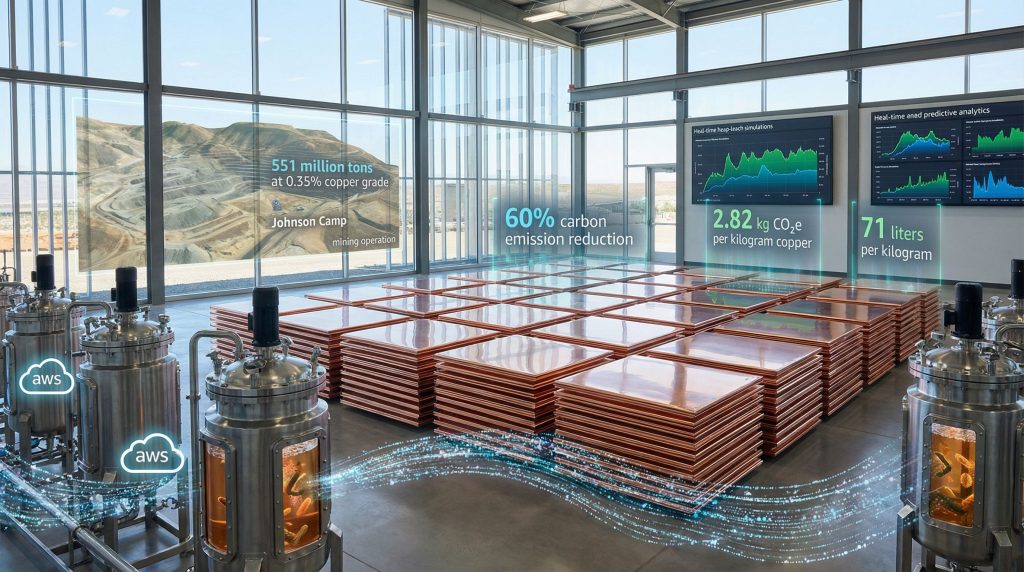
Bioleaching technology fundamentally transforms this paradigm by employing naturally occurring acidophilic bacteria and archaea to oxidise sulfide minerals directly within heap structures. The Rio Tinto and Amazon Web Services low-carbon copper collaboration at Johnson Camp demonstrates how microbial extraction can process primary sulfide ores with copper grades as low as 0.35%, converting previously uneconomic resources into productive feedstock.
The biological process eliminates several energy-intensive stages entirely. Furthermore, copper investment strategies must adapt to these technological innovations that are reshaping the industry landscape.
- Crushing and grinding operations (typically 30-40% of total energy consumption)
- Flotation concentration requiring chemical reagents and mechanical separation
- High-temperature smelting consuming fossil fuels for heat generation
- Refining stages that process concentrate into cathode-grade copper
Operational Performance Metrics and Environmental Benefits
Independent lifecycle assessment data reveals significant environmental improvements compared to conventional methods. The Nuton bioleaching system achieves 2.82 kg CO₂e per kilogram of copper across Scope 1, 2, and 3 emissions, positioning it within the lower range of global primary copper production that typically spans 1.5 to 8.0 kg CO₂e per kilogram.
Water consumption represents another critical advantage, with the system requiring 71 litres per kilogram of copper compared to industry averages of 130-200 litres. This 45-65% reduction proves particularly valuable as mining operations face increasing water scarcity and regulatory restrictions in arid regions.
| Environmental Parameter | Nuton Bioleaching | Industry Average | Improvement |
|---|---|---|---|
| Carbon intensity (kg CO₂e/kg Cu) | 2.82 | 3.5-8.0 | 18-65% reduction |
| Water usage (L/kg Cu) | 71 | 130-200 | 45-65% reduction |
| Processing stages | 2-3 | 5-7 | 50% fewer steps |
| Tailings generation | Zero | Significant | 100% elimination |
The 18-month deployment timeline from pilot testing to industrial-scale operations represents a dramatic acceleration compared to traditional mining development, which typically requires 8-15 years for new facility construction. This compression results from the modular infrastructure design and elimination of complex processing equipment like concentrators and smelters.
Technical Implementation and Scalability Framework
The microbial extraction process operates through carefully managed bacterial ecosystems that generate both oxidising compounds and sulfuric acid in situ. Temperature regulation, nutrient cycling, and oxygen distribution become critical operational parameters that determine copper recovery rates and processing timelines.
At Johnson Camp's 551 million ton resource base, the system targets 30,000 tonnes of refined copper over four years, representing approximately 8% of recent annual U.S. domestic copper production. The achievement of 99.99% cathode grade purity directly at the mine gate eliminates traditional supply chain steps and reduces transportation requirements.
Academic research from mining institutions in Chile, Australia, and Peru indicates that bioleaching operations can achieve 70-85% copper recovery rates from sulfide ores, comparable to conventional methods while processing previously unusable material. In addition, AI-driven mining technologies enhance process control and optimise extraction efficiency through real-time monitoring systems.
When big ASX news breaks, our subscribers know first
Digital Infrastructure Integration and Process Optimisation
Cloud-based analytics transforms bioleaching from a largely empirical process into a data-driven operation with real-time optimisation capabilities. The Rio Tinto and Amazon Web Services low-carbon copper collaboration employs machine learning algorithms to process continuous sensor data streams, enabling predictive modelling and automated process adjustments.
Traditional mining operations typically rely on periodic laboratory analysis conducted daily or weekly, creating operational delays when process adjustments become necessary. AWS integration enables sub-minute interval monitoring of critical parameters including heap temperature, solution chemistry, acid concentration, and copper recovery rates.
Advanced Analytics Architecture and Performance Improvements
The technical infrastructure combines IoT sensors, predictive modelling, and automated control systems to optimise copper extraction kinetics. Machine learning models analyse historical performance data alongside real-time measurements to forecast recovery trajectories and identify optimal operating parameters for varying ore compositions.
Key analytical capabilities include:
- Heap-leach simulation modelling predicting copper recovery under different conditions
- Solution chemistry optimisation managing acid dosing and recycling patterns
- Temperature control algorithms maintaining optimal microbial metabolic activity
- Quality assurance protocols ensuring consistent cathode grade specifications
Industry research suggests that advanced analytics typically improve copper extraction efficiency by 3-8% through optimised chemical dosing and process timing. For Johnson Camp's production target, a 5% improvement could generate approximately 1,500 additional tonnes annually, representing $120-150 million in additional value at current copper market prices.
The AWS partnership extends beyond operational optimisation to include supply chain integration, tracking Nuton copper performance in actual data centre components. This closed-loop feedback mechanism validates material specifications and enables rapid identification of any quality variations affecting end-use applications.
Cybersecurity and Scalability Considerations
Critical mineral supply chain assets require robust cybersecurity frameworks to protect operational integrity and prevent supply disruptions. AWS industrial IoT architecture incorporates multi-layered security protocols specifically designed for mining applications, addressing both operational technology and information technology vulnerabilities.
The analytics platform architecture supports scalability to additional Nuton deployments through transferable machine learning models and standardised sensor configurations. However, copper & uranium investment opportunities require careful evaluation of technological readiness and regulatory frameworks across different jurisdictions.
Artificial Intelligence Infrastructure and Copper Demand Dynamics
Data centre construction represents the fastest-growing segment of global copper demand, driven by exponential increases in computing capacity requirements for artificial intelligence applications. According to the International Energy Agency, copper consumption for data centres could reach 250,000 to 550,000 tonnes by 2030, depending on AI adoption rates and infrastructure expansion patterns.
Modern hyperscale facilities require extensive copper infrastructure across multiple systems:
| Data Centre Component | Copper Usage (kg per MW) | Primary Function |
|---|---|---|
| Electrical distribution cables | 2,500-3,000 | Power transmission |
| Transformer windings | 1,800-2,200 | Voltage regulation |
| Busbar systems | 800-1,200 | Current distribution |
| Processor heat sinks | 300-500 | Thermal management |
| Circuit board conductors | 150-250 | Signal processing |
| Total per MW | 6,550-8,150 | Complete facility |
Supply-Demand Imbalance and Market Projections
S&P Global analysis indicates that global copper demand could increase 50% by 2040, driven by artificial intelligence, electrification, and defence applications. However, without substantial investment in new mining capacity and recycling infrastructure, the market faces potential 10 million metric ton annual supply shortfall by 2040.
Current global copper production of approximately 21 million tonnes annually must expand to 30-35 million tonnes to meet projected demand scenarios. Consequently, copper global supply challenges become more complex as ore grades continue declining from historical averages of 1.2-1.5% in the 1990s to current levels of 0.7-0.9% for major producers.
The Rio Tinto and Amazon Web Services low-carbon copper collaboration addresses this supply constraint by demonstrating commercial viability for processing lower-grade material that traditional methods cannot economically extract. Bioleaching technology potentially unlocks billions of tonnes of previously unusable copper resources globally.
AI-Specific Copper Requirements and Substitution Limitations
Artificial intelligence applications create unique copper demand patterns that differ from traditional electrical and construction uses. AI processors operating at 300+ watts per chip require specialised thermal management systems where copper's 385 W/m·K thermal conductivity provides essential heat dissipation capabilities.
Unlike construction applications where aluminium can substitute for copper in some uses, AI infrastructure demands copper's superior electrical and thermal properties for:
- High-frequency signal transmission in advanced processors
- Thermal interface materials for heat sink applications
- Power delivery networks supporting rapid computational load changes
- Electromagnetic shielding protecting sensitive components
These technical requirements make AI-driven copper demand relatively inelastic, meaning supply constraints could limit AI deployment rather than encouraging substitution to alternative materials.
Johnson Camp Resource Profile and Strategic Positioning
The Johnson Camp copper project represents one of the largest open-pit developments in the United States, with measured and indicated resources of 551 million tons averaging 0.35% copper grade. Located in Arizona, the facility provides strategic domestic supply security for critical mineral requirements.
Geological Characteristics and Processing Advantages
Johnson Camp's orebody consists primarily of chalcopyrite and bornite sulfide minerals within a porphyry copper system typical of southwestern U.S. deposits. The geological setting provides several advantages for bioleaching operations:
- Consistent sulfide mineralogy enabling stable microbial processing
- Favourable heap-leach geometry supporting efficient solution flow
- Limited clay content reducing permeability and recovery issues
- Adequate crushing characteristics for optimal fragment size distribution
The project's four-year deployment timeline targeting 30,000 tonnes of refined copper establishes production parameters that could be replicated at other domestic sulfide deposits. For instance, major copper system developments in Argentina demonstrate similar potential for technological innovation in resource extraction.
Critical Mineral Designation and Supply Chain Security
Copper's designation as a critical mineral by the U.S. government reflects its importance for energy systems, digital infrastructure, and national security applications. The Rio Tinto and Amazon Web Services low-carbon copper collaboration demonstrates how domestic production can reduce international supply chain dependencies while meeting environmental objectives.
Current U.S. copper production of approximately 1.2 million tonnes annually supplies roughly 70% of domestic consumption, with imports primarily from Chile, Peru, and Mexico. Johnson Camp's contribution could reduce this import dependency while providing supply security for technology companies expanding data centre operations.
The proximity to major data centre markets in Arizona, California, and Nevada reduces transportation costs and carbon emissions compared to international copper sources. This geographic advantage becomes increasingly important as technology companies implement Scope 3 emissions accounting across their supply chains.
Technology Integration and Competitive Positioning Framework
The partnership between Rio Tinto and Amazon Web Services establishes a new model for mining industry collaboration that combines operational technology with digital infrastructure optimisation. This integration creates competitive advantages that extend beyond traditional mining metrics to include supply chain reliability, environmental performance, and scalability potential.
First-Customer Strategic Advantage and Market Positioning
AWS's position as the inaugural customer for Nuton copper provides several strategic benefits:
- Early access to breakthrough low-carbon copper technology
- Supply chain differentiation through sustainable sourcing credentials
- Process optimisation collaboration improving both mining and data centre efficiency
- Risk mitigation through diversified copper sourcing relationships
The two-year commercial agreement structure enables both companies to validate performance metrics and optimise integration processes before potential expansion to additional facilities or customers. This approach reduces deployment risks while demonstrating commercial viability for institutional investors and other potential partners.
Environmental Compliance and Regulatory Advantages
Bioleaching operations provide significant regulatory advantages compared to traditional mining methods, particularly regarding tailings management and water discharge standards. The zero tailings design eliminates risks associated with tailings storage facilities, which have become increasingly scrutinised following major incidents at conventional mining operations.
Environmental Protection Agency regulations under the National Pollutant Discharge Elimination System require extensive permitting and monitoring for conventional mining operations. Bioleaching systems can meet these requirements more easily due to:
- Reduced chemical reagent usage minimising discharge treatment requirements
- In-situ processing eliminating waste rock and tailings generation
- Lower water consumption reducing stress on local water resources
- Renewable energy compatibility enabling carbon-neutral operations
"The integration of breakthrough mining technology with cloud analytics represents a fundamental shift toward data-driven resource extraction that can accelerate project development timelines from traditional 10-15 year cycles to 2-3 years for bioleaching applications."
Comparative Environmental Performance Analysis
Comprehensive lifecycle assessment data reveals significant environmental advantages for bioleaching technology across multiple impact categories. Independent verification by Skarn Associates confirms both carbon intensity and water usage improvements compared to industry benchmarks.
Carbon Footprint Analysis Across Production Methods
The 2.82 kg CO₂e per kilogram copper carbon intensity for Nuton operations includes comprehensive Scope 1, 2, and 3 emissions accounting. This performance compares favourably across different copper production pathways:
| Production Method | Carbon Intensity (kg CO₂e/kg Cu) | Water Usage (L/kg Cu) | Energy Source |
|---|---|---|---|
| Traditional smelting | 3.5-8.0 | 130-200 | Fossil fuel intensive |
| Nuton bioleaching | 2.82 | 71 | Renewable matched |
| SX-EW operations | 2.0-4.5 | 80-150 | Grid electricity |
| Secondary recycling | 0.5-1.5 | 10-30 | Variable sources |
The renewable energy matching programme through 134,000 Green-e certified renewable energy certificates ensures that electrical consumption aligns with carbon reduction objectives. This approach enables technology companies to meet Scope 3 emissions reduction targets while securing reliable copper supplies.
Water Stewardship and Resource Management
Water consumption represents a critical constraint for mining operations in arid regions where many copper deposits are located. The 71 litres per kilogram water intensity achieved through bioleaching operations provides substantial advantages in water-stressed areas.
Conventional copper mining typically requires:
- Grinding circuit water for particle size reduction
- Flotation process water for mineral separation
- Smelter cooling systems for temperature control
- Dust suppression for environmental compliance
- Employee facilities and administrative uses
Bioleaching eliminates the first three categories entirely while reducing overall facility water requirements through simplified infrastructure. This reduction becomes increasingly valuable as mining operations face stricter water allocation limits and higher costs for water rights acquisition.
The next major ASX story will hit our subscribers first
Long-Term Market Structure and Investment Implications
The successful deployment of bioleaching technology at commercial scale could fundamentally alter copper market dynamics by expanding economically viable resource bases and reducing development timelines. Industry analysis suggests this transformation may influence investment patterns, pricing mechanisms, and geographic production distribution.
Capital Efficiency and Development Timeline Compression
Traditional copper mine development requires substantial capital investment for complex processing infrastructure including concentrators, smelters, and tailings management systems. The Rio Tinto and Amazon Web Services low-carbon copper collaboration demonstrates how bioleaching can reduce these requirements through:
- Modular heap construction replacing permanent building infrastructure
- Simplified equipment specifications eliminating high-temperature processing
- Reduced environmental mitigation through lower-impact operations
- Faster permitting processes due to simplified environmental footprint
Financial modelling suggests that bioleaching operations may require 40-60% lower capital expenditure compared to equivalent conventional mining projects, enabling faster project payback periods and improved investment returns. Furthermore, these innovations could accelerate similar developments, as demonstrated by Rio Tinto's breakthrough low-carbon copper initiatives across multiple facilities.
Technology Licensing and Global Expansion Potential
The proven commercial viability of Nuton technology creates opportunities for licensing agreements and joint venture partnerships at copper deposits worldwide. S&P Global estimates indicate that 60-70% of global copper resources occur in sulfide formations that could potentially support bioleaching operations.
Key target regions include:
- North America: Arizona, Nevada, Utah porphyry deposits
- South America: Chile and Peru lower-grade sulfide resources
- Australia: New South Wales and Queensland copper prospects
- Africa: Democratic Republic of Congo oxide and sulfide zones
The scalability of cloud analytics platforms enables rapid deployment of optimisation systems across multiple sites, creating operational efficiencies and knowledge transfer opportunities that traditional mining companies cannot easily replicate.
Market Premium Potential and ESG Compliance
Institutional investors increasingly emphasise environmental, social, and governance criteria in mining investment decisions. Low-carbon copper production provides potential market premium opportunities as technology companies implement sustainable sourcing requirements.
Early indicators suggest that certified low-carbon copper could command 2-5% price premiums in select market segments, particularly for companies with aggressive carbon reduction commitments. The Rio Tinto and Amazon Web Services low-carbon copper collaboration establishes precedent for direct supply relationships that capture these premium values through innovative data centre supply chain partnerships.
Disclaimer: This analysis contains forward-looking statements regarding copper market dynamics, technology deployment, and environmental performance. Actual results may vary based on market conditions, regulatory changes, technological developments, and other factors beyond current forecasting capabilities. Investment decisions should consider comprehensive due diligence and professional financial advice.
Ready to Capitalise on the Next Generation of Copper Discoveries?
Discovery Alert's proprietary Discovery IQ model delivers instant notifications on significant ASX mineral discoveries, empowering subscribers to identify actionable copper and critical mineral opportunities ahead of the broader market. Explore our discoveries page to understand how major mineral breakthroughs can generate substantial returns, then begin your 30-day free trial today to secure your market-leading advantage in this rapidly evolving sector.