August 5, 2026
The commercial viability of mining on the moon hinges on identifying resources that offer strategic advantages over terrestrial alternatives. Furthermore, understanding these dynamics requires examining how regulatory uncertainties, technological maturation cycles, and international cooperation models will converge to shape the first commercially viable lunar operations. In addition, current assessments reveal several critical resource categories that could justify the substantial infrastructure investments required for sustained lunar operations, particularly as asteroid mining advances continue to inform space-based resource extraction strategies.
Economic Foundations of Lunar Resource Development
The commercial viability of mining on the moon hinges on identifying resources that offer strategic advantages over terrestrial alternatives. Current assessments reveal several critical resource categories that could justify the substantial infrastructure investments required for sustained lunar operations.
Critical Resource Categories Driving Commercial Interest
Lunar Resource Concentration Analysis
| Resource Type | Estimated Concentration | Extraction Complexity | Commercial Applications |
|---|---|---|---|
| Helium-3 | ~1 million tonnes surface-wide | High (separation technology undeveloped) | Fusion fuel, cryogenic cooling systems |
| Water Ice | Concentrated at polar regions | Medium (requires precision drilling) | Propellant production, life support |
| Rare Earth Elements | Scandium, yttrium, lanthanides present | High (no carbon/liquid water processing) | Electronics manufacturing, defense applications |
| Titanium/Iron | Abundant in regolith | Medium (vacuum smelting required) | Space construction materials |
The lunar regolith composition presents unique opportunities, containing approximately 50 percent silica along with trace metals distributed throughout the surface material. However, NASA estimates suggest one million tonnes of helium-3 exist across the lunar surface, though extraction feasibility remains contested among researchers.
Water ice deposits represent the most immediately viable commercial target, particularly given their dual utility for life support systems and spacecraft propulsion. These resources can be separated into hydrogen and oxygen components, creating what industry experts describe as orbital refueling stations for deep space missions.
Economic Thresholds for Profitability
Launch Cost Analysis
Current launch costs to lunar surface operations require dramatic reduction before commercial viability becomes achievable. Consequently, the race to mine the Moon has intensified as nations and private companies recognise the economic potential. Industry projections suggest:
- Current baseline: $10,000-15,000 per kilogram to low Earth orbit
- Required threshold: $1,000-2,000 per kilogram for lunar surface delivery
- Break-even processing: 80-90% efficiency for water ice extraction
- Market demand projections: 500-1,000 tonnes annual fuel requirement for Mars mission architecture
The economic model fundamentally depends on space-based utilization rather than Earth return transport. Processing lunar water into spacecraft fuel creates value propositions that terrestrial resource extraction cannot match, particularly for missions beyond Earth orbit.
Revenue Generation Scenarios
Space-based fuel stations represent the primary commercial pathway, where lunar water ice becomes the foundation for Mars exploration logistics and deep space operations.
When big ASX news breaks, our subscribers know first
Technological Readiness Assessment for Lunar Operations
Current technological capabilities reveal significant gaps between existing Earth-based mining systems and the specialized equipment required for lunar resource extraction. Furthermore, these challenges encompass power generation, material handling, and autonomous operation requirements unique to the lunar environment, reflecting broader evolution in mining trends across both terrestrial and extraterrestrial applications.
Autonomous Extraction Systems Under Development
NASA's Advanced Robotic Programs
The development timeline for autonomous lunar mining systems extends through multiple phases:
- Resource mapping completion (2026-2030): Orbital surveys and ground-truth verification
- ISRU demonstration projects (2030-2032): Small-scale processing validation
- Commercial pilot operations (2035-2040): First revenue-generating extraction
NASA's RASSOR (Regolith Advanced Surface Systems Operations Robot) represents current testing capabilities, though operational constraints remain substantial. The system faces challenges from lunar dust properties, which are described as extremely sharp and abrasive, interfering with mechanical systems and creating contamination risks.
Operational Constraint Analysis
| Environmental Factor | Impact Level | Mitigation Requirements |
|---|---|---|
| Temperature extremes | High (-230°C to 120°C) | Thermal management systems |
| Lunar dust properties | Critical | Sealed mechanisms, electrostatic control |
| Power generation | Fundamental | Nuclear systems or advanced solar arrays |
| Communication delays | Medium | Autonomous decision-making capabilities |
In-Situ Resource Utilization Breakthroughs
Processing Technology Development
The absence of carbon and liquid water on the lunar surface necessitates completely novel processing approaches. Traditional Earth-based extraction methods rely heavily on chemical processes involving water and carbon-based compounds, creating fundamental design challenges for lunar applications.
Key technological advances required include:
- Vacuum-based smelting systems for metal extraction from regolith
- Electrolysis capabilities for water ice separation into propellant components
- Regolith sintering processes for construction material production
- Dust mitigation technologies to prevent equipment contamination
Current testing facilities, including CSIRO's lunar analog laboratories, provide controlled environments for validating these processes, though significant scaling challenges remain for commercial implementation.
International Competition and Investment Patterns
The global landscape for lunar resource development reflects both governmental space agency priorities and private sector commercial interests, creating complex partnership models that span traditional geopolitical boundaries.
Government-Led Strategic Initiatives
United States Artemis Architecture
The Artemis program establishes NASA's framework for commercial partnerships, outsourcing significant mission components to private companies including SpaceX and Blue Origin. This public-private model enables risk sharing while maintaining government oversight of strategic operations.
Recent Artemis II mission accomplishments include capturing detailed imagery of the Moon's Vavilov Crater, representing the furthest human travel distance achieved to date. These missions provide critical environmental data for future mining operations.
International Collaboration Models
| Partnership Type | Lead Nations | Strategic Focus | Timeline |
|---|---|---|---|
| Bilateral Research Station | Russia-China | Joint lunar base development | Next decade |
| Commercial Partnerships | US-Private Sector | Resource extraction technology | 2025-2035 |
| Scientific Cooperation | ESA-JAXA-NASA | Environmental assessment | Ongoing |
Russia and China have announced plans for nuclear power plant deployment on the lunar surface within the next decade, supporting their joint research station and resource extraction capabilities. This infrastructure development represents significant geopolitical positioning for long-term lunar presence.
Private Sector Investment Dynamics
Commercial Entity Analysis
Several private companies have established specific lunar mining strategies:
- Interlune: Seattle-based company targeting helium-3 commercialization as the first US space resource enterprise
- ispace: European operations focused on lunar payload transport and surface mission design
- SpaceX: Lunar city development projects with 10-year implementation goals
- Blue Origin: NASA partnership agreements for lunar lander capabilities
Technology Development Status
Current private sector capabilities remain in demonstration phases, with companies deploying small components of eventual processing systems rather than full-scale extraction operations. Power and energy constraints represent fundamental limitations for existing technologies, requiring substantial miniaturization and efficiency improvements.
The technology enabling lunar mining exists in early development stages, with significant engineering challenges remaining before commercial-scale operations become feasible.
Legal Framework Evolution for Space Commerce
The regulatory environment governing lunar resource extraction operates within established international treaty obligations while adapting to emerging commercial realities that original frameworks never anticipated.
Treaty Obligations versus Commercial Development
Outer Space Treaty (1967) Provisions
The foundational 1967 Outer Space Treaty, signed by the United States, Russia, and United Kingdom, establishes nine core principles governing lunar activities:
- Peaceful purposes mandate: All lunar activities must serve non-military objectives
- Non-appropriation principle: No national sovereignty claims over lunar territory
- Universal accessibility: All lunar areas must remain accessible to all nations
- Scientific cooperation requirements: Knowledge sharing obligations for lunar discoveries
Legal Ambiguity Areas
| Regulatory Gap | Current Status | Potential Conflicts |
|---|---|---|
| Exclusion zones around mining sites | Undefined boundaries | Operational safety vs. access rights |
| Commercial confidentiality | No established protocols | Proprietary technology vs. scientific transparency |
| Environmental impact assessment | Draft principles only | Resource extraction vs. preservation |
| Dispute resolution mechanisms | Limited enforcement capability | Competing national interests |
Moon Treaty (1979) Limited Adoption
The United Nations developed the Moon Treaty in 1979, yet only 18 countries have ratified it, and critically, none of these signatory nations have achieved lunar landing capabilities. This creates a regulatory vacuum where space-capable nations operate outside the treaty's jurisdiction.
Regulatory Framework Development
United Nations Working Group Initiatives
The UN Office for Outer Space Affairs maintains active working groups developing legal frameworks for space resource activities. These draft principles include:
- Environmental impact assessments before resource extraction operations
- Contamination prevention protocols for both lunar and Earth environments
- International notification requirements for commercial mining activities
- Scientific site preservation mandates for areas of research significance
However, these recommendations carry no binding legal authority, relying instead on voluntary national implementation and enforcement.
National Legislation Gaps
Unlike terrestrial mining operations with established regulatory frameworks, lunar resource extraction operates without explicit legal governance. No nation possesses sovereignty over lunar territory, creating jurisdictional challenges for commercial oversight and accountability mechanisms.
The legal framework governing space commerce relies on non-binding international recommendations and voluntary compliance, creating significant regulatory uncertainty for commercial investors.
Environmental Impact Assessment for Lunar Operations
Large-scale lunar mining operations present unprecedented environmental considerations that extend beyond the Moon itself, potentially affecting Earth-based ecosystems and astronomical research capabilities. For instance, the sustainable mining transformation occurring in terrestrial operations offers valuable lessons for developing environmentally conscious lunar extraction methods.
Scientific Research Vulnerability
Astronomical Infrastructure Protection
The lunar far side provides unique advantages for radio astronomy research due to natural shielding from Earth-based radio interference. Mining operations in these regions could compromise decades of scientific investment and future research capabilities.
Critical preservation areas include:
- Radio-quiet zones for deep space observation
- Polar crater ice deposits essential for environmental monitoring
- Apollo landing sites with historical and scientific significance
- Geological formations providing insights into solar system evolution
Vibration impact modelling suggests that heavy extraction equipment could interfere with sensitive scientific instrumentation, potentially requiring coordination protocols between commercial and research operations.
Earth-Based Ecological Considerations
Lunar Dust Cloud Formation Scenarios
Scientific analysis indicates potential for lunar mining operations to generate sufficient dust to create orbital particle clouds around the Moon. Such formations could alter moonlight reaching Earth, affecting species dependent on lunar illumination cycles.
Environmental Risk Assessment Matrix
| Risk Category | Impact Level | Affected Systems | Mitigation Requirements |
|---|---|---|---|
| Dust generation | High | Lunar astronomy, Earth moonlight | Precision extraction methods |
| Surface modification | Medium | Geological research sites | Protected zone designation |
| Equipment placement | Low | Local ecosystem disruption | Temporary installation protocols |
Species affected by moonlight disruption include:
- Marine turtles: Navigation systems dependent on moonlight for beach nesting
- Nocturnal owl species: Hunting behaviors synchronised with lunar cycles
- Coral spawning events: Reproductive timing linked to moon phases
- Migratory insects: Navigation systems utilising lunar positioning
The absence of atmospheric and biological renewal processes on the Moon means environmental modifications become permanent, unlike Earth-based mining where ecosystems can recover over time.
Sustainable Economic Models for Lunar Resource Development
The long-term viability of mining on the moon depends on developing economic frameworks that can support decades-long infrastructure development while generating sufficient returns to justify massive capital investments.
Cost-Benefit Analysis by Resource Category
Helium-3 Extraction Economics
Helium-3 presents significant technical and economic uncertainties despite its potential value for fusion energy applications. However, helium-3 mining on the lunar surface represents one of the most ambitious long-term prospects for space-based resource extraction. Current challenges include:
- Concentration uncertainty: Debate continues regarding economically viable deposit concentrations
- Extraction technology: No proven methods exist for large-scale helium-3 separation from regolith
- Fusion technology maturity: Commercial fusion power remains decades from implementation
- Transport logistics: Earth return costs may exceed resource value for foreseeable future
Water Ice Commercial Pathways
Water ice extraction offers the most immediate commercial potential through space-based utilisation models:
| Application | Market Size | Revenue Potential | Technical Readiness |
|---|---|---|---|
| Mars mission fuel | 500-1,000 tonnes/year | $50-100 million annually | Medium-term viable |
| Deep space operations | 200-500 tonnes/year | $25-75 million annually | Near-term possible |
| Orbital construction | 1,000+ tonnes/year | $100+ million annually | Long-term potential |
Infrastructure Investment Requirements
Break-Even Timeline Scenarios
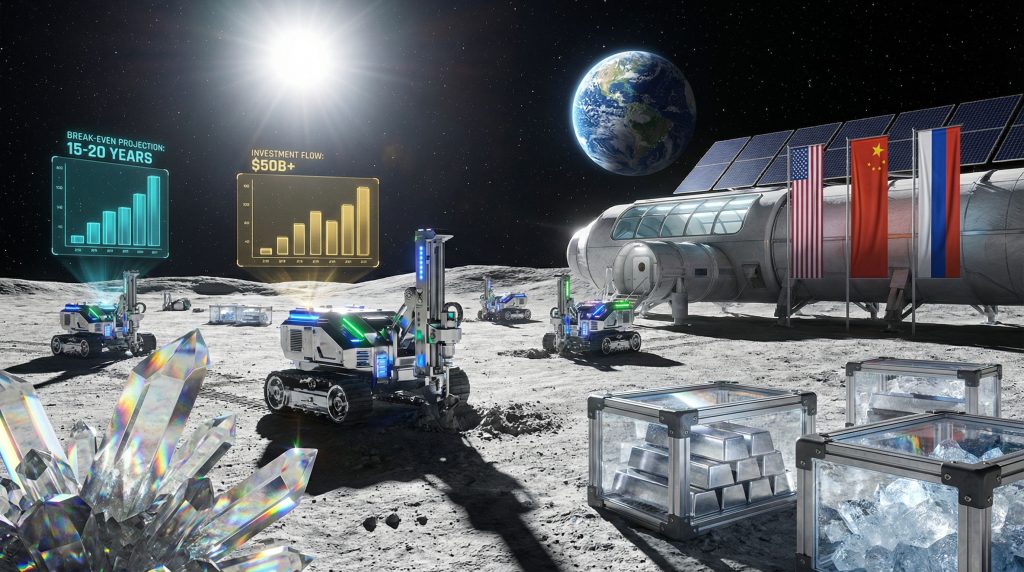
Optimistic Scenario (15-20 years):
- Rapid SpaceX/Blue Origin launch cost reduction to $1,000/kg lunar surface delivery
- Successful ISRU technology validation by 2030
- Mars mission architecture creating sustained fuel demand
- International cooperation reducing individual national investment requirements
Realistic Scenario (25-35 years):
- Steady technological progress with incremental cost reductions
- Gradual market development for space-based resources
- Mixed public-private funding models spreading investment risk
- Regional competition driving innovation while maintaining cooperation
Conservative Scenario (40+ years):
- Significant technical hurdles requiring breakthrough innovations
- Limited market demand constraining revenue generation
- Regulatory complications slowing commercial development
- Geopolitical tensions affecting international collaboration
Capital Requirements by Development Phase
| Phase | Investment Range | Primary Costs | Risk Level |
|---|---|---|---|
| Resource mapping & validation | $5-10 billion | Robotic missions, testing facilities | High |
| Technology development | $20-50 billion | R&D, prototype systems, Earth testing | Very High |
| Infrastructure deployment | $100-200 billion | Launch vehicles, mining equipment, processing facilities | Extreme |
| Commercial operations | $10-30 billion annually | Maintenance, expansion, workforce | Medium |
The next major ASX story will hit our subscribers first
Frequently Asked Questions About Lunar Mining Implementation
How Does Low Gravity Affect Mining Operations?
The Moon's gravitational field at one-sixth Earth strength creates unique engineering challenges and opportunities for resource extraction operations. Equipment designed for terrestrial use requires substantial modifications to function effectively in reduced gravity environments.
Key gravitational considerations include:
- Material handling systems: Conventional conveyor and transport mechanisms operate differently
- Dust control requirements: Lunar particles behave unpredictably in low gravity
- Equipment stability: Reduced surface adhesion affects machinery operation
- Human operator efficiency: Extended missions require adaptation protocols
Transportation of Mined Materials
Most lunar resources will remain in space for fuel production and construction rather than Earth return, creating orbital infrastructure supporting Mars missions and deep space exploration.
This space-based utilisation model fundamentally differs from terrestrial mining economics, where extracted materials typically return to surface markets. Lunar mining operations function as supply chains for space-based activities rather than Earth commodity markets.
Transportation priorities include:
- Fuel production facilities: Converting water ice to hydrogen and oxygen propellants
- Construction material processing: Transforming regolith into structural components
- Orbital depot establishment: Creating refueling stations for deep space missions
- Mars mission support: Enabling sustainable exploration beyond Earth orbit
Conflict Resolution for Competing Mining Claims
Current international frameworks provide limited mechanisms for resolving disputes between nations or companies targeting identical lunar resources. The absence of territorial sovereignty creates jurisdictional complications unprecedented in terrestrial mining law.
Existing precedent models include:
- Antarctic Treaty implementation: Peaceful cooperation despite territorial claims
- International waters mining: Deep sea resource extraction protocols
- Airspace management: Coordination systems for overlapping flight paths
- Spectrum allocation: Radio frequency sharing agreements between nations
Proposed resolution mechanisms:
- First-arrival priority systems: Establishing operational precedence rights
- Shared resource zones: Cooperative development of large deposits
- International arbitration panels: Neutral dispute resolution bodies
- Technology sharing agreements: Collaborative development reducing conflicts
Timeline Projections for Commercial Lunar Operations
The progression toward sustainable lunar mining operations follows technological development cycles, market demand growth, and international regulatory framework evolution across multiple decades. Meanwhile, the critical minerals outlook for space applications continues evolving as industries identify strategic materials essential for sustained off-world operations.
Near-Term Milestones (2026-2030)
Resource Characterisation Completion
Current robotic survey missions aim to complete comprehensive mapping of lunar resource distributions, particularly water ice concentrations at polar regions and rare earth element deposits across the surface.
Technology Validation Programs
- ISRU demonstration systems: Small-scale fuel production from lunar water ice
- Autonomous mining prototypes: Testing extraction equipment in lunar analog facilities
- Power generation validation: Nuclear and advanced solar systems for sustained operations
- Communication infrastructure: Establishing reliable Earth-Moon data links
Legal Framework Standardisation
International working groups target completion of non-binding guidelines for space resource activities, though enforcement mechanisms remain undeveloped.
Medium-Term Development (2030-2040)
Commercial Pilot Operations
First revenue-generating lunar resource extraction projects will likely focus on water ice processing for space-based fuel production, targeting Mars mission support and deep space exploration logistics. These operations will require data-driven mining strategies adapted for the unique challenges of lunar environments.
Infrastructure Establishment
| Infrastructure Type | Development Timeline | Investment Requirements |
|---|---|---|
| Power generation systems | 2032-2035 | $5-15 billion |
| Communication networks | 2030-2033 | $2-5 billion |
| Transportation systems | 2033-2038 | $20-50 billion |
| Processing facilities | 2035-2040 | $10-30 billion |
Technology Readiness Progression
Current technology readiness levels for key mining capabilities:
- Water ice extraction: TRL 4-5 (component validation in laboratory environments)
- Regolith processing: TRL 3-4 (analytical and experimental critical function proof-of-concept)
- Autonomous operations: TRL 5-6 (component validation in relevant environments)
- Power systems: TRL 6-7 (system prototype demonstration in operational environment)
Investment requirements to advance technologies to commercial readiness (TRL 8-9):
- Extraction systems: $5-10 billion in R&D and testing
- Processing capabilities: $10-20 billion for full-scale development
- Transportation infrastructure: $20-40 billion for reliable logistics
- Life support systems: $5-15 billion for human operations
Long-Term Industry Maturation (2040+)
Full-Scale Commercial Operations
Mature lunar mining operations supporting Mars colonisation efforts and permanent space-based manufacturing capabilities represent the ultimate commercial objective. These systems will operate independently of Earth-based supply chains while generating sustainable revenue streams.
Economic Integration Scenarios
The development of a true Earth-Moon economic system requires:
- Manufacturing capabilities: Space-based production facilities utilising lunar materials
- Population centres: Permanent lunar settlements creating sustained demand
- Transportation networks: Regular cargo and passenger services between Earth and Moon
- Financial systems: Banking and investment frameworks for space-based commerce
Market maturation indicators include:
- Multiple competing operators: Commercial competition driving efficiency improvements
- Standardised technologies: Interoperable systems reducing operational complexity
- Regulatory clarity: Established legal frameworks providing investment certainty
- Sustained profitability: Self-funding operations independent of government subsidies
The realisation of these long-term projections depends on sustained international cooperation, technological breakthrough achievements, and market demand development that current analysis can only estimate. However, the fundamental economic drivers supporting space-based resource utilisation continue strengthening as human activities expand beyond Earth orbit.
Disclaimer: This analysis contains forward-looking projections based on current technological capabilities and market trends. Actual development timelines may vary significantly due to technological challenges, regulatory changes, market conditions, and geopolitical factors beyond current predictive capacity. Investment decisions should consider substantial risks associated with emerging space commerce sectors.
Looking for Investment Opportunities in Space Mining and Frontier Technologies?
Discovery Alert's proprietary Discovery IQ model delivers real-time notifications on significant ASX mineral discoveries that could benefit from emerging space-based resource extraction technologies and frontier mining innovations. Stay ahead of market developments by exploring Discovery Alert's proven track record of identifying transformational discoveries that have generated substantial returns for early investors.