August 8, 2026
The Strategic Imperative Behind Lunar Nuclear Development
The race to put a nuclear reactor on the moon has emerged as one of the most critical technological competitions of the 21st century. Nations worldwide recognise that establishing reliable nuclear power systems on the lunar surface represents far more than a scientific achievement—it defines which countries will control humanity's expansion into space.
Unlike terrestrial nuclear programs designed primarily for energy generation, lunar nuclear reactors serve as the foundation for permanent human settlements, advanced resource extraction operations, and deep space exploration capabilities. The nation that successfully deploys the first operational nuclear reactor on the moon gains unprecedented strategic advantages that could reshape global power dynamics for decades.
Key Strategic Drivers:
- Territorial Control: Nations with functioning lunar nuclear infrastructure establish exclusive operational zones around their installations
- Resource Access: Continuous power enables year-round mining of valuable lunar materials including helium-3 and rare earth elements
- Deep Space Gateway: The Moon serves as a launching platform for Mars missions and asteroid mining advances
- Scientific Dominance: Uninterrupted research capabilities during harsh 14-day lunar nights when temperatures drop to -230°F
The strategic implications extend beyond national prestige. Countries that achieve first operational lunar nuclear power position themselves to lead the emerging trillion-dollar space economy whilst potentially establishing legal precedents for lunar territorial claims under existing international space law frameworks.
When big ASX news breaks, our subscribers know first
Technical Challenges That Define the Competition
Power Requirements for Sustained Lunar Operations
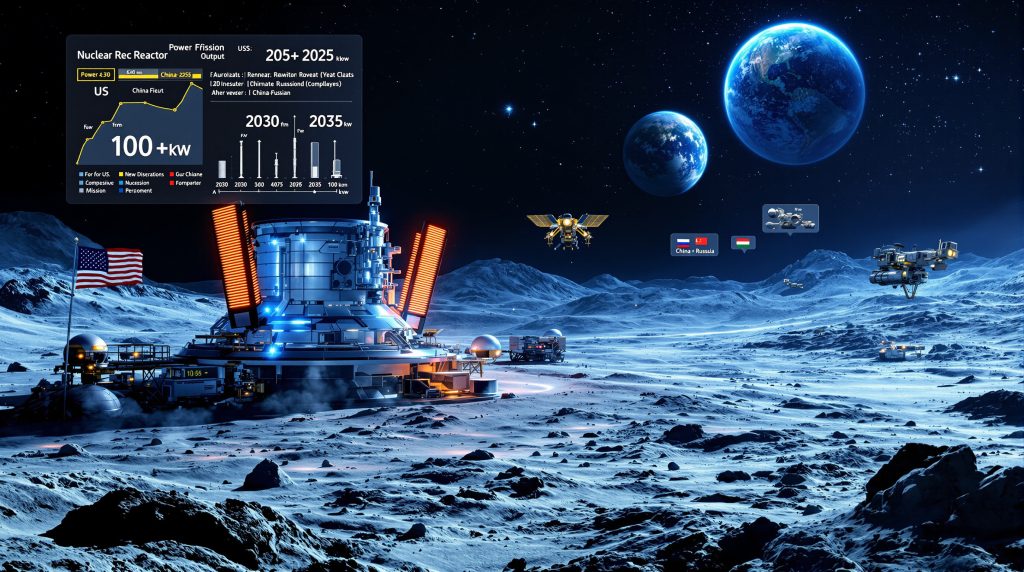
Modern lunar missions demand substantially more electrical power than the Apollo programme ever required. Current mission planners estimate needing at least 100 kilowatts of continuous electrical power to support comprehensive lunar operations including life support systems for permanent crews, industrial equipment for resource processing, communication arrays maintaining Earth contact, heating systems during extreme lunar nights, and sophisticated scientific instrumentation.
Comparison of Lunar Power Sources:
| Power Source | Capacity | Duration | Lunar Night Performance | Mass Constraints |
|---|---|---|---|---|
| Solar Arrays | 10-50 kW | Limited by dust accumulation | Zero output | Moderate |
| Radioisotope Generators | 0.1-1 kW | 10-15 years | Consistent | Low |
| Nuclear Fission Reactors | 100+ kW | 20+ years | Full capacity | High |
| Battery Storage Systems | Variable | Hours to days | Limited duration | Very High |
Engineering Obstacles Unique to Lunar Deployment
Mass and Size Constraints: Rocket payload limitations restrict complete reactor systems to approximately 3,500 kilograms total mass, requiring revolutionary compact designs that maintain safety standards and operational efficiency whilst fitting within launch vehicle fairings.
Heat Rejection Crisis: Without atmospheric convection for cooling, lunar reactors must rely entirely on radiative heat dissipation systems. This fundamental challenge requires innovative heat exchanger designs capable of operating in the vacuum of space whilst managing extreme temperature variations between lunar day and night cycles.
Autonomous Operation Requirements: Lunar nuclear reactors must function with minimal human intervention for extended periods, incorporating advanced monitoring systems and self-diagnostic capabilities that exceed terrestrial nuclear plant automation by orders of magnitude.
Micrometeorite Protection: Reactor systems require specialised shielding to protect against constant bombardment from space debris and micrometeorites that could damage critical components over multi-decade operational lifespans.
United States Lunar Nuclear Strategy and Timeline
NASA's Fission Surface Power Program
The United States approach centres on deploying a fully assembled, launch-ready fission reactor by 2030. This ambitious timeline leverages strategic partnerships between NASA, the Department of Energy, and leading aerospace contractors including Lockheed Martin, X-energy, and Westinghouse Electric Company.
Technical Specifications:
- Power Output: Minimum 100 kilowatts of electrical generation capacity
- Operating Life: 20+ years of continuous autonomous operation
- Fuel Type: High-Assay Low-Enriched Uranium (HALEU) similar to terrestrial advanced reactor fuel
- Cooling System: Closed Brayton cycle gas turbine with advanced radiative heat rejection
- Control Systems: Triple-redundant automated control mechanisms
Commercial Partnership Model
Unlike previous government-only space programmes, the U.S. lunar nuclear initiative emphasises commercial innovation through competitive contract structures. This approach aims to accelerate development timelines through private sector efficiency, reduce total programme costs through competitive bidding processes, leverage existing commercial nuclear expertise, and create sustainable lunar power industry foundations.
Industry Response: Major nuclear contractors have submitted detailed technical proposals for reactor designs optimised specifically for lunar deployment conditions. Several prototype systems are currently undergoing terrestrial testing at national laboratory facilities, with component validation programmes demonstrating key technologies under simulated lunar conditions.
The competitive structure has generated multiple innovative approaches to lunar nuclear reactor design, from compact fast reactors to modular systems that can be assembled on the lunar surface from multiple smaller components delivered in separate launches.
China-Russia Collaborative Lunar Nuclear Programme
Joint Development Timeline and Objectives
The China-Russia partnership targets lunar nuclear reactor deployment between 2035-2036, focusing on powering their planned International Lunar Research Station. This strategic collaboration combines Russian nuclear expertise developed over decades of space reactor programmes with Chinese lunar surface operations knowledge gained through successful Chang'e missions.
Partnership Advantages:
- Russian Nuclear Heritage: Decades of space reactor experience from the TOPAZ programme and nuclear submarine technologies
- Chinese Lunar Intelligence: Comprehensive mineral mapping and surface composition data from multiple lunar missions
- Shared Financial Resources: Combined funding capabilities exceeding individual national space budgets
- Complementary Technologies: Russia's power systems expertise paired with China's precision landing and surface operations capabilities
Strategic Advantages of the Partnership
Alternative Development Timeline: Their later deployment schedule allows learning from potential U.S. early deployment challenges whilst potentially delivering more advanced second-generation reactor systems incorporating lessons learned from the first operational lunar nuclear facility.
Resource Mapping Intelligence: China's extensive lunar mineral surveys, particularly detailed helium-3 deposit locations and rare earth element concentrations, inform optimal reactor placement strategies for future large-scale mining operations that could generate substantial economic returns.
International Precedent: The joint programme establishes precedent for international cooperation in lunar nuclear development, potentially attracting additional partner nations and expanding the operational scope of their lunar research station.
Technical Innovations Driving Lunar Nuclear Development
Advanced Reactor Design Solutions
Compact Core Architecture: Nuclear engineers are developing reactor cores with unprecedented power density ratios, utilising advanced fuel geometries and enhanced neutron economy designs to maximise electrical output within strict size and mass constraints imposed by launch vehicle capabilities.
Integrated Heat Management: Revolutionary heat pipe systems and liquid metal cooling loops enable efficient thermal management without relying on atmospheric convection, incorporating advanced materials capable of withstanding extreme temperature cycling between lunar day and night conditions.
Modular Assembly Concepts: Innovative designs feature reactors that can be assembled on the lunar surface from multiple smaller components, potentially overcoming single-launch mass limitations whilst providing redundancy and maintenance capabilities for extended operational periods.
Safety Systems for Remote Operation
Passive Safety Features: Lunar reactor designs incorporate inherent safety characteristics that prevent dangerous operating conditions without requiring active human intervention, utilising physics-based safety mechanisms that function reliably during extended unmanned operation periods.
Furthermore, nuclear waste disposal considerations for lunar operations present unique challenges requiring specialised containment solutions designed for the space environment.
Redundant Control Systems: Multiple independent control mechanisms ensure reliable reactor shutdown capability even if primary control systems fail during autonomous operation phases, with backup systems designed to operate reliably for decades without maintenance.
Advanced Containment Innovation: Specialised containment structures protect reactor systems against micrometeorite impacts whilst maintaining structural integrity during extreme lunar temperature cycles, incorporating materials and designs specifically developed for the space environment.
Economic and Strategic Implications of Lunar Nuclear Success
First-Mover Advantages in Space Commerce
The nation achieving first operational lunar nuclear power deployment gains significant strategic advantages that extend far beyond scientific prestige. Exclusive Operational Zones may be recognised under evolving interpretations of international space law around functioning nuclear facilities, potentially granting de facto territorial control over valuable lunar regions.
Resource Extraction Priority: Continuous power availability enables year-round mining operations for helium-3, rare earth elements, and other valuable materials, whilst competitors relying on solar power face operational limitations during 14-day lunar nights.
In addition, these developments align closely with broader mining industry innovation trends that emphasise automated operations and sustainable resource extraction techniques.
Commercial Space Leadership: Reliable lunar power infrastructure attracts international partnerships, commercial ventures, and private investment in lunar operations, creating economic multiplier effects that extend to terrestrial industries.
Long-term Economic Impact Projections
Lunar Resource Market Development: Successful nuclear power deployment could unlock a multi-trillion-dollar lunar economy based on rare element extraction, zero-gravity manufacturing capabilities, and space tourism infrastructure development over the coming decades.
However, uranium market trends significantly influence the cost and availability of reactor fuel, potentially affecting long-term operational economics for lunar nuclear facilities.
Technology Transfer Benefits: Technical innovations developed specifically for lunar nuclear systems often find valuable applications in terrestrial energy systems, creating additional economic value through intellectual property licensing and advanced manufacturing capabilities.
Space Industry Catalyst: Reliable lunar power infrastructure accelerates development timelines for Mars missions, asteroid mining operations, and deep space exploration capabilities, positioning the successful nation as the leader in humanity's expansion throughout the solar system.
The next major ASX story will hit our subscribers first
Current Development Status and Milestones
U.S. Programme Progress Indicators
Industry Engagement: NASA has received multiple comprehensive technical proposals from major contractors, with preliminary design reviews currently underway for several competing reactor concepts that demonstrate varying approaches to lunar nuclear power challenges.
Component Testing Initiatives: Terrestrial prototype testing of critical components, including advanced heat rejection systems and autonomous control mechanisms, is progressing at national laboratory facilities with simulated lunar environment conditions.
Regulatory Framework Development: The Nuclear Regulatory Commission is developing specialised licensing procedures for space nuclear systems, streamlining approval processes for lunar deployment whilst maintaining safety standards appropriate for space operations.
According to NASA's recent announcement, the agency is fast-tracking efforts to meet ambitious deployment targets.
Budget Allocation: Congressional appropriations for the Fission Surface Power programme demonstrate sustained political support for lunar nuclear development, with funding levels indicating serious commitment to meeting 2030 deployment targets.
International Competition Assessment
China's Preparatory Activities: Recent Chang'e missions include technology demonstrations directly relevant to nuclear reactor deployment capabilities, including precision landing systems, surface operations equipment, and extended-duration lunar operations that validate long-term mission planning.
Russia's Technical Contributions: Available information suggests Russia is adapting proven space nuclear reactor technologies from previous programmes for lunar applications, potentially accelerating their development timeline through leveraging existing technological foundations.
European Positioning: While not directly competing in lunar nuclear deployment, European Space Agency partnerships with both U.S. and Chinese programmes position European nations to benefit from successful lunar nuclear development regardless of which nation achieves first operational deployment.
Why Is Lunar Nuclear Power Critical for Space Exploration?
The strategic significance of the race to put a nuclear reactor on the moon extends beyond immediate lunar applications. These systems establish technological foundations for permanent human presence throughout the solar system, addressing fundamental energy security imperatives that define humanity's future in space.
Mars Mission Enablement: Technical expertise and operational experience gained from lunar nuclear reactor deployment directly translates to Mars surface power systems, where solar energy proves even less viable than on the Moon due to greater distance from the Sun and frequent dust storms.
Deep Space Infrastructure Development: Reliable space nuclear power capabilities enable construction of large-scale space stations, orbital manufacturing facilities, and interplanetary refuelling depots that support sustained human presence beyond Earth orbit.
Scientific Revolution Potential: Continuous high-power availability transforms lunar research capabilities, enabling sophisticated laboratory facilities and advanced manufacturing operations that could revolutionise materials science, pharmaceutical development, and other fields benefiting from low-gravity environments.
What Are the Main Technical Hurdles?
Several critical engineering challenges must be overcome for successful lunar nuclear deployment:
Thermal Management: Without atmospheric cooling, reactors must dissipate waste heat through radiation alone, requiring innovative heat exchanger designs.
Mass Optimisation: Launch constraints demand ultra-compact reactor designs whilst maintaining power output and safety margins.
Autonomous Operation: Systems must operate reliably for decades without maintenance, incorporating advanced diagnostic and self-repair capabilities.
Environmental Protection: Reactor systems require shielding against micrometeorite impacts, extreme temperature cycling, and space radiation exposure.
Furthermore, experts at The Conversation highlight the complexity of site selection for lunar nuclear installations.
Future Implications for Space Exploration
The successful deployment of nuclear reactors on the moon represents a pivotal moment in human space exploration history. Beyond immediate lunar applications, these systems establish technological foundations for permanent human presence throughout the solar system.
The race to put a nuclear reactor on the moon ultimately determines which nations will lead humanity's expansion into the solar system, making this technological competition one of the most strategically significant challenges defining international relations and economic development in the coming decades. Success in this endeavour positions nations not merely as space exploration leaders, but as architects of humanity's multi-planetary future.
Consequently, the stakes of this competition extend far beyond scientific achievement, encompassing economic dominance, strategic advantage, and leadership in humanity's greatest adventure—the colonisation of space.
Disclaimer: This analysis incorporates publicly available information about national space programmes and nuclear technology development. Specific technical details, timelines, and strategic assessments may change as programmes evolve. Readers should consult official government sources for the most current information regarding national space nuclear development initiatives.
Ready to Capitalise on Nuclear and Mining Opportunities?
Whilst nations race to deploy nuclear reactors on the moon, terrestrial nuclear and mining opportunities continue to present immediate investment potential for astute investors. Discovery Alert's proprietary Discovery IQ model delivers real-time alerts on significant ASX mineral discoveries, including uranium and rare earth elements critical to nuclear programmes, instantly empowering subscribers to identify actionable opportunities ahead of the broader market. Begin your 30-day free trial today at Discovery Alert and secure your market-leading advantage.