May 21, 2026
Understanding the Engineering Challenges of Lunar Resource Extraction
Space mining represents one of humanity's most ambitious technological frontiers, requiring fundamental reimagining of terrestrial equipment design principles. The vacuum environment, extreme temperature fluctuations, and reduced gravitational forces of lunar terrain demand specialized solutions like the vermeer lunar surface miner that push conventional mining industry evolution beyond its traditional operational parameters.
Current surface mining equipment operates within Earth's atmospheric envelope, relying on air cooling, standard hydraulic systems, and gravitational assistance for material handling. Lunar operations must function in conditions where traditional cooling mechanisms fail, where dust particles carry electrostatic charges, and where equipment must operate autonomously for extended periods without human intervention.
When big ASX news breaks, our subscribers know first
What Makes Lunar Surface Mining Technically Feasible?
Regolith Processing Requirements and Specifications
Lunar regolith processing demands entirely different approaches compared to terrestrial mining operations. The material consists of fine-grained particles created by billions of years of meteorite impacts, presenting unique handling challenges in the Moon's low-gravity environment.
| Parameter | Lunar Conditions | Earth Conditions |
|---|---|---|
| Gravity | 1.62 m/s² (16.5% of Earth) | 9.81 m/s² |
| Atmosphere | Complete vacuum | Standard atmospheric pressure |
| Temperature Range | -173°C to 127°C | -40°C to 50°C (typical mining) |
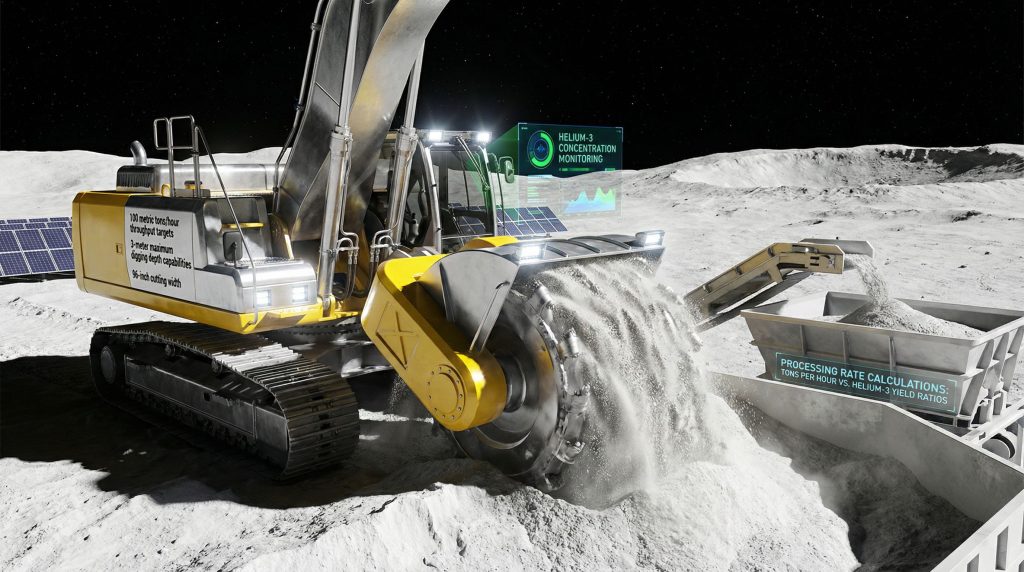
| Processing Capacity Target | 100 metric tons/hour | Variable by application |
The reduced gravitational field significantly impacts material flow dynamics, requiring redesigned conveyor systems and processing mechanisms. Traditional gravity-fed systems must be replaced with active material handling technologies that function reliably in vacuum conditions.
Material processing rates become critical when considering the economics of lunar operations. Target throughput rates of 100 metric tons per hour represent the minimum viable scale for commercial helium-3 extraction operations, accounting for the extremely low concentrations of the isotope in lunar regolith.
Power Systems and Energy Efficiency Constraints
Electric drive systems emerge as the preferred solution for lunar surface mining equipment, offering reduced maintenance requirements compared to hydraulic alternatives. The vacuum environment eliminates traditional cooling methods, making thermal management a primary engineering constraint.
Furthermore, power consumption optimisation becomes crucial during the 14-day lunar day cycle, when solar energy availability peaks. Battery storage systems must maintain operations during the equally long lunar night, requiring unprecedented energy density and thermal stability in extreme conditions.
The absence of atmospheric cooling necessitates radiative heat dissipation systems, fundamentally altering equipment design parameters. Additionally, power systems must operate efficiently across temperature ranges exceeding 300°C variation, demanding specialised materials and thermal management strategies.
Dust Mitigation and Environmental Control Systems
Lunar dust particles measure 50 times finer than terrestrial equivalents and carry persistent electrostatic charges that cause adhesion to equipment surfaces.
This unique characteristic of lunar regolith creates operational challenges unknown in terrestrial mining. The electrostatically charged particles adhere to mechanical components, solar panels, and optical systems, potentially degrading performance over extended operations.
Sealed operation compartments become mandatory rather than optional, requiring comprehensive filtration technologies that function in vacuum conditions. Traditional dust suppression methods using water or chemical agents cannot operate in the lunar environment.
However, surface disturbance minimisation protocols must account for the lack of atmospheric settling mechanisms. Disturbed regolith remains airborne indefinitely in the vacuum environment, creating operational hazards for equipment and future landing operations.
How Do Terrestrial Surface Miners Adapt to Lunar Conditions?
Mechanical Design Modifications for Vacuum Operations
Hydrostatic drive systems offer significant advantages in the extreme temperature variations encountered on the lunar surface. These systems maintain operational efficiency across the -173°C to 127°C temperature range, providing consistent performance during both lunar day and night cycles.
Chain-drive mechanisms require fundamental redesign for regolith extraction applications. Traditional cutting systems rely on atmospheric cooling and lubrication systems that cannot function in vacuum conditions. In addition, direct-drive alternatives eliminate many failure points while reducing maintenance requirements.
The low-gravity environment reduces tractive force requirements, allowing for lighter equipment designs while maintaining excavation capabilities. Consequently, this weight reduction becomes critical for transportation to lunar surface locations, where every kilogram represents significant launch costs.
Autonomous Operation and Remote Control Capabilities
Navigation systems must function without GPS satellites, requiring alternative positioning technologies. Lunar-based navigation relies on Earth-based tracking systems or dedicated lunar satellite constellations, both presenting unique technical challenges for precision equipment operation.
Communication delays between Earth and Moon create a minimum 1.3-second lag for control signals, making real-time remote operation impossible. This delay necessitates sophisticated autonomous systems capable of independent decision-making during excavation operations.
For instance, pre-programmed excavation patterns become essential for operational efficiency. Equipment must navigate obstacles, optimise cutting paths, and maintain safety protocols without continuous human oversight, requiring advanced AI in mining operations and sensor integration.
Material Extraction and Processing Integration
Continuous ingestion and deposition workflows must account for the unique properties of lunar regolith. The fine-grained nature of the material, combined with electrostatic effects, requires specialised handling systems that prevent material adhesion and ensure consistent flow rates.
| Surface Miner Model | Cutting Depth | Cutting Width | Processing Rate |
|—|—|—|
| Terrestrial SM55 | 3.0 metres | 2.44 metres | 415 hp capacity |
| Lunar Adaptation | 3.0 metres | 2.44 metres | Modified for vacuum |
| Commercial Scale | Variable | Up to 4.0 metres | 500+ tons/hour |
Quality control systems for helium-3 concentration monitoring require real-time analysis capabilities integrated into the extraction process. The extremely low concentrations of helium-3 in lunar regolith, estimated at 10-15 parts per billion, demand precise measurement and collection systems.
What Are the Key Technical Specifications for Lunar Excavators?
Excavation Performance Metrics
Three-metre maximum digging depth capabilities represent the current technical limit for lunar surface mining equipment. This depth provides access to regolith layers with varying helium-3 concentrations while maintaining equipment stability in the low-gravity environment.
Cutting width adaptations focus on maximising material processing while maintaining equipment transportability. The 2.44-metre (96-inch) width represents the optimal balance between processing capacity and rocket payload constraints for Earth-to-Moon transportation.
Processing rate calculations must account for helium-3 yield ratios, where extremely low concentrations require processing massive quantities of regolith to obtain commercially viable amounts of the isotope. Efficiency calculations suggest processing rates exceeding 1,000 tons per kilogram of helium-3 extracted.
Equipment Durability and Maintenance Requirements
Lunar mining equipment must operate continuously for months without direct human intervention or traditional maintenance protocols.
This operational requirement demands unprecedented reliability standards and component redundancy for all critical systems. Traditional maintenance schedules become impossible, requiring self-diagnostic capabilities and predictive maintenance protocols integrated into equipment design.
Component redundancy extends beyond simple backup systems to include modular replacement capabilities. Equipment must continue operations with partial system failures while maintaining safety and efficiency standards throughout extended operational campaigns.
Self-diagnostic capabilities must identify potential failures before they occur, enabling predictive maintenance scheduling aligned with lunar transportation windows. These systems require sophisticated sensor integration and machine learning algorithms adapted for space environments.
Transportation and Deployment Logistics
Modular design requirements stem from rocket payload constraints, where every component must fit within available launch vehicle dimensions and mass limitations. Current heavy-lift vehicles limit payload sizes to approximately 50 tons for lunar surface delivery.
Assembly procedures in the lunar environment require specialised tooling and techniques adapted for vacuum conditions and bulky pressure suits. Traditional assembly methods must be redesigned for gloved hands and limited visibility through helmet systems.
However, equipment lifecycle planning spans 10+ year operational periods, requiring component selection and design approaches that account for radiation exposure, thermal cycling, and mechanical wear in the unique lunar environment.
How Does Helium-3 Extraction Technology Function?
Isotope Separation and Collection Methods
Thermal processing of lunar regolith involves heating extracted material to approximately 600°C to release trapped helium-3 isotopes. This process requires significant energy input and sophisticated thermal management systems adapted for vacuum operations.
Helium-3 concentrations vary significantly across different lunar regions, with polar areas potentially containing higher concentrations due to solar wind deposition patterns. Mare regions average 10-15 parts per billion, while highland areas may contain lower concentrations.
Furthermore, storage and transportation systems for extracted helium-3 must maintain isotope purity while withstanding the thermal and radiation environment of cislunar space. Specialised containment systems ensure material integrity during the multi-day journey from lunar surface to Earth orbit.
Processing Efficiency and Yield Optimisation
| Lunar Region | Estimated He-3 Concentration | Processing Requirements |
|---|---|---|
| Mare Tranquillitatis | 15 ppb | 67,000 tons regolith/kg He-3 |
| Mare Imbrium | 12 ppb | 83,000 tons regolith/kg He-3 |
| Polar Highlands | 8 ppb | 125,000 tons regolith/kg He-3 |
| Optimal Sites | 20 ppb | 50,000 tons regolith/kg He-3 |
Energy input versus output calculations reveal the massive scale required for viable helium-3 extraction operations. Current estimates suggest processing 50,000 to 125,000 tons of regolith per kilogram of helium-3 extracted, depending on site selection and processing efficiency.
Waste heat management becomes a critical consideration given the energy-intensive nature of thermal processing. Heat recovery systems must operate in vacuum conditions while maintaining processing temperatures and equipment thermal stability.
Quality Assurance and Purity Standards
Contamination prevention during extraction and storage requires comprehensive environmental control systems that function in vacuum conditions. Traditional contamination prevention methods relying on atmospheric barriers cannot operate in the lunar environment.
Testing protocols for helium-3 purity verification must operate autonomously with minimal human oversight. Real-time analysis capabilities ensure extracted material meets commercial specifications before storage and transportation to Earth markets.
In addition, chain of custody requirements for lunar-to-Earth transport involve documentation and verification systems that maintain material integrity throughout the supply chain. These protocols ensure extracted helium-3 meets quality standards for high-technology applications.
What Infrastructure Requirements Support Lunar Mining Operations?
Landing Pad Construction and Site Preparation
Surface preparation requirements for heavy equipment deployment extend beyond simple levelling operations. The lunar surface must be stabilised to prevent dust generation during spacecraft operations while providing stable foundations for mining equipment.
Dust control during spacecraft landing and takeoff operations requires infrastructure design that minimises regolith disturbance. Landing pad construction using in-situ materials provides stable surfaces while reducing the need for Earth-supplied construction materials.
Equipment positioning and operational zone establishment must account for the unique challenges of lunar geography, including crater avoidance, optimal solar exposure, and proximity to high-concentration helium-3 deposits.
Power Generation and Distribution Systems
Solar panel arrays sized for lunar day/night cycles require massive energy storage systems to maintain operations during two-week dark periods. Current lithium-ion technology may require supplementation with alternative energy storage methods for sustained operations.
Nuclear power options for continuous operations present attractive alternatives to solar-battery combinations. Small modular reactors designed for lunar deployment could provide consistent power output independent of solar cycles.
Power grid design for multiple excavation sites requires distribution systems adapted for vacuum conditions and extreme temperature variations. Cable systems must withstand thermal cycling while maintaining electrical integrity over extended distances.
Communication and Data Management Networks
Real-time telemetry systems for equipment monitoring must function across Earth-Moon distances with inherent communication delays. Data buffering and autonomous decision-making capabilities become essential for operational efficiency.
Data-driven operations require high-bandwidth communication systems capable of transmitting large volumes of operational and scientific data. Current deep space communication networks may require enhancement for commercial mining operations.
Backup communication protocols for emergency situations must provide redundant pathways for critical safety and operational communications. These systems ensure continued operations during primary communication system failures.
The next major ASX story will hit our subscribers first
What Are the Operational Timeline and Deployment Phases?
Mission Validation and Testing Phases (2027-2029)
Resource validation mission objectives focus on confirming helium-3 concentrations at selected lunar sites while testing extraction equipment under actual operational conditions. These missions establish baseline data for commercial viability assessments.
Pilot plant deployment and initial operational testing provide critical performance data for full-scale operations planning. Early missions validate equipment functionality while refining operational procedures for autonomous operations.
Performance benchmarking against terrestrial surface mining standards establishes efficiency metrics adapted for lunar conditions. These benchmarks guide equipment optimisation and operational procedure refinement for commercial-scale deployments.
Commercial Scale-Up Planning (2030s)
Fleet expansion strategies for multiple excavation sites require coordinated logistics and supply chain management across Earth-Moon distances. Multiple equipment deployments maximise operational efficiency while providing redundancy for critical operations.
Production scaling from pilot to commercial volumes demands infrastructure expansion including additional power generation, processing facilities, and transportation systems. Commercial viability requires processing capabilities exceeding current pilot programme scales by orders of magnitude.
Integration with lunar base development initiatives provides synergies between mining operations and broader lunar infrastructure development. Shared facilities and resources reduce overall operational costs while supporting multiple lunar activities.
Long-Term Operational Sustainability
| Timeframe | Operational Costs ($/kg He-3) | Market Value ($/kg He-3) | Net Margin |
|—|—|—|
| 2030-2032 | $15,000,000 | $1,000,000 | Negative |
| 2033-2037 | $8,000,000 | $2,500,000 | Negative |
| 2038-2042 | $3,000,000 | $5,000,000 | Positive |
| 2043+ | $1,500,000 | $10,000,000 | Strong Positive |
Equipment replacement and upgrade schedules must account for technological advancement and equipment lifecycle management in the lunar environment. Regular technology refreshes ensure operational efficiency improvements and cost reductions over time.
Technology evolution and capability enhancement roadmaps guide long-term investment strategies for lunar mining operations. Continuous improvement in extraction efficiency, equipment reliability, and operational procedures drives commercial viability.
How Do Lunar Surface Miners Compare to Terrestrial Models?
Performance Specifications Across Operating Environments
The Vermeer SM55 surface miner, with its 415 horsepower capacity, represents the baseline technology for lunar adaptation. The terrestrial model's proven reliability and performance characteristics provide the foundation for space-qualified variants designed for lunar operations.
Larger models like the T1255III and T1655III offer increased processing capabilities that translate to higher throughput rates essential for commercial helium-3 extraction. These models require significant modifications for vacuum operations while maintaining their core excavation capabilities.
| Model | Power Output | Earth Productivity | Lunar Adaptation Status |
|---|---|---|---|
| SM55 | 415 hp | 350 tons/hour | Prototype development |
| T1255III | 755 hp | 600 tons/hour | Concept stage |
| T1655III | 1,200 hp | 1,000 tons/hour | Future consideration |
Operational efficiency comparisons between Earth and Moon operations reveal the unique challenges of lunar mining. While lunar gravity reduces energy requirements for excavation, the extreme environment and autonomous operation requirements offset many efficiency gains.
Cost-Benefit Analysis for Space-Grade Equipment
Development costs for space-qualified surface mining equipment exceed terrestrial equivalents by factors of 10-50, reflecting the specialised materials, testing, and certification requirements for space applications. These upfront investments require careful analysis against projected operational returns.
Operational cost per ton of processed material includes not only equipment operation but also transportation, maintenance, and replacement costs across Earth-Moon distances. Current estimates suggest operational costs of $100-500 per ton of processed regolith during initial commercial operations.
Return on investment calculations for helium-3 extraction operations depend heavily on future market demand and pricing for the isotope. Current projections suggest break-even points occurring 8-12 years after initial commercial operations begin, assuming consistent market development.
Technology Transfer and Innovation Applications
Terrestrial mining improvements derived from lunar equipment development include enhanced automation systems, improved dust control technologies, and advanced remote operation capabilities. These innovations benefit Earth-based mining operations in challenging environments.
Cross-industry applications for extreme environment excavation extend beyond mining to construction, disaster response, and infrastructure development in harsh conditions. Technologies developed for lunar operations find applications in Arctic, desert, and deep-sea environments.
Intellectual property and competitive advantages in surface mining technology create valuable assets for companies investing in lunar mining development. These technological advances position companies for leadership in both terrestrial and space-based resource extraction markets.
What Market Applications Drive Lunar Helium-3 Demand?
Quantum Computing and Advanced Technology Applications
Helium-3 cooling requirements for quantum processors represent the most immediate and highest-value market for lunar-extracted isotopes. Quantum computing systems require ultra-low temperatures achievable only through helium-3 dilution refrigeration systems.
Supply chain security for critical technology industries drives premium pricing for reliable helium-3 sources. Current terrestrial supplies derive primarily from nuclear weapons maintenance, creating supply uncertainty that lunar sources could resolve.
Market size projections for high-technology helium-3 applications suggest demand growth from current levels of 8 kilograms annually to potentially 100+ kilograms by the mid-2030s, driven by quantum computing expansion and advanced research applications.
Fusion Energy Research and Development
Helium-3 fuel requirements for fusion reactor research represent the long-term, highest-volume market for lunar extraction operations. Theoretical fusion reactors using helium-3 fuel produce minimal radioactive waste compared to deuterium-tritium alternatives.
Alternative fusion fuel comparisons reveal helium-3's advantages in clean energy production, though technological hurdles for helium-3 fusion exceed those for conventional fusion approaches. Commercial helium-3 fusion remains decades away from practical implementation.
Timeline alignment between lunar production capabilities and fusion technology maturity suggests overlap occurring in the 2040s, potentially creating massive demand for lunar-extracted helium-3 as fusion energy becomes commercially viable.
Global Supply Chain and Geopolitical Considerations
Current helium-3 scarcity stems from limited terrestrial production sources, primarily nuclear weapons stockpile maintenance programmes. This supply constraint creates opportunities for lunar sources to capture premium pricing in established markets.
International competition for lunar resource extraction rights involves complex legal and diplomatic considerations under current space law frameworks. The Outer Space Treaty and subsequent agreements create uncertainty around resource ownership and extraction rights.
However, strategic resource implications for national technology leadership drive government interest in lunar helium-3 capabilities. Nations view secure helium-3 supplies as essential for quantum computing and advanced technology competitiveness.
Future Prospects for Vermeer Lunar Surface Miner Technology
The development of the vermeer lunar surface miner represents a convergence of terrestrial mining expertise and space technology innovation. Companies like Vermeer Corporation are pioneering this transformation by adapting their proven surface mining equipment for lunar conditions.
These advanced systems integrate 3D geological modelling capabilities to optimise extraction patterns across lunar terrain. Furthermore, the technology builds upon decades of terrestrial surface mining experience while incorporating cutting-edge solutions for vacuum operation.
The broader implications extend beyond lunar operations to terrestrial applications. Innovations developed for lunar mining contribute to asteroid mining advances, creating a new paradigm for space-based resource extraction across the solar system.
Interlune's recent unveiling of their full-scale prototype excavator demonstrates the rapid progress in lunar mining technology development. These systems represent the future of space resource utilisation, with operational deployments expected within the current decade.
This analysis represents current understanding of lunar mining technologies and market conditions. Future developments may significantly alter operational parameters, costs, and market dynamics discussed in this assessment. Investment decisions should account for the speculative nature of space resource extraction and the extended development timelines required for commercial viability.
Are You Ready to Invest in the Next Major Mineral Discovery?
While lunar mining represents the future of resource extraction, significant mineral discoveries continue to emerge right here on Earth through ASX announcements. Discovery Alert instantly alerts investors to major ASX mineral discoveries using its proprietary Discovery IQ model, turning complex geological data into actionable insights that help identify the next breakthrough before the broader market catches on. Begin your 14-day free trial today and position yourself ahead of the market for terrestrial discoveries whilst space mining technology develops over the coming decades.