
May 10, 2026
Lynas Rare Earths shares represent one of the most strategically positioned investments in the global transition towards energy independence and technological sovereignty. As governments worldwide recognise the vulnerabilities inherent in concentrated supply chains, the handful of companies capable of producing these critical raw materials supply outside Chinese control have emerged as uniquely positioned beneficiaries. Within this context, understanding the operational fundamentals and competitive dynamics shaping these producers becomes essential for evaluating their long-term investment potential.
Market Forces Driving Non-Chinese Rare Earth Producer Valuations
The strategic importance of rare earth elements extends far beyond their commodity characteristics. Unlike traditional mining materials where supply diversification exists globally, rare earth processing capabilities remain concentrated within a handful of facilities worldwide. China currently processes approximately 70-80% of global rare earth elements despite producing only 40-45% of mined rare earth oxides, according to the U.S. Geological Survey's 2024 Mineral Commodity Summaries. Furthermore, this processing concentration creates fundamental supply chain vulnerabilities that Western governments increasingly recognise as national security concerns.
The geopolitical premium embedded in non-Chinese rare earth producer valuations reflects structural policy support rather than cyclical market dynamics. The United States imported 100% of its rare earth element requirements from China in 2023, highlighting the dependency that drives strategic purchasing initiatives and government support programs. In addition, Japan has allocated over ¥100 billion in budget resources for rare earth supply chain development, whilst the U.S. Defense Production Act has been invoked specifically for rare earth supply chain strengthening.
Technical Complexity Creates Natural Barriers to Entry
Rare earth element separation from mined ore requires sophisticated hydrometallurgical processes that represent 60-70% of total production costs. Consequently, this technical complexity explains why mining capacity alone provides limited value without corresponding processing capabilities. Environmental permitting for rare earth processing facilities typically requires 5-10 years due to waste management complexity, creating natural competitive moats for established producers.
The separation and purification processes demand specialised expertise in handling radioactive materials and managing complex chemical separation techniques. However, neodymium-praseodymium (NdPr) production requires purity standards exceeding 99.5% for high-performance permanent magnet applications, demonstrating the technical precision necessary for premium market participation.
When big ASX news breaks, our subscribers know first
Demand Fundamentals Beyond Electric Vehicle Applications
While electric vehicle growth captures significant market attention, rare earth demand extends across multiple expanding sectors with distinct growth trajectories. For instance, wind turbines using permanent magnet generators require approximately 500-600 kg of rare earth elements per megawatt of capacity, according to the International Energy Agency's Critical Minerals report. With global renewable energy capacity increasing 12% in 2023 to reach 4,600 GW, wind power expansion alone represents substantial demand growth.
The critical minerals energy transition scenario projects wind capacity reaching 8,500 GW by 2050, requiring approximately 4-5 million tonnes of rare earth oxides cumulatively. This demand visibility extends beyond typical commodity cycles, driven by regulatory mandates for renewable energy adoption and emissions reductions rather than economic cycles.
Defence and Industrial Automation Applications
Military radar systems, missile guidance systems, and advanced electronics require specific rare earth elements for specialised applications. Increased global defence spending creates additional demand layers independent of civilian energy transition trends. Furthermore, industrial automation systems utilise servo motors requiring permanent magnets, with global factory automation spending exceeding $200 billion in 2023.
Each electric vehicle motor requires approximately 1 kg of neodymium-praseodymium alloy, and with global EV sales reaching 13.6 million units in 2023, automotive demand represents significant volume. However, the breadth of applications across wind energy, defence, and industrial sectors provides demand diversification that reduces dependence on any single end market.
Operational Performance and Production Analysis
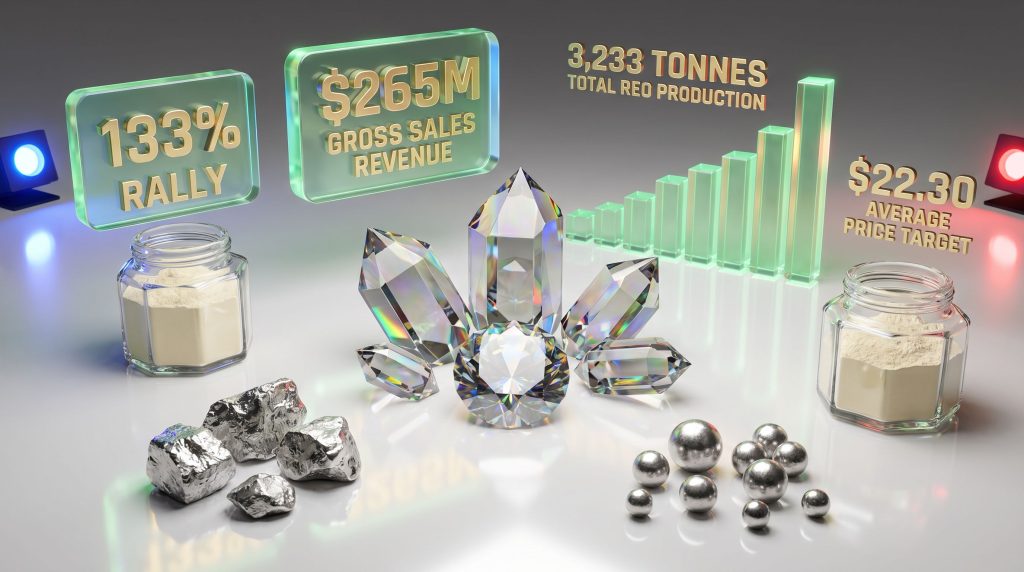
Lynas Rare Earths shares demonstrated significant operational momentum in Q1 2026, with gross sales revenue reaching $265 million compared to $201.9 million in Q4 2025, representing 31.3% quarter-over-quarter growth. Sales receipts totalled $234 million, indicating healthy cash conversion rates of 88%, typical for commodity businesses with standard customer payment terms.
Total rare earth oxide production reached 3,233 tonnes, with neodymium-praseodymium production accounting for 1,996 tonnes (61.7% of total output). Consequently, this product mix weighting toward the highest-value materials demonstrates operational focus on premium market segments where NdPr represents 80-85% of industry value despite comprising only 50-55% of volume.
| Production Metrics | Q1 2026 | Analysis |
|---|---|---|
| Total REO Production | 3,233 tonnes | Strong operational output |
| NdPr Production | 1,996 tonnes | 61.7% premium product mix |
| Gross Sales Revenue | $265 million | 31.3% quarterly growth |
| Sales Receipts | $234 million | 88% cash conversion ratio |
Integrated Value Chain Advantages
Lynas Rare Earths shares benefit from vertical integration between mining industry innovation at Mount Weld, Western Australia, and downstream processing at the Malaysian facility. This integration captures both mining margins and significantly higher processing margins that represent the bulk of rare earth industry profitability. Mount Weld produces rare earth oxide concentrates at grades among the highest-quality globally, reducing processing costs per unit of output.
The Malaysian facility employs proprietary separation technology for both light rare earth elements and heavy rare earth elements, with specific purification capabilities for premium materials like dysprosium and terbium. In addition, the facility commenced samarium oxide production ahead of schedule in Q1 2026, demonstrating successful scaling of advanced processing capabilities for specialised applications.
Financial Sustainability and Cash Generation
Strong cash flow generation provides the foundation for sustained operations and growth investment. Lynas Rare Earths shares maintained a robust cash position of $1.07 billion at quarter-end, compared to $1.03 billion previously, despite ongoing capital expenditure programmes. This cash accumulation during expansion phases indicates healthy underlying operational cash flow.
The 31.3% revenue growth combined with improved product mix suggests both volume expansion and favourable pricing conditions. Furthermore, average selling prices moved higher during Q1 2026, supported by improved product mix toward premium materials and firmer market conditions across both light and heavy rare earth elements.
Revenue quality assessment reveals important considerations for valuation:
• Contract vs. Spot Exposure: Long-term contracts with floor prices provide revenue stability similar to other contracted cash flow businesses
• Customer Concentration: Strategic buyers including governments and automotive OEMs typically prefer long-term contracts for supply security
• Pricing Mechanisms: Floor price arrangements typically represent 70-80% of historical averages whilst maintaining upside participation
Strategic Partnership Impact and Long-Term Positioning
The 12-year supply agreement with Japan Australia Rare Earths represents a significant strategic development beyond pure commercial terms. The agreement includes volume commitments and floor price mechanisms, providing revenue visibility whilst maintaining upside participation through profit-sharing arrangements above threshold prices.
This partnership structure reflects Japan's strategic priority for rare earth supply chain diversification, supported by substantial government budget allocations. However, the agreement's duration and pricing mechanisms suggest premium valuations for supply security that extend beyond spot market pricing dynamics.
Government-Backed Demand Support
The US$96 million letter of intent for rare earth material purchases from the United States represents government-backed demand support distinct from commercial market dynamics. While not constituting direct project funding, this arrangement indicates official recognition of supply chain strategic importance and provides demand visibility for planning purposes.
These strategic partnerships demonstrate how navigating US‑China trade war strategies creates value through geopolitical supply chain diversification trends beyond pure commodity market fundamentals. The combination of technical capabilities, operational scale, and strategic partnerships creates multiple value creation drivers.
Investment Valuation Framework and Market Positioning
Traditional commodity valuation metrics require adjustment when applied to strategically critical materials with limited alternative supply sources. Lynas Rare Earths shares trade at valuations reflecting both commodity fundamentals and strategic supply chain premiums.
Current analyst consensus shows constructive sentiment with 10 of 16 brokers rating the stock as buy or strong buy. Average price targets of $22.30 imply approximately 12% upside potential, whilst the most optimistic forecasts reach $32.11, representing 61% upside scenarios. These target ranges reflect uncertainty about appropriate valuation multiples for strategic materials producers.
Valuation Considerations for Strategic Materials
Several factors distinguish rare earth producer valuations from traditional mining companies:
• Strategic Premium: Government support and supply chain security concerns create valuation floors above pure commodity metrics
• Processing Value-Add: Separation and purification capabilities command significantly higher margins than mining operations
• Contract Portfolio Value: Long-term agreements with floor pricing deserve contracted cash flow valuation approaches
• Market Position Scarcity: Limited number of operational non-Chinese processors creates competitive positioning value
The 133% annual gain in Lynas Rare Earths shares reflects both operational improvements and strategic re-rating as markets recognise supply chain concentration risks. However, this performance raises questions about current valuation sustainability relative to operational fundamentals.
The next major ASX story will hit our subscribers first
What Are the Key Risk Factors for Investors?
Despite strategic advantages, Lynas Rare Earths shares face several operational and market risks requiring ongoing monitoring. The Malaysian processing facility operates under regulatory oversight requiring ongoing compliance with environmental standards. Any regulatory challenges could impact production capacity and operational costs.
Chinese rare earth export policy changes represent significant market risks. China's dominant processing position enables market manipulation through export restrictions or strategic flooding to regain market share. Furthermore, historical rare earth price volatility demonstrates boom-bust cycle potential that could impact even contracted revenue streams.
Competitive Dynamics and New Supply
New rare earth supply sources continue development globally, including MP Materials in the United States and Rainbow Rare Earths in South Africa. While these projects face similar technical and regulatory challenges, successful development could increase competitive pressures and impact market share distribution.
The influence of government policy, particularly following any potential executive order on critical minerals, could reshape competitive dynamics significantly. However, the specialised nature of rare earth processing means that technical problems often require extended resolution timeframes.
Investment Risk Warning: Rare earth markets exhibit significant price volatility and are subject to geopolitical influences beyond normal commodity market factors. Past performance of Lynas Rare Earths shares does not guarantee future returns, and investors should consider position sizing appropriate for high-volatility materials sector exposure.
Technical challenges in rare earth separation and purification create ongoing operational risks. Equipment failures, process optimisation requirements, and quality control issues can impact production output and customer relationships. Consequently, the specialised nature of rare earth processing means that technical problems often require extended resolution timeframes.
Portfolio Positioning for Australian Investors
Lynas Rare Earths shares represent exposure to several macro trends including energy transition, supply chain diversification, and strategic materials demand growth. However, the 133% annual performance raises position sizing considerations given volatility characteristics typical of materials sector stocks.
Correlation analysis with broader ASX resources stocks shows these shares exhibit both commodity sector correlation and unique strategic positioning that can create performance divergence during geopolitical events. For instance, this dual characteristic suggests portfolio diversification benefits within materials sector allocations whilst requiring risk management appropriate for single-stock concentration.
You can track the current performance of Lynas stock price and access detailed financial information to stay informed about latest developments.
What Timeline and Catalysts Should Investors Monitor?
Key operational milestones warrant ongoing attention from investors:
• Quarterly production metrics for capacity utilisation assessment
• Revenue mix disclosure between contract and spot market exposure
• Malaysian facility regulatory approvals for expansion projects
• Mount Weld mine life extension progress and resource definition results
• Strategic partnership development with additional government and commercial partners
Market pricing indicators for rare earth demand trends include wind turbine installation rates, electric vehicle sales growth, and defence spending allocations globally. These leading indicators provide early signals for demand trajectory changes that impact fundamentals.
The investment thesis ultimately depends on sustained demand growth for strategically critical materials combined with limited alternative supply development. While current valuations reflect significant optimism, the combination of operational capabilities, strategic partnerships, and market positioning suggests potential for continued outperformance despite near-term volatility expectations.
Investors considering Lynas Rare Earths shares should evaluate their portfolio allocation to materials sector exposure and position size appropriately for the volatility characteristics inherent in strategic materials markets. The unique combination of commodity exposure and geopolitical strategic value creates both opportunity and risk requiring careful consideration within broader investment objectives.
Want to Discover the Next Strategic Materials Opportunity?
Discovery Alert's proprietary Discovery IQ model delivers real-time alerts on significant ASX mineral discoveries, including critical minerals and rare earth elements, empowering subscribers to identify actionable opportunities ahead of the broader market. Begin your 14-day free trial today and position yourself to capture the next major discovery in Australia's strategic materials sector.