August 21, 2026
The Rare Earth Separation Bottleneck: Why Processing Capability Matters More Than Mining
Most investors instinctively focus on the mining side of the critical minerals equation. Grades, tonnages, and resource estimates dominate the conversation. Yet the rare earth industry operates by a fundamentally different logic: the most strategically consequential step in the value chain is not extraction but separation.
Rare earth elements occur together in ore bodies and must be chemically separated into individual oxides before they can be used in advanced manufacturing. This solvent extraction process requires specialised infrastructure, significant chemical inputs, and years of operational expertise to master. Furthermore, China's rare earth strategy built its dominance not primarily by discovering the world's largest deposits, but by systematically developing the processing infrastructure that the rest of the world largely neglected throughout the 1990s and 2000s.
This context is essential for understanding why ASX: LYC occupies such an unusual position in global materials markets and why the Lynas Rare Earths take profit question has become one of the most debated investment decisions on the Australian exchange in 2026.
When big ASX news breaks, our subscribers know first
What Makes Lynas Structurally Irreplaceable in the Western Supply Chain
Vertical Integration From Ore to Separated Oxide
Lynas operates the kind of end-to-end rare earth supply chain that takes decades and hundreds of millions of dollars to construct. The company's Mt Weld deposit in Western Australia is consistently cited as one of the highest-grade rare earth ore bodies in the world, with TREO (total rare earth oxide) grades that compare favourably to most global peers.
From Mt Weld, ore is concentrated and shipped to the Lynas Advanced Materials Plant (LAMP) in Kuantan, Malaysia, where it undergoes the critical separation process. This facility produces separated NdPr oxide, which is the primary input for the neodymium-iron-boron (NdFeB) permanent magnets that power EV motors, wind turbine generators, defence systems, and increasingly, the precision cooling and actuation systems embedded in AI data centre infrastructure.
Additional processing capabilities have been commissioned in Kalgoorlie, Western Australia, as part of a broader strategy to shift more processing onshore to Australia. A rare earth separation facility is also under development in Seadrift, Texas, representing the company's push into the North American market and the broader US rare earth supply chain.
As of late 2025, Lynas remained the only producer of separated heavy rare earths, including dysprosium and terbium, outside of Chinese jurisdiction, according to Morningstar. This distinction matters enormously because dysprosium and terbium are the elements added to NdFeB magnets to improve performance at elevated temperatures, a requirement critical for EV motors and defence applications.
The Financial Picture: Record Results Meet a Demanding Valuation
H1 2026 Performance in Numbers
Lynas delivered its strongest half-year financial result on record in H1 2026. The numbers reflect both the operational maturity of the business and the significant shift in the pricing environment:
| Metric | Value |
|---|---|
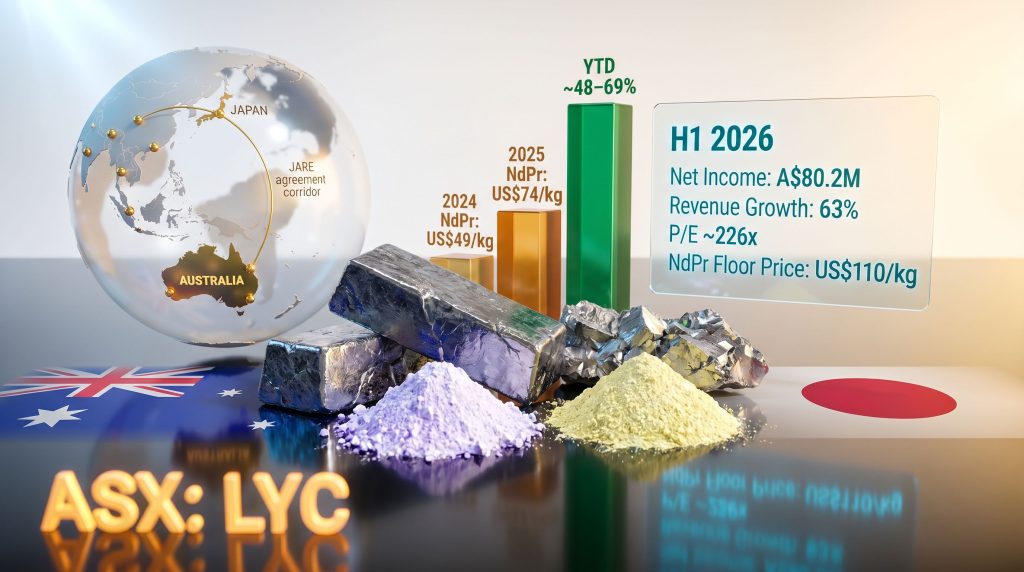
| H1 2026 net income | A$80.2 million (record) |
| H1 2026 revenue growth | 63% year-on-year |
| YTD share price performance (2026) | Approximately 48-69% |
| Recent share price (post-pullback) | A$18.12 |
| Current P/E ratio | Approximately 226x |
| NdPr average realised price (2024) | US$49/kg |
| NdPr average realised price (2025) | US$74/kg |
| JARE contract floor price | US$110/kg |
| US Pentagon contract floor price | US$110/kg |
| Pentagon contract value | Approximately US$140 million |
| JARE annual volume commitment | 5,000 tonnes NdPr |
| JARE contract duration | Through 2038 |
The revenue acceleration from a US$49/kg average in 2024 to US$74/kg in 2025 already represented a significant re-rating of the earnings base. The contracted floor prices at US$110/kg, embedded in sovereign offtake agreements, project an earnings step-change that most spot-exposed commodity producers simply cannot match.
Why the 226x Earnings Multiple Demands Scrutiny
A price-to-earnings ratio of approximately 226 times places Lynas in territory normally reserved for high-growth technology companies with software-like margin profiles and compounding network effects. The ASX mining sector broadly trades at single-digit to low double-digit P/E multiples. Even premium-quality gold producers rarely sustain earnings multiples above 30-40x.
What justifies an elevated multiple for Lynas is the predictability argument: sovereign floor contracts remove a substantial portion of the commodity price risk that typically compresses mining valuations. When governments underwrite revenue, the traditional discount applied to cyclical earnings should theoretically compress. However, the question for investors pursuing a Lynas Rare Earths take profit decision is whether that compression has already overshot.
Sovereign Offtake Agreements: A Revenue Architecture Unlike Any Other Miner
The JARE Agreement: Long Duration, Guaranteed Volume, Protected Pricing
The Japan Australia Rare Earths (JARE) supply agreement, extended in early 2026 through 2038, represents one of the most structurally significant commercial contracts in the ASX resources sector. Under the agreement, JARE commits to purchasing 5,000 tonnes of NdPr annually at a floor price of US$110 per kilogram, irrespective of spot market conditions.
To contextualise this: Lynas's average realised price across all NdPr sales in 2024 was just US$49/kg. The JARE floor at US$110/kg is more than double that level. Across 5,000 tonnes of contracted annual volume, the mathematical earnings implications are substantial. Indeed, this structure is comparable in ambition to the rare earth offtake deal frameworks emerging elsewhere in the sector.
The US Pentagon Framework: Defence Procurement as a Demand Anchor
The US Department of Defense offtake framework, valued at approximately US$140 million, establishes the same US$110/kg floor price for material supplied to defence applications. This arrangement insulates a meaningful portion of Lynas's revenue from spot market volatility entirely, anchoring it instead to defence procurement budgets that operate on multi-year planning cycles.
Several important dynamics arise from this structure:
- Commodity risk compression: The traditional pricing risk embedded in mining P/E multiples is partially neutralised by floor-priced sovereign contracts.
- Earnings floor visibility: Investors can model a revenue base anchored to US$110/kg for contracted volumes regardless of whether spot NdPr trades at US$70/kg or US$130/kg.
- Customer quality: Sovereign buyers (Japan's JOGMEC-backed JARE entity and the US Department of Defense) carry virtually no counterparty credit risk.
- Strategic stickiness: Unlike commercial offtake agreements, government supply frameworks are difficult to exit without significant diplomatic and policy consequences.
Understanding the Pullback: Profit-Taking Mechanics and Sentiment Rotation
When Geopolitical Risk Premium Deflates
A notable characteristic of rare earth stock valuations in 2025 and 2026 has been the inflation of a geopolitical scarcity premium — a valuation uplift that reflects the market's fear of Chinese supply disruption rather than current earnings. This premium is volatile by nature: it expands when US-China tensions escalate and contracts when diplomatic rhetoric softens.
The approximately 4-5% single-session decline that prompted broader take profit discussions was not accompanied by any adverse company-specific news. No production miss, no contract cancellation, no regulatory setback. The trigger was a softening of US-China trade rhetoric that temporarily reduced the urgency of the Western rare earth supply narrative. Consequently, rare earth processing challenges and supply security concerns that had previously driven sentiment took a back seat to short-term profit crystallisation.
This illustrates a critical distinction for investors evaluating rare earth equities:
- Structural supply advantage (durable) — Lynas's physical infrastructure, separation capability, and contracted revenue floors do not change with diplomatic headlines.
- Geopolitical risk premium (volatile) — The portion of Lynas's valuation that reflects fear of Chinese supply restriction is sentiment-driven and can deflate rapidly on positive diplomatic developments.
The Reflexive Selling Dynamic After a Major Rally
After a share price appreciation of 48-69% in under six months, the shareholder composition of a stock changes materially. Early buyers accumulate large unrealised gains. When a credible macro narrative emerges, even a modest one like trade softening, it provides the psychological justification needed for profit crystallisation.
This reflexive dynamic is well-documented in behavioural finance literature. Investors holding substantial unrealised gains face an asymmetric psychological pull: the fear of watching gains evaporate frequently outweighs the rational case for continued holding. According to analysis from The Bull, a 4-5% single-session decline is entirely consistent with this pattern and says nothing about the underlying business quality.
Five Risks That Make the 226x Multiple Uncomfortable
Risk 1: Valuation Leaves No Margin for Error
At 226 times earnings, even a 10% miss on NdPr pricing or a minor production shortfall at any facility in the processing chain could trigger meaningful de-rating. The multiple assumes near-perfect execution simultaneously across pricing, operations, capital projects, and the competitive landscape.
Risk 2: Texas Plant Commissioning Uncertainty
The Seadrift, Texas separation facility represents the most ambitious capital project in Lynas's history. Rare earth separation is a chemically complex process. Commissioning a new separation facility in a jurisdiction with limited prior rare earth processing infrastructure introduces execution risk that is difficult to quantify from the outside.
Key variables include:
- Construction timeline adherence
- Permitting and environmental compliance in Texas
- Achieving nameplate production capacity within projected timeframes
- Managing solvent extraction chemistry in a new operational environment
Risk 3: CEO Transition at a Critical Juncture
A leadership change scheduled for June 2026 introduces management transition risk at precisely the moment when the company is executing on its most capital-intensive programme. High-multiple growth stocks typically experience valuation compression during leadership changes as markets price in execution uncertainty.
Risk 4: Spot Price Sensitivity for Uncontracted Volume
While sovereign floor contracts protect a significant portion of Lynas's revenue, uncontracted volume remains exposed to spot NdPr pricing. If spot prices retreat toward the US$70-80/kg range, the contracted floors become the earnings ceiling rather than the floor, and the 226x multiple becomes even harder to justify.
Risk 5: Structural Premium Erosion From Diplomatic Normalisation
A sustained improvement in US-China trade relations carries the scenario risk that the Western rare earth security narrative diminishes in urgency. If China moves to expand rare earth supply access to Western buyers as a diplomatic gesture, the scarcity premium embedded in LYC's valuation could erode structurally rather than temporarily.
The next major ASX story will hit our subscribers first
The AI Infrastructure Demand Thesis: A Less-Discussed Tailwind
Most commentary on NdPr demand focuses on electric vehicles and wind energy. Less frequently discussed is the role of AI infrastructure expansion as an incremental demand driver for high-performance permanent magnets.
Modern GPU-dense data centres require:
- Precision cooling systems using variable-speed fan motors that increasingly incorporate NdFeB permanent magnets for efficiency
- Robotics and automation within data centre operations
- Power infrastructure including generators and UPS systems with permanent magnet components
As hyperscalers continue their capital expenditure acceleration, the cumulative rare earth demand from AI infrastructure builds represents an additional demand layer that conventional EV-centric forecasting models may underestimate. This demand is geographically concentrated in North America and Europe, precisely the markets where Lynas's Texas facility and JARE supply chain are positioned. In addition, Australian Mining notes that this diversification of end-market demand further reinforces the long-term earnings outlook for the company.
Lynas vs. ASX Rare Earth Peers: The Competitive Moat in Context
| Factor | Lynas (ASX: LYC) | Emerging ASX Rare Earth Peers |
|---|---|---|
| Production stage | Fully operational | Mostly exploration or development |
| Supply chain integration | Mine to separated oxide | Typically concentrate only |
| Sovereign offtake agreements | Yes (Japan, US) | Limited or none |
| Separated heavy rare earth production | Yes (Dy, Tb outside China) | Rare |
| Earnings multiple | Approximately 226x P/E | Varies widely |
| Revenue certainty | High (floor contracts) | Low (spot-dependent) |
| Workforce scale | 1,000+ employees and contractors | Typically pre-revenue |
The gap between Lynas and every other rare earth name on the ASX is not marginal. It spans years of capital deployment, operational learning, regulatory relationship-building, and customer development that cannot be compressed regardless of funding availability.
A Framework for the Lynas Rare Earths Take Profit Decision
For Existing Holders With Substantial Gains
The asymmetry of risk and reward has shifted materially from where it stood at the start of 2026. A 48-69% YTD gain at a 226x earnings multiple means the position has almost certainly grown to represent a disproportionate share of most portfolios. Consider the following:
- Partial profit realisation preserves structural upside exposure while reducing concentration risk.
- Portfolio rebalancing at elevated multiples is disciplined risk management, not a capitulation of the investment thesis.
- The business case for Lynas remains intact. What has changed is the price at which that business case is available.
For Prospective New Investors
A 4-5% single-session pullback does not meaningfully reset a 226x earnings multiple. More compelling entry conditions to monitor include:
- NdPr spot prices demonstrably sustaining above US$120/kg, which would confirm the pricing environment supports current earnings projections
- A deeper share price pullback toward the A$16-A$17 range, which would offer a materially more defensible entry multiple
- Successful commissioning milestones at the Texas separation facility providing operational de-risking
- Clearer visibility on post-CEO transition leadership continuity
The business case for Lynas has not changed with the pullback. What changes the investment case is the price paid to access it. Separating conviction in the underlying thesis from discipline around entry point is the most important analytical task for investors evaluating LYC at current levels.
Frequently Asked Questions: Lynas and the Take Profit Decision
What triggered the recent share price decline?
Softer US-China trade rhetoric reduced the geopolitical scarcity premium embedded in Western rare earth valuations. The decline was consistent with profit-taking behaviour after a substantial YTD rally, with no adverse company-specific news driving the move.
Does the share price drop indicate operational problems?
No. H1 2026 delivered record net income of A$80.2 million on 63% revenue growth. The share price movement reflects valuation recalibration, not any deterioration in business performance.
What is NdPr and why does it matter?
Neodymium-praseodymium (NdPr) is the blended rare earth oxide that Lynas produces from Mt Weld ore. It is the primary input for NdFeB permanent magnets, which are embedded in EV motors, wind turbine generators, robotics, defence systems, and increasingly in AI data centre infrastructure.
Why is the US$110/kg floor price so significant?
Because Lynas's average realised NdPr price across all sales in 2024 was just US$49/kg. A contracted floor at US$110/kg, locked in across 5,000 tonnes of annual JARE volume plus US Pentagon supply, represents an earnings step-change relative to recent historical pricing.
What would make LYC more attractive for new investors?
Either a sustained demonstration of NdPr spot prices above US$120/kg confirming the earnings environment, or a deeper share price pullback toward A$16-A$17 that reduces the valuation entry risk.
Strong Business, Demanding Price: The Core Tension for LYC Investors
Lynas Rare Earths occupies a genuinely irreplaceable position in the global critical minerals landscape. The combination of a high-grade ore body, vertically integrated processing capability, separated heavy rare earth production outside Chinese jurisdiction, and sovereign-backed revenue floors at more than double 2024 realised prices constitutes a competitive position that no other ASX-listed company can currently replicate.
The structural demand drivers — encompassing EV fleet expansion, wind energy buildout, defence modernisation, and AI infrastructure spending — are real, durable, and growing. None of this is in dispute.
What is in dispute is whether a 226x earnings multiple adequately prices in the execution risks, valuation sensitivity, and sentiment variables that surround even the strongest businesses. Admiration for a company and discipline about the price paid to own it are not incompatible. For investors navigating the Lynas Rare Earths take profit question in 2026, separating those two judgements is the defining analytical challenge.
This article is general information only and does not constitute financial advice. All figures, prices, and financial data referenced reflect information available at the time of writing and may have changed. Past performance is not indicative of future results. Investors should conduct their own research and consult a licensed financial adviser before making investment decisions.
Want To Catch the Next Major ASX Mineral Discovery Before the Market Does?
Discovery Alert's proprietary Discovery IQ model scans ASX announcements in real time, delivering instant alerts on significant mineral discoveries — including critical minerals like rare earths — so subscribers can identify actionable opportunities ahead of the broader market. Explore historic discoveries and their remarkable returns, then begin your 14-day free trial to position yourself at the forefront of the next major find.