June 18, 2026
The Battery Chemistry Shift That Could Redefine Industrial Energy Infrastructure
Few technology transitions in modern industry carry the upstream and downstream implications of a fundamental change in battery chemistry. The history of energy storage is littered with promising alternatives to lithium-ion that never survived contact with the economics of mass production. Yet the conditions shaping the battery sector in 2026 are materially different from those that defined the previous decade.
Capital markets have tightened. Greenfield battery factories have proven extraordinarily difficult to execute profitably. Furthermore, a new category of energy-hungry industrial customer has emerged with characteristics that align almost perfectly with what next-generation battery chemistries can offer.
That convergence forms the backdrop for understanding why Lyten lithium-sulfur batteries using Northvolt assets for data centers represents one of the more strategically layered industrial stories in the current energy storage landscape.
When big ASX news breaks, our subscribers know first
From Materials Science to Manufacturing Scale: Lyten's Core Technology
At its foundation, Lyten is a materials science company that has built its entire commercial strategy around a proprietary three-dimensional graphene architecture. The significance of this is not merely academic. For decades, lithium-sulfur has been recognised by researchers as theoretically superior to conventional lithium-ion chemistries on energy density grounds, but the chemistry has been commercially constrained by one persistent problem: sulfur degrades during cycling in ways that conventional electrode structures cannot contain.
The underlying mechanism is the polysulfide shuttle effect, where intermediate lithium polysulfide compounds dissolve into the electrolyte during charging and discharging cycles, migrating to the lithium anode and causing progressive capacity loss. This degradation pathway has historically limited cycle life to the point where the chemistry was commercially viable only for single-use or very low-cycle applications.
Lyten's 3D graphene platform addresses this by providing a structural scaffold that physically confines sulfur within the electrode architecture, reducing the migration of soluble polysulfide intermediates. According to Lyten's chief marketing officer Keith Norman, speaking to Fastmarkets in April 2026, the company describes itself as founded on a materials science breakthrough, with a platform designed to use advanced materials to produce higher-performing products.
The commercial implications of solving this problem, if independently validated at production scale, would be substantial. Sulfur is not a critical mineral in any conventional sense. It is an industrial byproduct of petroleum refining and natural gas processing, generated in quantities that vastly exceed any conceivable battery demand scenario. Norman noted that a single major Middle Eastern oil producer generates sufficient sulfur as a refining byproduct that, theoretically, it could supply enough to convert every battery in existence to sulfur-based chemistry and still have material remaining.
Lithium-Sulfur vs. Lithium-Ion: A Technical and Commercial Comparison
| Feature | Lithium-Ion (NMC) | Lyten Lithium-Sulfur |
|---|---|---|
| Energy Density | Moderate to High | Higher (claimed; independent validation pending) |
| Cathode Input Materials | Nickel, Manganese, Cobalt, Graphite | Sulfur (industrial byproduct) |
| Supply Chain Complexity | High, with critical mineral dependencies | Significantly reduced |
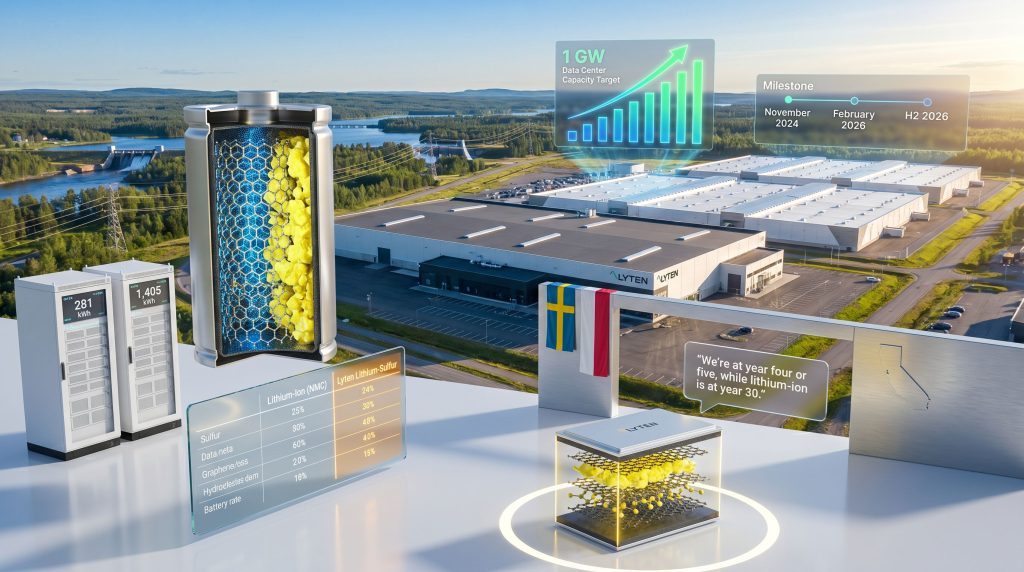
| Technology Maturity | Approximately 30 years of commercial development | Approximately 4 to 5 years of development |
| Primary Near-Term Applications | EVs, grid storage | Drones, defense, BESS, mobility |
| Cost Trajectory | Established and declining | Early-stage, declining trajectory expected |
| Cycle Life at Scale | Well-characterised | Requires independent production-scale validation |
Norman positioned the technology's maturity honestly: lithium-sulfur as a multi-decade battery chemistry is still in its early commercial chapters, compared to a lithium-ion industry that has had thirty years to optimise manufacturing, supply chains, and cell design. Near-term deployment is deliberately focused on applications where cycle life requirements are lower and performance density is the primary selection criterion, including autonomous systems and drone platforms in 2025 and 2026, with energy storage applications targeted for 2027 and 2028, and broader mobility markets from 2028 onward.
Disclaimer: Forward-looking timelines and commercial deployment projections cited in this article reflect statements made by Lyten management in April 2026 and have not been independently verified. Investors and industry participants should treat these as targets rather than confirmed outcomes.
How the Northvolt Collapse Created a Rare Manufacturing Opportunity
Understanding Lyten's current manufacturing position requires understanding what happened to Northvolt. Once described as Europe's flagship battery startup, Northvolt raised billions in capital to construct a vertically integrated, greenfield battery manufacturing ecosystem centred on supplying automotive original equipment manufacturers. The growth model assumed high-volume automotive demand, continued access to capital markets, and near-perfect execution across multiple simultaneous large-scale construction and ramp-up projects.
When any of those assumptions weakened, the entire structure became fragile. Norman characterised it directly: Northvolt had built a model that required perfect execution. The capital intensity of greenfield battery manufacturing at gigafactory scale leaves virtually no margin for delays, cost overruns, or demand softness in target markets.
The result was insolvency and the availability of stranded infrastructure that had absorbed, by Norman's estimate, somewhere between $8 billion and $10 billion in prior capital investment. Norman described these as mega-scale infrastructure projects representing an enormous concentration of both capital and industrial know-how.
For Lyten, the implication was clear. Norman noted that rebuilding equivalent capacity from scratch would be practically impossible in the current funding environment, where capital flowing into battery manufacturing has contracted significantly. There is no shortcut to recreating that kind of infrastructure, and the current market does not offer the capital pathways that made first-generation gigafactory construction possible. For more context on how Lyten completed this acquisition and established its first industrial hub in Sweden, the full announcement provides additional detail.
What Lyten Acquired: Full Asset Breakdown
| Asset | Location | Capacity or Scale | Status |
|---|---|---|---|
| Northvolt Ett Plant | Skellefteå, Sweden | 16 GWh | Restarting for NMC and BESS production |
| Northvolt Labs | Skellefteå, Sweden | Europe's largest battery R&D facility | Operational |
| Land Holdings | Skellefteå, Sweden | 160+ hectares | Development pipeline |
| Northvolt Dwa Plant | Gdańsk, Poland | 6 GWh | BESS supply target, second half of 2026 |
| Cuberg Facility | San Leandro, California, USA | Dedicated lithium-sulfur production | Operational (acquired November 2024) |
| Northvolt Revolt Recycling Plant | Sweden | Pending | Q2 2026 acquisition target |
The Swedish asset acquisition completed in February 2026. The compression of timeline and capital intensity this represents for a startup-stage company is structurally significant. Lyten's total acquisition cost has not been publicly disclosed, but the gap between the capital embedded in these facilities and any conceivable acquisition price for distressed assets represents a substantial structural advantage.
The Skellefteå Industrial Hub: Where Battery Manufacturing Meets Data Center Infrastructure
The strategic logic of the Skellefteå site extends well beyond manufacturing capacity. Lyten has established what it describes as the Lyten Industrial Hub at the former Northvolt campus, built around a co-location model that combines battery production with large-scale data center development.
The partnership with EdgeConneX targets the development of a data center campus scalable to 1 gigawatt of capacity at the Skellefteå site, which would position it among the largest data center concentrations in Europe. The rationale for this pairing is multi-layered.
First, Skellefteå benefits from access to clean, low-cost hydropower from northern Sweden's river systems. This is a critical input for both energy-intensive battery manufacturing and the continuous high-load power consumption that characterises large-scale data center operations. Co-locating both activities on existing permitted infrastructure with established grid connections eliminates duplicative permitting and construction timelines.
Second, the data center partnership provides what Norman described as an additional, non-governmental funding channel from a sector currently attracting significant capital investment. This is a material consideration. Battery manufacturing startups in 2026 face a tighter venture and project finance environment than existed during the 2021 to 2023 gigafactory buildout wave. Anchoring manufacturing economics to data center revenue from a well-capitalised infrastructure partner changes the financial risk profile of the battery ramp-up.
Third, Norman noted that the energy storage offering itself aligns directly with data center operational requirements. Data centers require battery energy storage systems to manage power fluctuation from variable loads, support grid resilience, and maintain continuity during grid disturbances. This is precisely the context in which Lyten lithium-sulfur batteries using Northvolt assets for data centers demonstrates its most compelling commercial logic.
Lyten's BESS Product Configuration
| BESS Configuration | Capacity |
|---|---|
| Entry-level pack | 281 kWh |
| Mid-scale pack | Approximately 700 kWh |
| Large-scale pack | 1,405 kWh |
The alignment between Lyten as BESS manufacturer and the Skellefteå data center campus as an anchor BESS customer creates a closed-loop commercial logic: the data center provides capital and revenue stability for the battery business, while the battery business provides the energy storage infrastructure that makes the data center more resilient and grid-independent.
The Dual-Chemistry Manufacturing Model and Why It Matters
One of the less-discussed but commercially critical aspects of Lyten's strategy is its manufacturing flexibility. Norman highlighted a technically significant characteristic of the lithium-sulfur production process: almost all the same equipment used for lithium-ion NMC production can be repurposed for lithium-sulfur cell manufacturing.
This is not trivially true. Different battery chemistries typically require different electrode coating processes, different electrolyte handling systems, and different formation cycling protocols. The degree to which Lyten's 3D graphene-based lithium-sulfur approach shares production equipment with standard NMC lines is a genuine competitive differentiator, because it means the chemistry transition does not require parallel greenfield investment in new manufacturing infrastructure.
The practical result is that Lyten can operate certain production lines on lithium-ion and others on lithium-sulfur simultaneously, adjusting the balance as market demand and technology readiness evolve. Norman described this as a function of where the market takes the business, rather than a predetermined binary switch between chemistries.
This flexibility directly addresses the execution risk that contributed to Northvolt's difficulties. Rather than betting the entire capital structure on a single chemistry, single market, and single customer concentration, Lyten maintains revenue-generating lithium-ion production while progressively expanding lithium-sulfur capacity.
Target Market Diversification by Timeline
Near-Term (2025 to 2026):
- Drone and autonomous systems platforms
- Defence applications requiring high energy density at low cycle volumes
- Battery energy storage systems for industrial customers
Medium-Term (2027 to 2028):
- Grid-scale energy storage expansion
- Industrial mobility applications
Longer-Term (2028 onward):
- Broader automotive and mobility sectors
- Consumer electronics (potential future application)
Norman explicitly noted that Lyten is starting with many different customers at lower volumes, targeting dozens of customers as scale builds, rather than concentrating on a small number of large automotive OEM programs. The contrast with Northvolt's customer concentration risk is deliberate.
Supply Chain Independence: The Strategic Case for Sulfur as a Battery Input
The supply chain implications of lithium-sulfur adoption at scale deserve careful analysis, because they extend well beyond Lyten as a company. Each of the four primary inputs that lithium-sulfur eliminates from the conventional NMC supply chain carries distinct geopolitical and pricing risk profiles. Indeed, shifts in the broader battery raw materials market are already reshaping how manufacturers and policymakers assess long-term input dependencies.
- Cobalt: Approximately 70% of global cobalt supply originates from the Democratic Republic of Congo, with additional concentration risk in Chinese processing capacity. Cobalt has historically been the most volatile and ethically complex input in the lithium-ion supply chain.
- Nickel: Increasingly dominated by Indonesian production, with processing capacity concentrated in Chinese-owned facilities. Indonesian export policy changes have repeatedly disrupted global nickel markets.
- Manganese: Less concentrated than cobalt or nickel, but South Africa and Gabon account for the majority of high-grade manganese ore supply, with Chinese processing dominance in battery-grade manganese sulfate.
- Graphite: China controls approximately 65 to 70% of natural graphite production and an even higher share of the processed spherical graphite used in battery anodes, representing one of the most acute single-country dependencies in the entire battery materials supply chain.
Sulfur, by contrast, is generated as a mandatory byproduct of desulfurisation processes in oil refining and natural gas sweetening. It cannot be withheld from markets without shutting down primary production, and it is produced across hundreds of facilities in dozens of countries. The concentration risk profile is structurally different from every conventional battery input.
For manufacturers and policymakers focused on supply chain resilience, this characteristic of lithium-sulfur chemistry is arguably as significant as its energy density advantages. The global lithium market is, however, retained as a necessary input regardless of cathode chemistry, meaning lithium demand trajectories remain relevant to any forward-looking analysis.
The next major ASX story will hit our subscribers first
Risk Factors and Commercial Uncertainties
A balanced assessment of Lyten's strategy requires acknowledging the substantial uncertainties that accompany any early-stage battery technology commercialisation. In addition, persistent lithium oversupply challenges continue to shape the broader market context within which Lyten is operating.
Technology Risk
The polysulfide shuttle problem has resisted commercial solutions for decades. Lyten's 3D graphene approach represents a credible architectural response to the challenge, but independent production-scale validation of cycle life, coulombic efficiency, and thermal stability has not been publicly documented. The distinction between laboratory performance and production-scale performance is where most battery technology transitions encounter unexpected difficulties.
Competitive Landscape
| Company | Country | Li-S Development Stage | Key Application Focus |
|---|---|---|---|
| Lyten | USA and Sweden | Pilot to early commercial | BESS, defense, drones, EVs |
| Sion Power | USA | Advanced development | Defence and aerospace |
| PolyPlus | USA | Advanced development | Aqueous lithium-sulfur variants |
| LG Energy Solution | South Korea | Research stage | Electric vehicles |
| Oxis Energy | UK | Dissolved (pre-commercial) | Aviation and defence |
Execution and Capital Risk
Managing simultaneous operations across Skellefteå, Gdańsk, San Leandro, and a prospective German facility, while co-developing a 1 GW data center campus, represents substantial operational complexity. The EdgeConneX partnership provides a non-governmental capital channel, but introduces its own form of commercial dependency. If data center investment priorities shift, the battery manufacturing ramp-up would require alternative funding mechanisms in a constrained market.
Furthermore, advances in battery recycling breakthrough technologies are reshaping end-of-life economics across the sector, adding another variable to long-term commercial planning. It is also worth noting that direct lithium extraction methods are evolving rapidly, which could influence input cost structures for lithium-retaining chemistries like lithium-sulfur over the medium term.
Speculative note: The co-location model is genuinely novel and has not been tested at the scale Lyten is targeting. While the strategic logic is compelling, there is limited precedent for managing battery manufacturing and hyperscale data center development as integrated operations on a single campus. The model's success depends on execution quality across two capital-intensive industries simultaneously.
What Lithium-Sulfur Scale-Up Would Mean for Battery Raw Materials Markets
If Lyten's roadmap for Lyten lithium-sulfur batteries using Northvolt assets for data centers advances broadly as described, the commodity-level implications are material and warrant monitoring by supply chain analysts and commodity investors.
The chemistry retains lithium as a required input, so lithium demand trajectories would not be affected. However, meaningful displacement of NMC capacity by lithium-sulfur production would reduce demand for cobalt, nickel, manganese, and graphite. In markets where Chinese processing dominance has created structural pricing power, demand reduction from a competing chemistry could have disproportionate pricing effects relative to volume displacement.
Conversely, if lithium-sulfur scale-up faces the technical or commercial obstacles that have historically constrained the chemistry, the NMC supply chain would face no material disruption, and the conventional critical minerals market would continue along its established trajectory.
The more nuanced scenario, and arguably the most likely near-term outcome, is that lithium-sulfur captures specific application niches where energy density and supply chain simplicity are prioritised over cost-per-kilowatt-hour, while conventional lithium-ion retains dominance in high-volume, cost-sensitive automotive markets for the remainder of the decade.
Investors and commodity analysts tracking battery raw materials should monitor three specific indicators:
- Independent cycle life validation of Lyten's lithium-sulfur cells at production scale from the Cuberg facility
- Commercial cell delivery timelines from Northvolt Ett in the second half of 2026, which will test whether the incremental ramp philosophy translates to actual production output
- EdgeConneX data center capacity milestones at Skellefteå, which will serve as a leading indicator of whether the co-location funding model is performing as intended
The intersection of battery chemistry innovation, distressed asset acquisition strategy, and AI-driven data center infrastructure demand is creating a genuinely novel industrial configuration. Whether Lyten lithium-sulfur batteries using Northvolt assets for data centers proves to be a template for the next generation of battery scale-up, or a case study in the difficulty of simultaneously managing multiple technological and commercial transitions, will become clearer as the 2027 and 2028 deployment milestones approach. For those following the resurrected Northvolt factory's supply plans, near-term BESS cell delivery milestones will be a key indicator of operational progress.
Readers seeking additional market intelligence on lithium battery raw materials, pricing trends, and supply chain dynamics may find value in exploring coverage available through Fastmarkets' lithium market insights, which tracks price data and analysis across the battery materials sector.
Want To Identify The Next Major Battery Minerals Discovery Before The Market Does?
Discovery Alert's proprietary Discovery IQ model delivers real-time alerts on significant ASX mineral discoveries across the battery raw materials landscape — including lithium, cobalt, nickel, and graphite — instantly converting complex data into actionable insights for investors tracking the chemistry shifts reshaping energy storage. Explore historic discoveries and their remarkable market returns, then begin your 14-day free trial to position yourself ahead of the broader market.