
August 14, 2026
When Armed Groups Become Supply Chain Actors: The Governance Crisis at the Heart of Critical Mineral Geopolitics
The global race to secure critical mineral supply chains has introduced a paradox that few policymakers anticipated: the very urgency driving wealthy nations to diversify away from Chinese-controlled resources is creating openings for non-state armed actors to insert themselves into legitimate commodity markets. Nowhere is this tension more acute than in the eastern Democratic Republic of Congo, where M23 Congo rebels' critical minerals to US ambitions represent one of the most complex supply chain governance challenges of the modern era.
Understanding how this situation developed requires looking beyond the headlines and into the structural mechanics of how conflict minerals move from artisanal mining pits to finished electronic products sold in markets across North America, Europe, and Asia.
When big ASX news breaks, our subscribers know first
Eastern DRC's Mineral Wealth: A Strategic Chokepoint in the Global Economy
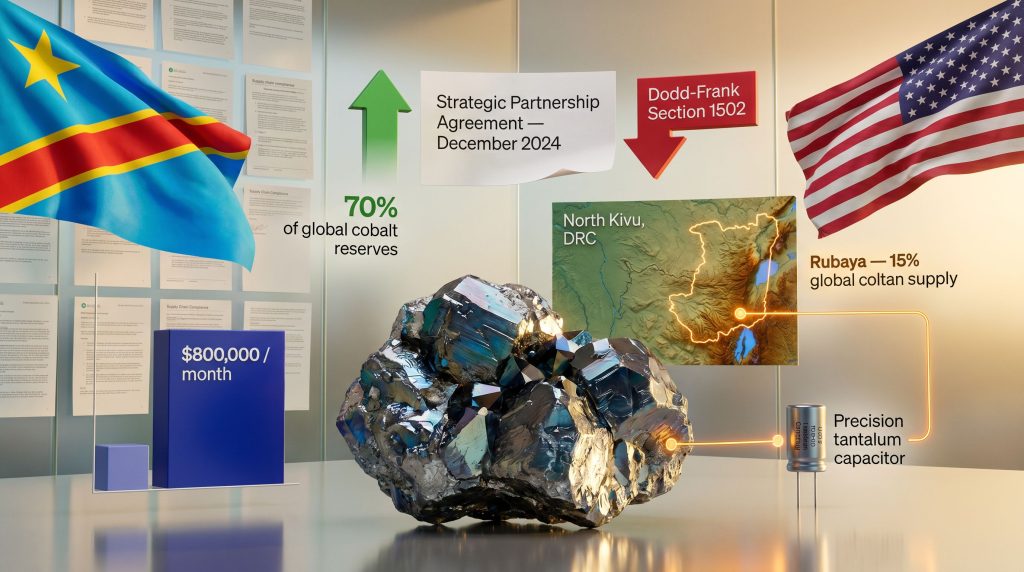
The natural resources in the DRC are not merely significant in volume. The country occupies a structurally irreplaceable position in several critical supply chains simultaneously, holding an estimated 70% of the world's cobalt reserves — a metal that sits at the chemical heart of lithium-ion battery cathodes used in electric vehicles and consumer electronics. For the battery supply chains underpinning the global clean energy transition, the DRC is not one option among many. It is the primary source.
Cobalt, however, is only part of the picture. Eastern Congo's Rubaya mining district accounts for approximately 15% of global coltan supply. Coltan is the ore from which tantalum is refined, and tantalum's ability to store and release electrical charge efficiently, combined with its high melting point and corrosion resistance, makes it the preferred material for capacitors in smartphones, laptops, aerospace systems, and military-grade communications hardware.
Beyond cobalt and tantalum, the region produces significant volumes of tin and tungsten, both of which appear on critical minerals priority lists maintained by the U.S. Department of Defense and allied governments. Tin is essential to electronics manufacturing as a primary component of solder, while tungsten's hardness and heat resistance make it indispensable in precision machining, armour-piercing ammunition, and cutting tools used across industrial manufacturing.
The convergence of these four minerals in a single geographic zone creates a strategic concentration that global supply chain planners regard with considerable unease.
Industry note: The so-called "3T" minerals framework, referring to tin, tantalum, and tungsten, alongside gold forms the basis of Dodd-Frank Section 1502 conflict mineral disclosure requirements. Eastern DRC produces all three at commercially significant scale, making the region the primary regulatory focus of conflict minerals compliance frameworks globally.
The M23 Militia: How an Armed Group Became a Mining Operator
Origins, External Support, and Territorial Expansion
The Mouvement du 23 Mars, known internationally as M23, emerged from the eastern DRC conflict landscape with a trajectory that distinguishes it from most other armed factions in the region. Its resurgence beginning in 2021 and 2022 was not simply a product of internal Congolese political dynamics. United Nations Group of Experts reports, along with corroborating assessments from Western intelligence agencies, have documented substantial military and logistical support flowing from Rwanda to M23 forces operating in North Kivu and South Kivu provinces. Rwanda has consistently contested this characterisation.
The geopolitical dimension of Rwandan involvement is not incidental. Analysts point to a convergence of motivations, including ethnic and security concerns, but also Rwanda's strategic interest in controlling cross-border mineral flows through its export infrastructure. Furthermore, this economic dimension gives Rwanda a structural incentive that goes beyond political alignment with M23. However, conflict mineral narratives don't fully explain the rebellion's complexity, and reducing the M23 insurgency purely to resource extraction risks overlooking deeper political grievances.
M23's battlefield gains since 2022 have been substantial. The group has captured strategically significant towns and mining zones across eastern Congo, progressively consolidating territorial control in ways that earlier iterations of the conflict had not achieved. The capture of the Rubaya coltan mining district in April 2024 represented a qualitative escalation, transforming M23 from an armed group that taxed mineral flows to one that directly administered a major global commodity source.
The Economics of Armed Mining Administration
The financial architecture M23 has constructed around Rubaya reveals a degree of institutional sophistication that distinguishes it from typical conflict-zone extractive operations. Revenue flows through multiple channels:
| Revenue Source | Mechanism | Estimated Scale |
|---|---|---|
| Coltan taxation (Rubaya) | Direct levies on mining operations | ~$800,000/month |
| Transport route taxation | Checkpoints along mineral export corridors | Undisclosed |
| Cross-border smuggling (Rwanda) | Laundered through export documentation | Significant volumes |
| Gold seizure (Twangiza mine) | Armed takeover of producing mine | ~$70 million reported |
The Rubaya figure, approximately $800,000 per month, is sourced from UN documentation and cited by the London-based investigative organisation Global Witness. This is not a trivial sum for an armed faction operating in a conflict environment. It represents a sustainable financing stream sufficient to maintain armed forces, acquire weapons and logistics, and sustain the patronage networks that hold militia structures together.
The mechanism by which these revenues are generated is also instructive. M23 does not simply loot the mines. Instead, it operates more like a parallel state, imposing taxation structures on existing artisanal and small-scale mining communities that continue to extract coltan under conditions of duress. This model is more financially durable than direct extraction because it leverages the labour and technical knowledge of existing mining populations without requiring M23 to develop operational mining capacity of its own.
The Compliance Architecture M23's Mineral Pitch Would Violate
Dodd-Frank and the Regulatory Foundation
The regulatory framework governing conflict minerals from the DRC is more extensive than most market participants appreciate. Dodd-Frank Section 1502, passed by the U.S. Congress in 2010 following years of advocacy by conflict minerals campaigners, requires all companies reporting to the Securities and Exchange Commission to conduct due diligence on whether their products contain tin, tantalum, tungsten, or gold sourced from the DRC or adjoining countries.
Where such minerals are present, companies must file Conflict Minerals Reports disclosing the origin and the due diligence measures taken. The practical consequence is that any U.S.-listed company knowingly or negligently sourcing 3T minerals from M23-controlled operations faces material legal exposure. The threshold for compliance failure is not limited to intentional sourcing — inadequate due diligence that fails to identify conflict-origin minerals in the supply chain can itself constitute a violation.
The OECD Five-Step Framework
The Organisation for Economic Co-operation and Development's Due Diligence Guidance for Responsible Mineral Supply Chains from Conflict-Affected and High-Risk Areas provides the international standard against which corporate behaviour is measured. Its five-step framework requires companies to:
- Establish strong company management systems with supplier transparency requirements
- Identify and assess risks in the supply chain, specifically including armed group control of mining sites
- Design and implement a strategy to respond to identified risks
- Carry out independent third-party auditing of supply chain due diligence
- Report annually on supply chain due diligence findings
Step two explicitly designates sourcing from areas controlled by armed groups as a red flag requiring immediate action. M23-controlled Rubaya would satisfy this criterion unambiguously under any responsible application of the framework.
The EU Conflict Minerals Regulation
The European Union's Conflict Minerals Regulation, which came into full effect in 2021, establishes mandatory due diligence obligations for EU importers of tin, tantalum, tungsten, and gold originating from conflict-affected and high-risk areas. The regulation is modelled on the OECD framework and similarly prohibits sourcing arrangements that would finance armed groups.
Compliance Warning: Any U.S. corporate or government entity entering into a mineral procurement arrangement with M23 directly or through intermediaries risks violating Dodd-Frank Section 1502, U.S. Treasury sanctions, and OECD responsible sourcing standards concurrently. The exposure is not merely reputational. It carries legal and financial consequences.
The Certification System's Structural Vulnerability
Why Conflict Minerals Successfully Enter Legitimate Markets
Perhaps the most underappreciated dimension of the eastern DRC minerals crisis is the extent to which existing certification systems have failed to prevent conflict-origin material from reaching global buyers. The primary traceability tools in operation are the ICGLR Regional Certification Mechanism and the iTSCi programme managed by the International Tin Association.
Both systems share a fundamental architectural weakness: certification occurs at the point of export, not at the point of extraction. Minerals extracted under armed group administration in Rubaya can acquire compliant export documentation at Rwandan processing and export points, effectively erasing their conflict origin before they enter international commodity markets. This laundering pathway has been documented extensively by UN investigators and conflict minerals researchers.
The implications are significant. Buyers in the United States, Europe, and Asia operating in good faith on the basis of certified supply chain documentation may nonetheless be purchasing material that originated under M23 administration. The certification system's credibility depends on an integrity of documentation that the smuggling architecture systematically subverts.
What Effective Verification Would Require
Reform-oriented analysts and supply chain specialists have identified the technical requirements for meaningful improvement in conflict minerals governance. These include:
- Mine-site level verification conducted by independent auditors with physical access to extraction points, not merely export documentation review
- Satellite monitoring of mining activity in conflict-affected areas to detect production volume discrepancies that suggest unreported extraction
- Blockchain-based provenance tracking that creates an immutable record of mineral origin from extraction through processing to export, resistant to documentation manipulation
- Independent chain-of-custody tagging at the point of extraction using forensic mineral fingerprinting technologies that can identify geographic origin through trace element signatures
These approaches remain at the frontier of conflict minerals governance rather than standard practice. Their implementation at scale would require substantially greater investment in monitoring infrastructure than current programmes provide.
M23's Mineral Pitch to Washington: Strategic Logic and Its Contradictions
Exploiting the Anti-China Urgency
The reported approach by M23 leadership to seek direct engagement with the Trump administration — positioning the militia as a reliable tantalum, tin, and tungsten supplier — is strategically calculated in ways that deserve analytical attention. The pitch exploits a genuine and significant policy vulnerability, and a Congolese militia wants to sell critical minerals directly to the Trump administration as a means of gaining political legitimacy.
Washington's urgency to secure non-Chinese mineral sources is real and well-documented. Chinese companies dominate the DRC's industrial mining sector, particularly in copper and cobalt, through two decades of state-backed corporate investment. The DRC cobalt export ban and associated Congo cobalt market impact have further complicated the supply landscape, intensifying Washington's desire to secure alternative arrangements. The Trump administration has consequently pursued an accelerated programme of mineral diversification, including a strategic partnership agreement signed with the DRC government in December 2024 that established frameworks for mineral access, investment, and security cooperation.
M23's approach attempts to insert the militia into this policy dynamic as an alternative supplier, framing territorial control of mineral resources as a form of commercial leverage. This is simultaneously a legitimacy-seeking exercise and a revenue strategy. Converting mineral access into political recognition would transform M23's status from a sanctioned armed group into something closer to an acknowledged commercial counterparty.
The Contradiction at Washington's Core
The strategic incoherence in any engagement scenario is substantial. The US-Congo mining security partnership imposed sanctions on the Rwandan military following the December 2024 strategic partnership with Kinshasa, directly linking mineral diplomacy to conflict accountability. Engaging with M23, whose battlefield capabilities depend on Rwandan logistical support, would undermine the very sanctions architecture Washington deployed to demonstrate accountability commitments to its DRC partner.
This contradiction is not merely rhetorical. It defines the practical limits of any informal engagement scenario. Furthermore, the Congo-US minerals security partnership framework explicitly ties resource access to governance standards, making any de facto recognition of M23 as a mineral counterparty structurally incompatible with existing treaty commitments.
The next major ASX story will hit our subscribers first
Scenario Analysis: Three Pathways for U.S.-DRC Mineral Engagement
The trajectory of U.S.-DRC mineral relations over the near to medium term can be mapped across three distinct scenarios, each with materially different implications for supply chain compliance and conflict dynamics.
Scenario A: Legitimate Deal With Effective Security Enforcement
U.S. security assistance enables DRC forces to recapture eastern mining zones including Rubaya; M23 is displaced from its mineral revenue base; certified supply chains resume operations under credible traceability infrastructure. This outcome requires a sustained U.S. commitment to the Great Lakes region that has historically been inconsistent.
Scenario B: Agreement in Name, Conflict Minerals in Practice
A U.S.-DRC minerals deal is formalised while M23 retains territorial control of key extraction zones; mineral flows continue through Rwandan laundering pathways with compliant documentation; U.S. buyers source conflict-origin material in good faith but without adequate verification. Legal and reputational exposure for U.S. entities accumulates without resolution.
Scenario C: De Facto Legitimisation of M23
Informal or indirect U.S. engagement with M23 as a mineral counterparty converts armed territorial control into a form of political recognition; the precedent established cascades into other conflict zones where armed factions control mineral resources. The accountability architecture built since 2010 faces existential credibility challenges.
Analytical note: Scenario B is arguably the most likely near-term outcome given the implementation gap between mineral access agreements and physical security of extraction zones. The history of the DRC's eastern conflict zone suggests that political agreements routinely outpace security realities on the ground.
Building Durable Alternatives: The Case for Supply Chain Diversification
The urgency that makes conflict-zone sourcing tempting is itself a product of insufficient investment in alternative supply chain development. Australia, Canada, Brazil, and several other jurisdictions host tantalum and cobalt deposits that could, with appropriate investment, reduce structural dependence on DRC-origin materials.
Australian hard-rock tantalum production, historically centred in Western Australia, represents one of the most geologically significant alternatives to African conflict-zone supply. Canadian cobalt projects, including refinery infrastructure currently under development in Ontario, offer processing capacity that could serve U.S. demand without the compliance complications of DRC sourcing.
Reducing the supply urgency that creates openings for actors like M23 requires long-term investment commitments of the kind that government financing mechanisms and bilateral investment frameworks can support, building supply security through commercially sustainable alternatives rather than geopolitically fraught conflict-zone arrangements.
Frequently Asked Questions: M23 Congo Rebels, Critical Minerals, and U.S. Supply Chains
What minerals does M23 control in eastern DRC?
M23 controls the Rubaya mining district, which produces approximately 15% of the world's coltan, the ore from which tantalum is refined. The group also administers taxation of tin and tungsten production and transport across its territorial holdings in North and South Kivu provinces.
Is it legal for U.S. companies to buy minerals from M23-controlled areas?
No. U.S. companies subject to SEC reporting requirements are bound by Dodd-Frank Section 1502, which mandates due diligence and disclosure for conflict minerals from the DRC. Minerals from M23-controlled zones constitute conflict minerals under this framework, creating legal exposure for buyers.
How much revenue does M23 generate from mining?
Global Witness, citing UN documentation, estimates M23 generates approximately $800,000 per month from the Rubaya coltan district alone. In addition, revenues flow from checkpoint taxation along mineral transport corridors and documented seizure of other mineral operations in the region.
Why does Rwanda support M23?
UN investigations have documented Rwandan military support for M23, which Rwanda contests. Analysts identify a convergence of ethnic, security, and economic motivations, with Rwanda's interest in controlling cross-border coltan export flows cited as a significant structural incentive alongside other considerations.
What is the coltan-to-tantalum supply chain and why does it matter?
Coltan, short for columbite-tantalite, is a metallic ore that is processed to produce tantalum metal. Tantalum's unique electrochemical properties — particularly its ability to form thin, stable oxide layers that function as efficient capacitors — make it a preferred material in miniaturised electronics. There is no widely commercialised substitute that performs equivalently in high-performance capacitor applications, which is why Rubaya's 15% share of global coltan supply carries outsized strategic significance.
Could M23 minerals realistically enter U.S. supply chains without detection?
This is already occurring indirectly. The structural weakness of export-point certification means conflict-origin minerals routinely acquire compliant documentation at Rwandan processing and export facilities before entering international commodity markets. However, without mine-site level verification, buyers operating on the basis of certified documentation have limited practical ability to distinguish conflict-origin from legitimately sourced material. Consequently, the M23 Congo rebels' critical minerals to US supply chains risk remains a live and largely unresolved compliance challenge.
Want to Stay Ahead of Significant ASX Mineral Discoveries Before the Market Moves?
Discovery Alert's proprietary Discovery IQ model delivers real-time alerts on high-potential ASX mineral announcements — cutting through the complexity of 30+ commodities into clear, actionable insights for both traders and long-term investors. Explore historic discoveries and their returns, then begin your 14-day free trial at Discovery Alert to gain a market-leading edge the moment the next major discovery is announced.