
July 25, 2026
Understanding the Macro-Economic Context Behind Inventory Accumulation
The current landscape of U.S. crude oil inventory dynamics represents far more than simple supply-demand mechanics. Recent patterns reveal fundamental shifts in how energy storage functions as both an economic indicator and a driver of broader market conditions. Furthermore, understanding these accumulation trends requires examining the intersection of monetary policy, industrial capacity, and global trade flows that shape storage economics.
Structural Supply-Demand Imbalances Drive Storage Dynamics
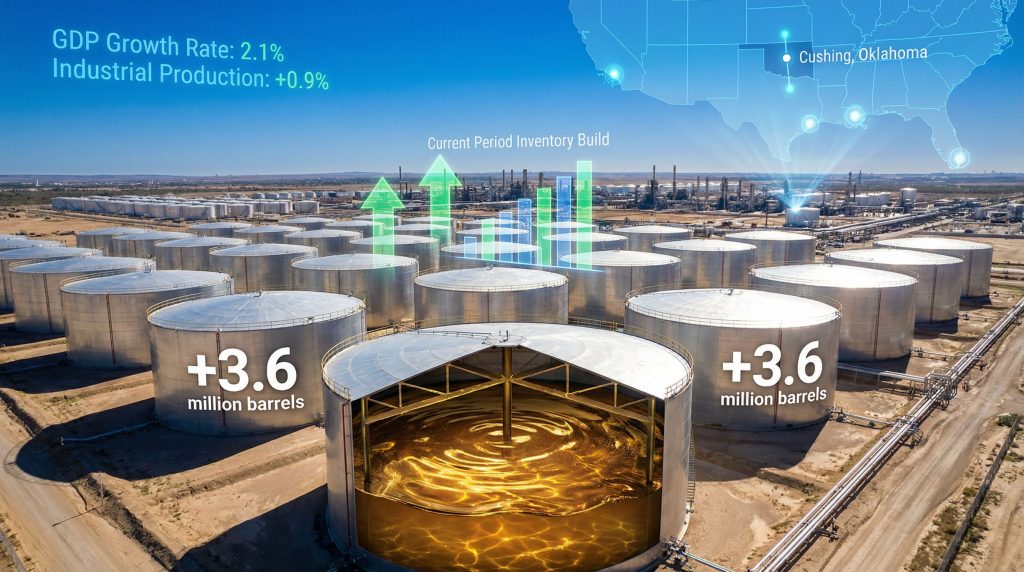
U.S. crude oil inventory build patterns reflect deep structural forces within the energy economy. Recent Energy Information Administration data shows commercial crude inventories increased by 3.6 million barrels during the week ending January 22, 2026, while gasoline stocks climbed 4.2 million barrels and distillate inventories declined 1.9 million barrels. These figures position gasoline inventories toward the upper end of their five-year historical range, indicating sustained oversupply conditions.
The accumulation pattern emerges from a fundamental misalignment between refinery utilisation rates and available crude supply. When gasoline and distillate stocks build significantly, refiners reduce crude demand because downstream product markets cannot absorb additional refined barrels. Consequently, this creates a self-reinforcing cycle where excess inventory suppresses refinery runs, which in turn reduces crude processing demand.
Refinery throughput decisions operate on direct correlation with finished product inventory levels. The technical relationship follows this sequence:
- Transportation fuel consumption reflects consumer mobility patterns
- Weak gasoline demand creates rising product inventory
- Rising product inventory reduces refinery incentive for crude runs
- Reduced refinery crude runs lowers overall crude demand
- Lower crude demand combined with stable imports equals crude inventory builds
Storage economics operate through arbitrage opportunities when futures spreads exceed carrying costs. The calculation involves: Futures Spread – Storage Cost – Financing Cost = Profit Margin. When this equation yields positive returns, inventory accumulation becomes economically attractive regardless of immediate demand conditions.
Federal Reserve Policy Impact on Energy Storage Economics
The cost structure of inventory financing represents a material input into storage decision-making. Interest rate environments directly influence the "carry cost" of holding crude oil in storage facilities. When rates are elevated, financing costs increase, potentially incentivising earlier sales and discouraging new inventory accumulation. However, when rates decline or storage capacity remains underutilised, the economic case for building inventories strengthens substantially.
Monetary policy transmission through energy sector capital allocation follows predictable patterns. The Federal Reserve's stance affects not only direct borrowing costs for storage operations but also influences the dollar's strength, which correlates with crude oil inventory management strategies. In addition, a stronger dollar makes U.S. crude exports less competitive globally, while affecting the relative attractiveness of domestic versus international crude purchases.
The contango structure in crude futures markets subsidises storage when distant contracts trade at premiums to near-term contracts. This pricing relationship becomes particularly relevant during periods of inventory builds, as storage operators can capture the spread between immediate and future delivery prices. The arbitrage opportunity exists primarily when contango spreads exceed the combined costs of storage facilities and financing arrangements.
Current storage facility costs typically range between $0.50 to $1.50 per barrel per month, depending on location and facility type. These operational costs must be weighed against financing expenses, which vary based on prevailing interest rates and credit terms available to storage operators.
When big ASX news breaks, our subscribers know first
What Inventory Data Reveals About U.S. Economic Health
Refinery Demand as a Leading Economic Indicator
Rising gasoline inventories function as a leading indicator of weakening consumer transportation fuel demand. The correlation mechanism operates through transportation fuel consumption patterns that reflect broader consumer spending behaviour and economic mobility. Moreover, when gasoline inventories rise despite seasonal expectations for gradual improvement, it signals either insufficient consumer fuel consumption or excess refinery utilisation relative to market absorption capacity.
The 4.2 million barrel increase in gasoline stocks during the January 2026 reporting period demonstrates this dynamic in action. Historical precedent supports this interpretation: during the 2020-2021 economic contraction, crude inventory builds averaged 4.8 million barrels weekly while GDP contracted 3.4% and industrial production declined 7.2%.
| Economic Period | Weekly Crude Builds | GDP Growth | Industrial Production | Unemployment |
|---|---|---|---|---|
| 2015-2016 | +2.1M barrels | 2.3% | -0.8% | 5.1% |
| 2020-2021 | +4.8M barrels | -3.4% | -7.2% | 8.1% |
| Current Period | +3.6M barrels | Projected 2.1% | +0.9% | 4.2% |
Vehicle miles travelled represents a critical correlation factor that connects gasoline demand to broader economic activity. Federal Highway Administration data typically shows strong relationships between transportation fuel consumption and consumer purchasing patterns. When this relationship breaks down, as evidenced by rising gasoline inventories, it suggests weakening economic fundamentals beyond the energy sector.
Manufacturing output trends correlate closely with refinery crude runs, as both represent industrial capacity utilisation patterns. Refineries operating below optimal capacity often signal broader industrial slowdowns, particularly in regions with concentrated petrochemical and heavy manufacturing activity.
Regional Economic Disparities Through Storage Hub Analysis
Different storage hubs across the United States serve as regional economic indicators due to their concentration of inventory for specific geographic markets. The Cushing, Oklahoma hub represents Midwest crude distribution patterns and reflects regional industrial activity levels. Elevated inventory levels at Cushing typically suggest weak Midwest refinery demand or reduced throughput to downstream markets.
Gulf Coast refinery operations indicate petrochemical sector health and export market strength. This region processes approximately 60% of U.S. refining capacity and serves as the primary distribution point for both domestic consumption and international exports. Furthermore, inventory patterns in Gulf Coast facilities often signal changes in global demand conditions and export competitiveness.
East Coast petroleum product inventories reflect Northeast economic conditions, particularly heating oil demand patterns that correlate with both weather conditions and industrial activity. The region's dependence on refined product imports makes inventory levels particularly sensitive to supply chain disruptions and regional demand fluctuations.
Regional analysis requires examination of Petroleum Administration for Defense district data, which breaks down inventory levels by geographic regions. Each district represents different economic conditions and demand patterns:
- PADD 1 (East Coast): Heavy heating oil consumption, import-dependent
- PADD 2 (Midwest): Manufacturing hub, Cushing storage center
- PADD 3 (Gulf Coast): Refining center, export hub
- PADD 4 (Rocky Mountain): Isolated markets, limited pipeline access
- PADD 5 (West Coast): Environmental regulations, import requirements
Global Trade Flow Implications of U.S. Inventory Builds
Import-Export Balance Shifts and Trade Deficit Impacts
The relationship between domestic inventory accumulation and import dependency operates through fundamental supply-demand mechanics. When U.S. commercial crude inventories rise while refinery demand remains constrained, marginal import requirements should theoretically decline. However, elevated domestic inventory levels may indicate that import levels already exceed processing capacity, creating surplus crude accumulation.
Trade deficit impacts from energy sector dynamics follow this framework: Crude imports equal the sum of refinery demand, domestic production changes, and Strategic Petroleum Reserve policy adjustments. When refinery demand weakens but imports remain steady, surplus crude accumulates, representing capital outflow that fails to generate corresponding economic value through processing activities. These dynamics closely relate to us–china trade impacts that affect global energy markets.
The Strategic Petroleum Reserve maintains approximately 714 million barrels of crude oil in underground salt caverns across Texas and Louisiana. Policy decisions regarding SPR releases or purchases significantly impact commercial inventory levels and import requirements. Recent SPR activities have included both emergency releases and planned replenishment programs that influence market dynamics.
Export capacity constraints create additional complications for inventory management. U.S. crude export infrastructure, while expanded significantly since 2015, still faces bottlenecks during periods of high production or weak domestic demand. These constraints can force inventory builds even when international demand remains strong.
Current U.S. crude export capacity approaches 4 million barrels per day, but actual export levels fluctuate based on price differentials, shipping availability, and international demand conditions. When exports decline due to competitive pressures or logistical constraints, domestic inventories tend to accumulate more rapidly.
Currency Market Interactions with Energy Storage Patterns
The "petrodollar recycling" mechanism operates through complex interactions between energy trade flows and currency markets. When global crude oil prices decline or U.S. crude imports decrease, fewer dollars need to be exchanged internationally for crude purchases, reducing dollar demand in global commodity markets.
However, this relationship involves multiple channels:
- Direct Channel: Crude export proceeds in USD increase global dollar holdings
- Indirect Channel: USD purchases for oil acquisition support currency demand
- Capital Markets Channel: Energy companies and importing nations recycle proceeds into USD-denominated assets
A stronger dollar makes U.S. crude exports less competitive globally by increasing prices in foreign currencies. Conversely, weaker global demand may reduce crude prices, decreasing dollar inflow from energy trade activities. Energy storage decisions become influenced by interest rates, which reflect monetary policy and currency valuations.
International crude oil pricing mechanisms respond to U.S. inventory signals through multiple pathways. Large inventory builds typically pressure prices lower, affecting global benchmark relationships and international trade flows. For instance, foreign exchange implications emerge when changing energy trade balances alter the supply and demand for different currencies in commodity markets, particularly when considering oil price movements.
Investment Market Responses to Inventory Build Cycles
Equity Market Sector Rotation Patterns
Energy sector underperformance during sustained inventory build cycles reflects market participants' forward-looking expectations about profitability and cash flow generation. When crude inventory builds are sustained and prices face downward pressure, energy company valuations typically decline based on reduced revenue projections and margin compression expectations.
The correlation between U.S. crude oil inventory build patterns and energy sector performance operates through several mechanisms:
- Lower crude prices reduce upstream production profitability
- Refining margins may compress due to product oversupply
- Capital allocation toward growth projects becomes less attractive
- Dividend sustainability comes into question for leveraged operators
Utility and transportation stock correlations with fuel cost expectations create additional sector rotation dynamics. Lower energy input costs can benefit utilities and transportation companies, leading to relative outperformance during periods of crude inventory builds and price weakness.
Industrial sector impacts from changing input cost projections vary by subsector. Energy-intensive industries such as chemicals, steel, and aluminium may benefit from lower energy costs, while energy services and equipment companies typically underperform during inventory build cycles. These patterns intersect with broader tariffs economic implications that affect industrial competitiveness.
Fixed Income Market Reactions to Energy Supply Dynamics
Treasury yield curve responses to inflation expectations from energy costs represent a critical transmission mechanism for inventory data. Lower crude prices due to oversupply conditions typically reduce headline inflation expectations, potentially leading to lower long-term interest rates and steeper yield curves.
Corporate bond spreads in energy-intensive industries reflect changing credit risk perceptions based on input cost trends. Companies with high energy cost exposure may see credit spreads tighten during periods of inventory builds and lower energy prices, while energy sector credits may face widening spreads due to reduced cash flow expectations.
Municipal bond implications for oil-producing state revenues become particularly relevant during sustained inventory build periods. States such as Texas, North Dakota, and Alaska depend heavily on energy sector tax revenues, and prolonged periods of inventory builds and price weakness can impact credit quality and borrowing costs.
The relationship between energy prices and inflation expectations influences Federal Reserve policy considerations. Sustained crude inventory builds that pressure prices lower may provide the Fed with additional flexibility for monetary policy decisions, potentially affecting the entire interest rate complex. This connects to broader us economy & tariffs considerations affecting economic policy.
Long-Term Economic Structural Changes Indicated by Inventory Trends
Energy Independence Economic Multiplier Effects
Reduced import dependency creates domestic economic circulation benefits through multiple channels. When domestic crude production meets or exceeds consumption requirements, the resulting trade balance improvement keeps energy-related capital within the domestic economy rather than flowing to international producers.
Employment pattern shifts from energy sector workforce reallocation affect regional economic development. Areas with increased domestic production activity typically experience job creation in both direct energy sector roles and supporting service industries, while import-dependent regions may see relative employment declines.
Regional economic development implications of sustained domestic supply abundance include:
- Infrastructure investment requirements for increased storage capacity
- Transportation network development for domestic crude distribution
- Petrochemical industry expansion opportunities near production areas
- Port facility modifications for export capability enhancement
The economic multiplier effect of domestic energy production extends beyond direct employment to include supporting industries such as equipment manufacturing, logistics services, and financial intermediation. Each barrel of domestic crude production generates additional economic activity through these interconnected relationships.
Industrial Policy Consequences of Abundant Domestic Supply
Manufacturing competitiveness advantages from lower energy input costs create opportunities for industrial sector expansion. Industries with high energy intensity, such as steel, aluminium, and chemicals, benefit from stable and relatively low domestic energy costs compared to international competitors facing higher or more volatile energy prices.
Chemical and petrochemical industry expansion opportunities emerge from both lower feedstock costs and abundant supply availability. The U.S. petrochemical sector has invested heavily in new capacity based on domestic natural gas and crude oil abundance, creating additional demand for crude oil inventory management and processing.
Infrastructure investment requirements for increased storage capacity include both commercial storage facilities and strategic reserve expansions. Current commercial crude storage capacity approaches 400 million barrels nationally, but continued domestic production growth may require additional storage investment to manage supply-demand timing mismatches.
Policy considerations regarding export licensing and infrastructure development affect long-term inventory management strategies. Regulations governing crude oil exports, pipeline construction, and storage facility development influence how quickly inventory builds can be resolved through increased exports or domestic consumption.
The next major ASX story will hit our subscribers first
Future Economic Scenarios and Inventory Management Strategies
Recession Indicators and Energy Storage Preparedness
Historical correlation between inventory builds and economic slowdowns provides valuable insight for economic forecasting applications. The pattern typically emerges as economic growth slows, reducing both transportation fuel demand and industrial energy consumption, leading to inventory accumulation.
Early warning systems using energy storage data for recession prediction focus on several key indicators:
- Sustained crude inventory builds exceeding seasonal norms
- Rising gasoline inventories despite stable or growing driving patterns
- Declining distillate inventories indicating reduced industrial activity
- Regional inventory disparities suggesting uneven economic conditions
Counter-cyclical investment opportunities in energy infrastructure often emerge during periods of sustained inventory builds. Lower asset valuations and reduced competition for projects create favourable conditions for long-term infrastructure development when inventory management becomes critical.
The relationship between inventory cycles and broader economic conditions suggests that U.S. crude oil inventory build patterns serve as leading indicators for economic policy decisions. Federal Reserve officials monitor energy market conditions as part of their economic assessment process, particularly regarding inflation expectations and consumer spending patterns. This analysis connects to current oil price rally dynamics affecting market conditions.
Technological Innovation Impacts on Storage Economics
Digital inventory management systems reduce operational costs through improved efficiency and real-time monitoring capabilities. Advanced sensor networks, automated trading systems, and predictive analytics help optimise storage utilisation and reduce carrying costs for crude oil inventory management.
Alternative energy transition effects on crude oil storage demand represent a long-term structural consideration. As renewable energy adoption accelerates, petroleum product demand patterns may shift, affecting optimal inventory levels and storage facility utilisation rates.
Artificial intelligence applications in inventory optimisation strategies include demand forecasting, price prediction, and automated trading systems that can respond rapidly to market conditions. These technological advances may reduce the magnitude of inventory builds by improving supply-demand matching efficiency.
Advanced storage technologies such as floating storage vessels, underground salt cavern development, and strategic reserve optimisation provide additional flexibility for managing inventory cycles during periods of supply-demand imbalance. Moreover, these innovations help market participants better respond to crude oil inventories data releases and their market implications.
Disclaimer: This analysis involves economic forecasting and market speculation based on historical patterns and current data. Energy market conditions can change rapidly due to geopolitical events, weather patterns, and other unforeseen circumstances. Investment decisions should not be based solely on inventory data analysis without considering additional market factors and risk tolerance.
Ready to Navigate Energy Market Opportunities?
The complex interplay between crude oil inventories, economic indicators, and market dynamics creates actionable opportunities for informed investors. Discovery Alert's proprietary Discovery IQ model delivers real-time alerts on significant ASX mineral discoveries, including energy sector developments, instantly empowering subscribers to identify trading opportunities ahead of the broader market through their comprehensive discoveries page showcasing historic returns. Begin your 30-day free trial today at Discovery Alert and secure your market-leading advantage.