
June 6, 2026
Macro Economic Forces Reshaping Commodity Investment Strategy
Industrial metals markets are experiencing a fundamental transformation as traditional cyclical patterns give way to structural supply-demand imbalances driven by technological innovation and geopolitical realignment. Unlike historical commodity booms rooted in temporary oversupply corrections, current market dynamics reflect permanent shifts in global energy infrastructure, digital transformation requirements, and supply chain geography that position copper supply bets as compelling risk-adjusted investment opportunities through multi-year time horizons.
The convergence of artificial intelligence infrastructure demands, renewable energy deployment acceleration, and electric vehicle adoption creates multiplicative rather than additive effects on copper consumption patterns. These demand drivers operate independently of traditional economic cycles, establishing baseline consumption growth rates that exceed historical mining capacity expansion capabilities across geographic regions and geological constraints.
When big ASX news breaks, our subscribers know first
Understanding Strategic Supply Deficit Scenarios Through Quantitative Analysis
Current copper market fundamentals demonstrate unprecedented structural tightness, with the red metal achieving its largest annual gain since 2009 through a 40% rally on the London Metal Exchange during 2025. This performance positions copper alongside tin as the best-performing industrial metal on the exchange, with biggest annual gains since 2009 reaching a record high of $12,960 per ton before settling at $12,558.50 per ton as of year-end trading sessions.
Furthermore, analysts suggest that New York copper record prices reflect deeper structural changes in global supply chains. This exceptional performance aligns with broader market sentiment regarding long-term supply constraints and increasing electrification demands.
Defining Critical Supply Disruption Pathways
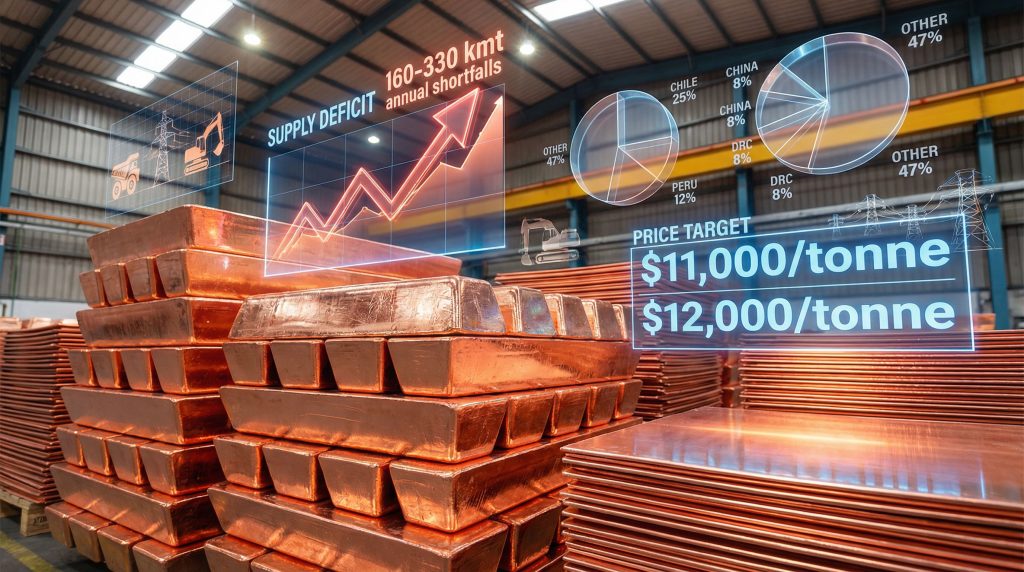
Base case scenarios project annual shortfalls ranging from 160-330 thousand metric tons through 2026-2027, driven primarily by mine production stagnation against accelerating electrification demand. These projections reflect flat global mine growth averaging 1.4% annually compared to demand increases of 8-12% from renewable energy infrastructure, electric vehicle manufacturing, and data center expansion requirements.
Bear case modelling incorporates accelerated mine closure scenarios that could push deficits beyond 500 thousand metric tons annually. Contributing factors include:
• Environmental regulatory tightening forcing premature operational shutdowns
• Grade decline acceleration in major producing operations
• Capital expenditure inflation exceeding 40-60% above historical norms
• Permitting delays averaging 7-10 years for new project development
Bull case scenarios assume China economic recovery amplifying demand beyond current BloombergNEF projections of consumption increases exceeding one-third by 2035 in baseline scenarios. Such demand acceleration would compound existing supply constraints through industrial copper consumption recovery in construction, manufacturing, and infrastructure development sectors.
Mine Production Bottlenecks Creating Structural Investment Opportunities
Recent supply disruption events exemplify the vulnerability of global copper production to operational incidents. Indonesia's Grasberg mine, identified as the world's second-largest copper operation, experienced a deadly accident creating immediate supply constraints. Simultaneously, the Democratic Republic of Congo faced underground flooding at major operations, while Chilean mining experienced a fatal rock blast, creating multiplicative strain on metal availability.
These incidents represent approximately 1.8 million tonnes of combined annual capacity across affected operations, equivalent to 9% of global copper production if simultaneously offline. Such concentration risk demonstrates how operational disruptions at key facilities can create supply shock scenarios that traditional commodity forecasting models fail to anticipate adequately.
However, investors seeking to understand the broader implications should consider copper supply forecast models that incorporate these structural vulnerabilities into longer-term projections.
Structural Versus Cyclical Supply Constraints in Modern Commodity Markets
Traditional commodity cycles operate through 3-5 year oversupply and undersupply patterns driven by capital expenditure cycles in production capacity. Copper's emerging supply paradigm differs fundamentally through 15-20 year structural deficit periods that cannot be resolved through conventional market mechanisms of price increases driving new capacity development.
Technology-Driven Demand Multiplication Effects
Artificial intelligence infrastructure deployment creates copper intensity requirements 4-6 times higher than traditional data centre configurations. While conventional data centres require 3-5 tonnes of copper per megawatt capacity, AI-optimised facilities demand 8-12 tonnes per megawatt due to enhanced cooling systems, power distribution infrastructure, and computational density requirements.
Projected demand surge from AI infrastructure alone ranges from 110-475 thousand metric tons annually by 2027-2028, representing substantial incremental consumption beyond baseline electrification trends. This demand category exhibits minimal price elasticity, as AI infrastructure deployment follows technological adoption curves rather than commodity pricing sensitivity.
In addition, those considering strategic positioning in this space may benefit from exploring copper investment insights that examine regional opportunities across different markets.
Grid Infrastructure Modernisation Requirements
Renewable energy integration necessitates 4-6 times copper intensity compared to traditional power generation infrastructure. Contributing factors include:
• Transmission line capacity expansion for distributed generation
• Energy storage system copper requirements for grid stabilisation
• Smart grid technology deployment across distribution networks
• Electric vehicle charging infrastructure requiring 200-300 thousand metric tons additional demand
Combined grid modernisation initiatives project 150-250 thousand metric tons of incremental copper demand annually through infrastructure upgrading requirements that operate independently of cyclical economic fluctuations.
Tariff-Driven Supply Dislocations Creating Geographic Arbitrage Opportunities
Policy-driven market distortions have created unprecedented inventory concentration patterns that generate trading opportunities across geographic markets. More than 650,000 tons of copper have entered the United States in anticipation of potential tariffs, representing 3.25% of annual global production redistributed within concentrated timeframes.
Inventory Concentration and Market Tightness Dynamics
Current market structure shows two-thirds of global visible copper stocks concentrated within COMEX warehouses, creating acute supply constraints in ex-US markets. This represents the most significant inventory redistribution in modern copper trading history, driven by Trump administration signals to revisit tariff policies on primary copper in 2026.
Market analyst perspectives emphasise that tariff expectations have created tightness ex-US even as underlying demand in key buyer China has softened. This geographical supply dislocation operates independently of fundamental demand patterns, creating arbitrage opportunities between tariff-protected and open markets.
Furthermore, investors should understand how tariffs impact investment decisions across various asset classes. The interconnected nature of trade policy and commodity markets creates ripple effects that extend beyond immediate supply considerations.
Price Differential Exploitation Mechanisms
Geographic price spreads have widened to $200-400 per tonne between London-Shanghai markets, creating profitable arbitrage trades for participants with logistics capabilities. Premium markets include Europe and Asia-Pacific regions excluding China, while discount markets encompass US domestic and select Latin American trading hubs.
Consequently, understanding global tariff effects becomes crucial for investors navigating these complex price dynamics across different geographical markets.
| Market Region | Price Premium | Inventory Availability | Arbitrage Potential |
|---|---|---|---|
| Europe | +$300-400/tonne | Critically tight | High |
| Asia-Pacific | +$250-350/tonne | Moderately tight | High |
| US Domestic | Baseline | Abundant | Low |
| Latin America | -$50-100/tonne | Variable | Medium |
Investment Vehicle Performance Analysis and Risk Profiles
Copper supply bets can be structured through multiple investment vehicles exhibiting distinct risk-return characteristics and time horizon suitability. Direct futures exposure provides highest sensitivity to price movements but requires sophisticated risk management capabilities due to leverage and contango effects.
Risk-Adjusted Return Frameworks
Mining equity investments offer leveraged exposure to copper prices through operational gearing effects, with major producers demonstrating beta coefficients of 1.5-2.5 times underlying metal price movements. This leverage amplifies both upside potential and downside risk, making position sizing and diversification critical for portfolio management.
Exchange-traded funds provide diversified exposure with 85-95% tracking efficiency to underlying copper prices, while avoiding single-company operational risks inherent in direct mining stock investments. However, futures-based ETFs experience 2-4% annual roll costs during contango market conditions, reducing long-term return potential.
Portfolio Allocation Strategy Development
Conservative allocation approaches suggest 5-10% portfolio weighting to copper-focused investments, balanced across multiple vehicle types to optimise risk-adjusted returns. Aggressive strategies may justify 15-25% allocations for investors with higher risk tolerance and shorter investment horizons.
Professional hedge fund strategies often employ 30-50% concentrated positions enhanced through derivatives instruments for additional leverage or downside protection. Such strategies require sophisticated risk management infrastructure and active position monitoring capabilities.
Demand Acceleration Catalysts and Timeline Analysis
Multiple demand acceleration scenarios could amplify baseline copper consumption projections beyond current BloombergNEF estimates. China economic stimulus packages targeting infrastructure development and manufacturing recovery represent the most probable near-term catalyst for demand surprises.
Electric Vehicle Adoption Rate Scenarios
Current EV adoption projections assume 20% market penetration by 2030, but faster-than-expected consumer adoption could reach 25-30% penetration under favourable policy and technology scenarios. Each percentage point of additional EV adoption translates to approximately 15-20 thousand metric tons of additional annual copper demand through vehicle manufacturing and charging infrastructure requirements.
Battery technology improvements enabling longer range and faster charging capabilities could accelerate consumer adoption timelines, particularly if supported by government incentive programmes and fossil fuel regulatory constraints.
Infrastructure Investment Multiplier Effects
Government infrastructure spending programmes exhibit copper demand multiplier effects through simultaneous deployment across transportation, communication, and energy sectors. The Infrastructure Investment and Jobs Act in the United States exemplifies how policy-driven spending creates sustained rather than cyclical copper demand increases.
Similar infrastructure programmes across European Union renewable energy initiatives and Asian development bank financing create concurrent demand acceleration across multiple geographic regions, reducing the probability that any single economic downturn could offset global copper consumption growth.
The next major ASX story will hit our subscribers first
What Price Targets Should Investors Expect?
Analyst price target analysis suggests $11,000 per tonne targets carry 70-80% achievement probability by Q3 2026, based on current supply-demand trajectory modelling. These targets reflect conservative estimates assuming no major supply disruption events and modest demand growth acceleration.
$12,000 per tonne targets exhibit 50-60% probability by year-end 2026, requiring either modest supply disruptions or demand growth exceeding baseline projections. Such price levels would generate substantial returns for equity investments in major copper producers, given typical operational leverage characteristics.
Bull Case Scenario Return Projections
Extreme scenarios projecting $15,000 per tonne copper prices carry 20-30% probability under severe supply disruption or exceptional demand acceleration circumstances. Achievement of such pricing would likely coincide with broader commodity complex strength and potential inflationary pressures across industrial materials.
Mining equity investments could generate 100-300% returns under such scenarios, particularly for companies with low-cost operations and expansion optionality. However, such returns would likely coincide with increased volatility and potential policy intervention risks in key consuming economies.
Additionally, analysis from supply bets and market positioning suggests institutional investors are increasingly allocating capital towards copper exposure as a hedge against supply disruption scenarios.
Risk Assessment and Investment Thesis Vulnerabilities
Primary downside risks to copper supply bets include demand destruction through global economic recession, with industrial copper consumption potentially declining 15-25% during severe downturns. Historical precedent suggests copper demand exhibits high correlation with manufacturing activity and construction spending, both vulnerable to credit tightening and consumer spending reductions.
Supply Response Scenarios
Potential supply responses could undermine current deficit projections if regulatory environments facilitate accelerated mine development or technological breakthroughs reduce development timelines and costs. Fast-tracking permitting processes could bring forward new production capacity, while improvements in extraction technology might extend existing mine life cycles.
Recycling technology advancement represents another supply response mechanism, as enhanced secondary copper recovery could offset portions of primary supply constraints. Current recycling rates suggest substantial room for improvement through technology deployment and economic incentive alignment.
Substitution Technology Risks
Alternative materials development poses long-term risks to copper demand growth, particularly in electrical applications where aluminium or composite materials might replace copper in specific use cases. However, copper's superior conductivity and corrosion resistance characteristics limit substitution potential in most critical applications.
Research into superconductor technology advancement could theoretically reduce copper requirements for certain electrical infrastructure applications, though commercial deployment timelines remain uncertain and likely decades away from meaningful impact on industrial copper demand.
Strategic Implementation Framework for Copper Exposure
Optimal entry point identification requires combining technical analysis for futures contract positioning with fundamental analysis for equity selection across the copper value chain. Dollar-cost averaging strategies during volatility periods help mitigate timing risk while building positions across multiple investment vehicles.
Exit Strategy Development
Profit-taking levels should align with analyst price targets while maintaining core positions for longer-term structural demand growth. Stop-loss mechanisms become particularly important for leveraged positions, with trailing stop orders helping protect gains during volatile trading periods.
Rebalancing triggers based on supply-demand updates ensure portfolio positioning remains aligned with evolving market fundamentals rather than maintaining static allocations through changing conditions.
Investment Vehicle Summary for Copper Supply Exposure
Direct Futures: COMEX copper contracts provide maximum price sensitivity for sophisticated traders with risk management capabilities
Diversified ETFs: COPX (mining companies), CPER (futures-based) offer broad exposure without single-company risks
Major Producers: Freeport-McMoRan (FCX), Southern Copper (SCCO) provide leveraged exposure to copper price movements
Emerging Companies: First Quantum Minerals, Lundin Mining offer higher risk-return potential through development projects
Investors considering copper supply investment strategies should conduct thorough due diligence and consider their risk tolerance, investment timeline, and portfolio diversification objectives. Past performance does not guarantee future results, and commodity investments carry inherent volatility risks that may result in substantial losses. This analysis is for educational purposes and does not constitute investment advice.
Looking to Capitalise on the Emerging Copper Supply Crisis?
Discovery Alert's proprietary Discovery IQ model delivers real-time alerts on significant ASX mineral discoveries, instantly empowering subscribers to identify actionable copper and base metals opportunities ahead of the broader market. Given the structural supply deficits and unprecedented demand drivers reshaping commodity markets, begin your 30-day free trial today to secure your market-leading advantage in this transformative investment landscape.