
May 21, 2026
Macroeconomic Forces Reshaping Precious Metals Markets
The precious metals landscape of 2026 reflects a convergence of monetary, geopolitical, and structural factors that have fundamentally altered investment demand patterns. While short-term volatility continues to challenge traditional portfolio allocation models, underlying market dynamics suggest a fundamental shift in how institutional investors approach gold positioning. The interplay between real interest rate environments, central bank reserve strategies, and retail investment flows has created conditions that major investment banks are interpreting as supportive for sustained precious metals appreciation.
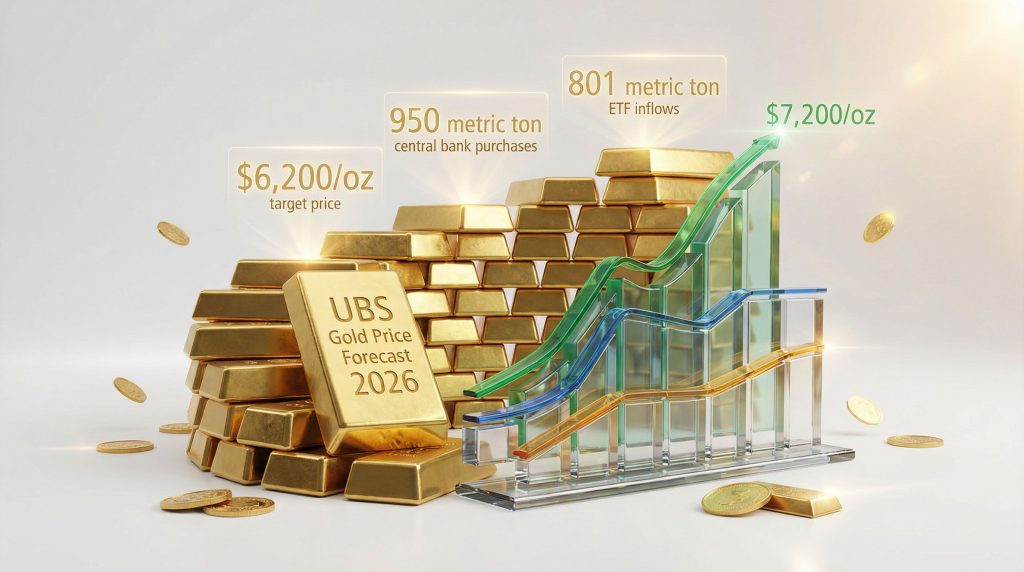
This analytical framework extends beyond conventional inflation hedging considerations into broader questions of financial system resilience and currency stability. The UBS gold price forecast 2026 represents one institutional perspective on how these converging forces might influence precious metals valuations through the remainder of the year.
When big ASX news breaks, our subscribers know first
What Drives UBS's Bullish Gold Outlook Through 2026?
Central Bank Accumulation Patterns Reshaping Global Reserves
Central banking institutions worldwide have demonstrated increasingly sophisticated approaches to gold reserve management, moving beyond traditional diversification strategies toward more active accumulation programs. The structural nature of this demand source differs significantly from speculative positioning, as central banks typically operate with longer investment horizons and different risk tolerance parameters than private investors.
Recent data indicates central bank gold purchases have maintained momentum despite elevated price levels, suggesting institutional buyers view current valuations as reasonable relative to perceived long-term value. This purchasing behavior appears driven by several converging factors:
• Geographic diversification of reserve assets away from concentrated currency exposures
• Hedge against currency debasement concerns in major developed economies
• Portfolio rebalancing toward tangible assets amid unprecedented monetary expansion
• Geopolitical risk management through increased precious metals allocation
The consistency of central bank buying programs provides a structural support mechanism that helps stabilise gold markets during periods of increased volatility. Unlike retail or institutional investors who may adjust positions based on short-term market conditions, central banks typically maintain steady accumulation schedules that are less sensitive to price fluctuations.
Real Interest Rate Environment Creating Investment Opportunity
The relationship between real interest rates and gold performance represents one of the most significant factors in current market dynamics. Real rates, calculated as nominal interest rates minus inflation expectations, directly impact the opportunity cost of holding non-yielding assets like gold.
Current Federal Reserve policy trajectories suggest continued pressure on real yields, particularly as inflation expectations remain elevated while nominal rate increases face economic growth constraints. Furthermore, this environment creates several investment implications through our comprehensive gold stock market guide.
Interest Rate Mechanism Analysis:
| Real Rate Environment | Gold Investment Appeal | Historical Precedent |
|---|---|---|
| Negative Real Rates | High (Low opportunity cost) | 2008-2012, 2020-2021 |
| Low Positive Real Rates | Moderate | 2016-2018 |
| High Positive Real Rates | Low (High opportunity cost) | 1980s, early 2000s |
The technical mechanism operates through investor decision-making frameworks where real yields on alternative investments provide direct competition for investment capital. When real yields fall, the relative attractiveness of gold increases as the foregone income from holding precious metals decreases.
How Do Current Market Dynamics Support UBS's $6,200 Price Target?
ETF Investment Flows Signalling Institutional Confidence
Exchange-traded fund flows provide real-time insight into institutional and retail investor sentiment toward gold exposure. These vehicles offer professional investors liquid access to precious metals exposure without the operational complexities of physical storage and insurance.
The pattern of sustained ETF inflows reflects several underlying market dynamics:
• Portfolio diversification strategies incorporating gold as uncorrelated asset class
• Risk management protocols seeking hedge against equity market volatility
• Institutional mandate changes allowing increased alternative asset allocation
• Retail investor accessibility through commission-free trading platforms
ETF Structure Advantages:
Professional investors appreciate ETF structures for their operational efficiency compared to direct physical gold ownership. These vehicles provide:
- Instant liquidity through secondary market trading
- Cost efficiency through shared storage and insurance expenses
- Tax optimisation opportunities in certain jurisdictions
- Portfolio integration compatibility with existing investment systems
The sustained nature of ETF inflows suggests investors are making strategic rather than tactical allocation decisions, indicating confidence in gold's long-term value proposition rather than speculative short-term positioning. In addition, recent analysis of gold market performance surge demonstrates this institutional confidence in action.
Supply-Demand Fundamentals Creating Structural Support
Gold market supply dynamics operate on significantly longer time horizons than demand fluctuations, creating potential for structural imbalances. Mining production typically requires 7-10 years from discovery to production, while demand can shift rapidly based on economic conditions.
Current Supply Constraints:
• Mining production plateaus despite elevated prices due to deposit grade decline
• Capital allocation limitations in mining sector following previous cycle losses
• Regulatory approval delays extending project development timelines
• Environmental compliance costs increasing operational expenses
Demand Sector Analysis:
| Demand Category | 2025 Estimated Tonnage | Growth Drivers | Price Sensitivity |
|---|---|---|---|
| Jewellery | 1,850 tons | Emerging market wealth creation | Moderate |
| Investment | 1,200 tons | Portfolio diversification | Low |
| Technology | 320 tons | Electronics miniaturisation | Low |
| Central Banks | 450 tons | Reserve diversification | Very Low |
Industrial demand for gold continues expanding through technology sector applications, particularly in semiconductor manufacturing where gold's electrical conductivity and corrosion resistance provide essential functionality. This demand source tends to be price-inelastic, providing support during market downturns.
What Are UBS's Multiple Scenario Projections for Gold in 2026?
Geopolitical Risk Premium Calculations
Investment banks typically employ scenario-based modelling to account for the range of potential outcomes affecting commodity prices. The UBS gold price forecast 2026 incorporates multiple variables that could influence precious metals valuations.
Risk Premium Factors:
• Regional conflict escalation potential affecting global trade flows
• Currency war implications between major economic blocs
• Trade policy uncertainty creating supply chain disruptions
• Political transition risks in key economies
According to UBS's latest analysis, "The quantification of geopolitical risk premiums in commodity pricing requires sophisticated modelling of probability-weighted scenarios rather than single-point estimates."
Historical analysis suggests gold prices can incorporate risk premiums of $200-$400 per ounce during periods of elevated geopolitical uncertainty, though these premiums tend to fade as specific threats resolve or become normalised in market expectations.
Monetary Policy Sensitivity Analysis
Federal Reserve policy decisions create cascading effects through global financial markets, with precious metals particularly sensitive to changes in US monetary policy stance. The appointment of new Federal Reserve leadership has introduced additional uncertainty into policy trajectory forecasting.
Policy Transmission Mechanisms:
- Direct real rate impact through federal funds rate adjustments
- Dollar strength effects on international gold demand
- Inflation expectation management through forward guidance
- Financial condition tightening through quantitative tightening programs
The complexity of these transmission mechanisms means that gold prices can respond to Federal Reserve communications even before policy changes are implemented, as markets attempt to anticipate future conditions. However, understanding gold as inflation hedge remains crucial for comprehensive market analysis.
How Does UBS's Forecast Compare to Historical Gold Market Cycles?
Bull Market Progression Patterns Since 2019
The current gold bull market cycle began in late 2018 and has demonstrated characteristics consistent with previous major precious metals bull markets. These cycles typically progress through distinct phases:
Bull Market Phases:
| Phase | Duration | Price Behaviour | Volume Characteristics | Investor Base |
|---|---|---|---|---|
| Accumulation | 12-18 months | Steady appreciation | Increasing | Institutional |
| Markup | 18-24 months | Accelerating gains | High volatility | Broad participation |
| Distribution | 6-12 months | Choppy trading | Extreme volatility | Speculative |
Current market conditions suggest the gold bull market remains in the markup phase, characterised by strong institutional participation and sustained momentum despite periodic consolidation periods.
Volatility Profile Analysis:
Recent trading sessions have demonstrated extraordinary volatility levels, with daily price movements exceeding historical norms. This volatility pattern reflects:
• Increased algorithmic trading in precious metals markets
• Leveraged position adjustments during policy uncertainty
• Cross-asset correlation breakdown during stress periods
• Liquidity concentration in electronic trading platforms
Inflation Hedge Performance Validation
Gold's effectiveness as an inflation hedge operates through multiple time horizons and economic environments. Short-term correlation with inflation measures can be inconsistent, but longer-term relationships demonstrate stronger protective characteristics.
Inflation Protection Mechanisms:
- Purchasing power preservation over multi-decade periods
- Currency debasement hedge during monetary expansion cycles
- Real asset characteristics maintaining intrinsic value
- Portfolio diversification benefits reducing overall volatility
Research indicates gold provides effective inflation protection over periods exceeding 3-5 years, though shorter-term performance can vary significantly based on other market factors including real interest rates and currency movements.
What Investment Strategies Align with UBS's Gold Projections?
Portfolio Allocation Framework for 2026
Professional investment management typically approaches gold allocation through risk-adjusted return optimisation rather than simple diversification requirements. Modern portfolio theory suggests precious metals allocation between 5-15% depending on investor risk tolerance and return objectives.
Strategic Allocation Considerations:
• Correlation analysis with existing portfolio holdings
• Volatility contribution to overall portfolio risk
• Rebalancing frequency based on price momentum
• Tax efficiency optimisation across account types
Risk Management Protocols:
| Risk Factor | Mitigation Strategy | Implementation Method |
|---|---|---|
| Price Volatility | Position sizing limits | Maximum 10% allocation |
| Liquidity Risk | ETF vehicle selection | High-volume products |
| Storage Costs | Indirect ownership | ETF or mining stocks |
| Currency Risk | Dollar-denominated exposure | US-listed securities |
Consequently, implementing effective gold market strategies becomes essential for optimal portfolio construction.
Implementation Vehicles and Timing Considerations
Investment implementation requires careful consideration of available vehicles and their respective characteristics. Each approach offers different risk-return profiles and operational considerations.
Vehicle Comparison Analysis:
Physical Gold:
- Advantages: Direct ownership, no counterparty risk, tangible asset
- Disadvantages: Storage costs, insurance requirements, liquidity constraints
- Best suited for: Long-term strategic holdings, wealth preservation
Gold ETFs:
- Advantages: High liquidity, low storage costs, professional management
- Disadvantages: Annual fees, potential tracking errors, counterparty risk
- Best suited for: Tactical allocation adjustments, institutional portfolios
Gold Mining Stocks:
- Advantages: Operational leverage to gold prices, dividend potential, equity appreciation
- Disadvantages: Operational risks, management quality variation, environmental liabilities
- Best suited for: Growth-oriented investors, sector specialists
The next major ASX story will hit our subscribers first
What Risks Could Derail UBS's Optimistic Gold Forecast?
Federal Reserve Policy Pivot Scenarios
Central bank policy represents the primary risk factor for precious metals pricing, as unexpected policy shifts can rapidly alter the fundamental investment case for gold exposure.
Policy Risk Scenarios:
• Aggressive rate hiking cycles creating positive real yields
• Quantitative tightening acceleration reducing money supply growth
• Dollar strengthening initiatives through intervention or policy coordination
• Inflation targeting success reducing inflation expectations
The magnitude of policy impact depends on both the direction and speed of changes. Gradual policy adjustments are typically absorbed by markets more easily than sudden policy pivots that force rapid portfolio reallocation.
Market Structure Vulnerabilities
Modern gold markets incorporate significant leverage through derivatives and margin trading, creating potential for amplified volatility during stress periods.
Structural Risk Factors:
- Leveraged position concentration in futures markets
- ETF redemption pressure during rapid outflows
- Algorithmic trading amplification of price movements
- Cross-market correlation increases during crisis periods
Historical precedent suggests these structural factors can create temporary price dislocations that diverge from fundamental value, though these typically resolve as market conditions stabilise.
How Should Investors Position for UBS's Projected Gold Rally?
Entry Point Optimisation Strategies
Investment timing requires balancing fundamental analysis with technical market conditions to optimise entry points for gold exposure.
Technical Analysis Integration:
• Support and resistance levels based on historical trading ranges
• Moving average convergence indicating momentum shifts
• Volume analysis confirming price movement sustainability
• Volatility patterns identifying optimal entry timing
Dollar-Cost Averaging Framework:
Systematic investment approaches can reduce timing risk while building gold exposure over time. This strategy proves particularly effective during volatile market periods when precise timing becomes challenging.
Implementation Schedule:
- Monthly purchases spread over 6-12 month periods
- Volatility-based adjustments increasing purchases during weakness
- Rebalancing triggers maintaining target allocation percentages
Risk Management Protocols
Professional gold investment requires sophisticated risk management beyond simple position sizing limitations.
Advanced Risk Controls:
| Risk Type | Measurement Method | Control Mechanism |
|---|---|---|
| Position Risk | Value at Risk (VaR) | Daily position limits |
| Liquidity Risk | Bid-ask spread monitoring | Minimum volume requirements |
| Correlation Risk | Rolling correlation analysis | Diversification requirements |
| Tail Risk | Stress testing | Scenario-based position sizing |
Profit-Taking Strategies:
Systematic profit-taking frameworks help capture gains while maintaining core exposure during extended bull markets:
- Percentage-based rebalancing at predetermined intervals
- Technical level recognition taking profits at resistance levels
- Volatility-adjusted sizing reducing exposure during extreme movements
- Time-based rotation systematically reducing positions over time
Market Psychology and Investment Demand Dynamics
Retail Investor Participation Patterns
The psychology of retail gold investment differs significantly from institutional approaches, with individual investors often demonstrating more emotional decision-making patterns.
Retail Behaviour Characteristics:
• Fear-driven purchases during crisis periods
• Momentum following after significant price movements
• Media influence sensitivity to news coverage and commentary
• Long-term holding tendencies once positions are established
Current retail participation levels suggest broader acceptance of gold as legitimate portfolio component rather than speculative investment vehicle. This evolution in retail investor perception provides more stable demand foundation compared to purely speculative interest.
Institutional Investment Framework Evolution
Professional investment management has increasingly sophisticated approaches to precious metals allocation, moving beyond simple inflation hedging toward comprehensive risk management strategies.
Institutional Adoption Factors:
- Regulatory capital requirements encouraging diversification
- Risk parity strategies incorporating uncorrelated assets
- Endowment model influence emphasising alternative investments
- Pension fund allocation mandates requiring inflation protection
For instance, recent gold price forecast analysis demonstrates how institutional frameworks are adapting to current market conditions.
Technical Market Structure Analysis
Electronic Trading Platform Impact
Modern gold trading occurs primarily through electronic platforms that have fundamentally altered market microstructure and price discovery mechanisms.
Platform Characteristics:
• Algorithmic trading dominance in daily volume
• High-frequency trading participation creating short-term volatility
• Global market integration through 24-hour trading access
• Reduced transaction costs enabling smaller position adjustments
These technological developments have increased market efficiency while potentially amplifying short-term volatility through algorithm-driven trading strategies.
Derivative Market Integration
Gold futures and options markets provide price discovery mechanisms and risk management tools that influence underlying physical market dynamics.
Derivative Market Functions:
- Price discovery through continuous trading and arbitrage
- Risk transfer between commercial and speculative participants
- Leverage provision enabling larger position control
- Hedging mechanisms for mining companies and dealers
The interaction between derivative and physical markets creates complex feedback loops that can amplify price movements in both directions during periods of extreme positioning.
Frequently Asked Questions About UBS Gold Forecast 2026
Why Did UBS Revise Their Gold Target Higher?
The investment bank's revised projections reflect several converging factors that exceeded previous expectations. Investment demand demonstrated greater resilience than anticipated, with sustained ETF inflows indicating institutional confidence despite elevated volatility levels.
Central bank purchasing programmes maintained robust pace throughout 2025, suggesting official sector demand remains structural rather than opportunistic. The persistence of this demand source provides foundation for continued price appreciation.
Real interest rate environment developments created more favourable conditions than initially forecasted, with Federal Reserve policy trajectory supporting continued precious metals investment appeal.
What Could Push Gold Beyond UBS's Bull Case Scenario?
Several potential catalysts could drive gold prices above even optimistic forecasting scenarios:
Extreme Upside Scenarios:
• Major currency crisis affecting dollar reserve status
• Significant geopolitical escalation creating sustained safe-haven demand
• Unexpected inflation acceleration requiring aggressive monetary response
• Financial system stress triggering flight-to-quality positioning
These tail-risk scenarios would likely involve rapid price appreciation accompanied by extreme volatility as markets adjust to fundamentally altered conditions. As highlighted in recent market reports, such scenarios remain within the realm of possibility.
How Reliable Are Long-Term Precious Metals Forecasts?
Commodity price forecasting accuracy diminishes significantly beyond 12-18 month horizons due to the complex interaction of multiple variables affecting supply and demand dynamics.
Forecasting Limitations:
- Geopolitical events remain inherently unpredictable
- Central bank policy shifts can occur with limited advance notice
- Economic cycle timing proves difficult to predict precisely
- Market sentiment changes create self-reinforcing price movements
Professional investment analysis typically employs scenario-based approaches rather than point estimates to account for this inherent uncertainty. The value lies in understanding potential ranges and probability distributions rather than specific price targets.
Strategic Implications of UBS's Gold Market Analysis
The investment bank's revised projections reflect sophisticated understanding of multiple convergent factors supporting precious metals appreciation. Their scenario-based approach acknowledges both opportunities and risks inherent in current market conditions, providing investors with framework for strategic decision-making rather than simplistic price predictions.
The emphasis on real interest rate dynamics, institutional demand patterns, and geopolitical risk premiums suggests gold's role in modern portfolios extends beyond traditional inflation hedging into broader financial system insurance.
Investment Implementation Considerations:
• Portfolio allocation optimisation based on risk-adjusted return expectations
• Vehicle selection strategies aligned with investment objectives and operational requirements
• Risk management protocols incorporating both systematic and idiosyncratic risk factors
• Performance monitoring frameworks for ongoing allocation decisions
The UBS gold price forecast 2026 represents one institutional perspective within broader analytical framework that investors should consider alongside other research sources and individual investment objectives. The convergence of multiple supporting factors suggests precious metals may continue playing expanded role in institutional portfolio management strategies.
Disclaimer: This analysis is for informational purposes only and should not be considered personalised investment advice. Precious metals investing involves risks including potential loss of principal. Past performance does not guarantee future results. Investors should consult qualified financial advisors before making investment decisions.
Ready to Capitalise on the Next Major Gold Discovery?
While institutional forecasts like UBS's $6,200 gold target provide valuable market insight, Discovery Alert's proprietary Discovery IQ model delivers real-time alerts on significant ASX gold discoveries, instantly empowering subscribers to identify actionable opportunities ahead of the broader market. Explore how major mineral discoveries have generated substantial returns and begin your 14-day free trial today to position yourself ahead of institutional investors in the discovery space.