
June 6, 2026
Understanding the Macroeconomic Forces Behind Global Magnet Manufacturing Transformation
Global supply chain architectures undergo periodic restructuring driven by technological innovation, geopolitical realignment, and regulatory evolution. The permanent magnet sector exemplifies this transformation, where decades of concentrated production models face systematic disruption through export control mechanisms, defense procurement policies, and strategic industrial development initiatives. Manufacturing capacity traditionally concentrated in single geographic regions now disperses across multiple jurisdictions as end-users prioritise supply security over cost optimisation.
Korean magnet manufacturer JS Link's expansion into American magnet market represents more than conventional foreign direct investment. This strategic positioning emerges from fundamental shifts in how multinational corporations evaluate supplier relationships amid escalating US-China trade impacts and national security considerations. The convergence of regulatory pressure, technological capability, and political endorsement creates unique market opportunities for non-Chinese manufacturers to capture substantial market share in critical applications.
When big ASX news breaks, our subscribers know first
What Drives JS Link's Strategic Market Entry Into American Manufacturing?
Geopolitical Manufacturing Realignment Accelerates Alternative Sourcing
Contemporary supply chain risk management extends beyond traditional cost-benefit calculations to encompass regulatory compliance, technology transfer restrictions, and national security alignment. JS Link's expansion into American magnet market capitalises on growing corporate demand for supply chain diversification away from concentrated Chinese production capacity.
The Korean manufacturer's strategic positioning benefits from Seoul's alignment with Washington's technology and defence policies. Unlike suppliers from neutral or non-aligned countries, Korean manufacturers enjoy preferential treatment in U.S. defence procurement processes and benefit from established bilateral technology transfer agreements. This diplomatic foundation reduces regulatory uncertainty for American customers considering long-term supplier relationships.
Export control escalations create structural advantages for manufacturers operating outside Chinese jurisdiction. According to the JS Link Newsletter (November 2025), China's Public Notice No. 61 requires export permits for products containing greater than 0.1% Chinese-origin materials, extending Beijing's regulatory reach to multinational supply chains. This regulatory expansion drives corporate risk managers to prioritise supplier diversity over marginal cost savings.
Columbus, Georgia: Strategic Infrastructure and Geographic Positioning
JS Link's selection of Columbus, Georgia for its American manufacturing base reflects sophisticated analysis of transportation networks, labour markets, and proximity to key customer segments. Georgia's manufacturing corridor provides established infrastructure supporting advanced materials processing, including specialised logistics capabilities for handling rare earth materials and finished magnet products.
The Southeast region concentrates significant automotive and aerospace manufacturing capacity, reducing transportation costs and delivery timelines for finished magnets. Major defence contractors including Lockheed Martin and Northrop Grumman maintain substantial operations within the regional economic zone, creating immediate customer proximity for high-value defence applications requiring stringent supply chain controls.
Governor Brian Kemp's October 24, 2025 private meeting with JS Link leadership demonstrates state-level political commitment to the project's success. According to the JS Link Newsletter (November 2025), Kemp emphasised the strategic importance of permanent magnets to advanced manufacturing, defence, and clean-energy supply chains, signalling sustained governmental support beyond initial investment incentives.
Columbus Mayor Skip Henderson led a delegation to evaluate JS Link's Yesan facility on October 29, 2025, conducting direct due diligence on the company's production capabilities. This municipal-level engagement indicates local political consensus supporting the project and suggests streamlined permitting and regulatory processes for facility development.
How Export Restrictions Reshape Global Magnet Supply Chain Architecture?
Regulatory Framework Evolution Beyond Traditional Trade Controls
China's Public Notice No. 61 represents a fundamental expansion of export control methodology, extending beyond direct product restrictions to encompass downstream applications and technology transfers. The 0.1% threshold for Chinese-origin materials creates compliance challenges for multinational manufacturers, requiring extensive supply chain documentation and third-party verification systems.
This regulatory approach differs significantly from traditional export quota systems, which focused on volume limitations rather than end-user applications. The current framework enables Chinese authorities to monitor and potentially restrict technology flows, equipment transfers, and processing know-how across global supply chains. Industry sources warn this could escalate to encompass intellectual property licensing and technical consulting services.
Compliance costs for multinational corporations extend beyond direct material sourcing to include:
- Supply chain traceability systems and documentation requirements
- Third-party verification and certification processes
- Legal consultation and regulatory compliance staffing
- Alternative supplier qualification and technology transfer
- Inventory management and strategic stockpiling programs
Market Response Mechanisms Drive Customer Diversification
JS Link experienced a doubling of customer inquiries to approximately 80 companies within weeks of Public Notice No. 61's announcement, according to the JS Link Newsletter (November 2025). This rapid response indicates that major corporations maintain contingency sourcing strategies and can execute supplier transitions more quickly than traditional procurement timelines suggest.
The customer base expansion includes major automotive OEMs, Tier-1 suppliers, and consumer electronics manufacturers actively seeking supply chain alternatives. These inquiries focus particularly on H and SH grade magnets, which reduce dependence on heavy rare earth elements like dysprosium and terbium, addressing both supply security and cost management objectives.
Risk premium calculations now incorporate geopolitical stability, regulatory compliance, and technology transfer restrictions alongside traditional factors like quality, delivery, and pricing. Corporate procurement departments increasingly weight supplier geographic diversity and political alignment as primary selection criteria for strategic materials.
Production Capacity Analysis and Competitive Positioning Metrics
Facility Scale Comparison and Global Network Development
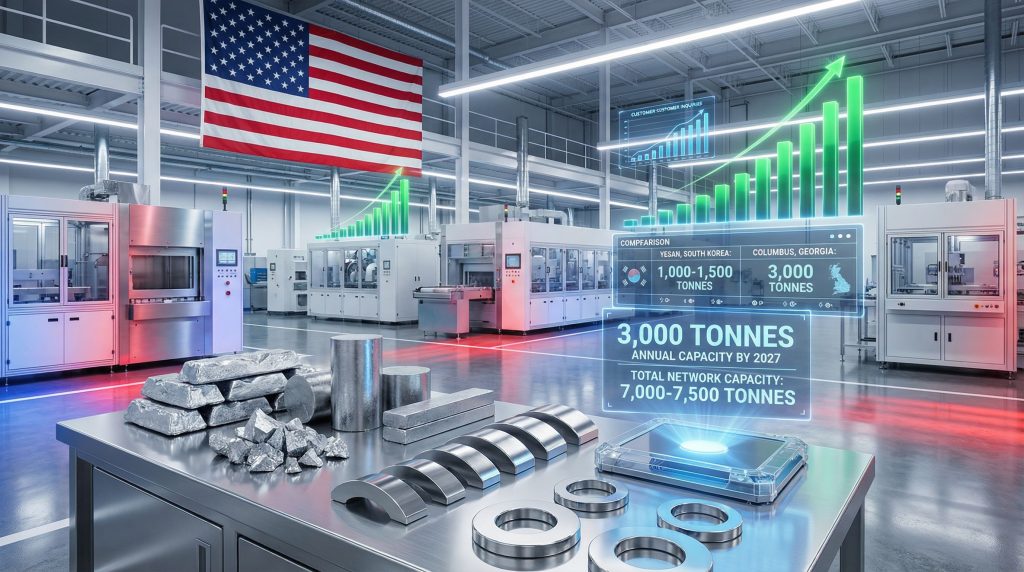
| Facility Location | Annual Capacity | Operational Status | Strategic Function |
|---|---|---|---|
| Yesan, South Korea | 1,000-1,500 tonnes | Operational | Technology development hub |
| Columbus, Georgia | 3,000-7,500 tonnes (projected) | Construction phase | U.S. market penetration |
| Malaysia (Lynas partnership) | 3,000 tonnes | Development | Southeast Asia supply base |
| Total Network Capacity | 7,000-12,000 tonnes | 2027-2028 target | Global diversification |
JS Link's Columbus facility represents a three-to-five-fold capacity expansion relative to the Yesan plant, positioning the company to capture substantial market share in North American magnet applications. This scale provides economies of scale for high-volume automotive applications while maintaining flexibility for specialised defence and aerospace requirements.
The company reports nearly two dozen plant equipment installations, machining upgrades, and facility renovations across its network, according to the JS Link Newsletter (November 2025). This simultaneous capacity expansion across multiple facilities indicates substantial capital commitment and operational expertise in rapid scaling operations.
Manufacturing Economics and Technology Transfer
Vertical integration from oxide processing through finished magnet production reduces dependency on external suppliers and enables quality control throughout the manufacturing process. Furthermore, JS Link's partnership with Lynas for rare earth magnets demonstrates strategic alliances supporting high-grade magnet production capabilities.
The company received dysprosium oxide delivery from Lynas' Malaysian refinery, with metalising work underway before UH-grade magnet sample production, according to the JS Link Newsletter (November 2025). This operational integration enables production of higher-coercivity magnets required for demanding applications including electric vehicle traction motors and aerospace systems.
Technology transfer between Korean and American facilities enables rapid capability replication while maintaining proprietary process knowledge within JS Link's corporate structure. This approach contrasts with joint venture models that require technology sharing with external partners and potentially compromise competitive advantages.
Technical Specifications and Market Differentiation Through Grade Optimisation
Magnet Grade Evolution and Heavy Rare Earth Reduction Strategies
Customer demand increasingly focuses on H and SH grade magnets that reduce reliance on heavy rare earth elements, according to the JS Link Newsletter (November 2025). This trend reflects both supply security considerations and cost management strategies, as dysprosium and terbium prices exhibit greater volatility than light rare earth elements.
Motor redesign initiatives across automotive and industrial applications optimise magnetic circuit design to achieve required performance with lower heavy rare earth content. These engineering developments enable manufacturers to maintain product specifications while reducing exposure to supply chain disruptions and price volatility in dysprosium and terbium markets.
JS Link's capability development in UH-grade magnets addresses high-temperature applications including defence systems, aerospace components, and industrial machinery operating in extreme environments. These applications command premium pricing and require suppliers with advanced metallurgical capabilities and quality control systems.
Supply Chain Integration and Quality Control Framework
The company's vertical integration from oxide sourcing through finished magnet production enables comprehensive quality control and traceability systems required for defence and aerospace applications. Supply chain documentation requirements for these sectors necessitate complete material provenance tracking from mining through finished product delivery.
Partnership with Lynas' Malaysian operations provides reliable dysprosium oxide supply outside Chinese jurisdiction, supporting production of high-coercivity magnets without exposure to Chinese export controls. This supply arrangement demonstrates the strategic value of diversified sourcing networks spanning multiple countries and regulatory jurisdictions.
Quality certification processes for defence applications include AS9100 aerospace quality management systems and ITAR compliance for technology transfer restrictions. These certifications require substantial documentation, process control, and facility security measures that create barriers to entry for smaller manufacturers but provide competitive advantages for established suppliers.
Regional Economic Impact and Manufacturing Cluster Development
Georgia Manufacturing Ecosystem and Workforce Development
JS Link's expansion into American magnet market functions as a catalyst for regional economic development, attracting supporting industries and service providers to the immediate geographic area. Manufacturing clusters generate multiplier effects through supplier networks, logistics services, and specialised technical support capabilities.
The project represents significant foreign direct investment in Georgia's manufacturing sector, demonstrating the state's competitive positioning for advanced materials production. State-level economic development incentives, workforce training programs, and infrastructure investments support the facility's operational requirements while generating sustained economic benefits for the region.
Skills development partnerships with regional technical institutions address specialised workforce requirements for rare earth magnet manufacturing. These programs combine theoretical education in materials science and metallurgy with practical training on production equipment and quality control systems.
Competitive Landscape Evolution and Market Share Redistribution
JS Link's expansion into American magnet market occurs amid broader market restructuring as customers actively diversify supplier bases away from concentrated Chinese production. This creates opportunities for alternative suppliers to capture market share in applications previously dominated by Chinese manufacturers.
Pricing dynamics for non-Chinese magnet suppliers reflect both premium pricing for supply security and competitive pressure from established Chinese manufacturers. Market positioning requires balancing cost competitiveness with value-added services including technical support, customised specifications, and reliable delivery performance.
Investment flows toward alternative rare earth processing capabilities accelerate as multinational corporations prioritise supply chain resilience over marginal cost advantages. This investment pattern supports sustained capacity expansion for non-Chinese manufacturers willing to meet quality and scale requirements of major industrial customers.
The next major ASX story will hit our subscribers first
Price Volatility Analysis and Market Structure Evolution
October 2025 NdPr Market Performance and Trend Analysis
| Material Type | Average Price ($/kg) | Monthly Change | Market Dynamics |
|---|---|---|---|
| NdPr Oxide | $71.57 | -10% | Producer discounting, weak confidence |
| NdPr Metal | $87.22 | +11% | Processing bottlenecks, tighter supply |
The divergent price trends between NdPr oxide and metal indicate structural changes in processing capacity and inventory management strategies across the supply chain. According to the JS Link Newsletter (November 2025), falling oxide prices reflect weak market confidence and discounting behaviour among metal producers, while rising metal prices suggest tightening supply conditions.
This price divergence creates opportunities for vertically integrated manufacturers like JS Link to capture processing margins while managing input cost volatility. Companies with metalising capabilities benefit from favourable input costs while selling into markets experiencing supply tightness.
Strategic Procurement and Risk Management Implications
Magnet manufacturers demonstrate cautious purchasing behaviour amid uncertain market conditions, according to the JS Link Newsletter (November 2025). Low transaction volumes indicate that customers prefer inventory management strategies that minimise exposure to price volatility while maintaining operational continuity.
Long-term contract structures increasingly incorporate price adjustment mechanisms and supply security provisions rather than fixed pricing models. These arrangements enable suppliers to manage input cost volatility while providing customers with delivery guarantees and pricing predictability over extended periods.
Strategic stockpiling by both suppliers and customers influences short-term price movements but creates inventory carrying costs and working capital implications. Companies must balance supply security benefits against financial costs of maintaining elevated inventory levels.
International Partnership Architecture and Strategic Alliances
U.S.-Australia Critical Minerals Framework and Investment Commitments
The U.S.-Australia joint framework represents more than $3 billion in combined investment over six months, with EXIM Bank committing $2.2 billion in project support, according to the JS Link Newsletter (November 2025). This bilateral initiative directly counters Chinese export controls by establishing alternative supply chains for critical materials.
Defence Department support for gallium refining capacity in Western Australia demonstrates vertical integration into semiconductor-critical materials beyond rare earth elements. This expansion addresses supply vulnerabilities across multiple technology sectors including defence electronics, telecommunications infrastructure, and renewable energy systems.
The partnership framework includes technology transfer provisions, intellectual property protections, and joint research initiatives that strengthen bilateral cooperation beyond immediate supply chain concerns. These elements create sustained competitive advantages for participating companies and countries.
Multi-Country Diversification and Vietnam Integration
Simultaneous U.S. engagement with Vietnam for diversified sourcing networks demonstrates systematic approach to reducing single-country supply dependencies. This geographic diversification strategy distributes political and economic risks across multiple jurisdictions while maintaining supplier competition.
Vietnam's integration into alternative supply chains leverages the country's manufacturing capabilities and political alignment with U.S. trade policies. Vietnamese suppliers benefit from preferential trade treatment and reduced regulatory scrutiny compared to Chinese manufacturers.
Technology transfer frameworks supporting these partnerships enable capability development in emerging supply countries while maintaining competitive advantages for established manufacturers. This approach balances supply diversification objectives with protection of proprietary technologies and processes.
Magnet Degradation Analysis and Asset Management Considerations
Natural Aging Mechanisms and Performance Implications
Permanent magnets experience gradual strength reduction of 1-2% over many years through natural magnetic creep, according to the JS Link Newsletter's technical analysis (November 2025). This degradation results from atomic-level domain realignment caused by thermal energy, opposing magnetic fields, and environmental exposure.
Temperature management represents the most critical factor in magnet longevity, particularly for applications operating near the material's Curie temperature. High-temperature exposure accelerates magnetic domain destabilisation and permanent strength reduction that cannot be reversed through re-magnetisation procedures.
Corrosion protection through specialised coating systems extends operational lifespan in harsh environments while maintaining magnetic performance. These protective measures become particularly important for outdoor applications including wind turbines and automotive systems exposed to road salt and moisture.
Life Cycle Cost Analysis and Replacement Strategies
Asset management for magnet-dependent systems requires balancing initial procurement costs against long-term performance degradation and replacement requirements. Premium-grade magnets with superior temperature stability and corrosion resistance justify higher initial costs through extended operational lifespans.
Re-magnetisation procedures can restore performance for magnets experiencing field exposure or improper handling, but cannot address degradation from thermal damage or corrosion. Preventive measures including magnetic flux management and temperature control provide more cost-effective performance preservation than reactive maintenance.
Design optimisation for critical applications incorporates magnetic circuit redundancy and performance margins that accommodate gradual strength reduction over operational lifespans. These engineering approaches ensure system reliability while minimising maintenance requirements and replacement costs.
Strategic Scenarios and Performance Benchmarks for Alternative Suppliers
Market Penetration Metrics and Customer Acquisition Strategies
JS Link's customer base expansion to approximately 80 companies within weeks of Chinese export control implementation demonstrates rapid market responsiveness to supply security concerns. This customer acquisition rate indicates substantial latent demand for alternative suppliers among companies previously dependent on Chinese sources.
Automotive sector adoption represents the largest volume opportunity for alternative magnet suppliers, with electric vehicle production scaling rapidly across North America and Europe. Defence applications command premium pricing but require extensive certification processes and security clearances that create barriers to entry.
Clean energy deployment acceleration creates sustained demand growth for permanent magnets in wind turbine generators, solar tracking systems, and energy storage applications. These markets value supply reliability and long-term performance over marginal cost advantages.
Investment Return Analysis and Financial Performance Projections
Capital expenditure requirements for rare earth magnet manufacturing include specialised equipment, environmental control systems, and quality assurance capabilities that create substantial barriers to entry. Established manufacturers with proven capabilities benefit from economies of scale and reduced execution risk.
Revenue diversification across multiple application sectors reduces exposure to cyclical demand patterns in individual markets. Balanced customer portfolios spanning automotive, defence, industrial, and renewable energy applications provide more stable financial performance.
Technology advancement requirements for maintaining competitive positioning include research and development investments, process optimisation initiatives, and next-generation product development. These investments support premium pricing and customer retention in competitive markets.
However, the success of such ventures depends heavily on supportive government policies. For instance, the trump critical minerals order has significant implications for the industry's regulatory environment and strategic planning.
Strategic Implications for Resource Security and Industrial Policy
Critical Materials Framework and National Security Considerations
The intersection of magnet manufacturing with critical minerals energy transition requirements creates compelling strategic imperatives for government intervention and industrial policy support. Consequently, nations recognise that permanent magnet supply chains directly impact defence capabilities, renewable energy deployment, and advanced manufacturing competitiveness.
Furthermore, Australia critical minerals initiatives demonstrate how resource-rich countries leverage geological advantages to build downstream processing capabilities. This vertical integration approach creates economic value while reducing dependence on single-country processing capacity.
The development of defence-critical materials strategies requires coordination across mining, processing, and manufacturing sectors to ensure supply chain continuity for national security applications. These comprehensive approaches address vulnerabilities at multiple supply chain stages rather than focusing solely on raw material availability.
Technology Transfer and Innovation Ecosystem Development
International partnerships facilitate technology transfer and capability development that strengthens alternative supply chains beyond immediate capacity expansion. These collaborations enable participating countries to develop indigenous expertise while reducing long-term dependence on dominant suppliers.
Innovation ecosystems supporting magnet manufacturing require sustained investment in research and development, workforce training, and specialised infrastructure. Government support for these foundational elements creates competitive advantages that persist beyond initial investment incentives.
The convergence of environmental regulations, energy transition requirements, and national security considerations creates alignment between commercial interests and government policy objectives. This convergence enables sustained political support for industrial development initiatives across changing electoral cycles.
Investment in rare earth and critical materials sectors involves significant risks including commodity price volatility, regulatory changes, geopolitical tensions, and technology evolution. Past performance does not guarantee future results.
Ready to Position Yourself Ahead of Critical Minerals Market Shifts?
Discovery Alert's proprietary Discovery IQ model delivers real-time alerts on significant mineral discoveries across critical materials sectors, instantly empowering subscribers to identify actionable opportunities ahead of broader market recognition. Explore Discovery Alert's dedicated discoveries page to understand how major mineral discoveries have generated substantial market returns, then begin your 30-day free trial to secure your market-leading advantage in the evolving critical minerals landscape.