July 21, 2026
Understanding Magnetic Material Dependencies in Next-Generation Cooling
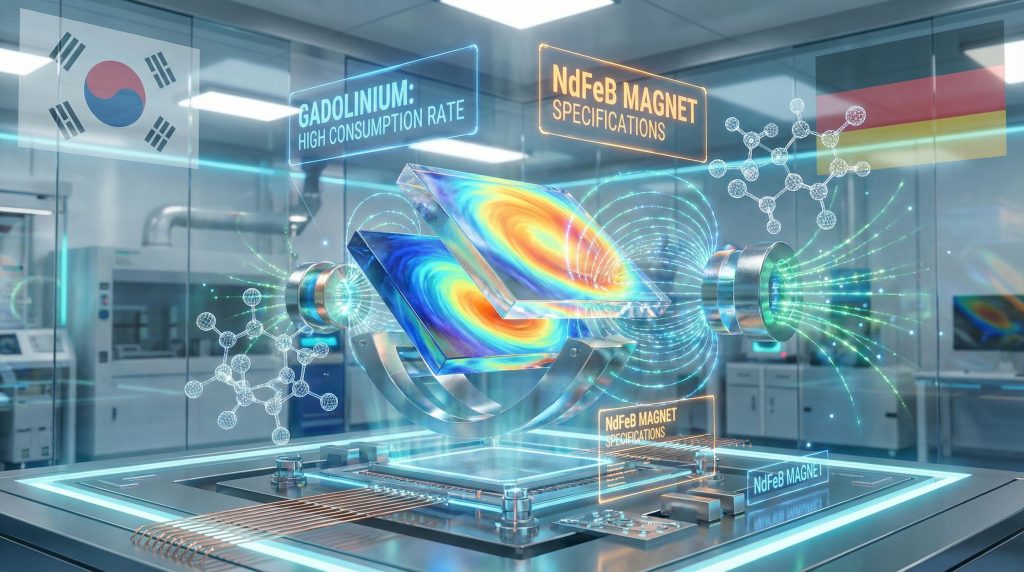
The refrigeration industry stands at a technological crossroads where traditional vapor-compression systems face mounting pressure from environmental regulations and energy efficiency demands. At the center of this transformation lies the magnetocaloric effect, a physical phenomenon that enables solid-state cooling without harmful refrigerants or mechanical compressors. This alternative approach operates through magnetic entropy manipulation, where specialized materials change temperature when exposed to varying magnetic fields, creating a significant magnetic cooling rare earth dependency.
Understanding these systems requires examining their fundamental material dependencies. Unlike conventional cooling systems that rely on chemical refrigerants, magnetocaloric technology demands specific rare earth elements to achieve commercial viability. The physics behind this dependency stems from the unique electronic configurations of lanthanide elements, particularly their unpaired electrons in 4f orbital shells that respond predictably to magnetic field changes.
The Magnetocaloric Effect in Commercial Context
Modern magnetocaloric systems achieve temperature changes of approximately 3-5 Kelvin under magnetic field strengths of 1-2 Tesla. This compares favourably to theoretical efficiency limits, with magnetocaloric systems potentially reaching 50-80% of Carnot efficiency compared to the 40-60% achieved by traditional vapor-compression systems.
The fundamental mechanism operates through magnetic entropy control. When a magnetocaloric material enters a magnetic field, its magnetic moments align, reducing magnetic entropy and forcing thermal entropy to increase, thereby elevating temperature. Removing the magnetic field reverses this process, creating a cooling effect suitable for refrigeration applications.
Environmental Drivers Behind Technology Adoption
Current refrigeration systems depend heavily on hydrofluorocarbons (HFCs) with Global Warming Potential ranging from 124 to 14,800 depending on the specific compound. HFC-134a, commonly used in commercial refrigeration, carries a GWP of 1,430, making it a significant climate concern.
The regulatory landscape has evolved to address these concerns through the Kigali Amendment, which mandates HFC phasedown schedules globally. Developed countries must achieve 85% reduction by 2036, while developing nations face 80-85% reduction targets between 2045-2047. These timelines create compressed development windows for alternative cooling technologies.
When big ASX news breaks, our subscribers know first
Critical Material Requirements Driving Supply Chain Dependencies
Gadolinium serves as the primary magnetocaloric material for room-temperature applications due to its half-filled 4f⁷ electron configuration, which yields optimal magnetic response near ambient temperatures. Current global gadolinium oxide production capacity reaches approximately 6,500-7,000 tonnes annually, with existing demand distributed across MRI systems (30%), permanent magnets (20%), optical applications (15%), catalysts (10%), and research activities (25%).
Furthermore, lanthanum functions as both a structural stabiliser and temperature-tuning element in magnetocaloric compounds. Annual lanthanum oxide production totals approximately 22,000-25,000 tonnes, primarily serving petroleum catalytic cracking (60%), polishing powders (15%), glass additives (10%), permanent magnets (10%), and battery applications (5%).
Manufacturing Precision Requirements
Recent developments in Korea demonstrate progress toward commercial-scale manufacturing. The Korea Institute of Materials Science achieved fabrication of lanthanum-based magnetocaloric sheets at 0.5 mm thickness and gadolinium-based fine wires at 1.0 mm diameter. These specifications represent significant manufacturing milestones, requiring precision control across multiple parameters.
Commercial-grade magnetocaloric materials demand rare earth element purity exceeding 99.9% to minimise magnetic noise and maximise entropy change. Processing to 99.99% purity increases material costs by approximately 25-40% over standard grades, but this precision proves essential for consistent system performance.
Table: Rare Earth Requirements by Magnetocaloric System Component
| Component Type | Primary REE | Secondary REE | Critical Function |
|---|---|---|---|
| Magnetocaloric Material | Gadolinium | Terbium | Primary cooling medium |
| Structural Alloys | Lanthanum | Cerium | Temperature stabilisation |
| Permanent Magnets | Neodymium | Dysprosium | Magnetic field generation |
| System Optimisation | Praseodymium | Europium | Performance enhancement |
Alloy Composition and Performance Optimisation
Lanthanum-iron-silicon (La-Fe-Si) based compounds demonstrate magnetocaloric effects ranging from 20-30 J/(kg·K) in magnetic field ranges of 0-5 Tesla near ambient temperature. Manganese doping increases this effect to 35-45 J/(kg·K), while hydridised variants can achieve 50-65 J/(kg·K), though stability concerns limit commercial adoption.
Optimal La:Fe:Si ratios typically range from 11:88:1 to 13:87:0 depending on target temperature requirements. These precise compositional controls require sophisticated materials processing capabilities and quality assurance protocols throughout the supply chain.
Permanent Magnet Infrastructure Dependencies
Magnetocaloric cooling systems require sustained magnetic fields regardless of refrigerant material choice, creating persistent rare earth dependencies through permanent magnet requirements. Standard neodymium-iron-boron (Nd-Fe-B) magnets for these applications operate at magnetic remanence of 1.2-1.4 Tesla with coercivity requirements of 900-1,100 kA/m for room-temperature stability.
Effective magnetocaloric cooling demands magnetic field strengths of 1-2 Tesla minimum, with optimal performance achieved at 2-5 Tesla for most room-temperature gadolinium systems. This requirement translates directly to permanent magnet specifications and associated rare earth consumption patterns.
Secondary Rare Earth Consumption Through Magnets
Standard Nd-Fe-B magnets contain 30-35 weight percent rare earth content, including 28-32% neodymium and 2-3% dysprosium for coercivity enhancement. Global Nd-Fe-B magnet production approaches 600,000-700,000 tonnes annually, representing substantial rare earth consumption independent of refrigerant material choices.
Each 1 kW magnetocaloric cooling system requires approximately 2-3 kg of permanent magnet material, translating to 60-105 grams of secondary rare earths (dysprosium, terbium, gadolinium) per cooling unit. This creates a baseline rare earth demand that persists regardless of advances in non-rare-earth refrigerant materials.
Critical Insight: Dysprosium and Terbium Dependency
"Secondary rare earths serve essential roles in permanent magnet coercivity, providing resistance to demagnetisation at elevated temperatures. Without these elements, Nd-Fe-B magnets lose magnetic strength above 100-150°C, creating performance limitations that compromise system reliability across wide temperature ranges."
Temperature Stability and Performance Trade-offs
Permanent magnet coercivity decreases approximately 0.5-0.8 kA/m per degree Celsius temperature increase above 20°C. Dysprosium and terbium substitution into Nd-Fe-B lattice structures increases uniaxial anisotropy, counteracting thermal demagnetisation effects.
Dysprosium addition costs approximately 3-5 times more than neodymium on a mass basis but improves high-temperature performance by 40-60%. This cost-performance relationship becomes critical in magnetocaloric systems operating across wide temperature ranges.
Alternative Materials Development and Commercial Viability
Transition metal alternatives based on iron-manganese systems show promise for reducing rare earth dependencies, but significant performance gaps remain. Manganese alloys typically exhibit thermal hysteresis of 5-15 K, reducing effective cooling capacity by 15-40% compared to gadolinium-based systems.
Recent Korean research claims improvements in thermal hysteresis for manganese alloys, though specific quantified reductions remain unverified through independent peer review. These developments represent important progress but have not yet achieved commercial performance parity with rare earth systems, highlighting the persistent magnetic cooling rare earth dependency.
Manufacturing Scalability Challenges
Non-rare-earth alternatives face substantial manufacturing barriers including:
• Complex processing requirements for large-area fabrication
• Quality control challenges in maintaining compositional uniformity
• Integration difficulties with existing cooling infrastructure
• Cost-performance ratios that currently favour rare earth systems
Alternative material processing often requires specialised heat treatment cycles, controlled atmosphere fabrication, and precision alloy composition control that adds manufacturing complexity and cost compared to established rare earth processing routes.
Performance Gap Analysis
Current transition metal alternatives operate effectively within narrower temperature ranges than rare earth systems, typically 250-300 K compared to 250-350 K for gadolinium-based materials. This limitation restricts application scope and market penetration potential.
Temperature span limitations particularly impact commercial refrigeration applications requiring wide operating ranges and consistent performance across seasonal temperature variations.
Regulatory Framework Driving Market Acceleration
The Kigali Amendment establishes binding HFC reduction schedules that compress development timelines for alternative cooling technologies. Developed countries began reductions in 2019 and must reach 85% phase-down by 2036, while developing countries started reductions in 2024 with completion targets of 80-85% reduction by 2045-2047.
These regulatory timelines create market pressure that may favour technologies with demonstrated manufacturing capabilities over those requiring additional development time. Magnetocaloric systems using established rare earth materials may gain competitive advantage over alternative material approaches still under development.
Market Readiness Indicators
Current demonstration projects in Germany and Korea indicate advancing technical maturity, though commercial deployment timelines remain uncertain. Investment flows into solid-state cooling research have increased substantially, with major refrigeration OEMs beginning preparation for regulatory compliance transitions.
The convergence of regulatory deadlines and technical readiness creates potential acceleration scenarios where the critical minerals strategy could increase rapidly despite ongoing alternative material research.
Global Demand Pattern Implications
Commercial magnetocaloric cooling adoption could significantly alter rare earth demand patterns across multiple elements simultaneously. Unlike other applications that primarily consume single rare earth elements, magnetocaloric systems create demand across lanthanum, gadolinium, neodymium, dysprosium, and terbium.
Current gadolinium supply allocation would face substantial pressure from large-scale cooling applications, given existing commitments to medical imaging and permanent magnet applications. Supply chain expansion would require coordinated development across mining, processing, and manufacturing capabilities.
Geographic Distribution of New Demand Centres
Cooling demand concentrates in regions with hot climates and growing economies, including Southeast Asia, India, Middle East, and parts of Africa. This geographic distribution differs from traditional rare earth consumption patterns centred in developed manufacturing economies, potentially requiring supply chain rebalancing.
Regional cooling demand growth could create new rare earth consumption centres requiring infrastructure development and supply chain extension into markets with limited existing rare earth processing capabilities.
Supply Chain Stress Point Analysis
Gadolinium Production Bottlenecks
• Limited global production capacity (6,500-7,000 tonnes annually)
• High processing complexity requiring specialised facilities
• Competition from established medical and research applications
Lanthanum Processing Infrastructure
• Existing capacity focused on catalyst and glass applications
• Material specifications differ from magnetocaloric requirements
• Potential conflicts with battery industry demand growth
Integrated Supply Chain Dependencies
• Single-point failure risks in Chinese processing dominance
• Transportation and logistics challenges for pure materials
• Quality assurance requirements across international supply chains
Consequently, the increasing focus on energy transition minerals has become critical for addressing these vulnerabilities.
The next major ASX story will hit our subscribers first
Manufacturing Innovation Pathways for Dependency Reduction
Advanced processing techniques offer potential pathways for reducing material consumption while maintaining system performance. Near-net shaping technologies could optimise material utilisation efficiency, reducing waste during component fabrication processes.
Fine-wire fabrication methods specifically designed for magnetocaloric applications may reduce material requirements per unit cooling capacity. Micro-channel machining for precision components could enable higher surface area-to-volume ratios, improving heat transfer efficiency with reduced material consumption.
Hybrid System Architectures
Combining rare earth and transition metal materials within single systems could optimise performance while reducing overall rare earth consumption. Staged cooling systems might use rare earth elements only in high-performance zones, with transition metals handling less demanding temperature ranges.
Selective rare earth placement strategies could maintain system performance whilst minimising consumption of the most critical elements, particularly gadolinium and dysprosium where supply constraints present the greatest concerns.
What Are the Prospects for Recycling and Recovery Integration?
End-of-life magnetocaloric material recovery presents opportunities for supply chain sustainability, though technical challenges remain significant. Permanent magnet recycling integration could address dual rare earth dependencies within magnetocaloric systems.
Current magnet recycling achieves recovery rates of 50-85% for neodymium, dysprosium, and terbium, with costs ranging from 40-70% of virgin material prices. Developing similar capabilities for magnetocaloric materials could reduce primary supply pressure.
In addition, the development of critical minerals recycling facilities represents a crucial step towards reducing dependency on primary extraction.
International Competitive Positioning and Strategic Implications
Korea's materials science infrastructure development positions the nation strategically in magnetocaloric technology competition. The Korea Institute of Materials Science achievements in manufacturing scalability demonstrate systematic national investment in this technology sector.
German demonstration projects have focused on system integration and performance validation, while Korean efforts emphasise materials manufacturing and process optimisation. These complementary approaches reflect different national competitive strategies within the same technology space.
National Research Investment Patterns
US Department of Energy strategic priorities include solid-state cooling research within broader critical materials security initiatives. This positioning reflects recognition that magnetocaloric cooling presents both technological opportunity and supply chain vulnerability.
Academic research output patterns show concentrated activity in Korea, Germany, and the United States, with emerging programmes in Japan and several European Union countries. Patent filing trends indicate accelerating commercial interest across multiple national jurisdictions.
Industrial Policy Considerations
Technology export controls and intellectual property protection mechanisms may influence international technology transfer and manufacturing location decisions. Countries with domestic rare earth processing capabilities may gain strategic advantages in magnetocaloric cooling commercialisation.
International cooperation frameworks could address supply security concerns whilst promoting technology development, though competitive pressures may limit information sharing across national boundaries. For instance, the European CRM facility demonstrates regional cooperation in addressing material dependencies.
Investment and Market Development Timeline
Commercial deployment phases depend critically on regulatory timeline convergence with technical maturity achievement. Current demonstration projects must scale to commercial production within compressed timeframes to meet HFC phasedown schedules.
Integration with existing cooling infrastructure requires coordination across refrigeration OEMs, building systems designers, and regulatory approval processes. These integration challenges may influence adoption rates and geographic deployment patterns.
Strategic Investment Considerations
Upstream rare earth mining capacity requirements extend beyond current production levels if magnetocaloric cooling achieves substantial market penetration. Processing infrastructure development needs span multiple elements simultaneously, requiring coordinated investment across the rare earth supply chain.
Technology risk assessment must balance potential market opportunities against supply chain dependencies and alternative material development uncertainties. Investment timelines must account for both regulatory drivers and technical development completion requirements.
Furthermore, understanding the broader implications of critical minerals supply chain vulnerabilities becomes essential for strategic planning.
How Will Research Innovations Impact Future Dependencies?
Recent breakthroughs in quantum materials research suggest potential pathways for developing alternatives to traditional magnetocaloric materials. These innovations could fundamentally alter the magnetic cooling rare earth dependency landscape in the next decade.
However, advanced cooling technology developments must still demonstrate commercial viability at scale. The transition from laboratory demonstrations to market-ready systems typically requires 5-10 years of development and testing.
Disclaimer: This analysis discusses emerging technologies and market projections that involve substantial uncertainties. Magnetocaloric cooling remains in demonstration phases with unproven commercial scalability. Rare earth demand projections depend on technology adoption rates that cannot be predicted with certainty. Investors should conduct independent due diligence and consider multiple scenario outcomes when evaluating opportunities in this sector.
Could Magnetocaloric Cooling Create New Investment Opportunities in Critical Minerals?
The magnetocaloric cooling revolution demands significant quantities of rare earth elements, creating substantial market opportunities as traditional refrigeration systems face regulatory phase-out. Discovery Alert's proprietary Discovery IQ model identifies emerging critical mineral discoveries across the ASX, providing subscribers with immediate insights into companies positioned to supply the lanthanum, gadolinium, and neodymium essential for next-generation cooling technologies. Explore Discovery Alert's discoveries page to understand how major mineral discoveries historically generate exceptional returns, then begin your 30-day free trial to position yourself ahead of this transformative market shift.