August 23, 2026
Understanding the Strategic Imperatives Behind Magnetic Material Independence
Manufacturing sovereignty in critical materials represents one of the most complex industrial challenges facing emerging economies today. While nations often focus on securing upstream mineral resources, the real competitive advantage lies in mastering downstream processing technologies that convert raw materials into precision-engineered components. This principle becomes particularly evident when examining the global permanent magnet supply chain, where a handful of countries control the sophisticated manufacturing processes required to produce automotive-grade magnetic materials.
The permanent magnet ecosystem reveals how technological complexity creates natural barriers to entry that extend far beyond resource availability. Countries with abundant rare earth deposits frequently find themselves importing finished magnets at premium prices, highlighting the disconnect between mineral wealth and manufacturing capability. This dynamic drives strategic recalibration toward building integrated production capacity rather than relying solely on resource extraction as a pathway to supply chain security.
When big ASX news breaks, our subscribers know first
Current Market Architecture: Mapping India's Magnetic Materials Ecosystem
India's position in the global permanent magnet market reflects broader patterns of technological dependency that characterise many developing economies. The country maintains substantial rare earth reserves, estimated at approximately 6.9 million metric tons of rare earth oxide equivalent, representing roughly 6-7% of global reserves according to the U.S. Geological Survey's 2025 Mineral Commodity Summaries. However, this resource endowment has not translated into meaningful downstream manufacturing capability.
The nation's import dependency for finished permanent magnets approaches near-complete reliance on foreign suppliers, primarily from China, which controls approximately 80-85% of global rare earth permanent magnet production with manufacturing capacity exceeding 150,000 metric tons annually. This concentration creates significant supply chain vulnerabilities, particularly given the critical applications where these materials are deployed. Furthermore, global rare earth reserves distribution patterns highlight how resource concentration affects strategic planning for emerging economies.
Current consumption patterns reveal the sectoral distribution driving India's rare earth permanent magnets demand. Electric vehicles represent an emerging but rapidly expanding segment, while consumer electronics continue to account for a substantial portion of current usage. Wind energy applications show particular promise given India's renewable energy commitments, though the sector requires specialised high-temperature magnets capable of sustained operation in demanding environments.
India's REPM Application Portfolio:
• Consumer Electronics: Traditional dominance driven by smartphone and appliance manufacturing
• Industrial Automation: Growing demand from manufacturing sector modernisation initiatives
• Transportation Systems: Emerging electric vehicle adoption creating new demand categories
• Renewable Energy: Wind turbine applications requiring specialised high-performance grades
• Defense Applications: Strategic systems requiring domestic supply chain security
The quality requirements for automotive-grade permanent magnets command significant price premiums, typically 15-25% above standard industrial grades. These specifications demand superior coercivity levels exceeding 11 kOe for electric vehicle applications, thermal stability maintaining performance at 150-180°C, and precise grain size control within 1-3 micrometer tolerances. Such demanding specifications explain why qualification cycles for automotive suppliers typically extend 18-24 months and require extensive testing protocols.
Economic Catalysts Accelerating Magnetic Material Requirements
Multiple macroeconomic forces converge to create unprecedented demand growth for permanent magnets across India's industrial landscape. The government's commitment to achieving 500 GW of renewable energy capacity by 2030, announced at COP26, represents one of the most ambitious clean energy transitions globally. This target translates into substantial magnet requirements, particularly for wind turbine applications where modern 3-5 MW units contain 600-1,200 kg of neodymium-iron-boron magnets in their permanent magnet direct-drive generators.
Electric vehicle adoption represents another powerful demand catalyst, supported by official targets of 30% electric vehicle penetration by 2030 under India's National Electric Mobility Mission Plan. This transition creates a multiplicative effect on magnet consumption, as electric vehicle traction motors require 1.5-2.5 kg of NdFeB magnets per vehicle compared to just 0.2-0.5 kg in conventional vehicles' auxiliary systems. This represents a 5-10x increase in magnet intensity per vehicle as the market transitions toward electrification.
The Atmanirbhar Bharat initiative adds strategic urgency to domestic manufacturing capabilities, particularly for defense applications where supply chain security takes precedence over cost optimisation. Production-Linked Incentive schemes for electronics manufacturing and battery storage systems create additional policy tailwinds supporting domestic magnet demand growth across multiple sectors simultaneously. Moreover, the government's critical minerals reserve strategy demonstrates how nations approach resource security planning.
Sectoral Growth Multipliers:
• Wind Energy Expansion: 140 GW projected capacity requiring approximately 40,000 metric tons of magnets
• Electric Vehicle Scaling: 30% market penetration implying 2,400+ metric tons annual magnet consumption
• Defense Modernisation: Unquantified demand due to strategic classification requirements
• Industrial Automation: Modest but consistent growth trajectory supporting manufacturing upgrades
Currency exposure represents an often-overlooked risk factor in import-dependent supply chains. INR/USD volatility of 5-8% annually creates significant cost uncertainty for magnet importers, particularly given the high unit values involved. At average costs of $100,000-120,000 per metric ton for automotive-grade NdFeB magnets, even modest exchange rate fluctuations translate into substantial budget impacts for manufacturers planning multi-year procurement strategies.
Manufacturing Integration: Where Strategic Value Creation Occurs
The permanent magnet value chain demonstrates how technological complexity concentrates value creation in downstream processing rather than upstream mining. Raw rare earth concentrates represent only 5-10% of final magnet value, while oxide separation and refining contribute 15-20%. The critical value-adding steps occur in metallisation and alloying (20-25%), sintering and magnetisation processes (30-35%), and quality assurance systems (10-15%).
This distribution explains why countries with abundant rare earth reserves often remain price-takers in the global magnet market. China's dominance stems not from exclusive access to raw materials, but from vertically integrated manufacturing capabilities spanning oxide separation through finished magnet production. This integration creates economies of scale and process optimisation advantages that are difficult to replicate through capital investment alone. Additionally, mining industry innovation continues transforming traditional extraction and processing methodologies.
Critical Process Control Parameters:
• Sintering Temperature Precision: ±2°C tolerance required for automotive-grade consistency
• Atmospheric Contamination: <50 ppm oxygen throughout production cycles
• Grain Structure Uniformity: 95%+ consistency for premium applications
• Magnetic Property Repeatability: ±3% tolerance for Tier-1 automotive qualification
The technical knowledge required to achieve these specifications represents accumulated intellectual property developed over decades of manufacturing experience. Temperature ramp rates during sintering must be controlled within 5-10°C per minute, with hold temperatures maintained at 1,050-1,100°C under high-purity argon atmospheres. Cooling rates of 15-25°C per minute become critical for achieving proper grain structure, while post-processing operations require precise dimensional control and surface finish specifications.
India's rare earth reserves present unique technical challenges that differentiate them from deposits in other countries. Indian monazite deposits contain significant thorium content, increasing processing complexity and regulatory compliance costs compared to lighter rare earth dominant deposits. This technical reality creates additional barriers to economic viability that extend beyond simple capital investment requirements.
The automotive qualification process for new magnet suppliers typically requires 5,000+ samples tested across thermal cycling from -40°C to +150°C, vibration protocols, and magnetic performance stability verification over 12-18 months.
Evaluating the ₹7,280 Crore Manufacturing Infrastructure Strategy
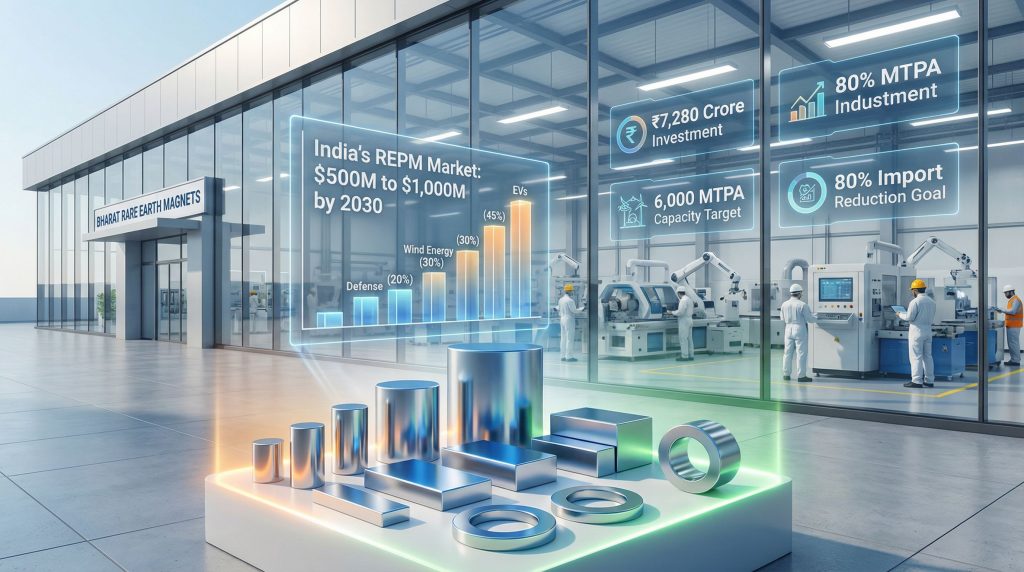
The government's commitment of ₹7,280 crore ($816 million) for integrated manufacturing capacity represents a substantial policy intervention targeting 6,000 metric tons per annum production capability. This investment scale positions India to capture approximately 3-4% of global magnet production, based on current market sizing of 150,000-180,000 metric tons annually worldwide. The Cabinet has approved this comprehensive scheme to establish India's domestic manufacturing capabilities.
The financial mathematics underlying this strategy reveal both opportunities and execution risks. Current import costs approaching $500 million annually could escalate to $1 billion by 2030 without domestic production capacity. Successful implementation could reduce import dependency to 20% while creating an estimated 15,000+ direct manufacturing jobs across five strategic facility locations. However, India's rare earth permanent magnets demand continues escalating rapidly across multiple industrial sectors.
Investment Impact Analysis:
| Metric | Current Baseline | 2030 Target | Strategic Benefit |
|---|---|---|---|
| Production Capacity | Minimal | 6,000 MTPA | 80% demand coverage |
| Import Dependency | ~100% | 20% | $600M annual savings |
| Employment Creation | Negligible | 15,000+ jobs | Industrial capability |
| Technology Transfer | Limited | Joint ventures | Knowledge development |
However, the 3-4 year timeline to operational capacity appears optimistic given the technical complexity involved. Automotive Tier-1 qualification processes alone typically require 18-24 months, assuming successful initial process development. New magnet manufacturers routinely encounter difficulties achieving consistent magnetic properties and dimensional tolerances required for premium applications.
The strategy's success depends critically on securing reliable rare earth oxide feedstock, either through domestic processing of Indian concentrates or stable import arrangements. Indian deposits' thorium content complicates domestic processing, potentially requiring continued import of separated oxides even with successful downstream manufacturing development. Consequently, understanding US-China trade impacts becomes essential for supply chain planning.
Critical Implementation Challenges and Risk Factors
Technical execution represents the primary uncertainty surrounding India's magnet manufacturing ambitions. Process optimisation for achieving automotive-grade quality typically requires 20-50 person-years of specialised engineering expertise, accumulated through iterative improvement cycles that cannot be accelerated through capital investment alone.
Quality qualification timelines create immediate market timing risks. Major automotive manufacturers require comprehensive testing protocols including AEC-Q200 automotive qualification standards, thermal cycling verification, vibration resistance testing, and magnetic performance stability validation. These requirements translate into 12-18 months of testing followed by additional supply chain verification and volume ramp validation periods.
Primary Execution Risk Categories:
• Process Development: Achieving consistent magnetic properties across production batches
• Feedstock Security: Securing reliable rare earth oxide supplies with appropriate specifications
• Workforce Development: Training specialised metallurgy and quality control personnel
• Customer Qualification: Meeting automotive Tier-1 approval timelines and requirements
• Technology Absorption: Developing internal capabilities versus joint venture dependencies
Market timing vulnerabilities add complexity to demand projections. Electric vehicle adoption rates may vary from current government targets, particularly if battery costs decline more slowly than anticipated or charging infrastructure development lags expectations. Similarly, wind energy capacity additions depend on land acquisition, grid connectivity, and financing availability that could affect actual magnet demand realisation. Furthermore, energy transition security considerations shape long-term planning requirements.
Competing technology developments represent longer-term strategic risks. Permanent magnet-free motor designs, including switched reluctance and induction motor configurations, continue advancing and may capture portions of the projected electric vehicle market. While these technologies currently face performance and efficiency limitations, breakthrough developments could reduce magnet demand growth below current projections.
The dysprosium supply challenge deserves particular attention. High-performance magnets for automotive and wind applications require 5-10% dysprosium content by weight to maintain coercivity at elevated operating temperatures. China holds approximately 60% of global dysprosium reserves, and Indian deposits contain limited heavy rare earth content. This creates potential continued import dependency even with successful downstream manufacturing development.
The next major ASX story will hit our subscribers first
Regional Supply Chain Transformation Implications
India's emergence as a regional magnet manufacturing hub could significantly alter Asian supply chain dynamics beyond domestic demand satisfaction. Southeast Asian countries currently rely heavily on Chinese suppliers for permanent magnets required in their growing electronics and automotive sectors. Indian manufacturing capacity could provide supply chain diversification options for regional customers seeking reduced concentration risk.
The technology transfer potential associated with joint venture arrangements offers accelerated capability development pathways. International magnet manufacturers seeking market access and production cost advantages may find Indian partnerships attractive, bringing established process knowledge and customer relationships that could accelerate market entry timelines. Recent industry analysis highlights India's strategic positioning in the rare earth ecosystem transformation.
Strategic Positioning Scenarios:
Scenario 1: Successful Integration (60% probability)
• Domestic production satisfies 80% of 2030 demand requirements
• Export capabilities develop for Southeast Asian markets
• Technology partnerships establish automotive-grade quality standards
• Annual import cost reduction of $400-500 million achieved
Scenario 2: Partial Implementation (30% probability)
• 40-50% domestic production capability achieved by 2030
• Quality challenges delay automotive market qualification
• Import dependency remains at 50-60% levels
• Limited export competitiveness due to cost and quality constraints
Scenario 3: Implementation Delays (10% probability)
• Capacity buildout extends beyond 2030 timeline
• Continued 90%+ import dependency through the decade
• Strategic objectives not achieved within planning horizon
• Increased vulnerability to supply chain disruptions
Labour cost advantages in manufacturing operations could provide sustainable competitive positioning once technical capabilities are established. Indian manufacturing costs for precision components typically run 20-30% below developed country levels while maintaining quality standards acceptable to international customers.
The broader geopolitical context supports supply chain diversification initiatives globally. International customers and governments increasingly prioritise supplier diversity over pure cost optimisation, creating market opportunities for qualified alternative suppliers regardless of modest cost premiums.
Investment Landscape and Commercial Opportunities
Private sector participation pathways extend beyond direct magnet manufacturing into supporting ecosystem development. Ancillary manufacturing opportunities include magnet assembly and finishing operations, specialised tooling and equipment supply, and quality testing services for both domestic and export customers.
Joint venture arrangements with international technology partners represent the most likely pathway for rapid capability development. These partnerships can provide established process knowledge, customer relationships, and quality systems while leveraging Indian manufacturing cost advantages and market access.
Investment Opportunity Categories:
• Technology Partnership Ventures: International manufacturers seeking cost-effective production
• Ancillary Equipment Supply: Specialised furnaces, testing equipment, and process instrumentation
• Raw Material Processing: Rare earth separation and purification facilities
• Logistics and Distribution: Specialised handling and transportation for magnetic materials
• Training and Certification: Workforce development for specialised technical skills
Infrastructure development requirements create additional investment opportunities in specialised transportation systems for magnetic materials, environmental compliance systems for rare earth processing, and research facilities for magnet optimisation and application development.
The regulatory environment requires careful navigation, particularly for rare earth processing facilities that must comply with environmental and safety standards. Ministry of Environment, Forest and Climate Change guidelines for rare earth processing affect both capital costs and operational timelines, requiring specialised expertise in regulatory compliance and environmental management systems.
Disclaimer: This analysis is based on publicly available information and industry research. Investment decisions should consider additional factors including regulatory changes, market volatility, and technological developments. Financial projections and scenarios represent estimates based on current information and may not reflect actual outcomes. Readers should conduct independent due diligence before making investment decisions related to rare earth or magnet manufacturing opportunities in India.
Looking to Capitalise on India's Rare Earth Permanent Magnet Manufacturing Revolution?
Discovery Alert's proprietary Discovery IQ model provides instant notifications when significant ASX mineral discoveries are announced, helping investors identify actionable opportunities in critical minerals and rare earth companies as they emerge. With India's ambitious ₹7,280 crore permanent magnet strategy creating substantial upstream demand, explore how historic mineral discoveries have generated exceptional returns and begin your 30-day free trial today to position yourself ahead of the market.