
June 24, 2026
When Geography Becomes the Last Line of Defence
Across the global mining industry, the relationship between political risk and operational continuity has never been more exposed than it is today in West Africa's Sahel belt. Investors who once applied blanket country-risk discounts to sub-Saharan African assets are now discovering that the real variable is not national stability in aggregate, but the precise geographic coordinates of a mine shaft relative to an insurgent's operational theatre. Nowhere is this calculus more visible, or more consequential, than in the ongoing Mali mining industry security crisis.
Mali sits at the intersection of two powerful forces: record-high gold prices that make its gold and lithium deposits extraordinarily valuable, and a deteriorating security environment that is testing the limits of operational resilience. Understanding how these forces interact requires moving beyond headline risk assessments and into the specific mechanisms that have, thus far, kept production flowing.
When big ASX news breaks, our subscribers know first
The Economic Architecture Underneath Mali's Mining Sector
Gold as the Fiscal Spine of a State Under Pressure
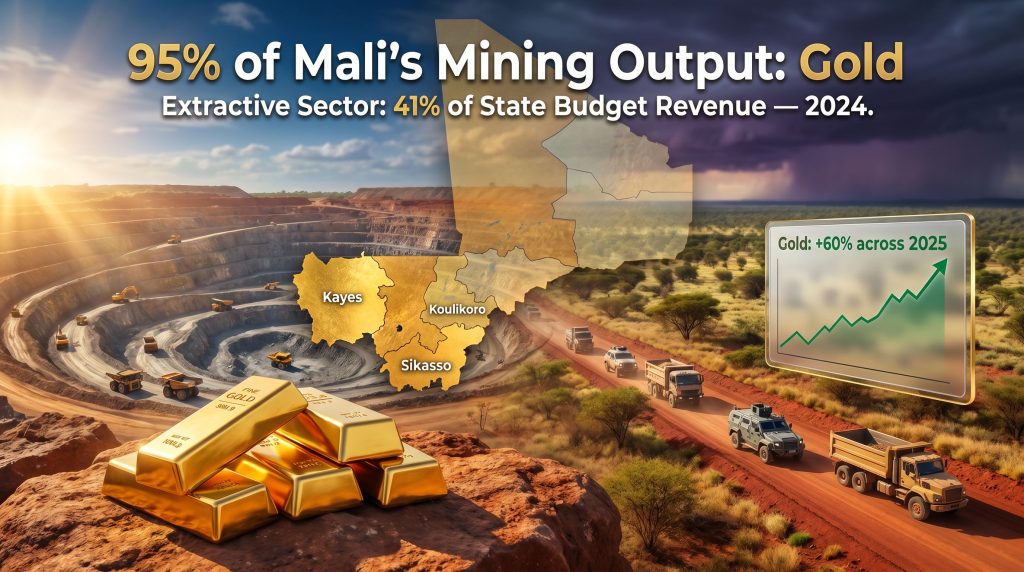
Mali consistently ranks among Africa's top four gold producers, and the numbers that underpin this status are striking. Gold accounts for approximately 95% of the country's total mining output, and the extractive sector as a whole contributed nearly 41% of Mali's state budget revenue in 2024, according to data from the Extractive Industries Transparency Initiative (EITI).
These figures frame the Mali mining industry security crisis in terms that go far beyond corporate earnings. When international gold prices climbed more than 60% across 2025 to trade near record levels on global markets, the fiscal stakes attached to every kilogram extracted from Malian soil rose in parallel. A government that derives more than two-fifths of its revenue from mining is not merely watching the sector with interest. It is structurally dependent on its continuation.
Furthermore, gold as a safe haven asset has reinforced the extraordinary value attached to Mali's deposits during this period of regional instability, making operational continuity even more financially critical for both investors and the state.
The Lithium Dimension: A Second Wave of Strategic Value
Beyond gold, lithium discoveries in southern Mali have begun attracting attention from battery-minerals investors tracking global energy transition supply chains. The Goulamina lithium project, in which Ganfeng Lithium holds a 65% stake, and Kodal Minerals' Bougouni project both sit in this southern corridor. Spodumene concentrate from Bougouni is currently exported through the Ivorian port of San Pedro, an export pathway that has remained operational through the current security escalation.
This lithium dimension adds a longer-term strategic layer to the immediate crisis. The deposits exist. The infrastructure is being built. However, realising their full potential over a multi-decade horizon requires a governance and security environment that the country has not yet stabilised. The broader lithium mining dynamics shaping global supply chains mean that delays in Mali carry consequences well beyond the country's borders.
Mali's extractive sector is not merely an economic pillar. It is the financial backbone of a government navigating one of the most complex security environments in West Africa. Any sustained disruption to mining revenue would accelerate fiscal deterioration at a moment when state capacity is already under severe strain.
What Happened on April 25, 2026
A Multi-Vector Attack That Targeted the Heart of the State
The late April 2026 attacks represented a qualitative escalation in the sophistication and ambition of militant operations in Mali. On April 25, coordinated assaults struck Bamako and several regional centres simultaneously. Defence Minister Sadio Camara was killed in a car bombing at his residence in Kati, near the capital, marking one of the most significant political assassinations in Mali's recent history.
Simultaneous strikes also targeted Bamako's international airport, while foreign-backed military units were forced to retreat from positions in the country's north. The breadth and coordination of the attacks signalled that JNIM had developed urban operational capacity well beyond the rural ambushes that characterised earlier phases of the insurgency. According to Al Jazeera's mapping of Mali's resource wealth, the timing of the attacks was not coincidental given the strategic value of the country's mineral assets.
Responsibility and Strategic Intent
The al-Qaeda-affiliated JNIM (Jama'at Nusrat al-Islam wal-Muslimin) and Tuareg separatist rebels jointly claimed responsibility for the April 25 assaults. This was not an isolated escalation. In September 2025, JNIM had already declared what analysts characterised as an economic jihad campaign, deploying supply-route blockades as a strategic weapon rather than attacking mine sites directly.
That indirect approach proved effective: Resolute Mining lowered its annual production guidance after disruptions to explosives and fuel deliveries impacted output during the third quarter of 2025. The April 2026 attacks demonstrated a further tactical evolution, moving from supply interdiction in rural corridors to coordinated strikes within the capital itself.
The Political Consolidation That Followed
President Assimi Goïta responded to Camara's death by appointing himself Defence Minister, consolidating direct command of the country's security apparatus. Western governments, including the UK, US, France, and Canada, subsequently escalated their travel advisories, urging nationals to avoid Mali or depart if conditions permitted.
For Western-headquartered mining companies with listed equities and institutional shareholder bases, these advisories introduce reputational and compliance considerations that sit alongside the direct operational risk calculus.
Operational Status: Who Is Running, and Why
The Geographic Buffer That Has Protected Southern Mines
The single most important structural factor sustaining production through the Mali mining industry security crisis is geographic. Mali's active conflict zones are concentrated in the central and northern regions, where JNIM and Tuareg factions maintain territorial influence. The country's major industrial mining operations are clustered in the southern and western regions, particularly the Kayes, Sikasso, and Koulikoro zones, which remain physically insulated from the primary theatres of violence.
This spatial separation is not a policy outcome. It is a geographic accident that has, until now, protected the sector's productive core. Recognising this distinction matters because it also defines the sector's primary vulnerability: the moment armed groups develop the operational reach to penetrate southern corridors sustainably, the entire resilience calculation changes.
Current Production Status Across Major Assets
Ten days after the April 25 attacks, the operational picture across Mali's major mining assets remained intact. The following table summarises the confirmed and reported status of key operations as of early May 2026:
| Company | Operation | Region | Status |
|---|---|---|---|
| Resolute Mining | Syama Gold Mine | Sikasso (South) | Fully operational; production uninterrupted |
| Allied Gold | Sadiola Gold Mine | Kayes (West) | Production confirmed continuing |
| Kodal Minerals | Bougouni Lithium Project | South Mali | Unaffected; San Pedro exports on schedule |
| Barrick Gold | Loulo-Gounkoto Complex | Kayes (West) | Operational; no public disruption statement |
| Ganfeng Lithium | Goulamina Lithium Project | South Mali | Operating with contingency protocols |
| B2Gold | Fekola Gold Mine | Kayes (West) | No public statement; continuity expected by industry observers |
Allied Gold confirmed on April 28 that production at Sadiola continued normally. Resolute Mining issued a corresponding statement confirming uninterrupted output at Syama. Kodal Minerals provided the most operationally specific update, confirming that fuel and spare parts deliveries were proceeding normally and that concentrate exports through San Pedro remained on schedule.
The Economics of Staying: A Three-Factor Framework
The decision by operators to maintain production through an intensifying security environment is not simply a matter of corporate courage. It reflects a layered economic logic:
- Record commodity prices make temporary production cuts disproportionately expensive relative to the security risk premium that operators are already absorbing.
- Sunk capital commitments mean that withdrawal would require writing off billions in infrastructure investment with no guarantee of re-entry under improved conditions.
- Government dependency creates an implicit political protection dynamic. A Malian state that derives 41% of its budget from the extractive sector has a structural incentive to protect operational continuity, including through military convoy escorts on key transport routes.
A mining executive cited by Reuters noted that the combination of elevated gold prices and the exceptional grade quality of Mali's deposits continues to outweigh the security risk calculation for operators currently in-country. Industry analysts reinforce this point: Mali's gold mineralisation, particularly in the Kayes corridor, represents genuinely high-quality assets that justify elevated security expenditure in a way that lower-grade deposits in more stable jurisdictions might not.
The Real Vulnerabilities: Where the Crisis Bites
Supply Chain Interdiction as the Primary Attack Vector
Security analysts with expertise in Sahel dynamics have drawn an important distinction that shapes the entire operational risk picture: mines themselves may remain intact, but security and terrorism risks concentrated on supply routes represent a persistent and escalating threat to production viability. This indirect approach, targeting the logistics arteries rather than the productive assets themselves, has been JNIM's most effective tool.
The economic jihad campaign of September 2025 demonstrated this clearly. By blocking fuel supply routes, JNIM imposed measurable production costs on operators without triggering the international military or diplomatic response that a direct attack on a mine site would generate. Resolute's guidance reduction during Q3 2025 was a direct consequence of this strategy.
Kodal Minerals' specific confirmation that fuel and spare parts deliveries remain normal in May 2026 should be read in this context. The company is signalling awareness of this exact vulnerability rather than simply providing routine operational colour. Indeed, Kodal's continued operations represent a deliberate and considered commercial decision in the face of considerable pressure.
A Track Record of Targeted Infrastructure Attacks
The pattern of incidents in the twelve months preceding April 2026 illustrates that targeted harassment of mining infrastructure is an established and evolving tactic:
- January 2026: Suspected jihadist fighters attacked the Morila gold mine, operated by state-owned SOREM in partnership with US-linked Flagship Minerals. Attackers burned equipment and abducted seven employees before releasing them the following day.
- May 2025: Armed groups intercepted a heavy equipment convoy destined for Allied Gold's Sadiola operation in the Kayes region, burning multiple vehicles and destroying construction machinery.
- Q3 2025: JNIM's supply blockade campaign disrupted fuel and explosives deliveries to Syama, forcing Resolute Mining to revise its annual production guidance downward.
None of these incidents forced a full operational shutdown. However, each one demonstrates that the geographic buffer protecting southern mines from direct conflict does not extend to the supply corridors that connect them to global markets.
Regulatory Risk: The 2023 Mining Code Reforms
Physical security is not the only pressure compounding the operating environment. Mali's August 2023 mining code reforms fundamentally restructured the terms on which foreign companies operate:
- State ownership stakes were increased from approximately 20% to 35% across mining operations
- Several previously applicable tax exemptions were removed, raising the effective fiscal burden on operators
- Local content requirements were tightened, adding compliance obligations across procurement and employment
- Government priority rights were established over strategic minerals including lithium and uranium
The extended standoff between the Malian state and Barrick Gold between 2023 and 2025 demonstrated that even the largest global mining operators are not immune to government-initiated disruption. Analysts note that one reason companies are now cautious about provoking Bamako, even amid legitimate grievances, is the reputational and financial cost of that precedent.
Scenario Modelling: Three Pathways Forward
Scenario 1: Contained Escalation (Base Case)
Security incidents remain concentrated in northern and central Mali. Southern mining zones maintain operational continuity with rising but manageable security costs. Periodic supply chain disruptions cause guidance revisions but no full operational shutdowns. This represents the most probable near-term outcome based on current geographic patterns and the economic incentives that keep both operators and the government aligned around continued production.
Scenario 2: Southern Corridor Penetration (Elevated Risk)
Armed groups successfully extend their operational reach into Kayes or Sikasso transport corridors. Sustained supply-route blockades force production halts at one or more major operations. Investor confidence in exploration-stage projects deteriorates, triggering capital withdrawal. The trigger indicators to watch include attacks within 100 kilometres of active mine sites and fuel delivery failures extending beyond 30 consecutive days.
Scenario 3: Political Rupture and Resource Nationalism (Tail Risk)
A new military faction seizes power and adopts an aggressive resource nationalism posture, scaling the Barrick Gold precedent across multiple operators simultaneously. This scenario, while less probable in the immediate term, has been assessed by risk analysts as having a credible and rising probability given the governance fragility exposed by the April 2026 attacks.
The transition from Scenario 1 to Scenario 2 could occur rapidly if JNIM successfully replicates its 2025 supply blockade strategy with greater geographic reach. The sector's resilience is real but contingent. It is not structural.
The next major ASX story will hit our subscribers first
Mali in Regional Context: The Sahel Risk Continuum
Mali's instability cannot be assessed in isolation. It forms part of a broader security deterioration across the Sahel region, encompassing Burkina Faso and Niger, all of which have experienced military coups and jihadist insurgencies since 2020. The following framework compares the risk-reward dynamics across the three primary Sahel mining jurisdictions:
| Factor | Mali | Burkina Faso | Niger |
|---|---|---|---|
| Primary Mineral | Gold | Gold | Uranium / Gold |
| Security Threat Level | High (urban + rural) | Very High | High |
| State Ownership Pressure | Elevated (35%) | Elevated | High |
| Geographic Mine Protection | Moderate (southern buffer) | Low | Moderate |
| Commodity Price Support | Strong (gold at record highs) | Strong | Moderate |
| Western Investor Exposure | High | Moderate | Low (post-coup) |
What this comparison reveals is that Mali's geographic buffer, however contingent, represents a relative structural advantage over Burkina Faso, where conflict zones are more widely distributed across the country's mining regions. For investors constructing portfolio-level exposure to Sahel gold, this distinction carries material weight.
The Geopolitical Realignment Factor
One dimension of the Mali mining industry security crisis that receives less systematic attention from commodity-focused analysts is the implications of Mali's geopolitical pivot. Following the expulsion of French forces and a reorientation toward Russian security partnerships through Wagner Group-affiliated operators, now operating under the Africa Corps designation, the security architecture surrounding mining operations has fundamentally shifted.
The broader geopolitical mining risks reshaping global commodity markets are acutely concentrated in Mali's case, where competing great-power interests now directly intersect with operational mine security. Russian-linked security providers now operate in proximity to certain mining zones, introducing new variables into the operational risk assessment for Western-headquartered companies.
Beyond the direct security implications, the presence of these actors creates compliance and reputational considerations for listed mining companies with Western institutional investor bases, particularly in jurisdictions with robust sanctions enforcement frameworks. This geopolitical dimension compounds the already complex regulatory environment and represents a risk layer that conventional country-risk models may systematically underweight.
Frequently Asked Questions
Is it safe to invest in Malian mining operations in 2026?
Investment in Mali's mining sector carries elevated but geographically differentiated risk. Operations in southern and western regions have demonstrated operational resilience through the current escalation. However, the combination of regulatory changes, coup risk, supply chain vulnerability, and JNIM's evolving tactical sophistication means that new capital commitments face a materially more complex risk-reward calculation than established operators currently absorbing sunk costs.
Which operations face the greatest exposure?
Assets reliant on northern transport corridors or located closer to central Mali carry the highest direct exposure. Across all operations, supply chain logistics, particularly fuel and explosives delivery, represent the primary operational vulnerability rather than direct attacks on mine sites themselves.
Has gold production actually declined?
Major operators maintained production through the April 2026 escalation. However, Resolute Mining reduced its annual production guidance in 2025 following supply disruptions during JNIM's blockade campaign. Operational continuity and financial impact are not the same thing: elevated security costs and guidance revisions represent measurable financial consequences even when mines keep running.
What is JNIM's economic jihad strategy?
JNIM's approach, formalised in its September 2025 campaign declaration, targets Mali's commercial infrastructure rather than production assets directly. By interdicting fuel and materials supply routes, the group imposes economic costs on operators and the state without crossing the threshold that a direct mine attack would represent. This indirect strategy has proven effective at generating production impacts while limiting the international response it provokes.
What did the 2023 mining code reforms change?
The August 2023 reforms increased mandatory state ownership to 35%, removed certain tax exemptions, tightened local content compliance requirements, and established government priority rights over strategic mineral permits including lithium and uranium. These changes increased the regulatory cost of operations independently of the security environment and contributed to the Barrick Gold dispute that defined the sector's regulatory risk profile through 2025.
The Resilience Window: How Long Can It Hold?
Mali's mining sector has absorbed repeated security shocks without suffering a full operational collapse. That record of resilience is genuine and should not be dismissed. But resilience is not the same as immunity, and the conditions underpinning it are more fragile than current production figures suggest.
The geographic buffer separating southern mining zones from active conflict is an accident of geology and insurgent operational focus, not a product of governance or security policy. JNIM's demonstrated capacity to evolve its tactics, from rural ambushes to supply blockades to coordinated urban strikes, means that the same adaptive logic could eventually extend its effective reach southward.
In the near term, the alignment of economic incentives between operators and the Malian government provides a structural floor beneath the sector. With gold near record highs and state finances dependent on mining revenue, both parties have powerful reasons to maintain production. The Malian Armed Forces' deployment of security escorts for mining convoys reflects this fiscal dependency in its most direct operational form.
Over the medium term, the question is whether JNIM's tactical evolution, compounded by the political uncertainty exposed by the April 2026 attacks, can outpace the geographic and economic factors that have protected operations to date. The answer will determine not only the future of established gold operations, but whether Mali's emerging lithium sector can attract the long-term capital commitments that transforming those deposits into producing mines requires.
This article is provided for informational purposes only and does not constitute investment advice. Mining operations in high-risk jurisdictions involve material uncertainties including security, regulatory, political, and commodity price risks. Readers should conduct independent due diligence and seek professional financial advice before making investment decisions related to any company or jurisdiction discussed herein. Forward-looking assessments and scenario projections represent analytical frameworks rather than definitive predictions.
Want to Stay Ahead of Significant ASX Mineral Discoveries?
While Mali's security complexities illustrate the importance of precise, timely intelligence in resource investing, Discovery Alert's proprietary Discovery IQ model delivers real-time alerts on significant ASX mineral discoveries, transforming complex mineral data into clear, actionable insights for investors at every experience level — explore historic discovery returns on Discovery Alert's dedicated discoveries page and begin your 14-day free trial today to secure a genuine market-leading edge.