
June 14, 2026
Gold, Governance, and the Geometry of a Resource-Dependent Economy
When a single commodity accounts for more than three-quarters of a nation's export earnings, every movement in its price becomes a fiscal event. This is not merely a feature of Mali's economy — it is its defining structural condition. Understanding how Mali mining revenues gold prices and reforms interact requires thinking beyond headline numbers and into the underlying mechanics of how extractive wealth flows from the ground to the state budget.
Mali's situation is instructive for any investor or policymaker studying resource-dependent economies in sub-Saharan Africa. The country's fiscal architecture is not diversified in any meaningful sense. Gold dominates exports at roughly 78.8% of total export value in 2024, the extractive sector contributed approximately 6.3% of GDP in 2023, and the state's annual budget performance is now so tightly correlated with gold price movements that the two are effectively co-dependent variables.
What makes Mali's case analytically distinct from other gold-producing nations is the combination of factors converging simultaneously: aggressive legislative reform, a major operational dispute at the country's largest mine, surging global gold prices, and the early-stage emergence of a lithium sector. Each of these threads pulls in a different direction, and the interaction between them explains both the record revenues of 2024 and the constrained growth of 2025.
When big ASX news breaks, our subscribers know first
The Fiscal Architecture Built on a Single Metal
Structural Concentration and Its Consequences
Mali's dependence on gold is not an accident of circumstance but an outcome of geography, historical investment patterns, and limited industrial development. The country is landlocked, faces persistent security pressures across its Sahel corridor, and has not developed an industrial or services base capable of generating comparable fiscal returns to mining.
The extractive sector's contribution to public revenues has shifted considerably over recent years:
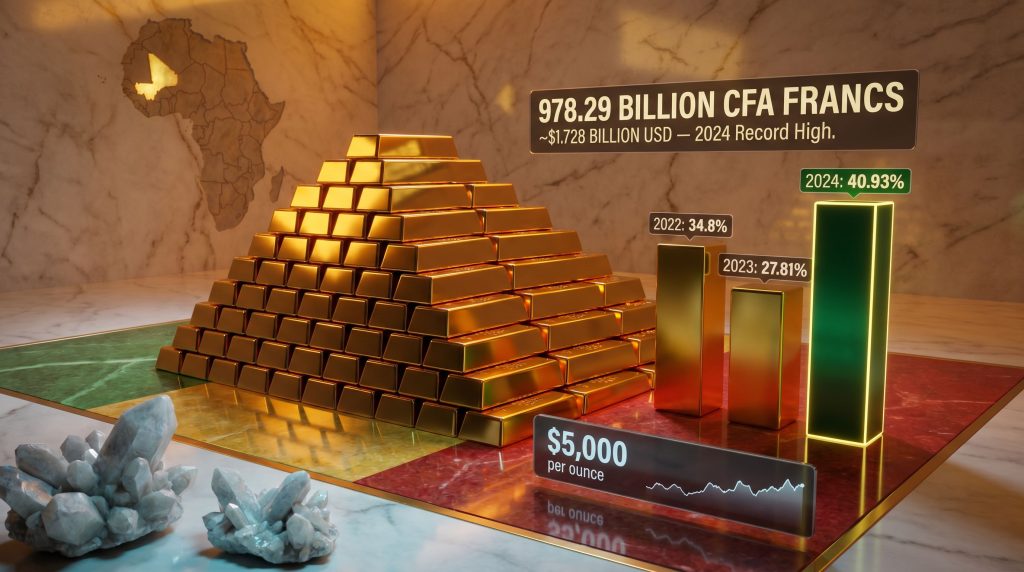
| Year | Extractive Revenue Share of Public Budget |
|---|---|
| 2022 | 34.8% |
| 2023 | 27.81% |
| 2024 | 40.93% (record high) |
The dip in 2023 reflects the consequences of political and contractual friction rather than any structural change in gold's importance. The subsequent jump to 40.93% in 2024, representing 978.29 billion CFA francs (approximately $1.728 billion USD), was not simply the product of favourable market conditions. It was the result of deliberate policy engineering.
What is less commonly understood is how thin Mali's fiscal buffer is against commodity price corrections. Unlike larger resource economies that maintain sovereign wealth mechanisms or diversified revenue streams, Mali operates with limited structural insulation. A sustained gold price correction toward the $2,000 to $2,500 per ounce range — entirely plausible in a global risk-off scenario — would compress extractive revenues dramatically without a corresponding expansion in other tax bases to compensate. Furthermore, Mali's position as a gold as an inflation hedge story is frequently cited by international investors assessing the long-term case for the country's mineral sector.
The 2023 Mining Code: Rewriting the Contract Between State and Operator
From 20% to 35%: What the Equity Shift Actually Means
The single most consequential policy change driving Mali's 2024 revenue record was the adoption of a revised Mining Code in 2023, which fundamentally restructured how the Malian state participates in extractive value. The mandatory public stake in new mining projects was raised from 20% to 35%, structured as follows:
- 10% free carried interest allocated to the state at no acquisition cost
- An option to purchase an additional 20% stake at agreed terms
- 5% reserved for Malian private investors, introducing a domestic capital participation requirement
This restructuring is significant beyond the headline percentage. The free carried interest model means the state captures upside without bearing proportional capital expenditure during development — a feature that disproportionately benefits the state during periods of elevated gold prices. When gold is trading above $3,000 per ounce, the economic value of a 10% free carry at a major producing mine is substantially larger than the same structure would yield at $1,500 per ounce.
The revised code also introduced stricter audit mechanisms and renegotiation pathways for existing contracts. Following a sector-wide audit, the government initiated contract renegotiations with multiple operators. The EITI March 2026 report verified 331.64 billion CFA francs collected through these renegotiations, though Economy and Finance Minister Alousséni Sanou publicly cited 500 billion CFA francs as the government's recovery figure. Indeed, how mining policy changes are reshaping the sector has been widely analysed by regional economists and governance specialists.
The gap between the EITI-verified figure and the government's stated recovery total points to a transparency challenge that multilateral institutions and international mining investors will continue to scrutinise. Broader estimates, when factoring in audit-driven compliance enforcement and prospective revenue adjustments, suggest the total recovery effort may have reached between CFA 500 billion and CFA 1.2 trillion.
The government also established and reinforced SOPAMIM, the state mining company tasked with managing direct equity stakes and providing operational oversight across the sector. SOPAMIM's expanded mandate is central to the long-term revenue strategy, as it represents the institutional mechanism through which state equity participation translates into actual budget flows.
Gold Price Amplification: The Market Multiplier
Structural reforms only deliver their full fiscal impact when commodity prices provide amplification. In 2024 and into 2025, gold provided exactly that. The metal reached 53 record highs during 2025, closing at an average annual price of $3,431 per ounce, a 44% increase year-on-year according to the World Gold Council. In 2024, prices were already elevated, allowing the reforms to land on favourable market conditions and produce a compounding revenue effect.
Moreover, the 2025 gold price forecast pointed strongly toward continued upward momentum driven by geopolitical uncertainty and sustained central bank buying. The combination of higher state equity stakes and rising spot prices is what transformed a policy reform into a fiscal record. Without the price tailwind, the same contractual restructuring would have generated meaningfully lower absolute revenues.
The Loulo-Gounkoto Paradox: When Price and Volume Move in Opposite Directions
A Single Mine That Shapes the National Budget
The Loulo-Gounkoto complex, previously Mali's largest gold-producing operation, became the focal point of a prolonged dispute between the Malian transitional government and Barrick Mining over compliance requirements under the new Mining Code. The standoff resulted in a suspension of operations, removing one of the country's highest-output production centres from the equation at precisely the moment gold prices were reaching record levels.
The outcome is one of the most instructive case studies in the mechanics of resource revenue: gold prices rose approximately 70% in 2025, yet mining revenue growth came in at just 6.4% year-on-year. Gold producers operating in Mali paid 888.5 billion CFA francs during the year — a meaningful absolute increase, but far below what price movements alone would have implied.
Mali's industrial gold production fell 22.9% in 2025, dropping from 54.8 metric tons in 2024 to 42.2 metric tons — a loss of over 12 tonnes of annual production capacity. This volume destruction almost entirely neutralised the price windfall.
The Revenue Sensitivity Framework: Mali's gold revenue is determined by three interacting variables: (1) the gold price, (2) production volume, and (3) the state's contractual share. The 2025 experience demonstrated empirically that a 70% price increase can be almost entirely offset by a roughly 23% production decline when the state's share remains fixed. This makes operational continuity as strategically critical as price trajectory when modelling revenue outcomes.
A resolution was eventually reached between the Malian state and Barrick, with production at Loulo-Gounkoto resuming in late 2025. The terms of that resolution have not been fully disclosed in public reporting, which itself represents a transparency gap relevant to investors assessing the durability of Mali's revenue trajectory.
Can 2026 Deliver a New Revenue Record?
Production Recovery and Price Momentum
Mali entered 2026 with two converging tailwinds: recovering production at Loulo-Gounkoto and continued strength in global gold prices. In Q1 2026, Barrick's mine produced 80,000 ounces, tracking toward an annual target of more than 360,000 ounces. Gold prices surpassed $5,000 per ounce in February 2026, with the World Bank projecting a 37% average annual price increase for the full year relative to the prior year's base.
The IMF has forecast Mali's economic growth at 5.5% for 2026, with gold production recovery identified as a primary driver. These conditions create a genuine opportunity for extractive revenues to approach or exceed the 2024 record. Consequently, Mali mining revenues gold prices and reforms remain a closely watched dynamic among frontier market analysts.
Three Scenarios for 2026 Mining Revenue Outcomes
| Scenario | Key Assumptions | Estimated Revenue Outlook |
|---|---|---|
| Upside | Full Loulo-Gounkoto recovery + gold sustains $4,500-$5,000+ average | Extractive share could approach or exceed 45% of public revenues |
| Base Case | Partial production recovery + gold averages ~$3,800-$4,200 | Revenues likely in the 978B to 1.1T CFA franc range |
| Downside | Security disruptions, operational setbacks, or price correction | 2025 levels maintained or marginally exceeded |
Disclaimer: Scenario projections are forward-looking estimates based on publicly available forecasts and historical production data. They are not financial advice and carry inherent uncertainty.
Lithium: Emerging Revenue Stream or Marginal Addition?
Mali's New Position in the Battery Metals Landscape
Two lithium operations have entered production, adding a new dimension to Mali's extractive profile and positioning the country among Africa's leading lithium producers:
- Goulamina (operated by China's Ganfeng Lithium): commenced production in December 2024
- Bougouni (operated by Britain's Kodal Minerals): achieved first production in February 2025
From a geological standpoint, Mali's lithium deposits are spodumene-bearing hard rock pegmatites, a deposit type that produces lithium concentrate rather than the brine-derived lithium carbonate more commonly associated with South American producers. Understanding spodumene lithium extraction is therefore essential for contextualising Mali's position within the broader global battery supply chain. Spodumene concentrate requires further processing into battery-grade lithium hydroxide or carbonate, which means Mali's lithium exports currently sit at a relatively early point in the value chain.
In the near term, lithium's contribution to state budget revenues remains marginal relative to gold's scale. However, the long-term trajectory matters. As electric vehicle demand matures through the late 2020s and global battery supply chains seek geographic diversification away from existing concentration points, Mali's lithium assets could evolve from marginal contributors into meaningful fiscal diversifiers. Furthermore, how lithium mining works in hard rock environments differs considerably from brine operations, and the key variable is whether processing infrastructure develops in-country or whether Mali remains a raw concentrate exporter.
The next major ASX story will hit our subscribers first
Redistribution and Value Capture: The Domestic Dimension
The Local Mining Development Fund
In March 2026, the Malian government allocated approximately CFA 18.4 billion (roughly $33 million USD) to municipalities through the Local Mining Development Fund. This distribution mechanism represents a deliberate shift from centralised revenue capture toward structured local reinvestment, targeting communities in mining-affected regions where social licence pressures are most acute.
The Gold Refinery Initiative
Mali is pursuing a gold refinery project in partnership with Russia, designed to process raw gold domestically rather than exporting unrefined material. If operational, this facility would allow Mali to capture additional value chain margin and shift its export profile from raw commodity toward processed-metal producer status. This aligns with a broader pattern across resource-rich African nations seeking to extract greater economic returns from their natural endowments by developing downstream processing capacity before export. In addition, the role of critical minerals and energy transition objectives is increasingly shaping how governments structure their resource policies, and Mali is no exception.
Structural Risks That Could Constrain the 2026 Outlook
Security, Regulatory Risk, and Investment Pipeline
Three structural risks warrant careful attention from anyone modelling Mali's mining revenue trajectory:
-
Security threats across the Sahel corridor remain the most unpredictable operational variable, affecting logistics, workforce continuity, and investor confidence. The Loulo-Gounkoto dispute demonstrated that political friction can produce production outcomes equivalent in scale to a major security disruption.
-
Regulatory risk premium has been introduced into Mali's investment environment by the aggressive renegotiation approach. International mining companies evaluating new project commitments must now price in the possibility of future contract renegotiations and equity dilution requirements, which may constrain the pipeline of new projects needed to sustain revenue growth beyond the current producing mine base.
-
Commodity concentration vulnerability remains the overarching structural challenge. With gold representing nearly 41% of public revenues at the 2024 peak, a sustained price correction would compress extractive revenues without a proportionate expansion in alternative fiscal sources.
FAQ: Mali Mining Revenues, Gold Prices, and Reforms
What percentage of Mali's state revenues came from mining in 2024?
Extractive revenues accounted for 40.93% of Mali's total public revenues in 2024, totalling approximately 978.29 billion CFA francs (~$1.728 billion USD) — the highest recorded share.
What did Mali's 2023 Mining Code change?
The code raised the state's mandatory participation in new mining projects from 20% to 35%, including a 10% free carried interest, an option to acquire an additional 20%, and a 5% allocation for Malian private investors.
Why did Mali's gold production fall in 2025?
A dispute between the government and Barrick Mining over compliance with the new Mining Code led to the suspension of operations at Loulo-Gounkoto, causing industrial gold output to fall 22.9% to 42.2 metric tons. This single operational disruption illustrates why Mali mining revenues gold prices and reforms cannot be analysed in isolation from one another.
What is the 2026 gold price outlook and how does it affect Mali?
The World Bank projected a 37% average annual gold price increase for 2026, with prices already exceeding $5,000 per ounce in February 2026. Combined with production recovery at Loulo-Gounkoto, conditions exist for mining revenues to approach or exceed the 2024 record.
Does Mali produce lithium?
Yes. Goulamina (Ganfeng Lithium) and Bougouni (Kodal Minerals) entered production in late 2024 and early 2025 respectively. Both produce spodumene concentrate from hard rock pegmatite deposits, positioning Mali among Africa's leading lithium producers, though fiscal contributions remain modest relative to gold.
How is Mali distributing mining revenues to local communities?
Through the Local Mining Development Fund, Mali allocated approximately CFA 18.4 billion (~$33 million) to municipalities in March 2026 as part of a structured local reinvestment mechanism.
For further data on West African extractive sector governance and revenue transparency, the Extractive Industries Transparency Initiative (EITI) March 2026 country report on Mali provides detailed revenue flow and compliance information. Additional regional coverage is available via Ecofin Agency.
Want to Know Which ASX Mineral Discoveries Could Deliver the Next Major Return?
Discovery Alert's proprietary Discovery IQ model scans ASX announcements in real time, instantly identifying significant mineral discoveries — from gold to lithium — and delivering actionable alerts to subscribers before the broader market reacts. Explore historic discoveries and their extraordinary returns, then begin your 14-day free trial to position yourself at the forefront of the next major find.