August 4, 2026
The Landlocked Premium: Why Infrastructure Deficits Cost Resource Nations More Than They Realise
Across the global economy, landlocked nations consistently pay a hidden tax that never appears on any government balance sheet. Researchers at the World Bank have estimated that landlocked developing countries face freight costs between 40% and 60% higher than their coastal counterparts, a structural penalty that compounds over decades into chronic underinvestment across transport, energy, and water networks. Mali mining revenues for infrastructure represent one of the more ambitious attempts to break this cycle, as commodity-dependent economies face a damaging feedback loop where extractive revenues are partially consumed by the inefficiencies that inadequate infrastructure produces.
Mali sits at the sharp end of this dynamic. Positioned deep within West Africa and separated from the nearest Atlantic port by more than 1,000 kilometres of road, the country's mining sector has long generated substantial wealth that struggles to translate into proportional economic development. Rail connectivity remains limited, energy access gaps persist across large portions of the national territory, and river transport along the Niger system remains underutilised relative to its potential.
Understanding how Mali is now attempting to break this cycle requires looking at the architecture of a financing model that is quietly becoming one of the more ambitious resource-to-infrastructure conversion strategies on the African continent.
When big ASX news breaks, our subscribers know first
Mali's Gold Sector: The Revenue Engine Behind the Plan
Production Realities and the 2025 Contraction
Mali occupies a prominent position within Africa's gold hierarchy, ranking as the continent's second-largest producer by industrial output. Gold dominates the country's export earnings and remains the single most significant contributor to government revenue, having delivered 644 billion CFA francs to Mali's national budget in 2023 alone. That figure underscores why Bamako treats the mining sector not as a discretionary revenue stream but as the structural foundation of public finance.
The current gold price outlook adds further strategic urgency to this approach. The production picture over recent years tells a story of volatility that any infrastructure financing model must account for:
| Year | Industrial Gold Output (Metric Tonnes) | Year-on-Year Change |
|---|---|---|
| 2024 | 54.8 | n/a |
| 2025 | 42.2 | -23% |
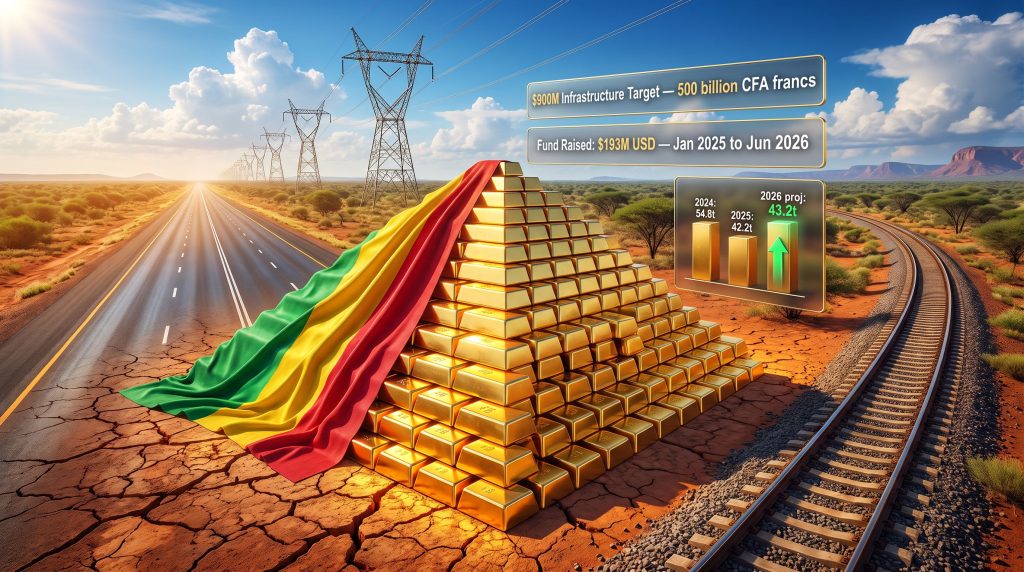
| 2026 (projected) | 43.2 | +2.4% |
The near-23% output contraction recorded in 2025 was substantially driven by operational disruptions at Barrick Mining's Loulo-Gounkoto complex, which became the focal point of a prolonged dispute between the Canadian miner and the Malian government over taxes, state participation, and outstanding payment obligations. Loulo-Gounkoto is one of West Africa's most productive gold operations, and its partial disruption was sufficient to register across the country's entire production statistics.
The projected 2026 recovery to 43.2 metric tonnes is modest in absolute terms, representing only a partial rebound from 2024 levels. However, its significance for infrastructure financing capacity is meaningful. A stabilised production base supports more predictable fund contributions, which in turn supports the borrowing capacity that sits at the centre of the government's infrastructure ambition.
Even during a year of severe output disruption, gold remained the indispensable pillar of Mali's public finances. This structural dependence is precisely why the government has chosen to institutionalise, rather than simply spend, the revenues the sector generates.
The Energy, Water and Transport Infrastructure Development Fund Explained
Architecture, Contributions, and Legal Mandate
Established in 2023 as a centrepiece of Mali's broader mining governance overhaul, the Energy, Water and Transport Infrastructure Development Fund represents a deliberate departure from the way many resource-producing nations have historically handled extractive revenues. Rather than channelling mining proceeds into the general budget where they compete with recurrent expenditures, the fund operates as a ring-fenced vehicle with a specific infrastructure mandate.
The broader context of African mining finance trends helps explain why this model is gaining traction across the continent. The fund is financed entirely through mandatory contributions from all mining permit holders operating under Malian jurisdiction. The contribution structure is tiered:
- Quarterly turnover contribution: 1% of quarterly turnover, payable by all permit holders
- Ad valorem tax component during initial operating phase: set at 1% for a mine's first five years of production
- Ad valorem tax escalation: rises to 2% after the initial five-year period, increasing the state's long-term revenue capture as mines mature
- Governance oversight: the fund operates under joint supervision of Mali's Finance Ministry and the Infrastructure and Transport Ministry
This tiered escalation mechanism is worth examining closely from an investment and policy perspective. Newer mines, which typically carry higher capital costs and debt service obligations, face a lower tax burden in their early years. As operations mature and become more cash-generative, the ad valorem component doubles, shifting more value toward public infrastructure financing at precisely the point when mining companies are better positioned to absorb the cost.
Fund Performance: What Has Been Raised?
Mali's Finance Minister Alousseni Sanou confirmed at the fund's inaugural meeting that between January 2025 and June 2026, total capital mobilised reached 109.14 billion CFA francs, equivalent to approximately $193 million USD (Business Insider Africa, August 2026). The fund is generating a minimum of 50 billion CFA francs per year, providing the predictable revenue base required to underpin significantly larger borrowing.
The financing leverage at play here is substantial. Using its annual revenue stream as collateral against future debt service, the fund is structured to support infrastructure borrowing of up to 500 billion CFA francs, approximately $900 million USD. This is not a grant mechanism; it is a structured finance model that treats predictable mining contributions as a quasi-sovereign revenue bond backing a larger capital programme.
### How Does Mali's Mining Infrastructure Fund Work?
Mali's Energy, Water and Transport Infrastructure Development Fund collects mandatory contributions from mining permit holders, calculated as 1% of quarterly turnover plus escalating ad valorem taxes. Generating at least 50 billion CFA francs annually, this stable revenue stream is designed to support borrowing of up to 500 billion CFA francs for roads, railways, energy, and water infrastructure projects across the country.
The Community Layer: Local Revenue Distribution
Running parallel to the national infrastructure fund is a second mechanism, the Local Mining Development Fund, which channels revenues directly to municipal governments rather than centralising them in Bamako. In March 2026, this fund distributed more than 18.4 billion CFA francs to local communities across Mali's mining regions.
Eligible expenditure categories at the local level include:
- Infrastructure connectivity and transport access
- Social services delivery and education provision
- Water supply infrastructure and sanitation systems
- Energy access projects and health facility construction
The two-tier architecture serves a dual function. At the national level, the infrastructure fund concentrates capital toward large-scale projects with transformational economic impact. At the community level, the local fund addresses the social licence dynamics that are increasingly critical to maintaining operational stability in mining regions.
Priority Infrastructure Investments and Their Economic Logic
What the $900 Million Will Finance
Infrastructure and Transport Minister Dembele Madina Sissoko has outlined an initial project pipeline that reflects the practical realities of Mali's geographic constraints. Announced priority areas include:
- Railway development: expanding Mali's limited rail network to reduce overland freight costs, particularly for mining outputs and agricultural commodities
- Road construction and rehabilitation: targeting key corridors connecting mining zones to population centres and regional trade routes
- River vessel acquisition: improving transport capacity along the Niger River system, which represents an underutilised natural logistics corridor
- Mali Airlines SA: capital support for the state-owned carrier to enhance domestic and regional connectivity
The railway component deserves particular attention. Mali currently lacks the rail infrastructure that would allow it to compete on freight costs with coastal neighbours. Constructing or extending functional rail corridors between mining zones and port access points could materially reduce the per-tonne cost of exporting gold concentrates and other commodities.
From Extraction to Transformation: The Compounding Development Case
Lower transport costs do not only benefit the mining sector. They lower input costs across manufacturing, agro-processing, and retail distribution, creating conditions under which non-mining sectors can begin to compete. Furthermore, energy infrastructure investment functions as a prerequisite for industrial diversification: without reliable electricity supply at competitive prices, value-added processing of Mali's natural resources remains economically unviable.
Economists studying resource-rich developing economies have consistently found that the quality and reach of physical infrastructure is among the strongest predictors of whether commodity booms translate into sustained per-capita income growth or dissipate into what analysts describe as the resource curse.
The 2023 Mining Code Reforms: Reshaping the Revenue Equation
Core Policy Changes
The infrastructure financing ambition would not be credible without the revenue reforms that preceded it. Mali's 2023 mining code introduced a package of changes designed to shift the balance of value capture from international operators toward the Malian state. Consequently, these reforms have reshaped how gold market trends interact with sovereign revenue expectations:
- Increased royalty rates applied to gold extraction across all mine classifications
- Expanded mandatory government equity participation in new and renegotiated mining ventures
- Strengthened audit mechanisms and compliance oversight for international operators
- Introduction of the infrastructure development fund as a mandatory contribution framework
The reforms generated friction with several major international mining companies, most notably Canada's Barrick Mining, whose dispute with the Malian government over the Loulo-Gounkoto complex contributed directly to the 2025 production contraction. An audit disclosed in December 2024 identified 761 billion CFA francs in alleged unpaid obligations across the mining sector, providing Bamako with substantial leverage in renegotiating revenue-sharing arrangements.
Formalising the Artisanal Sector
A less-discussed but strategically significant element of Mali's mining reform agenda is the formalisation of artisanal gold trading. The Malian Office of Precious Substances, established in July 2025, was created specifically to regulate small-scale and artisanal gold activities and bring undeclared exports into a structured compliance framework.
The scale of informal sector leakage in West African gold markets is considerable. According to EITI's country data for Mali, artisanal and small-scale mining accounts for a substantial proportion of regional gold production, yet much of this output exits through informal channels that bypass royalty obligations and export duties. Bringing even a portion of this activity into the formal economy could add a meaningful supplementary revenue layer to Mali's infrastructure financing capacity over time.
How Mali's Model Compares Across the Continent
A Growing African Policy Consensus
Mali's approach to Mali mining revenues for infrastructure is not without precedent, but the specific architecture of a ring-fenced, leveraged development fund is less common than the policy ambition it represents. In addition, wider mining industry consolidation trends are reshaping how governments across the continent negotiate revenue terms with international operators.
| Country | Primary Resource | Infrastructure Mechanism | Operational Status |
|---|---|---|---|
| Mali | Gold | Energy, Water and Transport Fund (est. 2023) | Active, $193M raised to mid-2026 |
| Ghana | Gold | Mineral Revenue Infrastructure Fund | Approved 2025 |
| Botswana | Diamonds | Pula Fund (sovereign wealth model) | Long-established |
| Zambia | Copper | Mining revenue budget integration | Ongoing reform |
Ghana's 2025 approval of a comparable mineral revenue-to-infrastructure mechanism is particularly relevant context. What differentiates Mali's approach from general budget integration models is the explicit insulation of infrastructure capital from recurrent expenditure pressures. Ring-fenced funds are structurally harder to raid during fiscal stress.
Risk Factors Investors and Policymakers Must Weigh
The financing model carries genuine structural vulnerabilities that warrant clear-eyed assessment. However, understanding the broader mining geopolitical risks at play provides essential context for evaluating Mali's prospects:
- Commodity price exposure: the fund's annual revenue generation is directly correlated with gold prices and production volumes, both of which are subject to significant cyclical and operational volatility
- Production concentration risk: the Loulo-Gounkoto disruption demonstrated how quickly a single operational dispute can suppress national output statistics by nearly a quarter
- Governance and disbursement quality: ring-fenced funds require robust institutional oversight to ensure capital reaches intended infrastructure projects
- Leverage sustainability: borrowing against future fund flows introduces fiscal risk if gold revenues underperform relative to debt service assumptions
- Geopolitical environment: Mali's current political context, operating under military governance since 2021, introduces uncertainties around international financing partnerships and project execution timelines
Disclaimer: The analysis above reflects structural assessments based on publicly available data and macroeconomic frameworks. It does not constitute financial or investment advice. Readers should conduct independent due diligence before drawing investment conclusions from the information presented.
The next major ASX story will hit our subscribers first
Key Metrics at a Glance
| Metric | Value |
|---|---|
| Infrastructure financing target | 500 billion CFA francs (~$900M USD) |
| Fund capital raised (Jan 2025 to Jun 2026) | 109.14 billion CFA francs (~$193M USD) |
| Minimum annual fund generation | 50 billion CFA francs |
| Contribution rate, first five years | 1% quarterly turnover + 1% ad valorem tax |
| Contribution rate, after five years | 1% quarterly turnover + 2% ad valorem tax |
| Local community distribution (March 2026) | 18.4+ billion CFA francs |
| Mining sector budget contribution (2023) | 644 billion CFA francs |
| Projected gold output (2026) | 43.2 metric tonnes |
| Mining arrears identified by audit | 761 billion CFA francs |
Frequently Asked Questions: Mali Mining Revenues for Infrastructure
How Much Is Mali Targeting for Infrastructure From Mining Revenues?
The government has set a target of up to 500 billion CFA francs, approximately $900 million USD, using the Energy, Water and Transport Infrastructure Development Fund's predictable annual revenue base as collateral for structured borrowing.
What Has the Fund Collected to Date?
Between January 2025 and June 2026, the fund accumulated 109.14 billion CFA francs, equivalent to approximately $193 million USD, according to Mali's Finance Minister Alousseni Sanou.
Why Did Mali's Gold Output Fall So Sharply in 2025?
Production declined by nearly 23%, from 54.8 to 42.2 metric tonnes, partly as a result of operational disruptions at the Loulo-Gounkoto mining complex during a dispute between the government and Barrick Mining over taxes and state participation terms.
Is Mali's Infrastructure Fund Model Unique in Africa?
No. Ghana approved a comparable mineral revenue-to-infrastructure mechanism in 2025, and other African producers are exploring similar approaches. Mali's model is notable for combining a ring-fenced structure with a leverage mechanism designed to multiply the fund's direct capital base into a significantly larger infrastructure investment programme.
What Projects Will the Fund Finance?
Announced priorities include railway expansion, road construction and rehabilitation, river vessel acquisition along the Niger system, and capital support for Mali Airlines SA, alongside energy and water access programmes.
Can Gold Genuinely Build a Nation?
The credibility of Mali mining revenues for infrastructure ultimately rests on three variables that sit outside any policy document: the trajectory of global gold prices, the stability of the country's political environment, and the institutional capacity to deliver complex infrastructure projects on time and within budget. All three carry meaningful uncertainty.
What the model does well is structurally align government incentives with mining sector performance. When gold output rises and operators pay higher contributions, more capital flows into infrastructure that reduces operating costs for the broader economy, including the mining sector itself. This creates a feedback loop with genuinely positive characteristics, provided governance remains robust enough to ensure funds reach their intended destinations.
The leverage component, borrowing up to 500 billion CFA francs against a revenue base that generates 50 billion annually, implies a significant multiplier that carries commensurate risk. Under scenarios where gold prices contract materially or production disruptions recur, the debt service burden could strain public finances at precisely the moment when fiscal headroom is most needed.
For Mali to succeed where previous commodity-cycle beneficiaries have fallen short, the critical ingredients are consistent revenue transparency, competitive procurement processes, and infrastructure project selection disciplined by economic return rather than political priority. If those conditions hold, the country's strategy of converting gold wealth into roads, railways, energy, and water access could serve as a replicable model for landlocked resource economies across West Africa and beyond.
Readers seeking broader coverage of Mali's mining sector and related African economic developments can explore relevant reporting via Business Insider Africa's markets section at africa.businessinsider.com.
Want to Capitalise on the Next Major Mineral Discovery Before the Broader Market?
Discovery Alert's proprietary Discovery IQ model delivers real-time alerts on significant ASX mineral discoveries, transforming complex mineral data into actionable investment insights for both short-term traders and long-term investors — explore historic examples of exceptional discovery returns to understand the scale of opportunity, then begin your 14-day free trial at Discovery Alert to position yourself ahead of the market.