June 14, 2026
When Commodity Wealth Reshapes a Nation's Financial DNA
Across Sub-Saharan Africa, the relationship between mineral extraction and public finance has long been one of the most consequential and least stable dynamics in sovereign economics. For resource-rich states operating with shallow tax bases, thin capital markets, and limited external financing options, the extractive sector frequently functions not as a supplement to the national budget but as its primary engine. This structural reality creates a distinctive vulnerability: when commodity cycles turn and production stumbles, the entire fiscal architecture can fracture almost overnight.
Mali mining revenues record levels achieved in 2024 illustrate both the extraordinary upside and the fragile underpinnings of this model. A combination of deliberate policy intervention, contract renegotiation, and a multi-year gold price surge propelled the country's extractive revenues to levels that would have seemed improbable just a decade ago. Understanding how this happened, where the risks remain embedded, and whether a new record is achievable in 2026 requires looking well beyond headline price movements.
When big ASX news breaks, our subscribers know first
The Numbers Behind Mali's Historic Fiscal Shift
The scale of Mali's extractive revenue transformation across a three-year window is striking when viewed as a continuous progression rather than a single data point.
| Year | Extractive Revenue Share of Total Public Revenues |
|---|---|
| 2022 | 34.8% |
| 2023 | 27.81% |
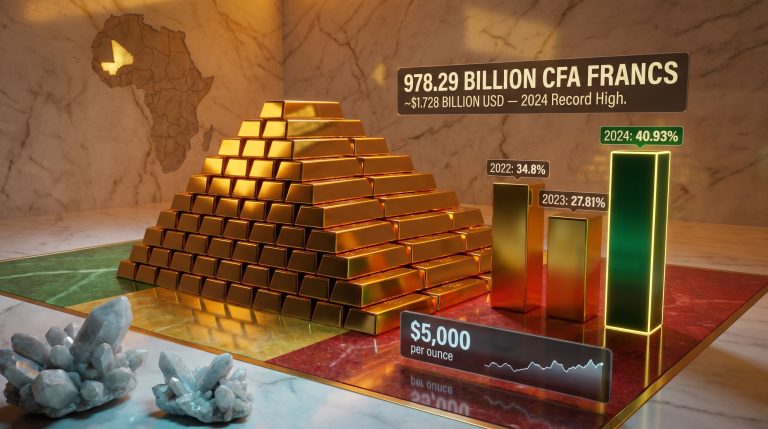
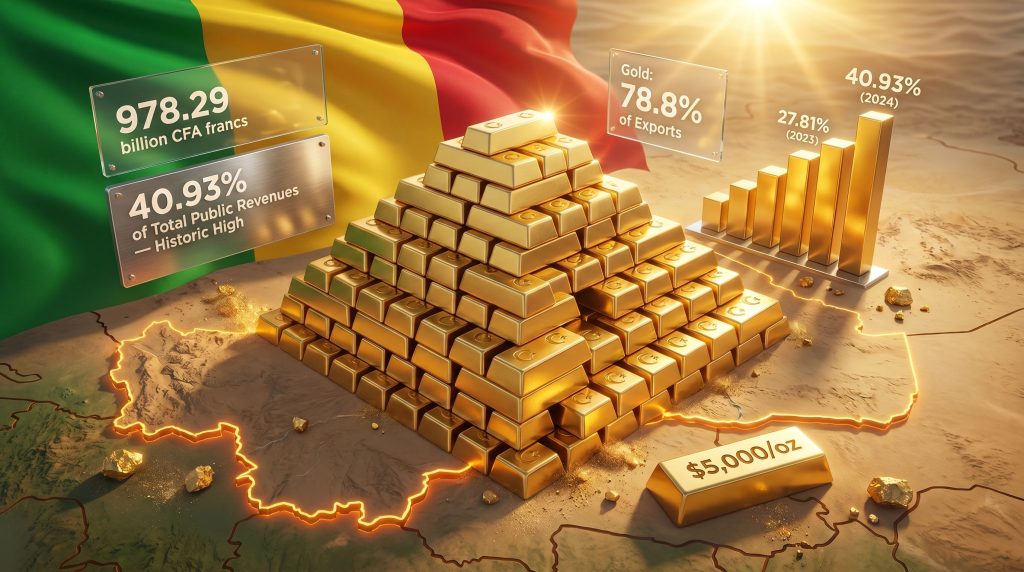
| 2024 | 40.93% (historic high) |
According to data verified by the Extractive Industries Transparency Initiative (EITI) and published in March 2026, total extractive revenues collected by Mali's state budget reached 978.29 billion CFA francs (approximately $1.728 billion) in 2024. The mining sector simultaneously accounted for 78.8% of total national exports during that year, with gold retaining its position as the country's dominant export commodity by a substantial margin.
The dip to 27.81% in 2023 followed by the surge to 40.93% in 2024 is not simply a function of gold prices. It reflects the compounding effect of legislative change, enforcement action, and contract restructuring arriving simultaneously in a single fiscal year, producing a step-change in the state's revenue capture capacity that price movements alone could not have generated.
Three Forces That Converged to Produce the 2024 Record
Structural Reform: Rewriting the Equity Framework
The foundation of Mali's revenue surge was legislative. The Mining Code enacted in 2023 fundamentally altered the contractual relationship between the Malian state and mining operators by increasing mandatory state equity participation in mining projects from 20% to 35%. Within that 35% total, 30% is reserved for the state and 5% is allocated to local Malian investors, embedding a domestic wealth-sharing mechanism that had been absent from earlier frameworks.
This is not simply a royalty adjustment. Equity participation means the state shares directly in project-level profitability, not just in production volumes or revenues. In practice, as gold prices rise, the state's equity stake amplifies its absolute financial gain in a way that fixed royalty structures do not. The implication for revenue forecasting is significant: at higher gold prices, the 2023 Mining Code's equity framework generates disproportionately larger gains for the Malian treasury than the previous 20% participation regime would have.
Contract Renegotiation: Recovering Value From Legacy Agreements
Following a sector-wide audit, the Malian government initiated renegotiation processes with multiple mining operators to recover revenues it argued were due under the new framework. The Mali mining negotiations produced EITI-verified payments in 2024 standing at 331.64 billion CFA francs. However, the figure cited by Mali's Economy and Finance Minister Alousséni Sanou is notably higher, and the government's mining commission has referenced recoveries reaching 761 billion CFA francs across the broader renegotiation programme, nearly doubling the original 400 billion CFA franc target that had been publicly stated.
Why the figures diverge: The EITI records verified payments within a defined reporting period and scope. The government's broader figure encompasses contractual settlements that may extend across multiple fiscal years or include components not captured within the EITI's standard reconciliation methodology. Neither figure is incorrect; they measure different things.
This approach to legacy contract renegotiation reflects a pattern gaining momentum across the Sahel and broader West Africa, where governments that signed mining agreements in periods of lower commodity prices and weaker bargaining positions are now using legislative reform as leverage to recapture value from deals that arguably underpriced sovereign assets.
Gold Price Amplification
The third factor was market-driven rather than policy-driven, but its timing proved critical. The gold price outlook was already elevated throughout 2024, and the World Gold Council confirmed that gold reached 53 record highs in 2025, ending the year at an average annual price of $3,431 per ounce, representing a 44% year-on-year increase. The favourable price environment in 2024 amplified the revenue gains from the structural changes already in motion, compressing what might otherwise have been a multi-year reform dividend into a single fiscal year.
The 2025 Paradox: Record Prices, Constrained Revenues
How a Price Rally Failed to Deliver Proportional Revenue Growth
The 2025 fiscal year presented Mali's revenue trajectory with a genuine paradox. Gold prices surged approximately 70% during the year, yet Mali's gold sector revenues grew by only 6.4% year-on-year, with gold producers contributing 888.5 billion CFA francs (approximately $1.57 billion) to the state. The explanation lies entirely in production volume.
Mali's industrial gold output fell by 22.9% in 2025, declining from 54.8 metric tons in 2024 to 42.2 metric tons. This collapse in output originated primarily from the Loulo-Gounkoto mine complex, which had previously been the country's single largest gold producing asset. A protracted dispute between the Malian state and Barrick Mining over compliance with the 2023 Mining Code's new requirements led to an operational suspension that persisted for much of the year before a negotiated resolution was eventually reached, with production resuming in late 2025.
The price-volume trade-off is a fundamental concept in resource-dependent sovereign budgets. A 70% price increase sounds transformational, but if production volume simultaneously falls by 23%, the net effect on revenues is severely compressed. Mali's 2025 experience is a textbook illustration of why resource economists insist on modelling both price and volume scenarios independently, rather than treating commodity price rallies as automatic revenue catalysts.
The Loulo-Gounkoto Dispute: Sovereign Risk in Practice
The Barrick-Mali standoff carries lessons that extend well beyond a single mine. Loulo-Gounkoto is not a marginal operation. At 54.8 metric tons of annual national production in 2024, Mali ranked among Africa's most significant gold producers, and Loulo-Gounkoto represented a disproportionate share of that total. When that single asset was suspended, the loss was large enough to neutralise the most powerful gold price rally in decades.
For investors and sovereign credit analysts, the episode illustrates a critical asymmetry in resource-state risk: the same legislative assertiveness that can dramatically increase revenue capture in benign conditions can simultaneously trigger the operational disruptions that erase those gains. The 2023 Mining Code's higher equity demands were the instrument of both the 2024 revenue record and the 2025 production collapse.
Can Mali Set a New Mining Revenue Record in 2026?
The Conditions That Would Make It Possible
Several converging factors have repositioned Mali for a potential revenue record in 2026. The key variables are:
-
Gold price trajectory: Prices surpassed $5,000 per ounce in February 2026, with the World Bank projecting an average annual increase of 37% for the full year, following a 17% rise in Q1 2026 alone compared to Q4 2025.
-
Loulo-Gounkoto recovery: Barrick's mine produced 80,000 ounces in Q1 2026 against a full-year target exceeding 360,000 ounces, indicating a substantive production recovery from the disrupted 2025 baseline.
-
Structural revenue floor: The 2023 Mining Code's 35% equity participation rate remains in force, meaning any incremental production gain generates a larger absolute revenue contribution to the state than under the pre-2023 framework.
-
IMF economic outlook: The International Monetary Fund projects Mali's economy will expand by 5.5% in 2026, with the mining sector's production recovery identified as a central driver of that growth forecast.
The Risk Factors That Could Prevent It
Against this constructive backdrop, three persistent risk vectors could constrain or derail the 2026 revenue story:
-
Security conditions: Jihadist and terrorist activity across Mali's central and northern mining corridors remains one of the most difficult risks to quantify or hedge. Unlike contractual disputes, security deterioration does not resolve through negotiation, and its impact on operational continuity can be sudden and severe.
-
Operator compliance risks: The Loulo-Gounkoto dispute was resolved, but the 2023 Mining Code's implementation continues to create friction points with other operators. A replication of that dispute with a different mine would again compress production volumes at precisely the moment market conditions are favourable.
-
Gold price correction: The current gold price environment is exceptional by historical standards. Any sustained pullback from the $5,000 per ounce threshold would reduce the revenue amplification effect the Malian treasury is counting on, even if production volumes fully recover. Furthermore, the record gold prices seen in recent years have heightened expectations that may prove difficult to sustain.
Scenario Analysis: 2026 Revenue Pathways
| Scenario | Key Assumptions | Revenue Outlook |
|---|---|---|
| Base Case | Loulo-Gounkoto hits annual target; gold averages $4,500-$5,000/oz; no major new disruptions | Material year-on-year increase; potential new record |
| Bull Case | Full production recovery across sector; gold sustains above $5,000/oz | Record-breaking revenues materially exceeding 2024 levels |
| Bear Case | New operational or security disruptions; gold price correction to $3,500-$4,000/oz | Flat to modest growth; 2024 record remains intact |
This scenario analysis is illustrative and should not be construed as financial forecasting. Actual outcomes will depend on variables that cannot be predicted with certainty.
Mali's Emerging Lithium Sector: Structural Promise, Not Near-Term Catalyst
Two new lithium operations entered production in the 2024-2025 period, repositioning Mali within the global battery metals conversation. Goulamina, operated by China's Ganfeng Lithium, commenced production in December 2024, while Bougouni, operated by Britain's Kodal Minerals, achieved first production in February 2025. Together, these assets place Mali among Africa's frontrunning lithium producers at a time when the global energy transition narrative continues to attract capital toward battery supply chains.
However, characterising either asset as a near-term fiscal contributor would overstate their current impact. Both mines are in early-stage ramp-up phases, and the global lithium market has been characterised by price volatility and significant lithium oversupply concerns that have compressed margins across the industry since late 2023. Their contribution to Mali's state revenues remains negligible relative to gold.
| Dimension | Gold | Lithium |
|---|---|---|
| Share of 2024 export revenues | ~78.8% of total exports | Marginal |
| Operational maturity | Multiple established, producing mines | Early-stage ramp-up |
| Price environment (2025-2026) | Strongly bullish; multi-decade highs | Volatile; global oversupply concerns |
| Fiscal contribution timeline | Immediate and material | Medium-to-long term |
| State equity framework | 2023 Mining Code applies | 2023 Mining Code applies |
The longer-term case for lithium is more compelling. As electric vehicle adoption accelerates across major economies, demand for battery-grade lithium is projected to grow substantially through the 2030s. Mali's spodumene deposits, which underpin both Goulamina and Bougouni, are considered high-quality resources by industry standards. Whether this translates into meaningful budget revenue within a five to ten year horizon will depend on mine ramp-up trajectories, sustained lithium demand, and the state's ability to apply its new equity framework effectively to these assets.
The next major ASX story will hit our subscribers first
The Broader Pattern: Resource Concentration Risk Across West Africa
Mali's fiscal architecture is not unique within its regional context. The concentration of public revenues within a single commodity sector is a structural feature shared by several West African resource states. Guinea derives a dominant share of its export revenues from bauxite. Burkina Faso, like Mali, depends heavily on gold. Niger has historically relied on uranium alongside gold. In each case, the same dynamic applies: when the primary commodity performs well, national budgets benefit handsomely; when it does not, fiscal stability deteriorates rapidly.
The EITI framework, which produced the verified data underpinning Mali's 2024 revenue figures, provides a valuable transparency benchmark for tracking these flows. However, the gap between EITI-verified figures and government-stated recovery amounts, as seen in the renegotiation data, also highlights the complexity of measuring extractive revenues in real time across multiple contractual instruments and fiscal periods.
For sovereign risk analysts, the key lesson from Mali's 2023-2025 period is not simply that mining reform can increase revenues. It is that the same reform mechanism that expands revenue capture also introduces new sources of operational and contractual uncertainty that can temporarily reverse those gains. The net long-term effect depends critically on implementation quality and the state's ability to maintain productive relationships with operators across the reform transition.
Frequently Asked Questions: Mali Mining Revenues
What were Mali's total mining revenues in 2024?
Mali's extractive sector generated 978.29 billion CFA francs (approximately $1.728 billion) in state revenues in 2024, representing 40.93% of total public revenues, the highest share on record according to EITI data published in March 2026. This Mali mining revenues record remains the benchmark against which 2025 and 2026 figures are being assessed.
How much did the gold sector pay the Malian state in 2025?
Gold producers operating in Mali contributed 888.5 billion CFA francs (approximately $1.57 billion) to state revenues in 2025, despite a significant decline in overall production volume caused by the Loulo-Gounkoto operational suspension.
Why did Mali's gold production fall in 2025?
A contractual dispute between the Malian government and Barrick Mining over compliance with the 2023 Mining Code led to the suspension of operations at Loulo-Gounkoto, previously Mali's largest gold complex. Industrial gold output fell 22.9%, from 54.8 metric tons in 2024 to 42.2 metric tons in 2025.
What is the 2023 Mining Code and how does it affect revenues?
The 2023 Mining Code raised mandatory state equity participation in mining projects from 20% to 35%, including a 5% allocation for local Malian investors. It also empowered the government to renegotiate legacy contracts, a process that recovered between 331.64 billion and 761 billion CFA francs depending on the measurement scope applied.
What is the gold price outlook for 2026 and what does it mean for Mali?
Gold prices exceeded $5,000 per ounce in February 2026, with the World Bank projecting a 37% average annual price increase for the full year. Combined with recovering production volumes at Loulo-Gounkoto, this creates conditions for Mali mining revenues record figures to potentially be surpassed in 2026.
Does Mali produce lithium?
Yes. Two lithium mines, Goulamina (Ganfeng Lithium) and Bougouni (Kodal Minerals), entered production in late 2024 and early 2025 respectively. Their fiscal contribution remains negligible compared to the gold sector at this stage of development, though their long-term potential is considered significant given the quality of Mali's spodumene deposits.
Want to Know Which ASX Gold Discoveries Could Deliver Outsized Returns?
As Mali's 2024 mining revenue record demonstrates, significant mineral discoveries and favourable commodity conditions can generate transformative financial outcomes — and Discovery Alert's proprietary Discovery IQ model delivers real-time alerts the moment significant ASX gold and mineral discoveries are announced, turning complex data into actionable investment insights. Explore the historic returns generated by major mineral discoveries on Discovery Alert's dedicated discoveries page, and begin your 14-day free trial today to position yourself ahead of the broader market.