July 14, 2026
The Mineral North America Cannot Afford to Keep Ignoring
Few supply chain vulnerabilities are as structurally awkward as the manganese problem facing North America. Unlike rare earth elements, which require exotic geology and complex separation chemistry, manganese is geologically widespread. Significant deposits exist across Canadian provinces and parts of the American interior. Yet despite this, both the United States and Canada currently operate zero active manganese mines.
Every tonne consumed domestically arrives from overseas, predominantly from Gabon, South Africa, Australia, and China. For a mineral that sits at the intersection of conventional heavy industry and cutting-edge energy technology, this is a striking paradox.
Understanding why this gap persists, and why a newly formed cross-border initiative called the North American Critical Manganese Alliance (NACMA) could represent a meaningful response to it, requires examining manganese not just as a commodity but as a systems-critical input spanning multiple industries simultaneously.
When big ASX news breaks, our subscribers know first
Why Manganese Occupies a Unique Position in the Critical Minerals Hierarchy
Most critical minerals earn that classification through a single dominant application. Lithium means batteries. Cobalt means cathodes. Neodymium means permanent magnets. Manganese is different. Its criticality derives from a dual-market structure that few other minerals replicate at comparable volume. Furthermore, the critical minerals demand profile for manganese is growing across multiple sectors simultaneously.
The Steelmaking Foundation
Manganese has been integral to commercial steel production since the mid-19th century. Its primary function is metallurgical housekeeping: it binds with sulfur during the smelting process to prevent the formation of iron sulfide, which would otherwise cause steel to crack under stress. It also acts as a deoxidiser, reducing porosity and improving the internal structure of the finished metal.
The downstream consequences of this are enormous. Virtually every steel-dependent sector, from construction and transportation infrastructure to heavy equipment manufacturing and shipbuilding, relies on manganese-treated steel for structural integrity. Approximately 90% of global manganese consumption is tied to steel production, making it one of the highest-volume alloying metals in existence.
The High-Purity Frontier
Beyond steelmaking, a separate and rapidly expanding demand profile is taking shape in advanced technology manufacturing. Battery-grade manganese, refined to significantly higher purity levels than conventional alloy feedstock, is a key input in several lithium-ion cathode chemistries. This includes lithium manganese oxide (LMO) and lithium manganese iron phosphate (LMFP) formulations, the latter of which is gaining traction as an alternative to lithium iron phosphate due to its improved energy density.
For grid-scale energy storage and electric vehicle applications, LMFP is particularly relevant because manganese is abundant and relatively low-cost compared to cobalt or nickel. This makes it attractive for large-format batteries where cost per kilowatt-hour is a defining constraint, a point well reflected in the broader battery raw materials market dynamics currently reshaping procurement strategies.
Specialty manganese compounds also serve aerospace and defence manufacturing, where alloy performance at extreme temperatures and pressures demands precision feedstock chemistry. Additive manufacturing, which requires tightly specified metal powders, represents an emerging demand node that is still in early-growth phases.
| Application Sector | Manganese Grade Required | Strategic Importance |
|---|---|---|
| Conventional steelmaking | Standard alloy grade | High-volume, foundational |
| EV battery cathodes (LMFP/LMO) | High-purity battery grade | Critical for energy transition |
| Aerospace and defence | Specialty alloys and compounds | National security relevance |
| Additive manufacturing | Ultra-refined powder feedstocks | Emerging industrial demand |
| Grid-scale energy storage | Battery-grade | Long-duration storage growth |
This dual-market structure means manganese demand does not follow a single cycle. It tracks both the global steel market and the electric vehicle transition simultaneously, creating a more resilient demand base than most single-application critical minerals.
North America's 100% Import Dependency: How Did It Get Here?
The absence of active North American manganese production is less a geological problem than an economic and infrastructural one. The economics of manganese mining historically favoured large, high-grade open-pit operations in resource-rich regions with low labour costs and established export infrastructure. This is precisely the profile that Gabon's Moanda mine (operated by Eramet) and South Africa's Kalahari Manganese Field have long satisfied.
"North America's import dependency on manganese is not explained by a lack of resources in the ground. It reflects the absence of the integrated downstream processing and refining infrastructure that would make domestic production economically competitive."
Without domestic refineries capable of upgrading run-of-mine ore into battery-grade or specialty alloy feedstocks, any nascent North American mining operation would face a painful economic paradox: mining the ore domestically but shipping it offshore for processing before reimporting it as a finished product. This circular inefficiency has historically made import sourcing the path of least resistance.
The North American Critical Manganese Alliance is specifically designed to break this cycle by building both ends of the value chain simultaneously rather than sequencing mine development before processing infrastructure.
What NACMA Is and How Its Architecture Works
Formalized through a Strategic Partnership Framework Agreement, NACMA brings together four founding organisations with complementary capabilities across the full value chain. The North American Critical Manganese Alliance represents a structured attempt to close the continent's manganese supply gap through integrated cross-border cooperation:
- Canadian Manganese Company Inc. contributes mineral development and project advancement, anchored by the Woodstock Project in New Brunswick.
- GreenMet Inc. brings critical mineral financing expertise and government engagement experience across federal program landscapes in both countries.
- AmForge LLC contributes advanced manufacturing capabilities that would underpin the downstream U.S. processing platform.
- Flash Metals USA Inc. provides specialty processing and high-value product conversion relevant to battery materials and precision alloy outputs.
It is important to note that a framework agreement of this nature establishes strategic intent and governance principles. It does not constitute binding financial commitments. Each definitive feasibility study and governing agreement for specific transactions, capital deployments, or commercial supply arrangements will require separate negotiation and execution. This is standard practice in multi-party critical minerals alliances, but investors and analysts should weigh the distinction carefully.
The Two-Platform Design
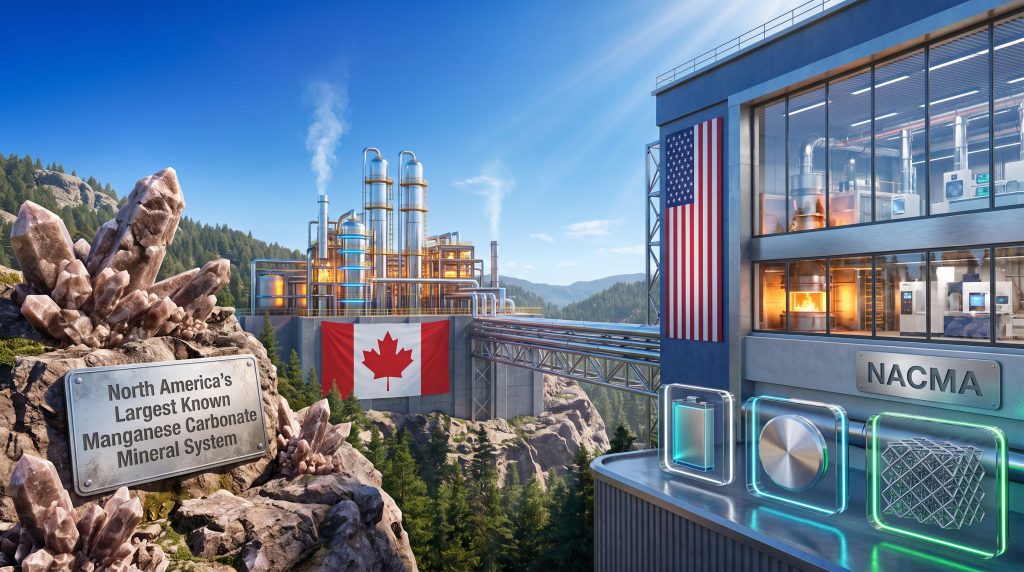
NACMA's operational architecture is deliberately binational. The Canadian platform, anchored in New Brunswick, handles resource extraction, beneficiation, and hydrometallurgical refining. The U.S. platform, centred in West Virginia, handles specialty chemical processing, battery material production, advanced alloy fabrication, defence-grade compound manufacturing, and additive manufacturing feedstock supply.
This division of function is not arbitrary. Canada's regulatory environment and geological endowment support the upstream and refining phases, while West Virginia's industrial infrastructure, proximity to advanced manufacturing clusters, and existing policy ecosystem around critical minerals processing make it a logical location for the downstream conversion operations.
The proposed value chain progresses through five sequential stages:
- Mining and beneficiation at the Woodstock site in New Brunswick, Canada.
- Hydrometallurgical refining to produce intermediate and high-purity manganese products within Canada.
- Cross-border transfer of refined feedstocks to the West Virginia processing platform.
- Conversion of those feedstocks into battery materials, specialty alloys, defence-grade compounds, and additive manufacturing inputs.
- Commercial supply to North American manufacturers across multiple end-use sectors.
The Woodstock Project: Scale, Geology, and Development Maturity
The geological foundation of NACMA is the Woodstock Project in New Brunswick, characterised as North America's largest known manganese carbonate mineral system. Manganese carbonate deposits, hosted in rhodochrosite-bearing sedimentary sequences, differ from the oxide ores that dominate African production. They typically require hydrometallurgical processing pathways rather than traditional pyrometallurgical smelting, which aligns with the high-purity product objectives NACMA is targeting.
Manganese carbonate ore, when processed through leaching and solvent extraction or electrowinning circuits, can yield high-purity electrolytic manganese metal or high-purity manganese sulphate monohydrate. This is the specific battery precursor form required for LMFP and other advanced cathode chemistries. This processing pathway is energy-intensive but produces a cleaner product profile than oxide ore routes, which is why carbonate geology is increasingly valued in battery material supply chain discussions.
With over a decade of geological characterisation, metallurgical testing, and engineering study already completed, Woodstock represents a more advanced development-stage asset than most North American critical mineral projects at comparable stages. That accumulated technical work is a meaningful differentiator in an environment where greenfield projects frequently underestimate the time and capital required to reach feasibility-level confidence.
The West Virginia Hub: A Multi-Commodity Industrial Strategy
The NACMA U.S. processing platform does not exist in isolation. GreenMet, AmForge, and Flash Metals are simultaneously advancing a separate but structurally overlapping initiative in Greenbrier County, West Virginia: a proposed ~$150 million processing facility targeting rare earth element recovery from coal tailings, in partnership with Greenbrier Smokeless Coal Company.
The strategic logic here is compelling. Coal waste streams in Appalachia contain measurable concentrations of rare earth elements and other critical minerals that were never extracted during original mining operations. Recovering these materials from tailings avoids much of the permitting complexity associated with greenfield mining while converting an environmental liability into an economic asset. In addition, the strengthening of rare earth supply chains across North America adds further strategic weight to this West Virginia initiative.
NACMA's manganese processing operations would extend this West Virginia platform beyond rare earth recovery, creating what would effectively be a multi-commodity critical minerals processing hub with shared infrastructure, processing expertise, and federal engagement leverage.
| Partner | Core Competency | NACMA Contribution |
|---|---|---|
| Canadian Manganese Company Inc. | Mineral development, project advancement | Woodstock Project as primary feedstock anchor |
| GreenMet Inc. | Critical mineral financing, government engagement | Capital access, federal program navigation |
| AmForge LLC | Advanced manufacturing | Downstream processing and fabrication |
| Flash Metals USA Inc. | Specialty processing | High-value product conversion |
The next major ASX story will hit our subscribers first
Regulatory Landscape and Critical Mineral Classification
Manganese holds formal critical mineral designation on both the U.S. Geological Survey's critical minerals list and Canada's equivalent federal classification. This dual designation matters practically because it opens eligibility for federal financing instruments, tax incentive programs, and procurement preference frameworks in both jurisdictions.
The USMCA creates additional structural advantages for a Canada-U.S. critical mineral supply chain of this type. Under the agreement's critical minerals provisions, integrated binational supply chains can access preferential treatment frameworks that are not available to purely domestic or third-country supply arrangements. However, evolving US critical minerals policy continues to shape the commercial and regulatory environment in which NACMA must operate.
It should be clarified, however, that critical mineral classification confers eligibility for policy frameworks. It does not automatically deliver project-specific government funding, accelerated permitting, or strategic designation. The competitive application processes for federal financing instruments remain rigorous, and NACMA's ability to access them will depend on the technical maturity and economic credibility of its individual project components.
Key Risk Factors to Monitor
- The framework agreement stage means no capital commitments or binding production timelines exist yet. The most complex financing, permitting, and commercial negotiation work remains ahead.
- Woodstock's development, including environmental assessment and community engagement in New Brunswick, involves multi-year regulatory processes.
- Battery-grade manganese processing requires precision hydrometallurgical capabilities that must be demonstrated at commercial scale before offtake buyers will commit to long-term supply agreements.
- Manganese spot prices are subject to cyclical volatility driven by steel market conditions, which can compress project economics during downturns.
- The West Virginia rare earth facility and NACMA's manganese processing operations are complementary but represent parallel development tracks, each carrying its own execution timeline and capital requirement.
Frequently Asked Questions: North American Critical Manganese Alliance
What is the North American Critical Manganese Alliance?
NACMA is a strategic cross-border partnership between Canadian Manganese Company Inc., GreenMet Inc., AmForge LLC, and Flash Metals USA Inc. It was established to build an integrated manganese supply chain linking Canadian mineral production with U.S. specialty processing and advanced manufacturing. Details of the alliance's formation have been reported across industry publications.
Where is the Woodstock Project located, and why does its geology matter?
The Woodstock Project is in New Brunswick, Canada. Its manganese carbonate geology is particularly relevant to battery material production because carbonate ore processed through hydrometallurgical circuits can yield the high-purity manganese sulphate monohydrate required for advanced lithium-ion cathode chemistries, including the LMFP formulations gaining traction in EV and grid storage markets.
Why does North America import all of its manganese?
The absence of domestic refining and processing infrastructure has historically made import sourcing more economically viable than developing domestic resources. Without local upgrading capability, mined ore would need to be exported for processing and reimported, negating the economic case for domestic mining.
What will the West Virginia platform produce?
The proposed U.S. platform is designed to convert refined Canadian manganese feedstocks into battery-grade materials, specialty alloys, aerospace and defence-grade compounds, and additive manufacturing feedstocks. It is also connected to a separate initiative targeting rare earth element recovery from coal tailings in Greenbrier County.
Is NACMA the same as a government-backed project?
No. Manganese's critical mineral classification makes NACMA's component projects eligible for various federal financing and incentive programs in both the U.S. and Canada, but eligibility is not the same as designation or awarded funding. No government backing for NACMA has been formally confirmed at the framework agreement stage. Broader context around the policy environment can be found through the 2026 Critical Minerals Ministerial, which outlines the international framework shaping these priorities.
What NACMA Signals for North American Critical Mineral Strategy
The formation of the North American Critical Manganese Alliance reflects a broader maturation in how North American industry is approaching critical mineral supply chain development. Rather than pursuing single-asset mining projects and hoping downstream markets self-organise around them, NACMA's architects have constructed a full-chain framework from the outset. This integrates resource ownership, processing capability, manufacturing capacity, and financing expertise before a single tonne of ore has been moved.
Whether execution matches strategic ambition will depend on factors that no framework agreement can predetermine: financing conditions, permitting outcomes, metallurgical performance at scale, and the commercial appetite of offtake buyers. But as a structural template for how North America might close its manganese supply gap, the North American Critical Manganese Alliance represents one of the most architecturally complete initiatives yet formalised in the sector.
Disclaimer: This article is intended for informational purposes only and does not constitute financial or investment advice. Forward-looking statements regarding project development timelines, capital commitments, and commercial outcomes involve inherent uncertainty. Readers should conduct their own due diligence before making any investment decisions related to companies or projects discussed herein.
Want to Catch the Next Major Critical Minerals Discovery Before the Market Does?
Discovery Alert's proprietary Discovery IQ model scans ASX announcements in real time, instantly identifying significant mineral discoveries across manganese, rare earths, and more than 30 other commodities — converting complex data into clear, actionable insights for investors at every level. Explore how historic mineral discoveries have generated extraordinary returns and begin your 14-day free trial today to position yourself ahead of the broader market.