July 14, 2026
The Anatomy of an Energy Security Gap: Why Strategic Petroleum Reserves Matter More Than Ever
Energy security is rarely front of mind until it fails. For most nations, the adequacy of South Africa strategic oil reserves only becomes a political priority in the aftermath of a supply shock, a price spike, or a geopolitical rupture that exposes just how thin the buffer between normalcy and economic disruption actually is. South Africa is navigating exactly this reckoning, and the country's response offers a revealing case study in how decades of deferred maintenance on energy infrastructure eventually demands a reckoning.
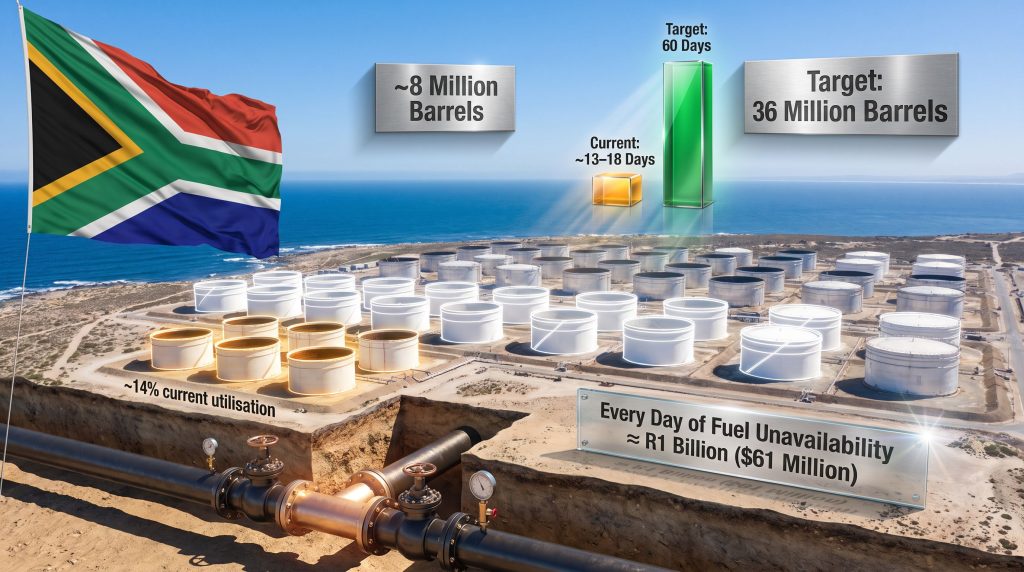
The mechanism behind strategic petroleum reserves is straightforward in theory: governments accumulate stockpiles of crude oil and refined fuel products during periods of relative supply abundance, then draw them down during disruptions to stabilise prices and maintain economic continuity. The International Energy Agency set the global benchmark at 90 days of national demand coverage, a figure most energy-secure nations treat as a floor rather than a ceiling. South Africa, by contrast, currently holds approximately 8 million barrels of strategic crude, sufficient to cover somewhere between 13 and 18 days of national demand depending on whether output from domestic producers such as Sasol is included in the calculation.
That gap between where South Africa sits and where the IEA standard places it is not a minor policy shortfall. It represents a structural vulnerability that is now being forced into the open by a convergence of geopolitical pressures, deteriorating domestic refining capacity, and the hard lessons of a 2015 reserve sale that a court later found to be unlawful.
When big ASX news breaks, our subscribers know first
South Africa's Reserve Position: Understanding the Numbers
The arithmetic of South Africa's energy security exposure is striking when laid out in a single view.
| Metric | Value |
|---|---|
| Current strategic crude holdings | ~8 million barrels |
| Days of demand covered (excluding domestic output) | ~13 days |
| Days of demand covered (including domestic output) | ~18 days |
| Proposed reserve target | ~36 million barrels |
| Proposed coverage target | 60 days |
| IEA international benchmark | 90 days |
| Total available storage infrastructure | ~58.2 million barrels |
What makes this data set particularly revealing is the final row. South Africa possesses roughly 58.2 million barrels of physical storage capacity, spread across the 45-million-barrel Saldanha Bay hub on the Atlantic coast and the 13.2-million-barrel OTMS facility. The country is currently using roughly 14% of that capacity. The problem is not a lack of infrastructure. It is the absence of the political will, governance frameworks, and financing mechanisms needed to fill it.
Furthermore, the current crude oil market conditions make this underutilisation even more consequential, as volatile pricing windows mean that delayed procurement translates directly into higher acquisition costs.
"South Africa holds approximately 50 million barrels of unused strategic energy storage capacity, representing one of the largest underutilised energy infrastructure positions on the African continent."
The Department of Mineral and Petroleum Resources has confirmed that the country currently requires at least 10 million barrels simply to replenish sold or rotated stock, before any expansion toward the 60-day target is even contemplated. According to Worldometers' South Africa oil data, the country's oil consumption patterns further underscore the urgency of closing this gap.
How Refinery Deterioration Has Deepened the Problem
The reserve shortfall does not exist in isolation. It has been compounded by a parallel structural shift in South Africa's domestic energy system. Approximately half of the country's refinery capacity has been offline in recent years, a trend driven by underinvestment in ageing plant infrastructure and the looming financial demands of upgrading to low-sulphur fuel standards ahead of a July 2027 regulatory deadline.
The consequence is a country that has become substantially more dependent on imported fuel at exactly the moment when global oil shipments are most exposed to disruption. Every barrel that cannot be refined domestically must arrive by ship through routes that include the Strait of Hormuz, a chokepoint whose vulnerability has been made viscerally apparent by the conflict in the Persian Gulf region.
South Africa's Department of Mineral and Petroleum Resources has estimated the economic cost of fuel unavailability at approximately 1 billion rand per day, equivalent to roughly $61 million USD, a figure that gives precise financial weight to what might otherwise feel like an abstract policy concern.
The Draft Policy Framework: What Is Actually Being Proposed?
On July 9, 2026, South Africa's Department of Mineral and Petroleum Resources published a draft policy document for public consultation that outlines a comprehensive restructuring of the country's approach to strategic petroleum reserves.
The centrepiece of the proposal is a two-tier reserve architecture designed to distribute the burden of energy security across both the state and the private sector.
| Reserve Category | Coverage Target | Composition | Responsible Entity |
|---|---|---|---|
| Strategic Petroleum Reserve | 60 days of demand | ~70% crude, ~30% refined products | South African National Petroleum Company (SANPC) |
| Mandatory Commercial Buffer | 21 days of inventory | Same crude/product ratio | All licensed wholesalers and importers |
The 60-day state-managed reserve, amounting to approximately 36 million barrels based on South African demand of roughly 600,000 barrels per day as estimated by the US Energy Information Administration, would be managed by the South African National Petroleum Company (SANPC). This entity would serve as the custodial authority for the stockpile, with the National Treasury working alongside SANPC to develop financing instruments and guarantee structures adequate to support what is, at prevailing crude prices, a multi-billion-dollar capital commitment.
The commercial buffer obligation is equally significant. Requiring all licensed fuel wholesalers and importers to maintain 21 days of inventory creates a distributed reserve layer that does not depend entirely on state procurement capacity. This approach mirrors frameworks used in European nations, where commercial obligations supplement government-held emergency stocks.
The Financing Challenge: Quantifying the Capital Requirement
At approximately $100 per barrel, the government's indicated threshold for strategic reserve sales, a 36-million-barrel target represents a gross asset value of roughly $3.6 billion. That figure does not account for storage operating costs, logistics, product rotation, or the additional infrastructure investment that maintaining a commercially viable reserve programme requires.
The draft policy acknowledges that direct government expenditure alone is insufficient to fund this programme. The intent is to develop structured financial instruments, potentially including off-balance-sheet financing arrangements, third-party storage leasing agreements, and sovereign-backed guarantee mechanisms. However, no specific financing architecture has been publicly confirmed as of the July 2026 consultation period.
The government has also indicated a degree of price sophistication in its approach to reserve management. There is a stated intention to time reserve purchases and sales strategically relative to crude oil price trends, including withholding crude from sale until prices approach the approximately $100 per barrel threshold, rather than liquidating at distressed levels.
From Apartheid-Era Sanctions to a 21st-Century Supply Shock: The Historical Arc
To understand why South Africa's reserve infrastructure exists in its current form, and why it is so chronically underutilised, it is necessary to trace the history back to its origins.
South Africa's last major strategic reserve build-up occurred during the 1970s, when United Nations sanctions imposed in response to the apartheid government's policies of institutionalised racial segregation created acute oil supply vulnerabilities. The response was the construction of the Saldanha Bay storage facility on the Atlantic coast, a 45-million-barrel hub designed to accumulate crude from non-sanctioning suppliers and insulate the domestic economy from international isolation.
Following South Africa's first democratic elections in 1994, the strategic rationale for that infrastructure dissolved. The country gradually wound down its emergency stocks through the 1990s and 2000s as sanctions were lifted and global markets reopened. This process culminated in the controversial 2015 sale of 10 million barrels at prices that were at their lowest point in eight years.
South Africa's High Court subsequently ruled in 2020 that the transaction was unlawful, citing governance failures and processes tainted by corruption. A detailed account of this episode is documented by OUTA's oilgate investigation, which outlines the governance failures that preceded the court ruling.
That ruling remains a defining institutional scar on South Africa's petroleum reserve management history. It created an accountability vacuum that the new draft policy must credibly address if the 36-million-barrel ambition is to be realised.
"The 2015 reserve sale and its subsequent legal invalidation represent precisely the kind of governance failure that erodes public confidence in state-managed strategic assets. Designing a new framework that is resistant to similar pressures is arguably as important as the procurement programme itself."
The Saldanha Bay Facility: From Commercial Asset to National Security Infrastructure
Saldanha Bay sits at the intersection of South Africa's past and its proposed future. Originally conceived as a sanctions-era emergency buffer, the facility evolved over the post-apartheid decades into a commercially operated storage hub, with capacity leased to international oil trading companies and used as a floating inventory management tool within the broader Atlantic crude market.
Its Atlantic coast positioning is strategically significant in ways that differ from South Africa's Indian Ocean import routes. Crude sourced from West African producers, South American exporters, and North Sea suppliers can reach Saldanha Bay without transiting Indian Ocean chokepoints. This geographic diversification is a genuine operational asset that distinguishes South Africa's storage infrastructure position from many of its African peers.
The transition challenge now facing policymakers is converting a facility that has functioned as a commercial asset back into its original role as a national security buffer. This involves navigating existing lease agreements, restructuring operational mandates, and resolving the question of how SANPC assumes custodial responsibility over infrastructure that may currently be partially encumbered by private commercial arrangements.
Storage Capacity Utilisation: The Underutilisation Paradox
The combination of the Saldanha Bay facility's 45 million barrels and the OTMS facility's 13.2 million barrels gives South Africa a theoretical storage capacity of approximately 58.2 million barrels. Filling even the proposed 36-million-barrel target would require utilising roughly 62% of available capacity, still leaving meaningful headroom.
The paradox embedded in this situation is that South Africa's energy security problem is not primarily one of infrastructure deficit. It is a problem of capital allocation, governance credibility, and institutional execution. The vessels to hold the oil exist. The challenge is filling them.
Africa's Broader Energy Infrastructure Push: Regional Context
South Africa's reserve expansion plan does not exist in isolation. Across the continent, governments are responding to Persian Gulf supply shocks with a range of infrastructure investments designed to reduce import dependency and build domestic supply resilience. The trade war oil impact on global pricing has further intensified these regional pressures, making domestic storage capacity a strategic priority rather than a discretionary investment.
| Country | Initiative | Scale / Investment |
|---|---|---|
| South Africa | Strategic reserve expansion to ~36 million barrels | Multi-billion dollar programme under SANPC |
| Morocco | New fuel storage facility development | $641 million announced June 2026 |
| Uganda | State-owned petroleum terminal expansion | Capacity expansion for domestic supply stability |
| Ghana | Increased use of domestic crude at the Tema refinery | Cost reduction and import substitution |
| Nigeria | Private-sector refinery expansion (Dangote Group) | Ramped up output during Persian Gulf conflict; Kenya plant in development |
What differentiates the South African approach from most peers on this list is the scale of existing infrastructure. Morocco's $641 million commitment is a greenfield investment in storage capacity that does not yet exist. Nigeria's most prominent energy infrastructure story is driven by the private sector. South Africa, by contrast, is working with an established 45-million-barrel facility whose original purpose is being restored rather than newly created.
The distinction matters for risk assessment. South Africa's path to 36 million barrels is primarily a financing and governance challenge. For Morocco and Uganda, it involves the additional complexity and timeline risk of physical construction. In addition, OPEC market influence on supply availability means that procurement timing will be a critical variable for any nation attempting to build reserves at scale.
The next major ASX story will hit our subscribers first
Key Risks to the 36-Million-Barrel Target
Despite the strategic logic of the draft policy, several material risks stand between the proposal and its realisation.
1. Governance credibility
The 2015 reserve sale and the 2020 High Court ruling create an institutional starting point that requires deliberate remediation. New oversight mechanisms, transparent procurement processes, and clear accountability structures must be embedded in the SANPC's operating mandate.
2. Financing scale
At approximately $3.6 billion in gross asset value, the stockpile target requires capital mobilisation at a scale that exceeds straightforward government balance sheet capacity in the current fiscal environment.
3. Procurement logistics
Acquiring approximately 28 million additional barrels of crude, above the 8 million currently held, involves navigating supplier relationships, shipping logistics, and price timing across what could be a multi-year procurement programme.
4. Refinery investment gap
Without parallel investment in domestic refining capacity to meet the 2027 low-sulphur fuel standard, even a fully stocked strategic reserve cannot address the structural import dependency that makes supply disruptions so costly.
5. Timeline uncertainty
The draft policy was open for public consultation as of July 2026. No confirmed implementation timeline has been published. The gap between policy aspiration and operational execution remains a live uncertainty.
Frequently Asked Questions: South Africa's Strategic Oil Reserves
What are strategic petroleum reserves and why do governments hold them?
Strategic petroleum reserves are government-controlled emergency stockpiles of crude oil and refined fuel products. They exist to buffer national economies against supply disruptions caused by geopolitical conflict, infrastructure failures, or sudden price shocks. The International Energy Agency established a 90-day coverage benchmark as the standard for energy-secure nations, a threshold South Africa currently meets less than one-fifth of. For broader context, global strategic petroleum reserves and the frameworks governing them are well documented at an international level.
How many barrels does South Africa currently hold?
The Department of Mineral and Petroleum Resources confirmed in March 2026 that South Africa holds approximately 8 million barrels of strategic crude. This compares to a proposed target of 36 million barrels and an available storage capacity of 58.2 million barrels.
What is the South African National Petroleum Company?
SANPC is the state-owned entity designated under the draft policy framework to manage South Africa's strategic oil reserves. It is also tasked, jointly with the National Treasury, with developing the financing instruments required to fund the reserve build-up programme.
What happens to the economy if fuel supplies are disrupted before reserves are rebuilt?
The Department of Mineral and Petroleum Resources has estimated that every single day of fuel unavailability costs the South African economy approximately 1 billion rand, or roughly $61 million USD. At current reserve levels of 13 to 18 days of coverage, the buffer against a sustained supply disruption is narrow.
Summary: Where South Africa Stands and Where the Policy Points
| Indicator | Current Position | Proposed Target |
|---|---|---|
| Strategic crude holdings | ~8 million barrels | ~36 million barrels |
| Days of demand covered | ~13-18 days | 60 days |
| Storage capacity utilisation | ~14% | ~62% |
| Commercial buffer obligation | None mandated | 21 days for all licensed wholesalers |
| Reserve custodian | No single designated manager | SANPC |
| Financing mechanism | Undefined | Joint SANPC / National Treasury framework |
South Africa's push to rebuild its South Africa strategic oil reserves for the first time since the apartheid era is best understood not as a single policy decision but as the culmination of several converging pressures: decades of post-apartheid stockpile drawdown, the 2015 reserve sale and its legal aftermath, the collapse of half the country's refinery capacity, and now a Persian Gulf conflict that has made the cost of energy import dependency impossible to ignore.
The draft policy framework, if enacted in its proposed form, would bring South Africa to 60 days of reserve coverage, meaningfully closer to the IEA's 90-day benchmark while creating a mandatory private-sector buffer layer that distributes risk beyond the state's balance sheet. Whether the financing mechanisms, governance structures, and procurement logistics required to deliver 36 million barrels can be assembled with sufficient speed and integrity is the central question that the public consultation process, and subsequent legislative action, will need to answer.
This article contains references to government policy proposals, draft regulatory frameworks, and cost estimates that are subject to change following public consultation and legislative review. Nothing in this article constitutes financial or investment advice. Readers should conduct their own due diligence and consult qualified advisers before making decisions based on information contained herein.
Want to Stay Ahead of Resource and Energy Sector Discoveries on the ASX?
Discovery Alert's proprietary Discovery IQ model delivers real-time alerts on significant ASX mineral discoveries — turning complex resource data into actionable investment insights for both short-term traders and long-term investors. Explore historic discoveries and their exceptional market returns, then begin your 14-day free trial to position yourself ahead of the broader market.