June 6, 2026
Manufacturing Excellence in Extreme Environments: The Engineering Science Behind Heavy-Duty Mining Equipment
Modern mining operations demand equipment capable of withstanding extraordinary operational stresses while maintaining consistent performance across diverse geological conditions. The evolution of ultra-class mining truck attachments represents a convergence of advanced materials science, precision engineering, and data-driven mining operations technologies that fundamentally reshape how mining companies approach productivity and operational efficiency.
The transition from traditional manufacturing approaches to sophisticated regional production hubs reflects broader industry recognition that proximity to end-users drives both innovation velocity and service responsiveness. As mining operations increasingly require customized solutions tailored to specific site conditions, equipment manufacturers must balance standardized production efficiencies with flexible customization capabilities.
When big ASX news breaks, our subscribers know first
Economic Drivers Behind Regional Manufacturing Hub Development
Strategic Location Selection for Manufacturing Excellence
Regional manufacturing facilities offer compelling economic advantages over centralized production models. Transportation cost reductions for heavy mining equipment can represent 15-20% of total delivered costs, particularly for ultra-class attachments weighing multiple tonnes. Furthermore, the establishment of Schlam's Muswellbrook facility in August 2025, targeting a 30-person assembly and manufacturing team, exemplifies this strategic approach to cost optimization as Schlam strengthens support for NSW mines.
Local workforce development creates sustainable competitive advantages through:
• Specialized skill retention in regional communities
• Reduced recruitment costs compared to metropolitan areas
• Enhanced community integration supporting long-term operational stability
• Faster knowledge transfer between experienced and new team members
Proximity-Based Service Optimization
The five-year history of refurbishment operations in the Hunter region prior to manufacturing facility establishment demonstrates proven market understanding and customer relationship development. This foundation enables enhanced operational efficiency as companies adapt to the ongoing mining industry evolution.
Response time improvements for maintenance and support services directly correlate with equipment availability rates. Regional proximity can reduce service response times from days to hours, particularly critical for ultra-class equipment where downtime costs can exceed $50,000 per day.
Custom engineering capabilities closer to mine sites enable real-time collaboration on design modifications. Engineering teams can conduct site visits, assess operational conditions, and implement modifications based on actual working environments rather than theoretical specifications.
Ultra-Class Mining Truck Engineering Requirements
Advanced Materials Science in High-Impact Applications
Ultra-class mining trucks carrying 300-400 tonne payloads require attachments engineered to withstand extraordinary mechanical stresses. The Hercules Ultra model incorporates high-strength steel construction with strategically distributed wear materials addressing specific operational challenges.
| Compatible Vehicle Models | Payload Capacity | Primary Applications |
|---|---|---|
| Caterpillar 797F | 400 tonnes | Coal, iron ore operations |
| Komatsu 980E-5 | 400 tonnes | Hard rock mining |
| Liebherr T 284 | 400 tonnes | Gold, copper extraction |
Material engineering specifications focus on optimising weight distribution while maintaining structural integrity:
• High-strength steel frameworks providing load-bearing capacity
• Thicker wear materials in high-impact zones subject to abrasion
• Lightweight structural components reducing overall vehicle stress
• Curved design geometries facilitating material discharge efficiency
Predictive Maintenance Integration Systems
Modern ultra-class attachments incorporate sophisticated monitoring capabilities enabling data-driven maintenance optimisation. In addition, AI in mining optimization provides real-time performance insights that support efficient servicing schedules, preventive maintenance planning, and wear pattern analysis.
Data collection mechanisms integrated into truck bed designs monitor:
- Load distribution patterns across attachment surfaces
- Impact frequency and intensity measurements
- Material flow characteristics during discharge cycles
- Structural stress concentrations in critical components
Performance Integration Focus: Advanced engineering combined with innovative data modelling delivers comprehensive financial benefits, environmental improvements, and enhanced safety outcomes through collaborative mine planning partnerships.
Manufacturing Technology Implementation Standards
International Quality Management Certification
The Muswellbrook facility incorporates internationally certified quality management systems supporting advanced manufacturing processes. These standards ensure consistent product quality while enabling scalable production methodologies that strengthen how Schlam strengthens support for NSW mines.
Quality assurance protocols encompass:
• Material traceability throughout the manufacturing process
• Dimensional accuracy verification using precision measurement systems
• Weld quality certification for structural integrity validation
• Surface treatment standardisation for corrosion resistance optimisation
Flexible Production Capabilities
Manufacturing systems designed for both standard production and custom order fulfilment enable responsive customer service. The facility's capability to produce attachments for excavators up to 600 tonnes demonstrates scalable engineering and production flexibility.
Modular assembly configurations support:
- Standard product line manufacturing for common applications
- Custom modification capabilities for site-specific requirements
- Refurbishment and rebuilding services extending equipment lifecycles
- Prototype development for innovative design validation
Regional Supply Chain Impact Analysis
Employment Creation and Skills Development
Regional manufacturing expansion creates measurable economic benefits beyond direct employment. The planned 30-person team represents skilled manufacturing positions supporting broader community economic development whilst providing enhanced support as Schlam strengthens support for NSW mines.
Workforce development benefits include:
• Technical skills training in advanced manufacturing processes
• Career progression pathways from assembly to engineering roles
• Knowledge transfer from experienced international operations
• Community investment supporting regional economic stability
Supply Chain Resilience Enhancement
Geographic diversification across Western Australia, Americas, Africa, and eastern Europe creates operational resilience while reducing single-location dependencies. Moreover, the NSW expansion strengthens domestic supply chain capabilities whilst incorporating sustainable mining transformation principles.
Risk mitigation strategies encompass:
• Multiple manufacturing locations reducing operational vulnerabilities
• Regional supplier networks supporting local content requirements
• Inventory optimisation through distributed production capabilities
• Service network expansion improving customer support coverage
Performance Measurement and Optimisation Metrics
Operational Efficiency Indicators
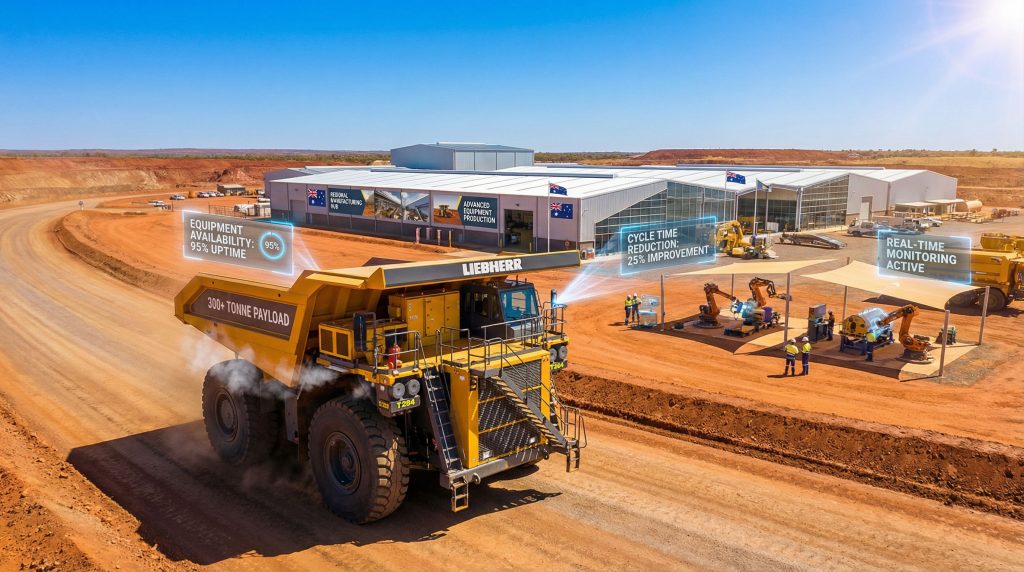
| Performance Metric | Target Range | Operational Impact |
|---|---|---|
| Equipment Availability | 85-95% uptime | Revenue generation capacity |
| Payload Optimisation | 300-400 tonnes | Productivity correlation |
| Maintenance Intervals | 20-30% extension | Cost reduction potential |
| Cycle Time Improvement | 15-25% enhancement | Operational efficiency gains |
Data-Driven Performance Optimisation
Real-time monitoring capabilities enable mines to minimise downtime while optimising product performance through collaborative data sharing. This approach transforms equipment attachments from passive components into integrated productivity enhancement systems.
Monitoring capabilities include:
• Predictive maintenance scheduling based on actual usage patterns
• Wear pattern analysis informing design improvements
• Performance benchmarking against operational targets
• Lifecycle cost optimisation through maintenance planning
The next major ASX story will hit our subscribers first
Customisation Solutions for Site-Specific Applications
Geological Condition Adaptations
Mining operations across coal, iron ore, gold, and copper applications require specialised equipment configurations addressing unique material handling challenges. The Hercules product line, operational since 2003, demonstrates proven adaptability across diverse mining environments showcased at the annual global resources innovation expo.
Site-specific modifications address:
- Material density variations affecting load distribution
- Abrasive characteristics influencing wear material selection
- Climate conditions impacting material performance
- Terrain challenges requiring structural adaptations
Lifecycle Partnership Development
Comprehensive product lifecycle services spanning commissioning to decommissioning and recycling create long-term value partnerships with mining operations. This integrated approach combines manufacturing excellence with operational support.
Partnership components include:
• Initial commissioning and performance validation
• Ongoing maintenance and component replacement
• Performance monitoring and optimisation recommendations
• End-of-life recycling and material recovery
Future Manufacturing and Technology Trends
Automation Integration Developments
Ultra-class trucks increasingly incorporate automation and digitalisation technologies requiring compatible attachment designs. Future manufacturing must anticipate autonomous vehicle integration requirements while maintaining current operational compatibility.
Technology integration priorities encompass:
• Sensor compatibility for autonomous operation systems
• Communication protocols enabling vehicle-attachment data exchange
• Safety system integration supporting unmanned operations
• Remote monitoring capabilities for predictive maintenance
Sustainability and Environmental Compliance
Environmental, social, and governance commitments drive equipment design toward sustainable materials and manufacturing processes. Consequently, regional manufacturing facilities must incorporate environmental considerations throughout production lifecycles.
Sustainable manufacturing approaches include:
- Energy-efficient production processes reducing carbon footprint
- Recyclable material selection supporting circular economy principles
- Waste reduction strategies minimising environmental impact
- Local sourcing optimisation reducing transportation emissions
Equipment Supplier Partnership Evaluation
Selection Criteria Framework
Critical Evaluation Elements: Manufacturing capability assessment, regional service network coverage, technology innovation track record, financial stability validation, and comprehensive environmental and safety compliance verification form the foundation of strategic supplier partnerships.
Key assessment categories include:
• Technical capabilities and manufacturing capacity
• Service network coverage across operational regions
• Innovation track record in equipment development
• Financial stability ensuring long-term partnership viability
• Compliance standards for safety and environmental requirements
Total Cost of Ownership Analysis
Equipment investment decisions require comprehensive cost analysis extending beyond initial capital expenditure. Regional manufacturing capabilities significantly impact total ownership costs through reduced transportation, faster service response, and customisation flexibility as evidenced by Schlam's major Fortescue mining contract.
Cost components encompass:
- Initial capital investment and delivery costs
- Operational expenses including fuel and maintenance
- Service and support costs throughout equipment lifecycle
- Residual value considerations for asset management
Industry Knowledge and Market Dynamics
Manufacturing Facility Location Optimisation
Optimal manufacturing locations balance multiple factors including customer proximity, transportation infrastructure, skilled workforce availability, and regulatory environment considerations. The selection of Muswellbrook reflects strategic analysis of these interconnected elements whilst demonstrating how Schlam's expansion serves Hunter Valley mining communities.
Location selection criteria include:
• Customer base proximity reducing delivery and service costs
• Transportation infrastructure supporting heavy equipment movement
• Skilled workforce availability and training institution access
• Regulatory environment and business development incentives
Equipment Reliability in Extreme Environments
Mining environments subject equipment to extraordinary operational stresses requiring comprehensive testing protocols and advanced materials selection. However, reliability standards must address temperature extremes, abrasive materials, and continuous operation requirements.
Reliability assurance encompasses:
• Environmental testing under extreme operational conditions
• Materials validation for durability and performance
• Quality control protocols ensuring manufacturing consistency
• Field performance monitoring and feedback integration
Regional Manufacturing Competitive Advantages
Local manufacturing capabilities enhance mining industry competitiveness through reduced lead times, improved customisation responsiveness, and strengthened regional economic development. For instance, the NSW facility expansion signals strategic commitment to domestic manufacturing excellence.
Competitive benefits include:
- Reduced delivery timeframes for equipment and service parts
- Enhanced customisation capabilities for specific applications
- Improved market responsiveness to changing operational requirements
- Economic development contribution supporting regional mining communities
Disclaimer: Performance projections and cost estimates reflect general industry analysis and may vary significantly based on specific operational conditions, equipment configurations, and market circumstances. Mining companies should conduct independent evaluation of equipment suppliers and manufacturing capabilities to determine optimal solutions for their specific operational requirements.
Want to capitalise on the next ultra-class mining equipment breakthrough?
Discovery Alert's proprietary Discovery IQ model delivers instant notifications on significant ASX mineral discoveries and industry developments, enabling investors to identify actionable opportunities in mining equipment and technology companies ahead of the broader market. Begin your 30-day free trial today and position yourself ahead of emerging mining innovations that could transform operational efficiency and investment returns.