June 18, 2026
Manufacturing Expansion Signals Transformation in Canadian Mining Equipment Services
The mining equipment sector's evolution toward electrification and advanced service capabilities has reached a pivotal moment in Northern Ontario. Complex market dynamics are reshaping how original equipment manufacturers position their service networks, with substantial capital deployments reflecting deeper strategic shifts in the industry. Regional manufacturing hubs are becoming critical nodes for supporting next-generation mining technologies, while government partnerships amplify private investment impacts across economic development initiatives.
This transformation extends beyond traditional equipment maintenance models, encompassing comprehensive infrastructure development for battery-electric mining systems, circular economy integration, and workforce development programs. The convergence of these factors creates compelling investment scenarios that merit detailed analysis from both operational efficiency and market positioning perspectives.
When big ASX news breaks, our subscribers know first
Strategic Investment Analysis in Greater Sudbury's Manufacturing Landscape
Capital Deployment Scale and Regional Economic Significance
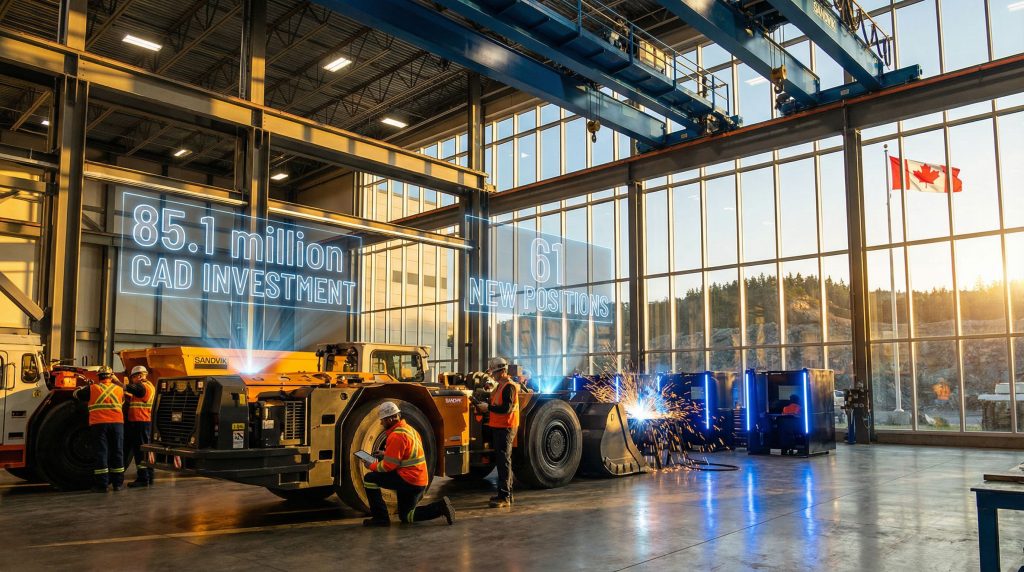
Sandvik's $85.1 million CAD commitment to its sandvik new sudbury facility represents approximately 4.7% government partnership support through the Invest Ontario Fund's $4 million CAD contribution. This investment scale positions the project among the most significant private manufacturing expansions in Greater Sudbury's recent industrial history, with the 135,000 square foot facility occupying 115 acres on Maley Drive.
Furthermore, the employment impact encompasses 61 new direct positions complemented by 400 retained roles, creating a total employment footprint of 461 positions. This workforce expansion occurs within Greater Sudbury's Census Metropolitan Area population base of approximately 160,701 residents, according to Statistics Canada's 2021 Census data, indicating substantial relative economic impact for the region.
Moreover, manufacturing investment patterns in Northern Ontario have historically concentrated on resource extraction rather than equipment production and service capabilities. The facility's focus on advanced maintenance, repair, and overhaul (MRO) operations represents a strategic shift toward higher-value manufacturing services that support regional mining operations while building technical expertise in emerging technologies.
Geographic Positioning and Infrastructure Advantages
The Maley Drive location provides strategic access to major Canadian mining operations across Northern Ontario, Quebec, and Manitoba. Transportation networks connecting Greater Sudbury to mining districts enable efficient equipment deployment and service delivery, while the region's established technical workforce offers specialised skills developed through decades of mining industry innovation.
In addition, proximity to Cambrian College enhances workforce development opportunities through formalised training partnerships, creating pathways for technical skill advancement in equipment maintenance, diagnostics, and emerging electric vehicle systems. This educational integration addresses skills gaps that could otherwise constrain facility operations and service quality delivery.
Consequently, regional infrastructure capacity supports heavy equipment transportation, power supply requirements for electric vehicle charging systems, and telecommunications connectivity for remote diagnostics and equipment monitoring capabilities. These foundational elements reduce operational complexity and enhance service delivery efficiency compared to alternative locations.
Operational Transformation Through Advanced Facility Design
Service Capacity Enhancement and Workshop Optimisation
The new facility doubles workshop capacity compared to Sandvik's existing Lively location, indicating the previous facility operated at approximately 67,500 square feet. This capacity expansion enables more efficient equipment rebuild cycles, reduced service turnaround times, and enhanced inventory management for critical components.
However, advanced MRO capabilities integration encompasses:
- Equipment rebuild and refurbishment programmes extending asset lifecycles
- Diagnostic and testing facilities for performance optimisation
- Component repair services reducing replacement costs
- Preventive maintenance programmes minimising equipment downtime
Specialised workshop areas include dedicated welding shops, paint booth facilities, and materials handling systems designed for heavy mining equipment. These capabilities support comprehensive equipment overhauls while maintaining quality standards required for underground and surface mining applications, which is crucial for mining job preparation in the industry.
Technology Infrastructure and Digital Integration
The sandvik new sudbury facility incorporates simulator and training systems for operator skill development, addressing workforce requirements as mining equipment becomes increasingly sophisticated. Training capabilities reduce operational risks while improving equipment utilisation rates through enhanced operator competency.
For instance, digital asset management systems enable real-time equipment monitoring, predictive maintenance scheduling, and performance analytics that optimise service interventions. These technologies reduce reactive maintenance costs while improving equipment availability for mining operations.
Furthermore, warehousing and office space optimisation supports modern inventory management practices, with automated systems reducing parts handling time and improving order accuracy. Integration with Sandvik's global supply chain ensures critical component availability while minimising inventory carrying costs.
Electric Vehicle Infrastructure and Technology Evolution
Battery-Electric Mining Equipment Support Systems
The facility's dedicated battery-electric vehicle (BEV) infrastructure represents strategic positioning for mining industry electrification trends. Specialised charging systems, battery maintenance protocols, and technician training programmes address technical requirements as mining operations transition from diesel-powered equipment.
Additionally, electric mining transportation adoption faces several technical challenges:
- Power infrastructure requirements for high-capacity charging systems
- Battery lifecycle management including replacement and recycling protocols
- Specialised diagnostic equipment for electric drivetrain systems
- Safety protocols for high-voltage system maintenance
The facility's electric vehicle support capabilities position Sandvik to capture market share as mining companies respond to environmental regulations and operational cost considerations driving electrification adoption.
Circular Economy Integration and Sustainability Metrics
Component refurbishment and lifecycle extension programmes reduce material consumption while providing cost-effective equipment maintenance solutions. Remanufacturing processes restore worn components to original specifications at fractions of new part costs, supporting mining operations' cost management objectives through innovations similar to battery recycling breakthrough technologies.
Moreover, waste reduction initiatives encompass:
- Material recovery programmes for steel, copper, and specialised alloys
- Fluid recycling systems for hydraulic oils and coolants
- Component core exchange programmes incentivising part returns
- Packaging optimisation reducing shipping waste
Energy efficiency design principles include LED lighting systems, high-efficiency HVAC equipment, and building envelope optimisation reducing operational energy consumption. These measures align with corporate sustainability objectives while controlling facility operating costs.
Government Partnership Structure and Economic Development Strategy
Provincial Funding Framework and Investment Incentives
The Invest Ontario Fund's $4 million CAD contribution represents targeted economic development support for manufacturing sector expansion. According to Ontario's announcement, this funding structure typically includes performance milestones related to job creation, capital investment completion, and operational timeline achievement.
However, government collaboration extends beyond financial support to encompass:
- Workforce development initiatives through educational partnerships
- Regulatory support for facility permitting and approvals
- Economic development coordination with regional planning initiatives
- Skills training programmes addressing technical labour requirements
Partnership with Cambrian College creates formal pathways for technical education aligned with facility needs, including specialised programmes for equipment maintenance, diagnostic systems, and electric vehicle technologies. These educational investments build regional technical capacity supporting long-term economic development objectives similar to the Canada energy transition.
Construction Timeline and Operational Milestones
The project timeline spans approximately 21 months from December 2025 construction commencement to Q3 2027 operational launch. This construction schedule accommodates facility design complexity, equipment installation, and workforce transition from the existing Lively location.
Furthermore, key implementation phases include:
- Site preparation and foundation work (Q1-Q2 2026)
- Building construction and infrastructure installation (Q2 2026-Q1 2027)
- Equipment commissioning and staff training (Q2-Q3 2027)
- Operational transition and service launch (Q3 2027)
Employee transition planning addresses workforce relocation, training requirements, and retention strategies ensuring service continuity during facility changeover. This human capital management approach minimises operational disruption while building capabilities for enhanced service delivery.
Competitive Market Positioning and Industry Analysis
Service Network Strategic Advantages
The enhanced sandvik new sudbury facility provides Sandvik with competitive differentiation through:
- Reduced service response times for Canadian mining operations
- Expanded technical capabilities supporting complex equipment systems
- Improved parts availability through optimised inventory management
- Enhanced customer relationships through local presence and expertise
Regional service hub positioning enables more efficient equipment deployment across multiple mining districts, reducing transportation costs and service delays. This geographic advantage becomes particularly valuable during critical equipment failures requiring immediate technical response.
Consequently, advanced diagnostic capabilities supported by trained technicians reduce equipment troubleshooting time while improving repair quality. These service improvements translate to higher equipment availability for mining operations, creating value that supports premium service pricing.
Workforce Development and Technical Expertise Building
The facility's training programmes address skills shortages in mining equipment maintenance, particularly for emerging electric vehicle technologies. Comprehensive training curricula encompass:
- Hydraulic and mechanical systems maintenance and repair
- Electric drivetrain diagnostics and troubleshooting
- Battery system safety protocols and maintenance procedures
- Digital diagnostic tools and equipment monitoring systems
For instance, simulator-based training reduces equipment dependency for operator education while providing controlled environments for complex procedure practice. This training approach improves learning effectiveness while minimising equipment downtime for educational purposes.
In addition, knowledge transfer from Sandvik's global expertise centres ensures local technicians access advanced technical support and continuous education opportunities. This knowledge sharing maintains service quality standards while building regional technical capabilities.
The next major ASX story will hit our subscribers first
Industry Context and Long-Term Strategic Implications
Mining Equipment Sector Investment Trends
Original equipment manufacturers increasingly focus on service revenue growth as equipment sales cycles extend and mining operations emphasise asset optimisation over new equipment purchases. Service-focused investments like the sandvik new sudbury facility reflect this strategic shift toward recurring revenue models.
However, competitive pressures drive OEMs to differentiate through service capabilities, response times, and technical expertise rather than equipment specifications alone. Regional service hubs provide competitive advantages through proximity to customers and specialised technical capabilities.
Furthermore, technology integration requirements create opportunities for service providers offering comprehensive support for digital mining systems, predictive maintenance programmes, and equipment optimisation services. These higher-value services generate superior margins compared to traditional repair and maintenance activities.
Regional Economic Diversification and Manufacturing Growth
Greater Sudbury's economic diversification beyond traditional mining activities benefits from advanced manufacturing investments that create high-skilled employment opportunities. As reported by The Sudbury Star, the facility contributes to regional industrial capacity while supporting existing mining operations through enhanced service capabilities.
Manufacturing sector development attracts complementary businesses including specialised suppliers, logistics providers, and technical service companies. These economic clustering effects amplify the facility's regional impact beyond direct employment creation.
Moreover, long-term economic sustainability requires continued investment in workforce development, infrastructure maintenance, and technology advancement. The Sandvik facility establishes foundations for sustained manufacturing growth while demonstrating private sector confidence in regional economic prospects.
Technology sector attraction benefits from demonstrated manufacturing capabilities, skilled workforce availability, and educational partnerships supporting innovation activities. These factors position Greater Sudbury for broader economic development beyond traditional resource extraction industries.
Investment considerations discussed in this analysis involve market projections and strategic assessments that may not reflect actual future performance. Readers should conduct independent research and consider multiple factors when evaluating mining industry investments or regional economic development outcomes.
Ready to Capitalise on Mining Equipment Innovation?
Discovery Alert's proprietary Discovery IQ model delivers real-time alerts on significant mining and exploration discoveries across the ASX, instantly empowering subscribers to identify actionable opportunities ahead of the broader market. Begin your 30-day free trial today at Discovery Alert and secure your market-leading advantage in the rapidly evolving mining sector.