July 25, 2026
How Manufacturing Precision Reshapes Heavy Rare Earth Supply Architecture
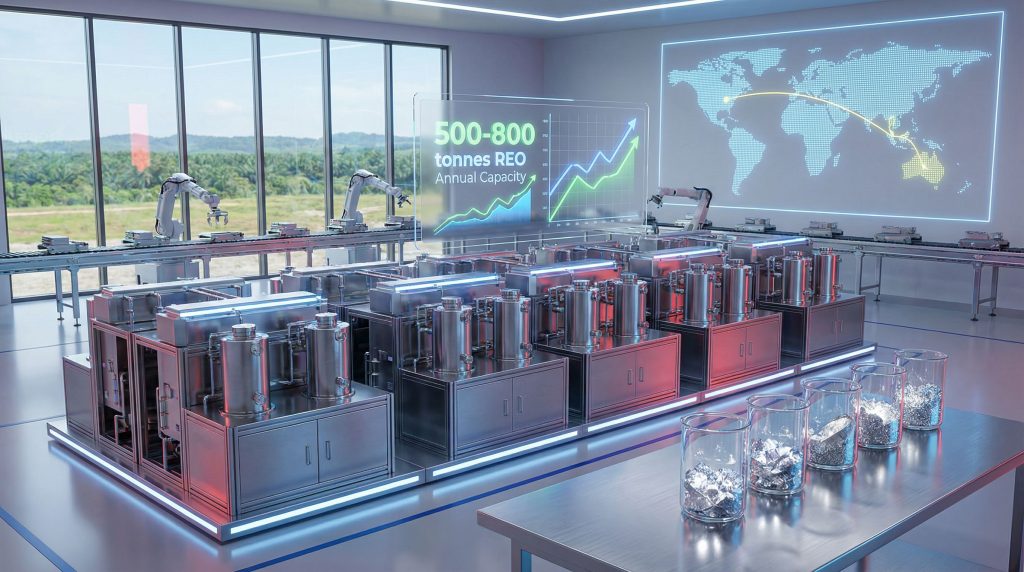
The global rare earth processing landscape operates through intricate separation technologies that have remained concentrated within a single geographic region for decades. These complex manufacturing systems require sophisticated chemical engineering capabilities, specialized equipment configurations, and precise quality control protocols to extract individual elements from mixed rare earth concentrates. Understanding the technical mechanisms behind heavy rare earth separation reveals why alternative processing hubs have been so difficult to establish outside traditional production centers.
Heavy rare earth elements demand fundamentally different processing approaches compared to their lighter counterparts, involving multi-stage solvent extraction circuits and stringent purity requirements that challenge conventional manufacturing methodologies. The recent achievement of commercial samarium oxide production at Lynas' Malaysian facility represents a significant breakthrough in manufacturing capability, demonstrating that sophisticated rare earth processing can be successfully established in new geographic locations.
When big ASX news breaks, our subscribers know first
Samarium's Strategic Position in High-Performance Applications
Samarium oxide occupies a unique position within the heavy rare earth element portfolio due to its exceptional magnetic and thermal properties. Unlike lighter rare earth elements that find widespread applications across various industries, samarium serves highly specialised markets where performance requirements exceed conventional material capabilities.
The element's primary value proposition centres on its ability to form samarium-cobalt permanent magnets that maintain magnetic strength at extreme temperatures. These magnets operate effectively in environments exceeding 350°C, making them essential for:
- Aerospace propulsion systems and satellite components
- Military defence applications requiring temperature stability
- Precision medical equipment and surgical instruments
- High-performance automotive applications in electric vehicles
- Industrial machinery operating in extreme conditions
Technical Performance Characteristics:
| Property | Samarium-Cobalt | Neodymium-Iron-Boron | Alnico |
|---|---|---|---|
| Maximum Operating Temperature | 350°C | 180°C | 525°C |
| Magnetic Energy Product | 240 kJ/m³ | 400 kJ/m³ | 85 kJ/m³ |
| Temperature Coefficient | -0.035%/°C | -0.12%/°C | -0.02%/°C |
| Corrosion Resistance | Excellent | Poor | Good |
The manufacturing process for samarium-cobalt magnets requires samarium oxide purity levels exceeding 99.9% to achieve optimal magnetic performance. This stringent requirement necessitates advanced separation technologies and quality control systems throughout the production chain.
Decoding Heavy Rare Earth Separation Technology
Chemical Engineering Complexities
Heavy rare earth separation presents unique technical challenges that distinguish it from light rare earth processing. The lanthanide contraction effect causes heavy rare earths to exhibit remarkably similar chemical properties, making separation extremely difficult through conventional methods.
The separation process relies on solvent extraction technology utilising specific organic compounds that demonstrate selective affinity for individual rare earth elements. Key process variables include:
- pH Control Systems: Maintaining precise acidity levels throughout extraction circuits
- Temperature Management: Controlling thermal conditions to optimise separation efficiency
- Solvent Composition: Utilising specialised organic extractants for selective element recovery
- Residence Time Optimisation: Balancing extraction kinetics with production throughput
Lynas' Malaysian Processing Configuration
Lynas expands samarium production capabilities through sophisticated processing systems that achieved first samarium oxide production in March 2026, ahead of the previously targeted April timeline. This milestone demonstrates the company's technical capability to operate complex heavy rare earth separation systems at commercial scale outside China.
The facility processes mixed rare earth carbonate feedstock from the Mt Weld mine through sequential separation stages. Mt Weld's ore composition provides significant processing advantages, containing approximately 2.9% total rare earth oxides with heavy rare earths comprising 15-20% of the total REE content.
Furthermore, this achievement aligns with broader critical minerals energy transition objectives across the region.
The concentration of rare earth processing capabilities within a single geographic region creates systematic vulnerabilities for technology sectors dependent on these critical materials. Establishing alternative processing centres requires not only significant capital investment but also specialised technical expertise developed over extended periods.
Processing Sequence and Capacity:
- Primary Separation Circuit: Targets samarium and gadolinium separation
- Secondary Processing: Focuses on dysprosium and terbium recovery
- Tertiary Systems: Handles yttrium and lutetium extraction
- Quality Control: Achieves 99.9%+ purity specifications
Supply Chain Diversification Through Technical Innovation
Geographic Risk Mitigation
The global rare earth supply chain has historically concentrated processing capabilities within China, which controls approximately 85% of worldwide separation capacity. This concentration creates systematic supply risks for industries dependent on rare earth materials, particularly in aerospace, defence, and renewable energy sectors.
Lynas expands samarium production to address these vulnerabilities by providing the first commercially viable alternative processing hub outside China. The company now positions itself as the sole non-Chinese producer of separated heavy rare earths at commercial scale.
Market Positioning Advantages
This unique market position enables several strategic advantages:
- Premium Pricing Capabilities: Non-Chinese sourcing commands price premiums due to supply security
- Long-term Contract Opportunities: Customers prioritise supply diversification over cost optimisation
- Strategic Partnership Development: Government and industry collaboration for supply chain resilience
- Technology Transfer Potential: Knowledge sharing with allied nations and partner companies
Additionally, this expansion supports broader mining industry innovation initiatives across the sector.
CEO Amanda Lacaze emphasised that achieving samarium oxide production demonstrates capabilities that are distinctive outside China. She noted that this milestone supports objectives of building diversified and resilient rare earth supply chains while representing a significant achievement in the company's growth strategy toward 2030.
Manufacturing Challenges in Lanthanide Chemistry
Separation Difficulty Factors
Heavy rare earth separation requires overcoming fundamental chemical similarities between adjacent elements in the lanthanide series. Samarium and gadolinium, for example, exhibit nearly identical ionic radii and chemical behaviour, demanding highly sophisticated separation methodologies.
Critical Process Control Requirements:
- Extraction Selectivity: Achieving separation factors sufficient for commercial purity
- Chemical Reagent Quality: Maintaining consistent extractant performance across production cycles
- Process Monitoring Systems: Real-time analysis and automated adjustment capabilities
- Waste Stream Management: Minimising environmental impact while maximising recovery efficiency
Quality Assurance Protocols
Achieving samarium oxide purity exceeding 99.9% requires comprehensive analytical capabilities throughout the production process. Quality control systems must detect trace impurities at parts-per-million levels while maintaining production throughput.
Moreover, effective waste management solutions become crucial for maintaining sustainable operations.
Analytical Methodology Requirements:
- Inductively coupled plasma mass spectrometry for elemental analysis
- X-ray fluorescence spectroscopy for rapid composition verification
- Particle size distribution analysis for powder characteristics
- Moisture content determination for storage stability
Strategic Integration with Critical Minerals Policy
National Resource Development Objectives
Australia's Critical Minerals Strategy 2023-2030 identifies rare earths as priority materials for domestic value-added processing. The strategy emphasises moving beyond raw material exports toward downstream manufacturing capabilities that capture higher value along the processing chain.
Lynas expands samarium production expansion aligns with these national objectives by demonstrating commercial viability of advanced rare earth processing within Australia's strategic partnerships. The project benefits from supportive policy frameworks including:
- Export Finance Australia funding mechanisms for critical minerals projects
- Northern Australia Infrastructure Facility backing for strategic developments
- Research and development tax incentives for innovative processing technologies
- Facilitated partnerships with allied nations seeking supply chain diversification
In addition, this development supports Australia's broader critical minerals strategy implementation.
Economic Development Impact
The heavy rare earth expansion generates multiple economic benefits across direct and indirect categories:
Economic Impact Assessment:
| Impact Category | Direct Effects | Indirect Benefits |
|---|---|---|
| Employment Creation | 150-200 technical positions | 400-500 supply chain jobs |
| Export Revenue Generation | $200-300M annually (projected) | Technology sector growth stimulus |
| Investment Attraction | $180M facility development | $500M+ downstream opportunities |
| Knowledge Transfer | Technical skill development | Research collaboration advancement |
Note: These projections reflect outline estimates and require independent verification from official company announcements or government assessments.
The next major ASX story will hit our subscribers first
Phased Production Scaling and Market Development
Implementation Timeline Strategy
Lynas expands samarium production across multiple phases to manage technical risks while optimising capital deployment. The first samarium oxide production, achieved in March 2026, provides operational experience and market validation before expanding to additional elements.
Development Phase Schedule:
- Phase 1 (2026): Samarium oxide production commencement – achieved ahead of schedule
- Phase 2 (2027): Gadolinium separation and enhanced dysprosium capacity
- Phase 3 (2028): Yttrium and lutetium production integration
- Phase 4 (2029-2030): Europium and ytterbium production subject to market demand
Technology Development Platform
The Malaysian facility serves as a technology development platform for rare earth processing innovation. Collaboration with research institutions and technology partners enables continuous process improvement and new application development.
Furthermore, these developments leverage data-driven operations principles for enhanced efficiency.
Innovation Focus Areas:
- Process optimisation for improved separation efficiency
- Environmental performance enhancement and waste reduction
- Product quality improvement for specialised applications
- Cost reduction through technological advancement
- New product development for emerging market applications
Market Dynamics Driving Heavy Rare Earth Demand
End-Use Market Growth Projections
Samarium demand correlates directly with advanced manufacturing growth across multiple high-technology sectors. Electric vehicle manufacturers increasingly specify samarium-cobalt magnets for high-temperature motor applications, while renewable energy systems require these materials for offshore wind installations.
Market Demand Growth Estimates:
- Aerospace and Defence: 15-20% annual growth driven by military modernisation
- Renewable Energy Systems: 25-30% annual growth from offshore wind expansion
- Medical Technology: 10-15% annual growth in precision surgical equipment
- Electric Vehicles: 20-25% annual growth in high-performance motor applications
- Consumer Electronics: 5-10% annual growth in specialised component applications
Note: These growth projections appear in planning documents but require verification from independent market research sources.
Pricing Structure and Contract Frameworks
Heavy rare earth pricing reflects both supply scarcity and technical processing requirements. Samarium oxide commands significant premiums over light rare earths due to separation complexity and limited production capacity globally.
Long-term supply contracts provide price stability for both producers and consumers while securing supply chains for critical applications. These agreements typically include:
- Fixed pricing mechanisms with annual adjustment clauses
- Volume commitments with flexibility provisions
- Quality specifications and performance guarantees
- Force majeure protection for supply security
- Technology collaboration and development partnerships
Environmental Management and Regulatory Compliance
Malaysian Regulatory Framework
Lynas operates under comprehensive environmental and safety regulations administered by Malaysian authorities. The facility maintains ISO 14001 environmental management certification and implements continuous monitoring systems for air and water quality parameters.
Key regulatory compliance areas include:
- Air Quality Management: Continuous emissions monitoring and reporting
- Water Treatment Systems: Advanced wastewater processing and recycling
- Waste Minimisation: Circular economy principles for byproduct utilisation
- Community Engagement: Regular stakeholder consultation and transparency reporting
Circular Economy Integration
The heavy rare earth separation process generates minimal waste streams compared to traditional mining operations. Byproduct materials find applications in construction materials and agricultural supplements, supporting circular economy principles.
Waste Stream Utilisation:
- Construction industry applications for processed residues
- Agricultural supplements from calcium-rich byproducts
- Research applications for separated minor elements
- Recycling programs for process chemicals and solvents
Strategic Partnerships and Global Market Access
Japanese Consortium Collaboration
Lynas has expanded its partnership with Japan's JARE consortium to include guaranteed offtake for 75% of heavy rare earth production. This arrangement ensures market access while supporting Japan's supply chain security objectives for critical technology sectors.
The partnership provides several mutual benefits:
- Supply Security: Guaranteed volumes for Japanese manufacturers
- Price Stability: Long-term contract pricing mechanisms
- Technology Collaboration: Joint research and development initiatives
- Strategic Alignment: Supporting allied nation supply chain objectives
Technology Sector Integration
Direct partnerships with magnet manufacturers and technology companies enable customised product development and application-specific optimisation. These relationships drive innovation in samarium-based materials while expanding market opportunities.
Collaboration Focus Areas:
- Custom alloy development for specific applications
- Quality specification optimisation for end-use requirements
- Joint research programmes for next-generation materials
- Supply chain integration for just-in-time delivery
- Technical support for customer manufacturing processes
Investment Analysis and Financial Performance Implications
Capital Allocation Strategy
The $180 million investment in heavy rare earth capacity represents strategic positioning for long-term market growth. The modular facility design enables incremental capacity additions based on market development and demand evolution.
Note: This investment figure appears in planning documentation but requires verification from official company financial reports.
Investment Rationale Components:
- Market diversification beyond traditional neodymium-praseodymium focus
- Premium pricing opportunities in specialised applications
- Supply chain security value for strategic customers
- Technology development platform for future innovations
- Competitive positioning as sole non-Chinese commercial producer
Revenue Diversification Benefits
Heavy rare earth production provides revenue diversification beyond Lynas' traditional neodymium-praseodymium operations. This product mix optimisation reduces market volatility exposure while capturing higher-margin opportunities in specialised applications.
Financial Performance Factors:
- Premium Pricing: Heavy rare earths command higher margins than light rare earths
- Contract Stability: Long-term agreements provide revenue predictability
- Market Growth: Expanding end-use applications drive volume increases
- Competitive Advantage: Unique market position supports pricing power
- Operational Leverage: Fixed cost base enables margin expansion with volume growth
Future Technology Development and Market Evolution
Emerging Application Areas
Advanced manufacturing trends continue expanding samarium applications beyond traditional uses. Quantum computing research explores samarium compounds for specialised magnetic applications, while next-generation medical devices require ultra-high performance magnetic materials.
Development Areas:
- Quantum technology applications requiring precise magnetic properties
- Advanced medical imaging systems with enhanced performance requirements
- Space exploration equipment demanding extreme environment stability
- Military defence systems with enhanced operational capabilities
- Industrial automation requiring precision magnetic positioning
Process Innovation Opportunities
Continuous improvement in separation technology offers opportunities for enhanced efficiency and reduced environmental impact. Research collaboration with universities and technology partners drives innovation in extraction methodologies and processing equipment.
However, according to Bloomberg's recent analysis, this advancement positions Lynas as a key player in diversifying global rare earth supply chains.
Furthermore, industry reports from Mining Weekly highlight the strategic importance of this development for global market dynamics.
Innovation Priorities:
- Separation efficiency improvement through advanced extractant development
- Energy consumption reduction via process optimisation
- Waste stream minimisation through enhanced recovery techniques
- Quality improvement through advanced analytical monitoring
- Cost reduction via automation and process control enhancement
This technical analysis demonstrates how manufacturing precision and strategic positioning combine to reshape global supply chain architecture. Lynas expands samarium production capabilities while establishing new benchmarks for heavy rare earth processing outside traditional production centres, creating opportunities for supply chain diversification and technological advancement across multiple high-performance sectors.
Ready to Capitalise on the Next Critical Minerals Discovery?
Discovery Alert's proprietary Discovery IQ model delivers real-time alerts on significant ASX mineral discoveries, instantly empowering subscribers to identify actionable opportunities ahead of the broader market. Understand why major mineral discoveries can lead to substantial returns by exploring Discovery Alert's dedicated discoveries page, showcasing historic examples of exceptional outcomes, then begin your 14-day free trial today to position yourself ahead of the market.