May 20, 2026
The Autonomy Gap That Has Held Mining Back for Two Decades
For years, the mining industry has chased a version of autonomy that always seemed just out of reach. Individual breakthroughs arrived in sequence: driverless haul trucks at iron ore operations in the Pilbara, automated drilling systems at gold mines in Western Australia, digitised process controls in copper refineries across South America. Each advance was real. Each delivered measurable gains. Yet none of them solved the deeper problem.
The issue was never whether autonomous hardware could outperform human-operated equipment in controlled conditions. It consistently could. The issue was integration. Every autonomous system deployed in isolation created its own data environment, its own operational logic, and its own boundary where the machine's decision-making ended and a human had to pick up the handoff. The compounding efficiency gains that true end-to-end automation promised remained theoretical, because no operator had yet built the connective tissue to join the pieces together.
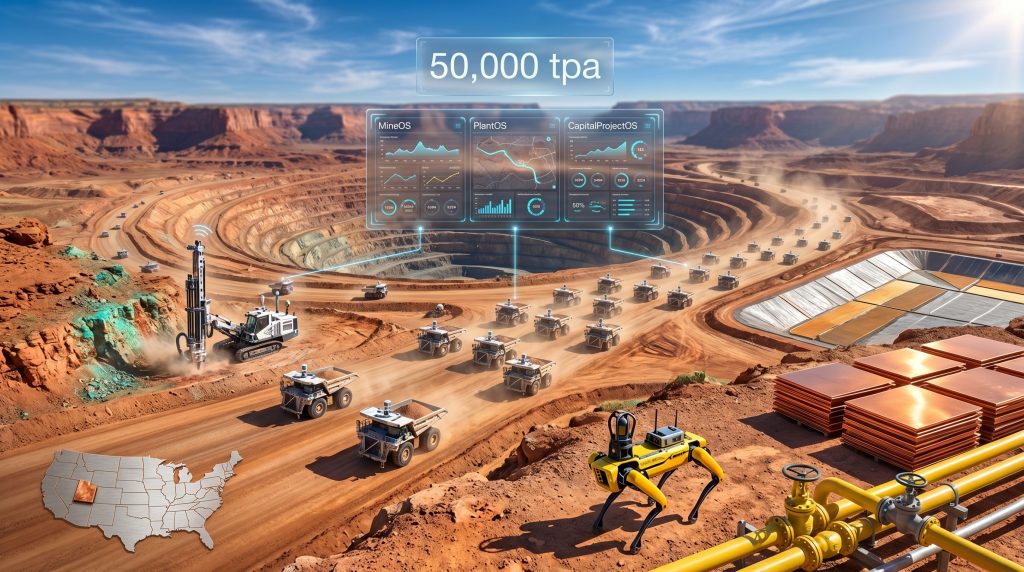
That constraint is now being directly challenged at a copper operation in south-eastern Utah, where Mariana Minerals Copper One autonomous mining operations have become the first in the world to deploy autonomous systems simultaneously across mining, refining, and capital project execution, all coordinated through a single proprietary operating platform.
When big ASX news breaks, our subscribers know first
Why the US Copper Deficit Makes This Moment Strategically Critical
Copper is not a commodity in the conventional sense anymore. It is an enabling material for the entire energy transition: every electric vehicle motor, every grid-scale battery storage installation, every new transmission line connecting solar and wind capacity to population centres requires refined copper in quantities that dwarf anything the industrial economy previously demanded.
The timing of this demand surge is colliding with a structural vulnerability in the United States supply chain. The US currently imports approximately 50% of its refined copper, a dependency that creates real exposure to geopolitical disruption, shipping bottlenecks, and the pricing leverage of foreign producers. Domestic copper demand is projected to double by 2035, driven by electrification programmes, EV infrastructure buildout, grid modernisation, and defence applications. The copper supply crunch now underway is intensifying the urgency for domestic producers to scale output quickly.
The convergence of a domestic copper deficit and maturing autonomous technology has created conditions for a genuinely new operational model, one that Copper One is the first site globally to attempt at full scale.
This supply-demand imbalance creates a narrowing commercial window for domestic producers willing to scale output quickly. It also makes the operational design decisions at Copper One far more consequential than they would be at any other moment in mining history. Furthermore, the global copper supply gap continues to widen as demand from clean energy infrastructure accelerates beyond what existing producers can reliably meet.
Turner Caldwell, co-founder and CEO of Mariana Minerals, has been clear that the site's restart is a direct response to this deficit. His position, as reported by Mining Technology in April 2026, is that the US faces a structural copper shortfall and the window to close it is narrowing. Copper One's ramp-up is explicitly framed as an aggressive contribution to closing that gap through domestic autonomous production rather than through increased import dependency.
Copper One: A Proven Site With a Deliberate Operational Reset
Understanding why Copper One matters requires understanding what it already was before Mariana Minerals arrived.
| Attribute | Detail |
|---|---|
| Location | South-eastern Utah, United States |
| Site Area | 10,000 acres |
| Production History | High-purity copper cathode since 2009 |
| Infrastructure | Open pit mine, heap leach pad, refining facilities |
| Previous Operator | Lisbon Valley Mining Company |
| Acquired By | Mariana Minerals (Q4 2025) |
| Mining Resumption | April 2026 |
| 2030 Production Target | 50,000 tpa of copper cathode |
The site has been producing high-purity copper cathode since 2009, which means the ore body is proven, the processing infrastructure is established, and the refinery's capability to deliver premium-grade product is not speculative. This is not a greenfield exploration story. It is an operational restart on a site with more than fifteen years of production history.
Why Did Mining Stop in 2024?
Mining activities were halted in late 2024 for reasons that are increasingly common across the global mining industry: escalating operational costs and persistent difficulty in recruiting and retaining the skilled labour required to sustain conventional pit operations. Critically, refinery processing continued throughout the suspension period. This tells an important technical story: the processing infrastructure remained economically viable; it was the upstream extraction side, with its heavy dependence on human operators, that became unsustainable.
The suspension created an opportunity that Mariana Minerals recognised when it completed its acquisition of Lisbon Valley Mining Company in Q4 2025. Rather than restarting under the same cost structure and workforce model that had failed, the company chose to redesign the operational framework entirely before resuming production. Mining resumed in April 2026, but under a fundamentally different model from anything the site had previously attempted.
The Autonomous-First Restart Advantage
There is an underappreciated structural advantage in restarting a suspended operation with autonomous systems as the baseline rather than retrofitting them into a running human-operated workflow. Legacy autonomous deployments at major iron ore and gold operations have repeatedly encountered integration friction: existing teams have established workflows, existing software systems resist replacement, and the cultural resistance to removing human decision-making from processes that workers understand intimately is substantial.
A clean-slate restart bypasses all of that. Every system at Copper One is designed from inception to communicate with MarianaOS. There are no legacy handoffs to replace, no parallel human-autonomous operations to manage through a transition period, and no siloed data environments to reconcile. The data architecture is unified from day one.
MarianaOS: The Operating System Connecting the Entire Mine
At the centre of everything operating at Copper One is MarianaOS, a proprietary integrated operating system developed by Mariana Minerals to coordinate autonomous hardware, refinery optimisation, and capital project management within a single continuous data environment. It is the connective layer that transforms three independent autonomous systems into one coordinated operational intelligence.
MarianaOS comprises three functional subsystems, each governing a distinct domain while feeding data into the central platform:
MineOS: Intelligence for the Open Pit
MineOS governs the full range of pit-level operational decisions: drill and blast sequencing, haul truck and shovel fleet orchestration, and material routing to the heap leach pad. It draws continuously on real-time sensor inputs from autonomous equipment, predictive maintenance algorithms, and reinforcement learning models that refine operational decisions as conditions evolve.
What distinguishes this from conventional fleet management software is the feedback loop. When autonomous drilling equipment transmits bore performance data, MineOS does not simply log it. It uses that data to dynamically adjust blast design parameters and update production routing decisions in real time, without waiting for a human supervisor to review a report. This approach reflects a broader shift towards data-driven mining operations that are transforming how modern mines manage performance across the full production cycle.
PlantOS: Autonomous Refinery Management
PlantOS governs the heap leach and refinery operations using live process data streams. Machine learning models generate predictive adjustments to process variables, reducing the need for manual intervention in routine optimisation decisions. The design intent is a largely human-free refinery environment, with human roles structured around oversight and exception management rather than direct operational control.
This is technically significant in the context of heap leach operations, where process variables including solution pH, leach agent concentration, application rates, and temperature gradients traditionally require continuous manual monitoring and adjustment. Automating these adjustments through real-time ML models represents a meaningful departure from standard industry practice. In addition, predictive maintenance systems embedded within PlantOS further reduce unplanned downtime by flagging equipment stress indicators before they develop into failures.
CapitalProjectOS: Real-Time Infrastructure Execution
CapitalProjectOS coordinates the infrastructure development work that must run in parallel with production: heap leach pad expansions, refinery upgrade programmes, and autonomous equipment deployment schedules. It provides real-time progress tracking and risk management to ensure capital execution stays aligned with the production ramp-up curve toward 50,000 tpa by 2030.
The significance here is architectural. In conventional mining operations, capital project management and production management are functionally separate, often running on disconnected software platforms with manual coordination between teams. CapitalProjectOS eliminates that gap, meaning a delay in pad expansion immediately registers against production targets and triggers resource reallocation decisions algorithmically rather than through a management escalation process.
The integration of pit, plant, and project execution into one system means that a grade change detected at the pit face can flow through to refinery process adjustments and capital schedule updates without any manual coordination between departments.
The Three Autonomous Hardware Platforms at Copper One
MarianaOS provides the intelligence layer. The hardware that executes its decisions comprises three distinct autonomous platforms, each purpose-built for a specific operational function and each feeding continuous data back into the central system.
| Platform | Provider | Function | Data Integration |
|---|---|---|---|
| Autonomous Haulage | Pronto | Driverless haul trucks | MineOS (route optimisation and maintenance) |
| Surface Drilling | Sandvik AutoMine | Autonomous drill and blast operations | MineOS (blast design and material routing) |
| Site Patrol Robots | Boston Dynamics Spot | Infrastructure inspection and monitoring | PlantOS (maintenance alerts) |
Pronto Autonomous Haulage: Camera-Based Fleet Intelligence
Pronto's autonomous haulage system uses camera-based machine learning combined with Global Navigation Satellite Systems (GNSS) to enable driverless haul truck operations across the open pit. A key design advantage is fleet agnosticism: the system is adaptable across different truck manufacturers and models, which gives Copper One operational flexibility when expanding its fleet or managing equipment transitions without being locked into a single original equipment manufacturer's ecosystem.
Haul truck data, including route performance, cycle times, fuel consumption patterns, and mechanical stress indicators, feeds continuously into MineOS for route optimisation and predictive maintenance scheduling. This creates a dynamic feedback loop where fleet performance data directly informs dispatch decisions for subsequent cycles.
It is worth noting a less commonly discussed vulnerability with GNSS-dependent autonomous systems: GPS signal degradation or spoofing in complex terrain can meaningfully affect positioning accuracy. Camera-based ML provides a complementary sensing layer that reduces dependence on satellite signal integrity alone, which is one reason the camera-plus-GNSS combination is increasingly preferred over single-input positioning systems in open pit environments.
Sandvik AutoMine Surface Drilling: Autonomous Blast Hole Operations
Sandvik's AutoMine system provides autonomous drilling and automated pipe handling across the open pit. As Forbes reported, drill performance data, including penetration rate, rotary torque, and bore position accuracy, is transmitted in real time to MarianaOS, where it directly informs blast design decisions and downstream material classification.
The precision implications of this are significant and underappreciated by non-specialists. In conventional operations, blast hole pattern quality depends heavily on individual driller skill and consistency. Autonomous drilling systems eliminate inter-operator variability, producing more uniform bore patterns that generate more predictable fragmentation. Better fragmentation reduces downstream crushing and grinding energy requirements, which is both a cost and an environmental benefit.
Boston Dynamics Spot: Robotic Site Patrol and Inspection
Boston Dynamics' Spot robots conduct programmatic patrol routes across both the mine site and refinery infrastructure, replacing scheduled manual inspection rounds. The robots continuously monitor equipment condition, structural integrity across the heap leach pad, and safety compliance parameters.
Inspection data integrates with PlantOS to flag maintenance requirements before failures occur, shifting the refinery from reactive to predictive maintenance. The practical benefit is reduced unplanned downtime, which in a heap leach operation can be particularly costly given the continuous-flow nature of the leaching process.
How Autonomous Mining Transforms the Workforce Model
A persistent misconception about autonomous mining is that it eliminates the workforce. The more accurate framing is that it transforms the skills profile of the workforce it requires.
The labour shortage that contributed directly to the 2024 suspension at Copper One reflects a structural challenge across the US mining industry: recruiting and retaining the volume of skilled equipment operators needed to run conventional pit operations in a competitive labour market. Autonomous systems directly address that challenge, but they replace it with a different requirement rather than eliminating the human element altogether.
The new role categories emerging at autonomous operations like Copper One include:
- Autonomy Systems Supervisors who monitor fleet-wide performance across MineOS and respond to exception alerts rather than controlling individual machines
- Data Quality Engineers who ensure the sensor data feeding into MarianaOS is accurate, clean, and representative of actual site conditions
- ML Model Operators who validate and recalibrate predictive models within PlantOS as ore characteristics and process conditions evolve over the mine life
- Autonomous Equipment Technicians who maintain and service the physical hardware layer underpinning the software stack
This shift demands higher technical literacy from the site workforce than conventional mining operations typically required. It also creates roles that are less physically hazardous, more analytically demanding, and more aligned with the skills profile of workers entering the labour market today. The workforce problem that forced the 2024 suspension and the autonomous solution that Mariana Minerals deployed are not coincidentally connected: they are causally linked.
The next major ASX story will hit our subscribers first
What the 50,000 tpa Target Actually Represents
Mariana Minerals has set a production target of 50,000 metric tonnes per annum of high-purity copper cathode by 2030. Achieving that figure will require developing additional ore deposits identified within the 10,000-acre site boundary beyond the current active mining footprint, and incorporating copper scrap recycling into the feedstock mix to diversify input sources.
High-purity copper cathode, typically refined to 99.99% copper content, commands premium pricing across industrial and technology markets. It is the preferred feedstock for electrical wiring manufacturers, EV motor producers, semiconductor fabricators, and renewable energy infrastructure contractors. All of these sectors are simultaneously experiencing structural demand growth, which means the premium for high-purity domestic cathode is likely to widen rather than narrow through the decade.
The inclusion of copper scrap recycling in Mariana's feedstock strategy is a lesser-discussed element that deserves attention. Furthermore, the broader expansion of US copper recycling infrastructure signals that scrap integration is becoming a mainstream strategy rather than a niche supplement. Scrap copper recycling requires significantly less energy per tonne than primary smelting from ore, carries a lower environmental footprint, and provides a feedstock buffer against ore grade variability. Integrating scrap into a heap leach and refining operation requires careful process management, but the economics at scale are compelling.
The 50,000 tpa target is not purely a commercial goal. It functions as a proof-of-concept benchmark for whether Mariana Minerals Copper One autonomous mining operations can deliver at industrial scale. If Copper One reaches that figure by 2030, it establishes a replicable deployment model for every greenfield and restart operation that follows.
Benchmarking Copper One Against Conventional Autonomous Deployments
| Dimension | Conventional Autonomous Deployment | Copper One Model |
|---|---|---|
| Scope | Single function (e.g., haulage only) | Full operational chain (mine, refinery, capex) |
| Integration | Siloed systems with manual handoffs | Single OS with continuous data loop |
| Workforce Model | Parallel human and autonomous operations | Autonomous-first with supervisory human roles |
| Restart Strategy | Retrofit into existing operations | Clean-slate autonomous deployment |
| Production Target | Incremental improvement on baseline | 50,000 tpa by 2030 via aggressive ramp-up |
Previous autonomous mining deployments at scale, including those at major iron ore operations in Australia, have achieved meaningful productivity gains but have consistently been limited to individual functions. None have attempted to coordinate the full production chain, from pit excavation through refining to infrastructure delivery, through a unified software intelligence layer. Copper One's distinction is not merely one of scale but of architectural completeness.
Frequently Asked Questions
What is MarianaOS?
MarianaOS is Mariana Minerals' proprietary integrated operating system, connecting MineOS (pit operations), PlantOS (refinery management), and CapitalProjectOS (infrastructure delivery) into a single continuous data environment. It coordinates autonomous hardware and machine learning optimisation without requiring manual handoffs between operational domains.
Why Did Copper One Suspend Mining in 2024?
Mining activities were paused in late 2024 primarily due to rising operational costs and difficulties recruiting and retaining sufficient workforce to sustain conventional pit operations. Refinery processing continued throughout the suspension period.
What Autonomous Equipment Operates at Copper One?
Three platforms are deployed: Pronto's camera-based autonomous haulage system for driverless trucks, Sandvik's AutoMine system for autonomous surface drilling, and Boston Dynamics' Spot robots for independent site and refinery inspections.
What is the Production Target for Copper One?
Mariana Minerals is targeting 50,000 tonnes per annum of high-purity copper cathode by 2030, drawing on additional on-site deposits and incorporating copper scrap recycling into the production mix.
Is Copper One the First Autonomous Mine of Its Kind Globally?
Mariana Minerals Copper One autonomous mining operations are recognised as the first globally to deploy autonomous systems across the complete operational chain, covering mining, refining, and capital project execution, all managed through a single integrated operating system. Prior autonomous deployments have been limited to individual operational functions.
Does Autonomous Mining Eliminate Jobs?
Rather than eliminating the workforce, the autonomous-first model transforms the roles required on site. Workers shift from directly operating individual machines to supervising coordinated autonomous systems, with new technical positions created in data quality management, machine learning model oversight, and autonomous equipment maintenance.
Disclaimer: This article contains forward-looking statements regarding production targets, operational timelines, and market projections. These reflect current expectations and assumptions based on publicly available information and are subject to material risks and uncertainties. Readers should not place undue reliance on forward-looking statements, which may differ materially from actual outcomes. This article does not constitute financial or investment advice.
Want to Invest in the Next Major Mineral Discovery Before the Broader Market?
Discovery Alert's proprietary Discovery IQ model delivers real-time alerts on significant ASX mineral discoveries, transforming complex mineral data into actionable insights for both new and experienced investors — explore historic discoveries and the substantial returns they've generated, then begin your 14-day free trial to position yourself ahead of the market.