June 27, 2026
Why the World's Biggest Mining Companies Are Running Out of Copper to Buy
The global copper industry is facing a slow-motion supply crisis that no single mine can solve. Average copper ore grades at major producing operations have declined by roughly 30% over the past two decades, according to data tracked by Wood Mackenzie and the International Copper Study Group. New large-scale discoveries have become increasingly rare, and the lead time from initial discovery to first production now routinely exceeds 15 years. Against this backdrop, the ongoing copper supply crunch means every high-grade copper discovery in a proven mining jurisdiction carries a weight that transcends its immediate drill results.
It is within this context that the Marimaca Copper Pampa Medina drilling results deserve serious analytical attention. Not simply because the numbers are impressive in isolation, but because the deposit is taking shape in precisely the location, at precisely the grade, and with precisely the geological characteristics that define a genuinely scarce category of asset.
When big ASX news breaks, our subscribers know first
What Pampa Medina Is and Where It Sits Geologically
Pampa Medina is a sediment-hosted copper sulfide discovery located within Chile's Antofagasta region, one of the world's most prolific copper-producing corridors. The deposit lies within the same geological belt that has hosted world-class operations for Antofagasta PLC and other major producers for decades. For broader context on the regional landscape, Chile copper market analysis highlights the structural advantages this jurisdiction offers to discovery-stage companies.
Sediment-Hosted Copper Manto Systems and Why They Attract Capital
Manto-style copper deposits are distinct from the porphyry systems that dominate headlines in the copper sector. Rather than forming from large magmatic intrusions, manto deposits develop when copper-bearing hydrothermal fluids migrate through sedimentary sequences and concentrate along permeable horizons, often creating flat-lying or gently dipping ore sheets with remarkably consistent grade profiles.
This geometry has important economic implications:
- Predictable mineralisation geometry simplifies mine planning and resource estimation
- Stratiform ore bodies often allow for higher mining recovery rates than irregular porphyry systems
- Bornite-dominant assemblages, where they occur, carry copper grades significantly higher than chalcopyrite-dominant equivalents
- Silver co-product credits from bornite-rich zones can materially improve net revenue per tonne
Manto systems in Chile's coastal belt, including the historical Michilla and El Tesoro deposits, have demonstrated that this deposit style is capable of supporting long-life, low-cost mining operations. Pampa Medina is being evaluated within this established geological and economic framework.
How Pampa Medina Fits Into Marimaca Copper's Dual-Asset Strategy
Marimaca Copper (TSX: MARI) is advancing two fundamentally different copper assets simultaneously. The Marimaca Oxide Deposit (MOD) is a near-surface oxide resource in advanced development planning, targeting heap leach solvent extraction and electrowinning production of copper cathode. Pampa Medina, by contrast, is a deeper sulfide discovery that would ultimately require underground mining and either concentrate or cathode production.
This dual-asset structure creates a layered investment profile: the MOD provides near-term development optionality and a valuation floor, while Pampa Medina represents a longer-dated but potentially much larger upside opportunity. Furthermore, understanding the copper price growth drivers shaping the current market helps contextualise why both assets are attracting growing investor attention.
Breaking Down the Marimaca Copper Pampa Medina Drilling Results
Of more than 40 holes drilled at Pampa Medina to date, 36 have returned mineralisation at economic widths and grades, a hit rate that is statistically exceptional for a discovery-stage programme and speaks directly to the continuity of the mineralised system.
Key Drill Hole Intercepts at Pampa Medina
| Drill Hole | Intercept (m) | Copper Grade (% Cu) | Silver Grade (g/t Ag) | Notable Feature |
|---|---|---|---|---|
| SWRD-13 | 26 m | ~4.0% | ~25 | Discovery hole from 580 m depth |
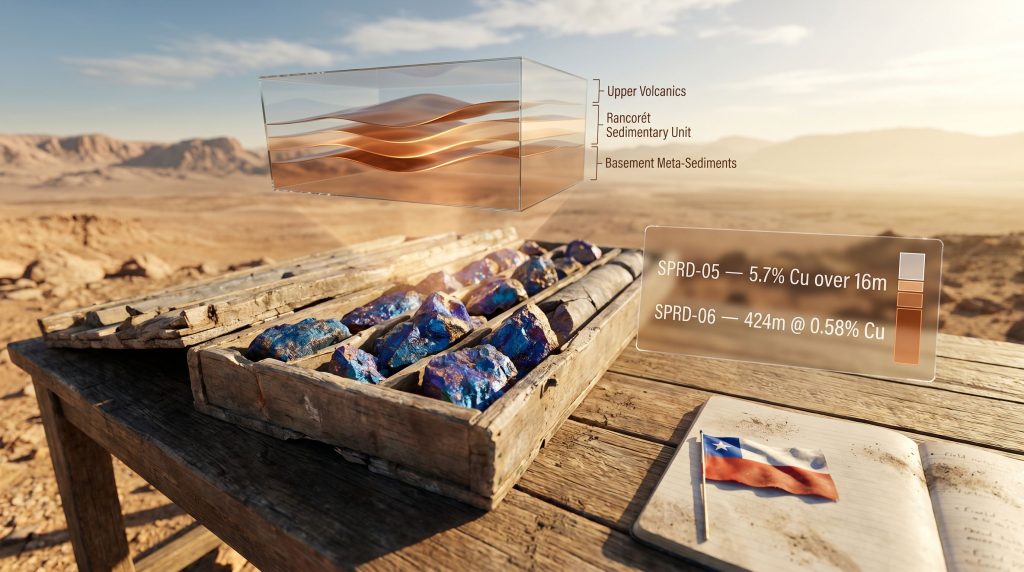
| SPRD-05 | 16 m | 5.7% | 62.6 | Ultra high-grade bornite; 650 m WNW of SWRD-13 |
| SPRD-04 | 22 m | 2.0% | High-grade patches | 150 m north; bornite-dominant |
| SPRD-06 | 424 m | 0.58% | 2.2 | Broadest intercept; five stacked high-grade mantos |
| SPRD-06 (internal) | Narrow intervals | Up to 2.54% | Up to 21.0 | High-grade manto intervals within broader column |
What Ultra High-Grade Bornite Actually Means
Bornite (Cu₅FeS₄) is one of the copper-richest sulfide minerals in the geological toolkit. With a theoretical copper content of approximately 63% by weight, it produces significantly higher-grade ore than chalcopyrite (approximately 35% copper by weight), which dominates most large porphyry copper deposits globally. When bornite occurs in thick, continuous intercepts rather than isolated patches, it signals a deposit with genuinely exceptional copper concentration.
Geological Context: The presence of thick bornite-dominant mineralisation at Pampa Medina places it in a rare category globally. Most copper deposits of scale are chalcopyrite-dominant, with average grades typically below 1.0% copper. Sustained bornite intervals above 5% copper over meaningful widths are uncommon in any mining jurisdiction.
The significant bornite intersections at Pampa Medina reinforce what the drilling data already suggests. The 16 metres at 5.7% copper and 62.6 g/t silver returned by SPRD-05 is not merely a headline number. It represents a grade profile that, if confirmed at resource scale, would rank among the highest-grade copper intercepts in the current global discovery pipeline.
The Broader Mineralised Column: The Number That Changes Everything
While the ultra high-grade bornite core attracts the most immediate attention, a less-discussed but potentially more important characteristic of Pampa Medina is the structure of the broader mineralised column. Drill logs indicate that while the peak-grade intervals range from 16 to 26 metres, the overall mineralised column extends to nearly 100 metres at an average grade of approximately 1.2% copper, interrupted only by occasional narrow barren intervals associated with post-mineral dykes.
This distinction reshapes the economics fundamentally. A 1.2% copper average over a 100-metre column is not a diluted mediocre system. At the right mining cost structure, it is a bulk mining scenario with compelling economics, and it is precisely this observation that is driving a reconsideration of the appropriate development model.
The Stacked Manto Geological Model and What It Implies for Scale
Three Mineralised Host Units at Pampa Medina
Mineralisation at Pampa Medina is distributed across three distinct geological horizons:
- Upper volcanics horizon: Structurally elevated position; captures early-stage or remobilised mineralisation; contributes to the vertical extent of the system
- Middle Rancorét sedimentary unit: The primary host for bornite-rich, high-grade mantos; organic-rich black shales within this unit appear to have acted as chemical traps for copper precipitation
- Basement meta-sediments: An emerging and previously underappreciated horizon; hosts the nearby historical Cachorro deposit associated with Antofagasta PLC's tenure in the region
The basement meta-sediment horizon is particularly significant because it was not part of the original Pampa Medina geological model. Its recognition opens a third layer of prospectivity below the already-defined system, with analogies to deposits that have been historically productive in the same regional belt.
The Role of Black Shale Organic Matter in High-Grade Copper Concentration
A technically important but rarely discussed aspect of sediment-hosted copper deposits is the role of organic matter in ore formation. In the Rancorét sedimentary unit, organic-rich black shale horizons appear to have functioned as reductants, chemically precipitating copper from hydrothermal fluids as those fluids moved through the sequence. This redox-driven precipitation mechanism is broadly analogous to the process responsible for Central African Copperbelt deposits such as Kamoa-Kakula, where organic-rich sediments hosted exceptional bornite accumulations.
Technical Insight: The correlation between organic matter content in host sediments and bornite grade intensity is a well-documented phenomenon in sediment-hosted copper systems globally. Where organic matter is abundant and laterally continuous, it tends to produce high-grade, laterally consistent ore zones rather than patchy or structurally controlled mineralisation. This may partly explain the remarkable consistency seen in Pampa Medina's drill results.
Five Stacked High-Grade Mantos: What SPRD-06's 424-Metre Intercept Reveals
SPRD-06 returned the broadest single intercept in the programme: 424 metres at 0.58% copper and 2.2 g/t silver, which is not a headline-grabbing number on its own. Its significance lies in what it contains internally: five distinct high-grade manto intervals reaching up to 2.54% copper and 21.0 g/t silver within the broader column. Consequently, this architecture — five stacked high-grade sheets separated by lower-grade material — is precisely what the geological model predicted and what bulk underground mining methods are designed to exploit efficiently.
How Large Could Pampa Medina Be? Preliminary Scale Modelling
Geometric Scenarios: From 120 Million to 500 Million Tonnes
| Assumed True Thickness | Estimated Mineralised Area | Indicative Contained Ore |
|---|---|---|
| 20 metres | 2 km × 2 km | 120–150 million tonnes |
| 60 metres (stacked manto model) | 2 km × 2 km+ | ~500 million tonnes |
| Full district extent | 5 km × 4 km manto horizon | Open; extensions confirmed |
These figures are preliminary geometric estimates, not mineral resource estimates under NI 43-101 or JORC standards. They depend on true thickness assumptions that remain subject to confirmation through further drilling and structural analysis. Investors should treat them as indicative of scale potential rather than formal resource guidance.
What Confirmed Mineralisation Over 2 km² Actually Means
Drilling has now confirmed economic-grade mineralisation across an area exceeding 2 square kilometres, with the northeast-southwest structural trend remaining open at both ends. Step-out holes have extended the footprint by more than 300 metres beyond previously drilled positions, and deeper holes are returning evidence of mineralisation at vertical extents not previously captured.
A contained copper endowment in the range of 3 to 5 million tonnes of copper metal within a low-cost Chilean jurisdiction is precisely the asset profile that the world's largest mining companies are actively seeking. For a major copper project comparison, Pampa Medina's grade and scale characteristics stand out clearly against other development-stage assets. For context, Ivanhoe Mines' Kamoa-Kakula in the Democratic Republic of Congo, which has attracted comparisons from observers familiar with bornite-dominant systems, was valued at many multiples of its discovery-stage capitalisation as resource definition advanced.
Mining Method Evolution: From Room-and-Pillar to Bulk Mechanised Underground
Why the Shift in Mining Method Matters More Than the Grade Headlines
The evolution in Marimaca's thinking about how to mine Pampa Medina is arguably more consequential for long-term value creation than any single drill intercept. Early-stage consideration of the deposit centred on a selective underground approach, targeting only the highest-grade core intervals. However, the emerging picture of a broad, stacked mineralised column has prompted a reconsideration toward bulk mechanised methods.
Comparing Mining Method Economics
| Parameter | Selective Underground | Bulk Mechanised Underground |
|---|---|---|
| Target interval | High-grade core only (16–26 m) | Broader column (~100 m at ~1.2% Cu) |
| Unit mining cost | Higher per tonne | Lower per tonne at scale |
| Effective cut-off grade | Higher | Lower |
| Captured tonnage | Fraction of column | Majority of column |
| Production scale | Smaller, higher-grade | Larger, lower-grade but higher total Cu |
Moving to a bulk mechanised approach lowers the effective economic cut-off grade, meaning a larger proportion of the 100-metre column becomes financially viable to mine. The total copper recovered from the deposit could increase dramatically, even if the average grade of the mined material is lower than the headline bornite intercepts suggest.
This is not a downgrade of the asset. It is a recognition that the deposit is large enough, and its average grade high enough, to support an operation scale that generates superior economics through volume rather than selectivity alone.
The next major ASX story will hit our subscribers first
The MOD Valuation Framework and What It Means for Pampa Medina's Implied Value
Why the Marimaca Oxide Deposit Acts as a Valuation Floor
The MOD is the company's near-term development priority, with management indicating that at an assumed acid price of $300 per tonne and copper price of $5 per pound, the oxide asset alone on a fully diluted market capitalisation basis of approximately C$1.1 billion appears to exceed the current share price. This scenario, if it holds under independent scrutiny, implies that the market is currently ascribing close to zero value to Pampa Medina's growing resource base.
Investor Framework: When an asset with confirmed ultra high-grade drill results across more than 2 km² of mineralisation is effectively valued at zero by the market, one of two things is true: either the market is correctly sceptical of the deposit's ultimate scale and economics, or a significant mispricing exists. The path toward resolving that uncertainty runs directly through the maiden mineral resource estimate.
Acid Supply Negotiations as a Critical De-Risking Step
The MOD is a heap leach operation, and heap leach copper projects that process oxide ores using acid are materially exposed to sulfuric acid pricing and supply security. Marimaca is in advanced discussions with a large-scale acid producer to secure long-term acid supply contracts that would underwrite the full operational life of the oxide facility. Finalising this agreement would remove one of the most significant variables from the MOD's economic model.
Infrastructure Sharing Scenarios
Two development pathways exist for the relationship between the MOD and Pampa Medina:
- Scenario A (Shared Infrastructure): At production scales of 25,000–30,000 tonnes of additional copper cathode per year, Pampa Medina could utilise existing MOD water supply, power connections, logistics networks, and supply chain arrangements, significantly reducing incremental capital requirements
- Scenario B (Standalone Facility): At larger production scales consistent with a tier-one deposit, a dedicated concentrator and cathode facility would be required, demanding higher capital investment but enabling operational independence and maximum production throughput
In addition, thoughtful copper investment strategies that account for infrastructure optionality may prove particularly relevant as Marimaca advances both assets toward development decisions.
Path to a Maiden Mineral Resource Estimate
Current drilling at Pampa Medina is operating at approximately 150 by 150 metre spacing, which is broadly appropriate for an initial inferred resource classification under standard industry guidelines. The maiden estimate will cover a defined subset of the drilled area, chosen to maximise the proportion of holes that meet the spacing and continuity requirements for resource classification.
Critically, the maiden resource will represent only a fraction of what the company believes is the full prospective system. Two active drill rigs are simultaneously working to extend the mineralised footprint along strike to the northeast and southwest, and to test for additional depth extent. Resource additions beyond the maiden estimate are therefore expected as drilling continues. The validated sedimentary-hosted copper manto model underpinning this programme lends geological credibility to the scale potential being outlined.
The resource estimate will be accompanied by preliminary economics and a mining method study, giving investors a structured framework for evaluating the deposit's development potential for the first time.
Key Milestones and Risks for Investors to Monitor
De-Risking Milestones That Could Catalyse a Rerating
- Publication of the maiden inferred mineral resource estimate for Pampa Medina
- Release of the preliminary economics and mining method study
- Finalisation of the MOD long-term acid supply agreement
- Announcement of the MOD financing structure and ring-fencing mechanism
- Continued step-out and depth extension drilling results confirming system scale
Key Risks Investors Should Evaluate
- Geological risk: True thickness assumptions across the full system remain unconfirmed; the 60-metre stacked manto scenario requires continued drilling validation
- Commodity price sensitivity: Both copper and silver price movements affect cut-off grade economics and net present value calculations
- Financing execution: The MOD capital structure, dilution management, and acid contract terms are material variables
- Mining method transition: Bulk mechanised underground mining carries greater execution complexity than selective approaches and requires careful geotechnical assessment
- Timeline uncertainty: Resource estimate publication and preliminary study timelines have not been formally committed to by management
Frequently Asked Questions: Marimaca Copper Pampa Medina Drilling Results
What are the best drill results from Pampa Medina to date?
The standout result is SPRD-05, which returned 16 metres at 5.7% copper and 62.6 g/t silver, including an internal interval of 4 metres at 11.32% copper and 144.0 g/t silver. The discovery hole SWRD-13 returned 26 metres at approximately 4.0% copper and 25 g/t silver from 580 metres depth.
What is bornite and why does its presence signal high-quality mineralisation?
Bornite is a copper iron sulfide mineral with a theoretical copper content of approximately 63% by weight, compared to around 35% for chalcopyrite, the dominant copper mineral in most large porphyry deposits. Its presence in thick, continuous intervals indicates a deposit that is both high in grade and potentially lower in processing complexity than some sulfide assemblages.
How does Pampa Medina's grade compare to global copper discoveries?
Sustained drill intercepts above 5% copper over meaningful widths are rare in the current global discovery pipeline. Most development-stage copper deposits report average grades of 0.4% to 0.8% copper. Pampa Medina's bornite core grades are more comparable to the high-grade zones at Kamoa-Kakula than to a typical Chilean porphyry system. Furthermore, the Marimaca Copper Pampa Medina drilling results continue to build a compelling case for the deposit's tier-one potential.
What is the difference between the MOD and the Pampa Medina discovery?
The MOD is a near-surface oxide copper deposit being advanced toward heap leach production, representing the company's near-term development and cash flow opportunity. Pampa Medina is a deeper sulfide discovery that would require underground mining, targeting a longer-dated but potentially much larger-scale copper production scenario.
When is the maiden mineral resource estimate expected?
No firm publication date has been confirmed by management. The estimate will cover the most densely drilled portion of the system and will be accompanied by preliminary economics and mining method analysis. Given current drill spacing of approximately 150 by 150 metres, the programme is approaching the threshold for initial inferred classification across the core area.
What would make Pampa Medina attractive to a major mining company?
A contained copper endowment of 3 to 5 million tonnes within Chile's established low-cost mining corridor, with demonstrated ultra high-grade bornite intervals, access to existing infrastructure, and a credible path to bulk underground mining, represents precisely the combination of scale, grade, jurisdiction, and development economics that major mining companies are competing to acquire in a structurally supply-constrained copper market.
This article contains forward-looking statements and preliminary geological interpretations. Scale estimates and economic scenarios presented are indicative only and do not constitute formal mineral resource estimates under NI 43-101, JORC, or any other reporting standard. Investors should conduct their own due diligence and seek independent financial advice before making investment decisions. Commodity price assumptions are illustrative and actual outcomes may differ materially.
Want to Stay Ahead of the Next Major Copper Discovery?
Discovery Alert's proprietary Discovery IQ model delivers real-time alerts the moment significant mineral discoveries are announced on the ASX, transforming complex geological data into actionable investment insights for traders and investors at every experience level — start your 14-day free trial today, or explore how historic mineral discoveries have generated extraordinary returns to understand what early positioning in a tier-one find can mean for a portfolio.