
July 13, 2026
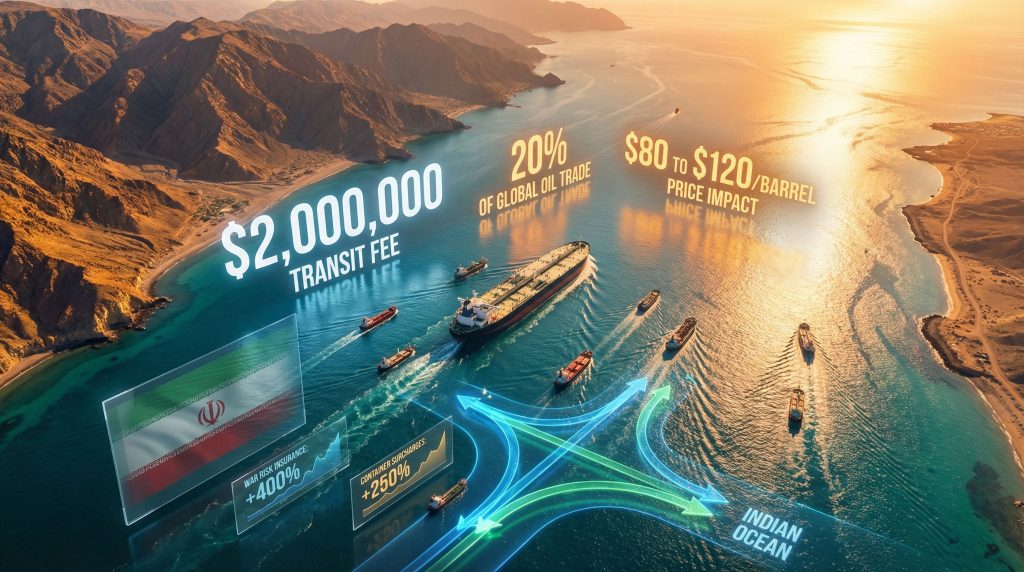
Maritime chokepoint control has evolved far beyond traditional military blockades, transforming into sophisticated economic warfare mechanisms that leverage critical infrastructure for geopolitical advantage. The ability to monetise strategic waterways represents a fundamental shift in how nations assert sovereignty while generating revenue from global trade dependencies. This emerging paradigm demonstrates how geographic advantages can be weaponised through selective access frameworks rather than complete route closures, as exemplified by the Iran Strait of Hormuz transit fee implementation.
Iran's Strategic Maritime Control Framework in the Strait of Hormuz
Selective Access Implementation vs Total Maritime Closure
Iran's implementation of transit fees through the Strait of Hormuz represents a calculated departure from historical chokepoint control strategies. Unlike complete blockades that typically trigger immediate international military responses, Iran has adopted what officials describe as a sovereign regime approach to maritime governance. This methodology allows for continued revenue generation whilst maintaining plausible deniability regarding complete trade route disruption.
Furthermore, the strategic advantage of selective enforcement becomes evident when compared to historical precedents. Complete closures of critical waterways typically result in immediate military intervention from affected nations, total loss of legitimate maritime revenue, international isolation and expanded sanctions, as well as domestic economic hardship from reduced trade.
Iran's selective access model, by contrast, maintains revenue streams from friendly nations whilst pressuring adversaries through targeted economic measures. This approach draws inspiration from successful chokepoint monetisation examples, including the Suez Canal's annual revenue of approximately $7-8 billion and the Panama Canal's $4-5 billion in transit fees. Additionally, this strategy directly relates to how tariffs impact markets globally through selective economic pressure.
Revenue Generation Through Strategic Maritime Leverage
The $2 million transit fee structure implemented by Iran creates substantial revenue potential whilst serving broader geopolitical objectives. Based on current shipping volumes through the Strait of Hormuz, which handles approximately 21% of global petroleum liquids and 25% of global LNG trade, the revenue implications are significant.
Conservative estimates suggest Iran could generate $500 million to $1 billion annually from transit fees, assuming selective enforcement affects roughly 20-30% of current traffic. This calculation assumes average of 40-50 vessels per day transiting the strait, selective targeting of vessels from specific nations, seasonal variations in enforcement based on geopolitical tensions, and potential exemptions for diplomatic or economic considerations.
The strategic value extends beyond immediate revenue generation. Transit fees provide Iran with a continuous revenue stream that partially offsets international sanctions whilst creating leverage in diplomatic negotiations. This approach transforms the strait from a geographic asset into an active revenue-generating instrument of foreign policy, much like how the US‑China trade war has reshaped global economic relationships.
When big ASX news breaks, our subscribers know first
Global Energy Supply Chain Economic Transformation
Immediate Cost Impacts on Energy Transportation Networks
The implementation of Iran's Strait of Hormuz transit fee creates cascading cost implications throughout global energy supply chains. Beyond the direct $2 million fee, additional costs compound the overall impact on energy transportation economics.
Strait of Hormuz Transit Cost Analysis
| Cost Category | Pre-Crisis Level | Current Impact | Percentage Increase |
|---|---|---|---|
| Direct Transit Fee | $0 | $2,000,000 | N/A |
| War Risk Insurance | 0.125% cargo value | 0.3-0.5% cargo value | 240-300% |
| Container Surcharges | Standard rates | $2,200-$3,800 | 40-45% |
| Crude Oil Price Impact | $75-85/barrel | $110-130/barrel | 45-55% |
| Alternative Route Costs | Standard | 15-25% premium | Variable |
These cost increases create ripple effects throughout global energy markets. A single large crude carrier (VLCC) transporting 2 million barrels faces additional costs of approximately $4-6 million per voyage when combining transit fees, increased insurance, and alternative routing requirements. These developments contribute to the broader oil price rally insights affecting global markets.
Secondary Market Disruption and Long-term Implications
The strategic importance of the Strait of Hormuz becomes evident when considering the volume of energy trade flowing through this 21-mile wide waterway at its narrowest point. Disruptions affect not only immediate transportation costs but fundamentally alter global energy security calculations.
Key secondary impacts include strategic petroleum reserve utilisation where major consuming nations accelerate reserve drawdowns to compensate for supply disruptions, alternative infrastructure development with increased investment in pipeline projects bypassing the strait, energy source diversification through accelerated development of domestic energy resources in import-dependent nations, and regional pricing disparities creating significant price differences between Asia-Pacific and Atlantic Basin crude markets.
Long-term implications suggest permanent changes to global energy infrastructure investment priorities. The International Energy Agency estimates that alternative pipeline capacity would require $50-75 billion in infrastructure investment to meaningfully reduce dependence on the Strait of Hormuz for global energy transportation. These challenges mirror those faced in energy transition challenges affecting multiple nations.
Strategic Vulnerability Assessment by Geographic Region
Primary Target Nations Under Selective Access Framework
Iran's classification system for determining transit fee applicability creates clear winners and losers in global energy markets. Nations classified as non-hostile maintain access to standard transit procedures, whilst those deemed hostile face the full $2 million fee structure.
Countries facing maximum strategic vulnerability include the United States with heavy reliance on Middle Eastern crude imports for specific refinery configurations, Israel with complete dependence on maritime energy imports through regional chokepoints, Japan importing 85% of crude oil through the Strait of Hormuz, South Korea with 70% of energy imports affected by strait disruptions, and the European Union facing 15-20% of crude imports directly impacted.
The selective enforcement mechanism creates powerful incentives for diplomatic realignment. Nations seeking to avoid transit fees may reconsider foreign policy positions, particularly regarding sanctions regimes or military cooperation arrangements with Iran's adversaries.
Regional Energy Dependencies and Alternative Route Analysis
Asian economies demonstrate the highest vulnerability to Strait of Hormuz disruptions due to geographic isolation from alternative energy sources. China, despite its expanding domestic production capabilities, still imports approximately 40% of its crude oil through the strait.
Alternative routing options present significant cost and capacity constraints. The Suez Canal Route adds 15-20 days transit time and $300,000-700,000 in additional fees. The Cape of Good Hope increases voyage time by 25-30 days with proportional cost increases. Pipeline alternatives offer limited capacity through existing infrastructure in Turkey and Central Asia, whilst Arctic routes provide only seasonal availability with specialised vessel requirements.
The limited capacity of alternative routes means that complete strait closure would require immediate strategic petroleum reserve utilisation by major consuming nations. Current global strategic reserves could compensate for strait disruption for approximately 60-90 days before serious supply shortages emerge.
Geopolitical Implications of Maritime Toll Precedent Setting
International Maritime Law Challenges and Enforcement
Iran's new transit fee system operates in a complex legal environment governed by the United Nations Convention on the Law of the Sea (UNCLOS). The strait contains both territorial waters and international shipping lanes, creating ambiguous jurisdiction for fee enforcement.
Legal challenges to the transit fee system include freedom of navigation principles where UNCLOS guarantees innocent passage through territorial waters, non-discriminatory access as international law prohibits arbitrary restrictions on maritime commerce, proportionality requirements ensuring fees relate to actual costs of maintaining navigation infrastructure, and environmental justifications through potential claims regarding environmental protection costs.
The practical enforcement challenges highlight the limitations of international legal remedies. Even successful legal challenges through the International Court of Justice typically require several years for resolution, during which economic impacts continue to accumulate.
Replication Potential in Other Strategic Waterways
Iran's transit fee model creates concerning precedents for other nations controlling critical maritime chokepoints. Approximately 90% of global trade travels by sea, with significant portions flowing through narrow passages controlled by individual nations.
Strategic waterways that could implement similar fee structures include the Strait of Malacca controlled by Malaysia, Indonesia, and Singapore, handling 25% of global traded goods, the Bosphorus Strait under Turkish control over Black Sea access for energy exports, the Strait of Gibraltar with Spanish and Moroccan influence over Mediterranean access, and the Danish Straits controlling Baltic Sea shipping routes for Northern European trade.
The successful implementation of Iran's selective transit fee system could encourage similar measures by other nations seeking revenue generation or geopolitical leverage. This potential for widespread adoption represents a fundamental threat to the principle of free maritime commerce that underpins global trade. The situation relates closely to how OPEC market influence shapes global energy dynamics.
Risk Management Strategies for Energy Companies
Immediate Operational Adjustments and Cost Mitigation
Energy companies operating in affected regions must rapidly adapt their operational frameworks to address both immediate cost increases and long-term supply chain vulnerabilities. The $2 million transit fee, whilst substantial, represents only one component of comprehensive risk management requirements.
Essential immediate adjustments include route diversification planning with development of alternative shipping routes and pre-negotiated charter agreements, insurance coverage optimisation through restructuring of war-risk and political violence insurance to cover transit fee scenarios, inventory management via increased strategic stockpiling in key consumption markets to buffer against supply disruptions, and contract renegotiation including force majeure clause activation and cost-sharing arrangements with customers.
The insurance sector has responded with significant premium adjustments, with war-risk insurance rates increasing from 0.125% to 0.4-0.5% of cargo value for affected vessels. These increases translate to $800,000 to $2 million in additional insurance costs for a fully loaded VLCC, compounding the direct transit fee impact.
Long-term Strategic Infrastructure Development
The persistent nature of geopolitical tensions surrounding the Strait of Hormuz necessitates fundamental changes to energy infrastructure investment strategies. Companies are accelerating investments in chokepoint-independent supply chains and alternative energy sources.
Priority infrastructure developments include regional storage expansion through construction of strategic storage facilities in key consumption markets, alternative pipeline infrastructure with investment in overland pipeline projects bypassing maritime chokepoints, technological solutions developing real-time supply chain monitoring and automated rerouting systems, and renewable energy acceleration with increased investment in domestic renewable capacity to reduce import dependence.
The cumulative infrastructure investment required to meaningfully reduce global dependence on the Strait of Hormuz approaches $100-150 billion over the next decade. This investment represents both a cost of geopolitical instability and an opportunity for companies specialising in alternative energy infrastructure.
Economic Scenarios and Revenue Optimisation Analysis
Iran's Strategic Revenue Potential Under Multiple Scenarios
Iran's transit fee implementation presents multiple revenue optimisation pathways depending on enforcement intensity and international response patterns. The strategic value of the strait provides Iran with significant leverage in calibrating fee structures to maximise both revenue and geopolitical impact.
Annual Revenue Potential Under Different Scenarios
Conservative Scenario (20% Traffic Affected):
Monthly vessel count of 300-400 affected vessels could generate annual revenue of $720 million – $960 million, with moderate international pressure as the diplomatic cost.
Moderate Scenario (35% Traffic Affected):
Monthly vessel count of 500-650 affected vessels could generate annual revenue of $1.2 billion – $1.56 billion, with increased sanctions pressure and potential military response as diplomatic costs.
Aggressive Scenario (50% Traffic Affected):
Monthly vessel count of 750-900 affected vessels could generate annual revenue of $1.8 billion – $2.16 billion, with high probability of military intervention and complete economic isolation as diplomatic costs.
The optimisation challenge for Iran involves balancing immediate revenue generation against the risk of triggering responses that could eliminate future revenue streams. The strategic value extends beyond monetary considerations to include diplomatic leverage and domestic political benefits.
Global Economic Response and Adaptation Mechanisms
International responses to Iran's transit fee implementation will likely follow established patterns of chokepoint crisis management, involving both immediate diplomatic pressure and long-term infrastructure development to reduce vulnerability.
Coordinated international responses may include strategic petroleum reserve coordination through synchronised releases from major consuming nations to stabilise prices, alternative infrastructure acceleration with international funding for pipeline projects bypassing the strait, technology development through investment in maritime monitoring and automated response systems, and diplomatic isolation via expanded sanctions and reduced international cooperation.
The effectiveness of international responses depends heavily on sustained cooperation between major consuming nations and oil-producing countries outside Iran. Historical precedents suggest that coordinated responses can successfully mitigate short-term impacts but require substantial investment for long-term vulnerability reduction.
The next major ASX story will hit our subscribers first
Investment and Market Implications for Energy Stakeholders
Shipping and Logistics Sector Adaptations
The maritime shipping industry faces fundamental restructuring as the Iran Strait of Hormuz transit fee creates permanent cost increases for affected vessels. Reports indicate that container shipping companies have already implemented emergency surcharges ranging from $1,800 to $3,300 per container for routes transiting the strait.
Key sector adaptations include fleet deployment optimisation through reallocation of vessels to minimise exposure to affected routes, charter rate restructuring with integration of geopolitical risk premiums into standard charter agreements, insurance portfolio management via comprehensive review and restructuring of war-risk coverage, and alternative route development through investment in relationships with ports along alternative shipping corridors.
Tanker markets demonstrate particularly acute sensitivity to Strait of Hormuz disruptions. VLCC day rates have increased by 40-60% for vessels willing to transit the strait, whilst Suezmax and Aframax vessels serving alternative routes command significant premiums.
Energy Infrastructure Investment Priority Shifts
The persistent nature of transit fee risks accelerates investment in infrastructure projects that reduce dependence on the Strait of Hormuz for global energy transportation. Pipeline projects previously considered economically marginal now receive enhanced strategic priority.
Priority infrastructure investments include Trans-Arabian Pipeline expansion for increased capacity bypassing Gulf maritime routes, Central Asian pipeline networks developing overland routes from producing regions to Asian markets, Arctic shipping infrastructure with investment in year-round northern route capabilities, and regional refining capacity through construction of refineries closer to producing regions to reduce crude transport requirements.
The cumulative capital requirements for meaningful chokepoint independence approach $200-300 billion globally over the next 15 years. This represents both a substantial cost imposed by geopolitical instability and a significant investment opportunity for infrastructure specialists.
Technology investments in supply chain monitoring and risk assessment gain particular importance as companies seek to optimise routing decisions in real-time based on evolving geopolitical conditions. Advanced analytics platforms capable of integrating political risk assessment with operational logistics create competitive advantages in volatile environments.
Please note: This analysis contains forward-looking statements and projections based on current geopolitical conditions. Actual outcomes may vary significantly based on diplomatic developments, international responses, and unforeseen events. Investors should conduct independent analysis and consider multiple scenarios when making investment decisions related to energy infrastructure and maritime shipping companies.
Ready to Capitalise on Geopolitical Energy Market Opportunities?
Discovery Alert's proprietary Discovery IQ model delivers real-time alerts on significant ASX mineral discoveries, instantly empowering subscribers to identify actionable opportunities ahead of the broader market. Explore historic examples of exceptional market returns from major discoveries by visiting Discovery Alert's dedicated discoveries page, then begin your 14-day free trial today to position yourself ahead of evolving energy and commodities markets.