August 7, 2026
Global energy infrastructure operates through interconnected systems that face constant vulnerability to geopolitical disruption and supply chain bottlenecks. Strategic chokepoints have historically demonstrated their capacity to trigger cascading market disruptions that extend far beyond regional boundaries, creating ripple effects across pricing mechanisms, freight logistics, and alternative sourcing strategies. Understanding these dynamics becomes particularly crucial when examining current oil price movements analysis and their broader implications for global energy markets.
Maritime transportation networks rely on concentrated passage points that channel substantial volumes of global energy flows through narrow geographic corridors. When these critical pathways experience operational constraints, market participants must rapidly adapt their sourcing, routing, and risk management approaches to maintain supply chain continuity.
Maritime Chokepoint Disruption Analysis
The current restrictions on vessel movements through strategic waterways represent one of the most significant maritime disruptions in contemporary energy history. Traffic through Hormuz remains minimal, with vessel transits experiencing dramatic reductions from historical operational baselines. Furthermore, this situation has created unprecedented challenges for maritime logistics and energy distribution networks.
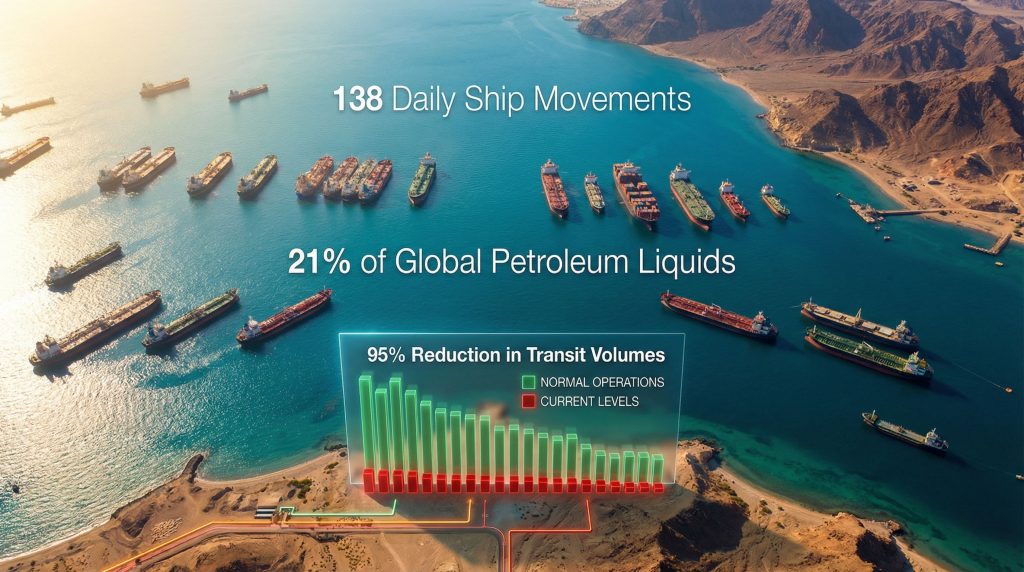
Normal maritime operations typically facilitate approximately 138 daily ship movements through this critical passage. Current operational levels have collapsed to fewer than five vessels per day since late February 2026, representing a reduction exceeding 95% from standard traffic volumes.
Daily Transit Collapse by Vessel Category:
| Vessel Type | Normal Daily Transits | Current Daily Transits | Reduction Percentage |
|---|---|---|---|
| Oil Tankers | 44 | 1-2 | 95-98% |
| Product Tankers | 28 | 0-1 | 96-100% |
| Dry Bulk Carriers | 35 | 3-7 | 80-91% |
| Container Ships | 31 | 0-2 | 94-100% |
The UK Maritime Trade Operations documented 17 incident reports involving vessels in the region since conflict initiation, including 13 attack reports and four suspicious activity reports. Consequently, these operational constraints have created unprecedented challenges for maritime logistics and energy distribution networks.
Strategic Vessel Navigation Tactics
Commercial operators have implemented sophisticated navigation strategies to manage transit risks through the disrupted corridor. For instance, some vessels maintain Automatic Identification System tracking for portions of their journey while disabling signals during critical passages.
Notable Transit Case Study:
- Torm Hermia: A 114,951 dwt LR2 tanker successfully completed eastbound transit in ballast condition on March 7, 2026
- Original routing plan: Cape of Good Hope scheduled for February 26, before conflict escalation
- Post-transit status: Signalled availability for new orders across Arabian Sea waters
- Strategic significance: Demonstrated selective vessel deployment under crisis conditions
Chinese-flagged vessels have employed nationality signalling strategies, with two bulk carriers successfully transiting by prominently displaying Chinese ownership identification to reduce attack probability assessments. However, this approach remains limited to specific flag states with particular diplomatic relationships.
When big ASX news breaks, our subscribers know first
Critical Energy Flow Dependencies
The strategic waterway controls access to approximately 21% of global petroleum liquids, including 14 million barrels per day of crude oil and 6 million barrels per day of refined products. These volumes represent fundamental components of international energy supply chains that lack immediate alternative routing capacity, which directly influences oil futures trends across global markets.
Regional Supply Vulnerability Assessment
Pakistan demonstrates typical dependency patterns seen across energy-importing nations reliant on Gulf supplies. The country sources at least 60% of gasoline requirements from regional suppliers, with UAE providing the majority of import volumes.
Pakistan's Supply Chain Response:
- State-owned Pakistan State Oil typically purchases from Oman's OQ, Dubai-based ENOC, and PetroChina Dubai
- Two vessels operated by state-owned Pakistan National Shipping Corporation deployed toward Yanbu and Fujairah ports
- Saudi Aramco provided loading capacity assurances at Yanbu for larger tanker arrangements
The government implemented immediate pricing adjustments to reflect supply constraints:
- Gasoline price increase: Rs55/litre (approximately 20% increase) to Rs321.17/litre
- Diesel price increase: Rs55/litre to Rs335.86/litre
- Review frequency: Weekly price assessments replacing fortnightly schedules
Freight Rate Escalation Impact
Transportation costs have experienced unprecedented increases across multiple shipping routes, fundamentally altering the economics of energy trade relationships. In addition, these changes are closely connected to broader patterns in oil price rally insights that market analysts continue to monitor.
Cross-Gulf MR Rate Evolution:
- Baseline rates (February 27): $375,000-$400,000
- Crisis rates (March 4+): $1.0-$1.025 million
- Percentage increase: 167-173%
Pakistan Gasoline Route Analysis:
- Pre-crisis contract: Torm Damini shipped 35,000 tonnes from Fujairah for approximately $400,000
- Current market rates: $1.2-$1.5 million for comparable routes
- Cost multiplier: 300-375% increase from baseline
Japan-bound LR2 rates from the Gulf reached five-year highs at WS435 ($98.53/t), representing a 117.5% increase from WS200 levels recorded on February 27. According to recent shipping analysis, these elevated rates reflect the severe supply chain disruptions affecting global energy transportation.
Alternative Sourcing Economics
Market participants have begun evaluating unconventional supply routes despite elevated transportation costs. ExxonMobil provisionally booked two Medium Range tankers from the US Gulf to Australia at $6 million lumpsum each, equivalent to $157.89/t for 92 RON specification gasoline delivery.
European gasoline sourcing for Asia-Pacific destinations, historically minimal at 114,000 tonnes between 2022-2025, has gained consideration as regional supply tightness intensifies. Singapore 92 RON front-month swaps reached a $7.52/bl premium to European barges, representing a three-year high.
Floating Storage Solutions Deployment
The shipping bottleneck has triggered widespread floating storage contract arrangements as port-side storage capacity approaches maximum utilisation levels. Furthermore, this situation highlights the interconnected nature of global energy supply chains and storage infrastructure.
Current Storage Deployment:
- 75 tankers anchored in Gulf of Oman waters
- 126 million barrels of crude oil stranded west of the strait
- Major charterer Admic contracted vessels for floating storage arrangements
Kuwait's state-owned petroleum corporation initiated production adjustments, reducing crude output and refinery operational rates due to transportation constraints. These production changes contribute to broader concerns about US oil production decline and its market ramifications.
Recovery Timeline Scenarios
US Energy Secretary Chris Wright provided cautiously optimistic recovery projections during CNN broadcast interviews, suggesting traffic through Hormuz remains minimal but resumption should occur within manageable timeframes rather than extended periods.
Official Recovery Assessment:
- Timeline expectation: Traffic resumption anticipated in the near term
- Worst-case duration: Several weeks rather than months
- Military support: US-backed vessel insurance and escort provisions planned
French diplomatic engagement included direct communication with Iranian leadership demanding an end to the de facto strait closure and cessation of attacks on neighbouring territories. However, the complexity of regional geopolitics suggests that swift resolution remains uncertain.
Extended Disruption Risk Factors
Potential Complications:
- Iranian strait mining operations could significantly impact shipowner transit willingness
- Continued military activities affecting commercial shipping confidence
- Infrastructure damage requiring sustained repair periods
Qatar's Energy Minister warned that crude prices could reach $150 per barrel within 2-3 weeks if current disruption patterns continue, highlighting the severity of potential market impacts. This assessment aligns with broader concerns about OPEC production impact on global oil pricing mechanisms.
Container Shipping Network Adaptations
Major liner operators implemented comprehensive service suspensions affecting containerised cargo movements throughout the region. Consequently, these disruptions extend well beyond energy commodities into broader global trade flows.
Operator Response Patterns:
- Cosco, Hapag-Lloyd, HMM, and MSC halted Gulf-bound operations
- 655 cargo ships congregating off UAE ports since crisis onset
- Service diversions redirected to alternative regional hub facilities
Container vessel attack incidents continue affecting operational confidence, with vessels sustaining damage from unknown projectiles in proximity to major shipping lanes. Maritime security experts monitoring the situation through specialized tracking systems report continued volatility in shipping patterns.
The next major ASX story will hit our subscribers first
Long-Term Strategic Infrastructure Implications
The disruption demonstrates fundamental vulnerabilities in global energy transportation networks concentrated through single chokepoint passages. Market participants are reassessing supply chain resilience strategies and alternative infrastructure investment priorities.
Enhanced Risk Management Frameworks
Corporate Adaptation Strategies:
- Supply chain diversification reducing Gulf dependency ratios
- Strategic inventory buffer expansion beyond normal operational levels
- Contract flexibility clauses incorporating force majeure and routing alternatives
- Alternative supplier relationship development outside traditional Gulf sources
Insurance Market Evolution:
- War-risk coverage costs experiencing dramatic increases
- Specialised maritime security product development
- Enhanced vessel tracking and protection system deployment
Pipeline infrastructure capacity utilisation has increased as market participants maximise existing overland transportation alternatives. Strategic petroleum reserve policies are under review by importing nations seeking enhanced buffer inventory capabilities.
Market Psychology and Investment Implications
The crisis reveals persistent structural vulnerabilities in global energy supply chains dependent on concentrated geographical passage points. Investment flows are likely to accelerate toward alternative transportation infrastructure and supply source diversification projects.
Sector Impact Assessment:
- Pipeline infrastructure valuations enhanced for overland transport capacity
- Alternative energy transition investment potentially accelerated
- Regional refinery capacity outside Gulf regions gaining strategic value
- Specialised risk management and insurance product opportunities expanding
This analysis is based on publicly available market data and should not be considered investment advice. Energy market conditions remain highly volatile, and supply chain disruptions can evolve rapidly based on geopolitical developments.
Want to Stay Ahead of Energy Market Disruptions?
Global energy chokepoint crises like the current maritime disruption demonstrate how quickly market conditions can shift, creating immediate opportunities for alert investors. Discovery Alert's proprietary Discovery IQ model monitors ASX mineral discoveries that could benefit from energy sector volatility, delivering instant notifications on significant discoveries to help subscribers capitalise on market-moving announcements before broader awareness develops.