August 5, 2026
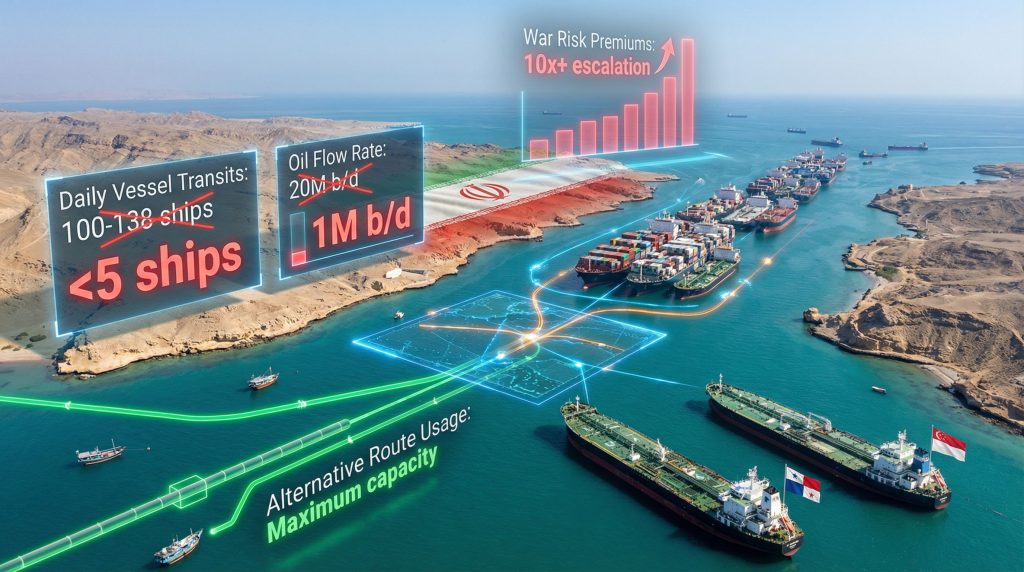
Maritime chokepoints have become focal points of unprecedented tension as the strait of Hormuz traffic increases but remains low compared to historical baselines. Traditional supply chain assumptions crumble under geopolitical pressures, forcing market participants to reconsider fundamental risk assessment frameworks. Furthermore, the interconnected nature of modern energy infrastructure means that disruptions ripple through multiple commodity sectors simultaneously, creating cascading effects across global markets.
Strategic Maritime Vulnerabilities Reshape Global Energy Flows
Maritime chokepoints represent the most critical infrastructure dependencies in global energy supply chains, with strategic waterways handling massive daily throughput volumes under normal conditions. These natural and artificial passages create concentrated risk points where geopolitical tensions can instantly transform from regional conflicts into global supply disruptions.
Primary chokepoint classification encompasses three distinct categories of vulnerability:
- Natural straits with limited alternative routing capabilities
- Canal systems dependent on continuous operational maintenance
- Coastal passages subject to territorial jurisdiction disputes
Current disruptions demonstrate how rapidly normal operations can deteriorate when strait of Hormuz traffic increases but remains low. According to recent vessel tracking data, daily ship transits have collapsed from historical baseline operations to minimal levels, with only five vessels recorded crossing with active transponders during a recent 24-hour period.
The economic multiplier effects extend far beyond immediate shipping delays. When major energy export routes face restrictions, the cascading impacts affect fertiliser supply chains serving agricultural markets thousands of miles away. Moreover, LNG distribution networks requiring specialised vessel capacity face severe constraints.
Alternative routing mechanisms face significant capacity limitations. Pipeline bypass systems, while strategically valuable, cannot absorb the full volume of disrupted maritime traffic. The East-West Pipeline system, for instance, provides important redundancy but operates at maximum throughput levels that cannot compensate for complete strait closures.
Vessel Classification and Traffic Analysis
Different vessel classes experience varying degrees of impact during chokepoint disruptions. Recent transit data shows that dry bulk vessels, Very Large Gas Carriers (VLGCs), and Supramax vessels have successfully navigated restricted passages, suggesting that enforcement mechanisms may differentiate based on cargo type rather than size constraints.
The Qeshm-Larak gap has emerged as a critical enforcement checkpoint, where vessels undergo selective screening processes. Market participants report that this narrow passage now serves as a controlled transit point where diplomatic classifications determine access rights.
When big ASX news breaks, our subscribers know first
Crisis-Driven Supply Chain Adaptations
Supply chain disruption metrics reveal the immediate market impacts of reduced transit volumes through strategic waterways. Baseline traffic analysis indicates that normal operations depend on consistent daily vessel flows, but current operational status shows capacity utilisation falling below 5% of normal levels.
Economic throughput calculations demonstrate massive daily value losses. When energy export corridors operate at minimal capacity, the financial impact compounds across multiple commodity sectors simultaneously. However, the oil price rally has created opportunities for alternative suppliers to capture market share.
Cargo value calculations must now incorporate:
- Extended voyage times for alternative routing
- Premium freight rates reflecting increased risk assessments
- Insurance cost escalations for high-risk transit zones
- Storage facility limitations at alternative export terminals
Container shipping diversions create secondary bottlenecks as TEU capacity becomes stranded in regional ports lacking adequate handling infrastructure. These cascading effects demonstrate how energy sector disruptions rapidly spread throughout broader maritime logistics networks.
Real-Time Market Adaptations
Commodity flow redistribution patterns show markets actively restructuring supply relationships under crisis conditions. LNG market reconfiguration involves rapid contract adjustments as buyers seek alternative suppliers outside affected regions. In addition, spot price volatility reflects this fundamental supply-demand rebalancing.
Agricultural input costs face particular pressure as fertiliser supply chain impacts propagate through global food production systems. Australia's fertiliser import dependency illustrates this vulnerability, with the country sourcing nearly two-thirds of its annual urea imports from the Middle East Gulf region.
Recent price assessments show granular urea reaching A$1,250-1,340 per tonne, representing a 55% increase from pre-crisis levels. Some trades have exceeded A$1,400 per tonne, indicating severe supply tightness. These price escalations directly impact agricultural decision-making, with growers receiving advice to shift toward pulse crops requiring less fertiliser input.
Diplomatic Transit Control Mechanisms
Geopolitical tensions have created sophisticated selective transit policies that fundamentally alter traditional freedom of navigation principles. Iran's foreign minister has explicitly articulated a "friendly nation" classification system that permits passage for vessels from specific countries while restricting access for others.
The approved transit list includes China, Russia, India, Iraq, and Pakistan, demonstrating how diplomatic relationships directly translate into commercial shipping access. This selective enforcement represents a significant departure from historical maritime law interpretations.
Transit fee structures have become a contentious diplomatic issue. Parliamentary discussions in Iran have referenced $2 million charges for vessel operators seeking safe passage, though official government sources have disputed these specific figures as unauthorised commentary.
Legal Framework Disputes
International law compliance questions centre on UNCLOS Article 38 interpretations. The Gulf Cooperation Council secretary general has challenged selective transit policies as violations of the UN Convention on the Law of the Sea, arguing that natural straits differ fundamentally from constructed waterways like the Suez or Panama Canals.
UNCLOS provisions require that strait states "must not discriminate among foreign ships" and cannot impose policies that have "the practical effect of denying, hampering or impairing the right of transit passage." These legal interpretations create ongoing diplomatic tensions regarding enforcement mechanisms.
Strategic alliance impacts extend beyond immediate transit access. The China-Russia-Iran corridor demonstrates how energy partnerships can create resilient supply chains that bypass traditional Western-controlled routes. Consequently, this configuration suggests potential permanent structure changes in global energy flows.
Technology Solutions and Dark Shipping
Vessel tracking systems face unprecedented challenges as ship operators adapt to restricted transit environments. AIS transponder management has become a critical component of navigation strategy, with some vessels choosing to "go dark" when approaching sensitive areas.
Recent examples include the Rastanplan, a container ship that switched off its AIS transponders when approaching the Iranian coast. This dark shipping behaviour complicates real-time supply chain monitoring and creates additional uncertainty for market participants.
Satellite monitoring capabilities provide alternative tracking methods, but these systems cannot fully compensate for intentionally disabled identification systems. Furthermore, market intelligence now requires sophisticated analysis of GNSS jamming countermeasures and communication protocol security.
Supply Chain Optimisation Under Uncertainty
Route optimisation algorithms must now incorporate multiple risk variables beyond traditional cost and time calculations. Dynamic path calculation systems analyse real-time geopolitical developments, insurance availability, and port accessibility to recommend optimal shipping routes.
Predictive analytics deployment attempts to model disruption probability, but traditional algorithms struggle with the rapid policy changes characteristic of crisis situations. Machine learning systems require continuous retraining as new enforcement patterns emerge.
Blockchain documentation systems offer potential solutions for trade finance digitisation, providing immutable records of cargo ownership and transit authorisation that can facilitate passage through politically sensitive areas.
Alternative Energy Infrastructure Activation
Pipeline infrastructure utilisation has accelerated as maritime routes face restrictions. Strategic pipeline networks throughout the Middle East provide partial alternatives to sea-based transportation, though capacity limitations prevent complete substitution. Moreover, the trade war oil impact has intensified these infrastructure challenges.
The UAE's pipeline systems connecting to Fujairah terminal facilities demonstrate how alternative export infrastructure can maintain some energy flows despite strait closures. These facilities provide direct access to Indian Ocean shipping routes, bypassing the Strait of Hormuz entirely.
Saudi Arabia's Red Sea export capabilities through the Petroline system offer additional routing options, though maximum throughput capacity cannot fully compensate for disrupted Gulf exports. The Iraq-Turkey corridor provides northern route activation potential for regional oil flows, particularly relevant given recent Saudi exploration licenses.
Long-Distance Maritime Alternatives
Cape of Good Hope transit economics involve significant additional costs and voyage times, making this routing economically viable only under extreme market conditions. Current freight rate premiums justify the longer routes, but tanker availability becomes a limiting factor.
Arctic shipping routes offer seasonal alternatives during summer months, though infrastructure requirements and ice-class vessel specifications limit accessibility. These routes require specialised navigation equipment and crew training.
Trans-Pacific supply chains are experiencing rebalancing as Asian markets seek alternative suppliers outside traditionally dominant Middle Eastern sources. This geographic diversification may create permanent structural changes in global energy trade patterns, particularly as US oil production decline affects global supply balances.
Agricultural Sector Impact Analysis
Regional agricultural systems face severe disruption from fertiliser supply chain interruptions. Australia's urea dependency on Middle East Gulf sources creates immediate threats to crop topdressing applications scheduled for June through August.
Timing criticality compounds the supply challenge, as the last fertiliser vessel departed the Gulf region on February 23rd, with three-week transit times meaning April arrivals are unlikely. This gap threatens winter crop nutrition during critical growth phases.
Nitrogen fertiliser substitution limitations prevent easy replacement of granular urea with alternatives. Urea ammonium nitrate (UAN) faces supply restrictions as China stopped exports on March 13th. Ammonium sulfate contains only half the nitrogen content of urea, increasing handling costs and application complexity.
Agricultural Decision Adaptations
Crop selection strategies are shifting toward lower fertiliser requirements. Western Australian growers receive agronomic advice favouring pulse crops like broad beans and lentils over traditional grains requiring intensive fertilisation.
Protein level reductions in wheat crops represent a longer-term quality concern if topdressing applications are delayed or reduced. Yield impacts extend beyond volume concerns to fundamental crop quality characteristics affecting export competitiveness.
Fallow land decisions in northern crop regions reflect the economic calculations farmers must make when fertiliser costs exceed expected crop returns. These acreage adjustments create secondary impacts on rural employment and equipment utilisation.
The next major ASX story will hit our subscribers first
Insurance Market Reconfiguration
War risk premium calculations have undergone fundamental restructuring as traditional risk assessment models prove inadequate for current conditions. Hull and machinery coverage now requires specialised underwriting expertise for vessels transiting politically sensitive areas.
Lloyd's of London exposure management involves complex syndicate participation decisions as underwriters evaluate concentration risks across multiple vessel classes and route combinations. Business interruption policies must now address supply chain disruptions extending far beyond immediate vessel damage.
Political risk evaluation incorporates rapidly changing diplomatic relationships and enforcement policies that traditional insurance models cannot easily quantify. Mutual insurance associations face capacity constraints as P&I club coverage confronts unprecedented claim scenarios.
Coverage Availability Challenges
Market participants report that insurers simply will not provide coverage for certain routes, forcing ship operators to seek alternative protection mechanisms. Captive insurance utilisation increases as companies develop self-insurance strategies for uninsurable risks.
Reinsurance market dynamics show capacity limitations as primary insurers seek to transfer war-related exposures. Risk transfer mechanisms struggle with the interconnected nature of modern supply chains where single incidents create multiple claim categories.
Economic Adaptation Strategies
Demand destruction analysis reveals how reduced energy access forces regional economies to modify consumption patterns. Industrial production adjustments prioritise energy-intensive sectors based on economic criticality and substitution possibilities.
Transportation fuel rationing emerges as governments implement consumer behaviour modification programs. Power generation mix changes accelerate adoption of alternative fuel sources, potentially creating permanent shifts away from traditional energy dependencies. For instance, the US natural gas forecast suggests increased reliance on domestic sources.
Strategic stockpile management becomes crucial as government reserve policies activate emergency release mechanisms. Commercial inventory strategies balance immediate supply needs against longer-term storage costs and opportunity expenses.
Regional Cooperation Frameworks
Resource sharing protocols between neighbouring countries provide mutual support during supply disruptions. Alternative energy acceleration programmes receive crisis-driven funding as governments recognise energy security vulnerabilities.
Economic growth projections require fundamental revision as GDP impact assessment methodologies incorporate supply chain disruption variables previously considered low-probability events.
Recovery Scenario Modeling
Diplomatic resolution timelines remain highly uncertain as negotiation frameworks must address multiple competing interests and legal interpretations. Phased traffic resumption would likely prioritise essential commodities and friendly nation vessels before returning to normal operations.
Insurance market recovery depends on premium normalisation trajectories that could extend well beyond the resolution of immediate conflicts. Supply chain reconstruction requires relationship rebuilding between suppliers, transporters, and end-users across multiple industries.
Permanent Infrastructure Changes
Alternative route establishment may create lasting changes in global energy flows as companies invest in pipeline infrastructure and storage facilities to reduce future chokepoint dependencies. Supplier relationship diversification involves long-term contract restructuring away from single-source dependencies.
Strategic reserve enhancement programmes will likely expand buffer capacity requirements as governments reassess energy security frameworks. Technology adoption acceleration in tracking, communication, and alternative energy systems may create permanent operational improvements.
However, the situation where strait of Hormuz traffic increases but remains low demonstrates the complex challenges facing global energy markets. Recovery scenarios must account for the possibility that geopolitical tensions may create lasting structural changes in energy trade patterns.
Disclaimer: This analysis involves forward-looking assessments of geopolitical developments, market adaptations, and economic impacts that are inherently uncertain. Actual outcomes may differ significantly from scenario projections due to rapidly changing diplomatic, military, and economic conditions. Market participants should conduct independent risk assessments and consider professional advisory services when making investment or operational decisions related to energy supply chain exposures.
Looking for Strategic Opportunities During Global Energy Market Disruptions?
Discovery Alert's proprietary Discovery IQ model delivers real-time alerts on significant ASX mineral discoveries, instantly empowering subscribers to identify actionable opportunities ahead of the broader market during volatile periods like these energy supply disruptions. Begin your 14-day free trial today and secure your market-leading advantage while global commodity markets undergo fundamental restructuring.