July 20, 2026
Maritime Enforcement Mechanisms Transform Global Energy Supply Chains
The contemporary global energy landscape reflects an increasingly complex interplay between traditional market forces and emerging enforcement paradigms that extend beyond conventional sanctions frameworks. The u.s. blockade on venezuelan oil represents a sophisticated evolution in economic pressure tactics, fundamentally altering how energy commodities move through international waters and reshaping the risk calculations of both state and private actors in global petroleum markets.
Modern enforcement approaches demonstrate how strategic chokepoints in global shipping lanes can amplify the effectiveness of economic pressure campaigns far beyond their immediate geographic scope. The Caribbean Basin, historically a critical transit zone for Western Hemisphere energy flows, exemplifies how maritime geography intersects with enforcement capabilities to create systemic vulnerabilities in established trade patterns.
When big ASX news breaks, our subscribers know first
Current Strategic Framework Behind Venezuelan Oil Interdiction
The implementation of maritime enforcement against Venezuelan petroleum exports represents a comprehensive escalation from traditional financial sanctions to direct physical interdiction of commercial shipping. This strategic shift involves the deployment of significant naval assets, including carrier strike groups positioned to monitor and intercept tanker traffic throughout the Caribbean corridor.
Furthermore, the enforcement architecture combines real-time vessel tracking capabilities with legal authorities that extend U.S. jurisdiction over sanctions violations occurring in international waters. Current operations have resulted in approximately $900 million worth of Venezuelan crude oil remaining stranded in tankers awaiting clearance, demonstrating the immediate financial impact of maritime interdiction strategies.
The u.s. blockade on venezuelan oil has created unprecedented disruptions to traditional shipping routes. Additionally, this enforcement escalation has triggered broader analysis of oil price rally analysis across global markets.
Enhanced Surveillance and Interdiction Capabilities
Modern enforcement relies heavily on satellite-based vessel tracking systems that monitor ship movements, cargo transfers, and destination changes in real-time. The Automatic Identification System (AIS) provides continuous location data, while synthetic aperture radar satellites can detect vessels attempting to operate with disabled transponders.
However, the enforcement strategy specifically targets what industry analysts term the "shadow fleet" – vessels that facilitate trade with sanctioned entities through complex ownership structures and flag-of-convenience registrations. Intelligence estimates suggest that approximately 40% of Venezuelan tanker fleet capacity currently operates under various sanctions designations.
Legal and Operational Framework Integration
The maritime enforcement regime operates under expanded interpretations of existing sanctions authorities, allowing for the interdiction of vessels carrying sanctioned cargo regardless of vessel nationality or registration. This represents a significant departure from traditional enforcement mechanisms that primarily relied on financial system exclusions.
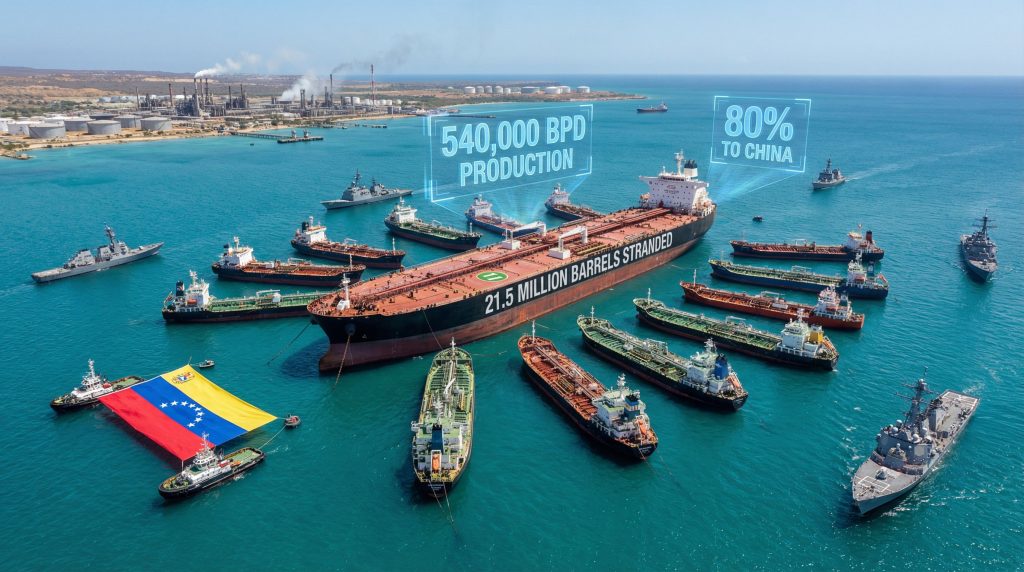
Consequently, Venezuelan production data indicates current Orinoco Belt output of approximately 540,000 barrels per day, representing a decline from previous levels of 630,000 bpd. This reduction reflects both enforcement pressure and operational constraints arising from limited export capacity.
Chinese Commercial Networks as Critical Infrastructure Targets
Chinese firms occupy a central position in Venezuelan oil trade infrastructure, providing not merely purchasing power but comprehensive logistical and financial services that enable sanctions evasion. These entities manage complex networks encompassing shipping coordination, insurance arrangements, trade finance, and cargo handling services across multiple jurisdictions.
In addition, historical trade patterns demonstrate that approximately 80% of Venezuelan petroleum exports have traditionally flowed to Chinese markets, making Chinese intermediary companies high-value targets for enforcement actions. The disruption of these relationships creates cascading effects throughout the entire export infrastructure, amplifying enforcement impact beyond direct vessel seizures.
Shadow Banking and Trade Finance Vulnerabilities
Chinese involvement extends into sophisticated financial arrangements that circumvent traditional banking channels monitored by U.S. authorities. These systems often utilise cryptocurrency transactions, barter arrangements involving refined products or manufactured goods, and complex letter-of-credit structures issued by regional financial institutions outside primary enforcement jurisdictions.
For instance, the targeting of these financial networks reveals vulnerabilities in alternative payment systems that have emerged to facilitate sanctioned trade. Recent enforcement actions have specifically focused on Chinese entities providing trade finance services, demonstrating how financial infrastructure targeting can complement maritime interdiction efforts.
Alternative Route Development and Adaptation
Sustained pressure on traditional Chinese trade channels has encouraged the development of alternative transshipment mechanisms involving regional intermediary ports and ship-to-ship transfer operations. These adaptations often involve longer transit times, higher operational costs, and increased detection risks.
Moreover, intelligence assessments indicate that enforcement pressure has forced Venezuelan exporters to develop more sophisticated operational security measures, including the use of multiple intermediary vessels, false documentation, and route diversions through jurisdictions with limited enforcement cooperation.
Production Optimisation Under Storage and Export Constraints
Venezuelan production adjustments demonstrate how downstream export disruptions translate directly into upstream operational decisions. Field operators currently face acute storage constraints with approximately 21.5 million barrels of crude oil stranded in various stages of the export process, approaching the practical limits of available storage infrastructure.
Nevertheless, the country's storage capacity limitations, estimated at approximately 20 million barrels of usable capacity, create immediate operational pressure when export channels face disruption. This infrastructure constraint means that any export interruption forces immediate production optimisation decisions rather than allowing for extended storage buffering.
These developments directly influence oil price movement trends and broader trade war oil impacts across global markets.
Infrastructure Stress Response Mechanisms
When storage facilities approach capacity limits, petroleum operations must balance multiple technical and economic factors:
- Equipment protection: Preventing overpressurisation of storage tanks and pipeline systems
- Product quality maintenance: Avoiding contamination in extended storage scenarios
- Operational cost management: Minimising shutdown and restart expenses
- Revenue optimisation: Prioritising higher-value crude grades for limited export capacity
Current production data shows Orinoco Belt output declining by approximately 90,000 barrels per day, representing a 14.3% reduction that correlates directly with enforcement escalation timelines. This production adjustment reflects immediate operational responses to storage and export constraints rather than longer-term strategic planning.
Real-time Operational Decision Making
Storage limitations create forcing mechanisms that compress decision-making timeframes from strategic planning horizons to immediate operational necessities. Field operators must continuously adjust production rates based on real-time storage utilisation data and export capacity estimates.
This dynamic creates feedback loops where enforcement effectiveness can be measured through production impact metrics, providing near-real-time assessment of policy implementation success. The storage constraint mechanism amplifies enforcement impact by creating direct linkages between maritime interdiction and upstream production decisions.
Global Market Resilience and Price Dynamics
Despite significant Venezuelan supply disruptions, global petroleum markets have demonstrated remarkable stability with Brent crude maintaining levels around $60.25 per barrel and WTI crude at approximately $56.82. This price resilience reflects successful activation of alternative supply sources and strategic inventory management among major consuming nations.
Furthermore, market stability suggests that global petroleum supply chains have sufficient flexibility to absorb Venezuelan production shortfalls without triggering significant price volatility. This resilience demonstrates the effectiveness of strategic petroleum reserve policies and spare production capacity management among major producers.
The OPEC market influence has played a crucial role in maintaining global price stability during these disruptions.
Alternative Supply Source Activation
Several indicators demonstrate active supply rebalancing in response to Venezuelan disruptions:
- Nigerian production increases: NNPC has boosted oil production to 1.6 million barrels per day
- Saudi pricing strategies: Continued price optimisation for Asian markets to maintain market share
- Strategic reserve utilisation: Coordinated releases from consuming nation stockpiles
- OPEC production flexibility: Adjusted output quotas to offset supply disruptions
Market intelligence indicates that alternative suppliers have successfully compensated for Venezuelan shortfalls through a combination of increased production, strategic reserve drawdowns, and optimised distribution logistics.
Price Discovery and Risk Premium Integration
Current pricing patterns suggest that markets have effectively integrated Venezuelan supply risk into baseline pricing models rather than treating disruptions as temporary shock events. This integration reflects market expectations that enforcement measures represent structural rather than cyclical supply constraints.
The relatively modest risk premium incorporated into current pricing indicates market confidence in alternative supply availability and strategic inventory buffers maintained by major consuming nations.
Licensed Operations and Market Segmentation Dynamics
The continuation of Chevron's licensed operations, producing approximately 245,000 barrels per day under existing U.S. Treasury authorisations, creates a distinctive two-tier market structure with significantly different risk profiles and pricing mechanisms.
Recent operational data confirms Chevron's ability to deliver Venezuelan crude directly to U.S. ports while enforcement actions intensify against unlicensed operators. This operational distinction demonstrates how licensing frameworks can create market segmentation that serves broader policy objectives while maintaining selective commercial relationships.
Risk Premium Differentiation
Licensed versus unlicensed Venezuelan crude now carries substantially different risk premiums, affecting both pricing structures and buyer willingness to engage:
| Operation Type | Risk Level | Market Access | Price Premium |
|---|---|---|---|
| Licensed (Chevron) | Low | Direct U.S. delivery | Minimal discount |
| Unlicensed exports | High | Limited buyers | Significant discount |
| Shadow fleet operations | Very High | Restricted routes | Major discount |
This market segmentation influences global pricing patterns as buyers factor enforcement risks into purchase decisions and pricing negotiations.
Regulatory Compliance Frameworks
Licensed operations demonstrate how selective authorisation mechanisms can maintain commercial relationships while supporting broader enforcement objectives. Chevron's operations continue under specific Office of Foreign Assets Control (OFAC) general licenses that include detailed compliance requirements and operational restrictions.
The licensing framework provides a template for calibrated enforcement approaches that distinguish between policy-aligned commercial activity and sanctions evasion, allowing for precise targeting of enforcement measures.
The next major ASX story will hit our subscribers first
Strategic Policy Objectives and Enforcement Escalation
Venezuelan petroleum revenues traditionally fund approximately 95% of government revenue, making export disruption an exceptionally effective pressure mechanism for achieving political objectives. This fiscal dependency creates immediate budgetary stress that extends throughout government operations and social programmes.
The recent escalation to include kinetic operations, such as the drone strike on Venezuelan port facilities publicly acknowledged by U.S. officials, represents a significant expansion of enforcement tools beyond traditional economic measures. This escalation demonstrates willingness to employ direct action while maintaining official policy frameworks.
These developments contribute to broader tariff-driven economic impacts affecting global trade patterns.
Deterrence Effect Amplification
High-profile enforcement actions serve broader deterrence objectives by signalling to other potential sanctions violators that enforcement capabilities extend beyond traditional financial measures to include direct physical interdiction and targeted infrastructure disruption.
The strategic communication value of acknowledged operations provides deterrence benefits that extend beyond immediate tactical objectives, influencing behaviour among potential sanctions evaders across multiple regions and commercial sectors.
Escalation Ladder Management
The progression from financial sanctions through maritime interdiction to acknowledged kinetic operations demonstrates systematic escalation management designed to maintain pressure while preserving options for further intensification:
- Financial sanctions: Asset freezes and banking restrictions
- Maritime interdiction: Vessel seizures and cargo confiscation
- Infrastructure targeting: Selected strikes on enabling facilities
- Expanded operational scope: Potential for broader target sets
This escalation framework provides policymakers with graduated response options while maintaining strategic ambiguity about future enforcement intensification.
Storage Infrastructure as Enforcement Force Multiplier
Venezuela's limited petroleum storage capacity creates critical infrastructure vulnerabilities that significantly amplify enforcement effectiveness. With current utilisation approaching 21.5 million barrels against practical capacity limits of approximately 20 million barrels, storage constraints force immediate production decisions.
This infrastructure limitation transforms temporary export disruptions into sustained production impacts, creating compounding pressure that extends enforcement effectiveness beyond immediate maritime interdiction periods.
Technical Constraints and Operational Risks
Storage capacity limitations create multiple operational risk factors:
- Overpressurisation risks: Potential equipment damage from excess storage pressure
- Product quality degradation: Extended storage impacts on crude oil specifications
- Operational flexibility loss: Reduced ability to optimise production timing
- Maintenance complications: Limited operational windows for facility maintenance
These technical constraints ensure that enforcement actions create lasting operational impacts that persist beyond immediate interdiction periods.
Economic Decision Forcing
Storage limitations compress decision-making timeframes and force immediate economic trade-offs between production continuation and equipment protection. This dynamic creates predictable operational responses that enhance enforcement effectiveness through infrastructure constraint exploitation.
The mechanism demonstrates how understanding target infrastructure limitations can multiply enforcement impact through relatively modest operational pressure application.
What Are the Long-term Market Structure Implications?
Sustained enforcement pressure drives continuous adaptation in global energy trade patterns, creating new market structures that may persist beyond current enforcement periods. These adaptations include alternative financing mechanisms, modified shipping routes, and revised commercial relationships.
Shadow Fleet Evolution and Counter-measures
Enforcement pressure accelerates innovation in sanctions evasion techniques, driving development of more sophisticated operational security measures:
- Vessel ownership obfuscation: Complex legal structures spanning multiple jurisdictions
- Technology countermeasures: AIS manipulation and communication security upgrades
- Route optimisation: Alternative transit corridors avoiding enforcement zones
- Financial innovation: Enhanced cryptocurrency and barter transaction capabilities
This evolutionary dynamic creates an ongoing enforcement-evasion cycle that requires continuous adaptation of countermeasures and detection capabilities.
Regional Trade Pattern Restructuring
Enforcement pressures encourage development of alternative regional trade relationships that may create lasting changes to global energy flow patterns:
| Region | Traditional Role | Emerging Adaptation |
|---|---|---|
| Caribbean | Transit corridor | Enhanced interdiction zone |
| South America | Regional integration | Alternative route development |
| Asia-Pacific | Primary destination | Diversified source seeking |
| West Africa | Limited involvement | Potential transshipment role |
These adaptations may create persistent changes to global energy trade geography that extend beyond current enforcement periods.
How Do International Legal Frameworks Affect Implementation?
The expansion of enforcement actions into international waters raises significant questions regarding maritime law compliance and precedent-setting for future economic warfare applications. The primarily unilateral nature of current enforcement measures creates potential conflicts with established principles of freedom of navigation and territorial sovereignty.
United Nations legal experts have expressed concerns regarding the international law implications of maritime interdiction operations, particularly regarding the expansion of sanctions enforcement beyond traditional financial mechanisms.
Maritime Law Considerations
Enforcement operations must navigate complex maritime law principles including:
- Freedom of navigation rights: International waters transit protections
- Flag state jurisdiction: Primary legal authority over vessel operations
- Territorial sovereignty: Coastal state exclusive economic zone rights
- Commercial law frameworks: International trade and shipping regulations
These legal constraints create operational parameters that influence enforcement effectiveness and international legitimacy considerations.
Precedent Setting for Economic Warfare
Current enforcement approaches establish precedents for maritime interdiction applications in future economic pressure campaigns, potentially normalising expanded enforcement authorities for sanctions implementation.
The international community's response to current operations will influence the legitimacy and replication potential of similar enforcement approaches in future sanctions regimes.
Investment and Risk Assessment Framework Updates
Current enforcement patterns provide valuable intelligence for updating investment risk assessment frameworks, particularly regarding sanctions evasion detection capabilities and supply chain vulnerability analysis.
Asset Valuation Under Enforcement Uncertainty
Venezuelan petroleum infrastructure and reserves face significant valuation uncertainty due to ongoing enforcement risks and operational constraints:
| Asset Category | Valuation Impact | Risk Duration |
|---|---|---|
| Production facilities | High negative | 24+ months |
| Export infrastructure | Severe negative | 12-24 months |
| Tanker fleet assets | Variable | 6-18 months |
| Offshore concessions | Moderate negative | 36+ months |
This valuation uncertainty affects broader regional energy asset pricing and investment decision-making across Latin American petroleum markets.
Strategic Intelligence for Market Participants
Current enforcement operations provide market participants with valuable intelligence regarding:
- Detection capability assessment: Understanding surveillance technology limitations
- Enforcement pattern analysis: Predicting future operational targeting
- Alternative infrastructure evaluation: Identifying resilient trade route options
- Regulatory evolution tracking: Anticipating enforcement escalation patterns
This intelligence enables more sophisticated risk management and strategic planning for market participants operating in sanctioned or potentially sanctioned jurisdictions.
The evolution of enforcement capabilities from traditional financial sanctions to comprehensive maritime interdiction represents a fundamental shift in economic warfare methodology. While immediate market impacts remain contained through alternative supply activation and strategic reserve management, the precedent established for enforcement escalation carries profound implications for global energy security frameworks and international maritime commerce.
The effectiveness of storage constraint exploitation and shadow fleet network targeting provides a template for future enforcement strategies, while demonstrated market resilience highlights the critical importance of supply diversification and strategic inventory management in maintaining energy security. As enforcement mechanisms continue evolving, market participants must adapt risk assessment frameworks to account for expanding operational capabilities and their potential application across multiple jurisdictions and commercial sectors.
Ready to Capitalise on Energy Market Disruptions?
Discovery Alert's proprietary Discovery IQ model provides instant notifications on significant ASX mineral discoveries, including critical energy transition metals that benefit from global supply chain disruptions. Explore how historic discoveries have generated substantial returns by visiting Discovery Alert's dedicated discoveries page and begin your 30-day free trial today to position yourself ahead of market volatility.