
July 5, 2026
Understanding Maritime Power Dynamics in Strategic Waterways
Strategic chokepoints have shaped global commerce and military doctrine for centuries, with narrow maritime passages serving as pressure points where regional powers can exert disproportionate influence over international trade flows. These geographical bottlenecks concentrate enormous economic value into confined spaces, creating vulnerabilities that extend far beyond their physical boundaries. When tensions escalate around such critical transit routes, the ripple effects cascade through energy markets, supply chains, and geopolitical relationships worldwide, particularly affecting the oil price rally that often follows major disruptions.
The concentration of global energy flows through narrow straits creates unique strategic dynamics where asymmetric capabilities can challenge conventional naval power. Unlike open ocean warfare, confined waterway operations favour coastal defence systems, fast attack craft, and area denial strategies over traditional fleet engagements. This fundamental shift in tactical advantage explains why control claims over strategic straits carry weight far beyond the physical size of the territories involved.
When big ASX news breaks, our subscribers know first
Understanding Strait of Hormuz Control Mechanisms
Geographic Sovereignty vs. Operational Control
The distinction between legal sovereignty and practical maritime control represents one of the most complex aspects of strait governance. Under the United Nations Convention on the Law of the Sea (UNCLOS), territorial waters extend 12 nautical miles from coastal baselines, creating a framework where multiple nations can claim sovereign rights over different sections of the same waterway.
| Territory | Territorial Waters (Nautical Miles) | Legal Basis | Strategic Assets |
|---|---|---|---|
| Iran | 12 (northern shore) | UNCLOS Article 3 | Coastal missile batteries, naval bases |
| Oman | 12 (southern shore) | UNCLOS Article 3 | Musandam Peninsula positions |
| International Waters | ~30 (central channel) | UNCLOS transit passage | Shipping lanes, traffic separation |
The practical reality of strait of hormuz control extends beyond legal frameworks to encompass surveillance capabilities, enforcement mechanisms, and the ability to project power across the entire waterway. While sovereignty claims provide legal authority over specific zones, operational control requires the technical and military capacity to monitor, intercept, and influence maritime traffic throughout the strategic corridor.
Naval Force Projection Capabilities in the Region
Iran's asymmetric naval doctrine centres on layered coastal defence systems designed to offset conventional naval superiority through concentrated firepower in confined waters. The Islamic Revolutionary Guard Corps Navy (IRGCN) deploys fast attack craft, coastal missile batteries, and maritime mining capabilities specifically optimised for chokepoint operations.
Recent events demonstrate how these capabilities translate into operational influence. During the March 2026 escalation, Iranian forces demonstrated anti-ship missile effectiveness against commercial vessels, including strikes on container ships that required rescue operations by neighbouring navies. The Omani Navy's successful rescue of 24 crew members from a missile-struck container ship illustrates the international maritime coordination required when strait tensions escalate.
Military analysts emphasise that asymmetric naval tactics in narrow waterways can achieve strategic effects disproportionate to force size, particularly when combined with coastal surveillance networks and area denial weapons systems.
The presence of multiple naval forces creates a complex operational environment where traditional rules of engagement may not apply. U.S. submarine operations in the region, including reported strikes on Iranian vessels in international waters, demonstrate how conflict dynamics extend beyond the strait itself into broader regional maritime zones.
What Makes the Strait of Hormuz Strategically Critical?
Global Energy Transit Statistics and Dependencies
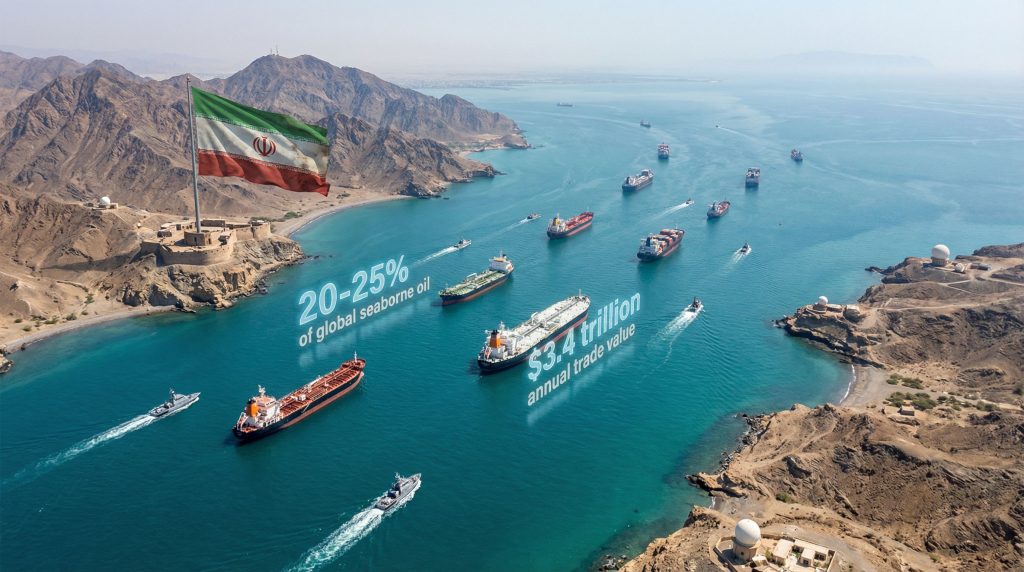
The economic significance of the Strait of Hormuz stems from its role as the primary transit route for Middle Eastern energy exports to Asian and European markets. Approximately 21-25 million barrels of oil per day transit the strait during normal operations, representing roughly 20-25% of global seaborne petroleum trade.
| Energy Flow Type | Daily Volume | Primary Destinations | Economic Value (Annual) |
|---|---|---|---|
| Crude Oil | 21-25 million barrels | Asia-Pacific, Europe | $2.8-3.4 trillion |
| Liquefied Natural Gas | 3.5-4.2 billion cubic feet | Japan, South Korea, India | $180-220 billion |
| Refined Products | 2.5-3.1 million barrels | Regional markets | $145-175 billion |
The concentration of energy flows creates systemic vulnerabilities for importing nations, particularly in Asia where alternative supply routes face significant capacity and cost constraints. Furthermore, Japan imports approximately 88% of its crude oil from Middle Eastern producers, while South Korea and India maintain similar dependency levels of 75% and 80% respectively.
Chokepoint Vulnerability Assessment
Alternative transportation routes cannot fully replace Strait of Hormuz capacity in the event of closure or significant disruption. Pipeline systems offer partial bypass capabilities but operate at much lower throughput levels compared to maritime transport.
Pipeline Bypass Limitations:
- Saudi East-West Pipeline: 5 million barrels per day capacity
- UAE pipeline systems: 1.8 million barrels per day capacity
- Iran Goreh-Jask pipeline: 1 million barrels per day capacity
- Total alternative capacity: 7.8 million barrels per day
- Strait closure gap: 13-17 million barrels per day
The mathematics of chokepoint vulnerability reveals why pipeline alternatives cannot substitute for maritime transit. Even operating at maximum capacity, existing bypass infrastructure covers only 35-40% of normal strait throughput, creating an unavoidable supply gap that would require dramatic demand reduction or alternative sourcing strategies.
Why can't pipelines replace Strait of Hormuz transport? The answer lies in fundamental capacity constraints, infrastructure investment requirements exceeding $200 billion, and geographical limitations that make additional pipeline construction technically challenging and economically prohibitive for many producing nations.
How Do Iran's Control Claims Affect Global Markets?
Historical Precedents of Strait Disruptions
Market responses to strait tensions follow predictable patterns based on historical precedents, though each crisis presents unique characteristics that influence price volatility and duration. However, the 1980-1988 Iran-Iraq War period provides the most comprehensive data on sustained strait disruptions and their economic consequences, which help analysts understand the broader US‑China trade impacts on global energy flows.
During the Tanker War phase (1984-1988), approximately 540 vessels were attacked, leading to insurance premium increases of 10-20 times normal rates. Oil prices fluctuated between $15-22 per barrel during peak tension periods in October 1987, with volatility driven more by supply disruption fears than actual production losses.
Case Study: 2019 Tanker Seizures Impact Analysis
The June-July 2019 incident sequence demonstrates how modern markets respond to strait control assertions:
- Incident Timeline: Iranian seizure of British-flagged Stena Impero
- Insurance Response: Gulf transit premiums increased from $10,000 to $300,000+ per voyage
- Price Impact: Brent crude rose from $63 to $71 per barrel within two weeks
- Recovery Period: Market normalisation required 6-8 weeks post-incident resolution
The March 2026 escalation follows similar patterns, with oil prices rising immediately following Iran's control declaration and subsequent maritime incidents. The reported strikes on commercial vessels, including a tanker explosion off Kuwait with "oil in the water," demonstrates how actual incidents amplify market concerns beyond rhetorical claims.
Economic Leverage Through Maritime Chokepoints
Iran's strategic calculus relies on the asymmetric economic impact that strait disruptions create for energy-dependent economies versus the costs of maintaining closure operations. Economic modelling suggests that full strait closure would increase global oil prices by 40-60% within the first week, creating approximately $150-200 billion in additional energy costs for importing nations monthly.
| Closure Scenario | Price Impact | Asian Economic Cost | Duration Sustainability |
|---|---|---|---|
| Partial (50% reduction) | +25-35% oil prices | $75-100 billion/month | 3-6 months |
| Full closure | +40-60% oil prices | $150-200 billion/month | 2-8 weeks |
| Intermittent disruption | +15-25% oil prices | $40-65 billion/month | 6-12 months |
The economic leverage calculations explain why strait of hormuz control claims carry significant credibility in global markets, even when enforcement capabilities may be limited. In addition, the threat of disruption often generates greater market impact than actual closure attempts, as precautionary behaviour by shipping companies and energy traders amplifies supply concerns, particularly when considering the broader market impact of tariffs on global trade flows.
Which Countries Have Strategic Interests in Hormuz Control?
Primary Stakeholder Analysis
Each nation bordering or economically dependent on the Strait of Hormuz maintains distinct strategic interests that shape their positions on control and access issues.
Iran's Strategic Position:
Iran views strait control as a defensive asset and diplomatic leverage tool, particularly during periods of international sanctions or military pressure. The March 2026 declaration of wartime control authority reflects this strategic doctrine, though enforcement capabilities remain constrained by international maritime law and naval force limitations.
The Islamic Revolutionary Guard Corps Navy operates approximately 1,500 fast boats, coastal missile systems, and mining capabilities designed specifically for chokepoint operations. However, maintaining full strait closure would require resources that Iran cannot sustain indefinitely whilst facing international military response.
Oman's Neutrality Strategy:
Oman's approach emphasises diplomatic neutrality whilst maintaining operational maritime capabilities. The Omani Navy's rescue of 24 crew members during the March 2026 incidents demonstrates their commitment to maritime safety regardless of regional tensions.
Oman benefits economically from strait transit through port services, shipping logistics, and regional trade facilitation, creating incentives to maintain operational access even during political crises.
Saudi Arabia's Export Vulnerability:
Approximately 60-70% of Saudi oil exports typically transit the Strait of Hormuz, representing 6-8 million barrels per day during normal operations. This dependency drives Saudi investment in alternative export routes, including the East-West pipeline system and Red Sea terminal expansion.
The Petroline (East-West) pipeline currently operates at 5 million barrels per day capacity, providing partial but incomplete export diversification for Saudi Arabia's 12-million-barrel daily production capacity.
Global Powers' Maritime Security Strategies
International naval presence in the Gulf reflects the global strategic importance of maintaining open shipping lanes through the strait. The United States maintains the Fifth Fleet headquarters in Bahrain, while European nations contribute to maritime security through the European Maritime Awareness Mission.
Multilateral Coordination Mechanisms:
- Combined Maritime Forces (CMF) 34-nation coalition
- International Maritime Security Construct (IMSC)
- Gulf Cooperation Council naval coordination protocols
- NATO's Operation Sea Guardian extension discussions
China's Belt and Road Initiative includes alternative energy transportation routes, but current Chinese energy imports remain heavily dependent on Gulf producers and strait transit, creating shared interests with Western nations in maintaining maritime access whilst addressing energy export challenges.
What Are the Technical Aspects of Strait Control?
Naval Warfare Capabilities in Confined Waters
The technical characteristics of the Strait of Hormuz favour defensive operations and asymmetric tactics over conventional naval supremacy. At its narrowest point, the strait spans only 21 nautical miles between shipping lanes, with depths averaging 60-70 metres in the main channels.
Iranian anti-ship missile systems, including Khalij Fars and Khalij Fars II variants, provide effective ranges of 300+ kilometres, enabling land-based targeting of vessels throughout the strait and surrounding Gulf waters. Coastal radar networks and underground command facilities create redundant surveillance and targeting capabilities.
Defence experts note that modern anti-ship cruise missiles can achieve hit probabilities exceeding 85% in confined waterways, particularly when deployed in saturation attack patterns that overwhelm defensive countermeasures.
The March 2026 incidents involving container ship and tanker strikes demonstrate the operational effectiveness of these systems against commercial targets. The reported "large explosion" on a tanker off Kuwait, with subsequent oil spillage, indicates the use of high-explosive warheads capable of causing significant damage to large vessels.
Maritime Traffic Management Systems
Normal strait operations involve approximately 17-21 commercial vessel transits daily, including oil tankers, LNG carriers, container ships, and bulk cargo vessels. Traffic separation schemes establish designated shipping lanes to minimise collision risks and optimise navigation safety.
| Vessel Type | Daily Transits | Average Size (DWT) | Cargo Value |
|---|---|---|---|
| Oil Tankers | 8-12 | 150,000-300,000 | $75-150 million |
| LNG Carriers | 2-4 | 125,000-180,000 | $45-85 million |
| Container Ships | 3-5 | 50,000-200,000 | $200-500 million |
| Bulk Carriers | 2-4 | 80,000-180,000 | $25-65 million |
Emergency response coordination between Iranian and Omani maritime authorities normally follows International Maritime Organisation protocols, though political tensions can complicate rescue and assistance operations. The successful Omani Navy rescue during the March 2026 incidents demonstrates that professional maritime cooperation can continue despite broader regional conflicts.
The next major ASX story will hit our subscribers first
How Do International Laws Apply to Strait of Hormuz Control?
UNCLOS Transit Passage Rights
The United Nations Convention on the Law of the Sea establishes specific legal frameworks for international straits that supersede normal territorial water restrictions. Under Part III (Articles 34-45), ships and aircraft of all nations enjoy transit passage rights through straits used for international navigation.
Transit passage differs from innocent passage in that it cannot be suspended by coastal states and applies to both surface vessels and submerged submarines. This legal framework theoretically prevents unilateral strait closure, though enforcement mechanisms depend on international response rather than automatic legal remedies.
Can Iran legally close the Strait of Hormuz? Under international law, Iran cannot legally prevent transit passage through the strait during peacetime, regardless of wartime control claims. However, enforcement of these rights requires international naval intervention, creating practical complications when coastal states assert emergency authority.
Enforcement Mechanisms and Dispute Resolution
International legal challenges to strait access restrictions typically proceed through the International Court of Justice, though this process requires months or years whilst economic impacts occur within days. The 2019 tanker seizure incidents illustrated how legal remedies often lag behind market responses to access disruptions, highlighting the broader global trade repercussions of maritime disputes.
Case Study: Legal Response Framework
The March 2026 Iranian control declaration creates several legal challenges:
- Transit passage violations: Commercial vessel targeting contradicts UNCLOS Article 38
- Environmental damage: Oil spills from tanker strikes violate marine pollution conventions
- Search and rescue obligations: Both Iran and Oman maintain SAR responsibilities regardless of political tensions
UN Security Council intervention protocols exist for maritime security threats, but require consensus amongst permanent members who may have competing regional interests. This creates enforcement gaps where legal rights exist without corresponding practical remedies.
What Are the Economic Consequences of Control Disputes?
Market Response Mechanisms to Supply Disruptions
Energy markets demonstrate consistent patterns when strait access faces credible threats, with price volatility typically exceeding actual supply disruption percentages. Furthermore, the March 2026 incidents produced immediate oil price increases despite minimal actual production losses, reflecting precautionary behaviour by traders and logistics companies.
Historical correlation analysis shows that strait tension announcements generate 15-25% price increases within 24-48 hours, whilst actual vessel incidents can produce 25-40% spikes depending on cargo type and incident severity.
| Historical Event | Price Impact (First Week) | Duration | Peak Premium |
|---|---|---|---|
| 1987 Tanker War Peak | +35% (Brent) | 6 weeks | +45% |
| 2019 Tanker Seizures | +12% (WTI) | 3 weeks | +18% |
| 2020 Soleimani Crisis | +8% (Brent) | 2 weeks | +12% |
| 2026 Control Declaration | +15% (preliminary) | Ongoing | TBD |
Strategic Petroleum Reserve activation protocols provide buffer mechanisms for major importing nations, though reserves typically contain 60-90 day supply equivalents that cannot substitute for extended strait closure. Consequently, the United States, Japan, South Korea, and India maintain coordinated release procedures, but these address short-term disruptions rather than sustained access denial.
Long-term Energy Security Implications
Repeated strait control disputes accelerate structural changes in global energy infrastructure and sourcing strategies. European and Asian importers increasingly prioritise supply diversification, alternative transportation routes, and renewable energy acceleration as strait-dependency mitigation strategies.
Regional Economic Diversification Efforts:
- Gulf Cooperation Council pipeline network expansion
- Asian LNG terminal construction acceleration
- European renewable energy target advancement
- Strategic petroleum reserve capacity increases
- Alternative crude oil sourcing agreement development
Investment analysis suggests that sustained strait tensions increase infrastructure spending on bypass capabilities by 15-25% annually, though these investments require 5-10 years to achieve meaningful capacity additions.
Which Military Technologies Shape Strait Control Dynamics?
Surveillance and Detection Systems
Modern strait of hormuz control relies heavily on integrated surveillance networks that combine satellite monitoring, coastal radar systems, underwater sensors, and electronic intelligence gathering. Iran operates a multi-layered detection network that can track vessel movements throughout the Gulf region and into the Arabian Sea.
Satellite surveillance capabilities provided by various nations enable near real-time monitoring of all maritime activity in the strait, though weather conditions and electronic countermeasures can create detection gaps. In addition, commercial satellite imagery increasingly provides public domain intelligence on naval deployments and maritime incidents.
Intelligence analysts emphasise that technological deterrence in modern chokepoint operations depends more on surveillance persistence and targeting accuracy than on raw firepower, creating advantages for well-prepared defensive positions.
The March 2026 incidents demonstrate effective targeting capabilities against moving commercial vessels, suggesting integration between detection systems and weapons platforms that enables engagement of multiple targets simultaneously.
Offensive and Defensive Naval Capabilities
Asymmetric naval warfare in confined waters emphasises speed, survivability, and concentrated firepower over traditional fleet composition metrics. Fast attack craft operating in swarm formations can overwhelm defensive systems through numerical superiority and distributed targeting.
| Platform Type | Iran | Regional Allies | International Forces |
|---|---|---|---|
| Fast Attack Craft | 1,500+ | 150-200 | 25-35 |
| Coastal Missiles | 300+ launchers | 50-75 launchers | Ship-based systems |
| Mine Warfare | Extensive capability | Limited | Clearance focus |
| Submarine Assets | 3-5 operational | 8-12 regional | 4-6 deployed |
Coastal missile battery effectiveness in the March 2026 strikes indicates successful integration of targeting data with weapon systems, achieving hits on both container ships and tankers despite defensive countermeasures. The reported tanker explosion off Kuwait suggests employment of anti-ship cruise missiles with substantial explosive payloads.
Defensive naval capabilities focus on escort operations, mine clearance, and electronic warfare systems designed to protect commercial shipping rather than engage in decisive fleet actions. However, the complexity of defending multiple simultaneous transits creates tactical challenges that favour offensive planning.
How Do Geopolitical Tensions Affect Strait Control Claims?
Regional Conflict Spillover Effects
The March 2026 Iran-Israel escalation demonstrates how broader regional conflicts directly impact strait security through escalation dynamics that extend maritime tensions beyond immediate participants. What began as bilateral confrontation evolved into multi-theatre operations affecting commercial shipping, naval deployments, and international crisis response.
The reported U.S. submarine strike on Iranian frigate Dena "carrying almost 130 sailors" in international waters illustrates how strait control disputes can escalate into direct military confrontation between major powers. Iran's characterisation of this incident as an "atrocity at sea" reflects the diplomatic complications that arise when maritime operations extend beyond commercial vessel targeting.
Case Study: 2026 Escalation Pattern Analysis
The six-day conflict progression shows classic strait tension escalation:
- Day 1-2: Bilateral air strikes between primary combatants
- Day 3-4: Maritime domain expansion with commercial vessel targeting
- Day 5-6: International naval engagement and control declaration
- Ongoing: Allied evacuation operations and diplomatic intervention
Regional proxy relationships between Iran and various Middle Eastern actors create additional escalation pathways where strait tensions can spread to Lebanon, Yemen, and other maritime zones throughout the Red Sea and Arabian Sea regions.
Alliance Systems and Maritime Security Cooperation
Multilateral naval coordination becomes essential during strait crises, though competing national interests can complicate unified response strategies. The Combined Maritime Forces coalition provides frameworks for information sharing and coordinated patrols, but decision-making authority remains with individual national commands.
Multilateral Naval Exercise Participation:
- International Maritime Exercise (IMX): 65+ nations annually
- Gulf Cooperation Council naval drills: Quarterly coordination
- NATO maritime presence: Rotating national contributions
- Indo-Pacific partnership patrols: Growing Asian participation
The March 2026 crisis response demonstrates both cooperation and limitations in alliance coordination. Whilst Omani naval forces conducted professional rescue operations and Australia deployed military assets for citizen evacuation, the reported U.S. submarine operations against Iranian vessels occurred without apparent allied consultation or coordination.
China's position presents particular complexities, as Chinese energy security depends heavily on Gulf imports transiting the strait, yet direct military intervention would contradict established diplomatic positions regarding regional conflicts.
What Future Scenarios Could Change Hormuz Control Dynamics?
Alternative Energy Infrastructure Development
Pipeline capacity expansion represents the most viable near-term strategy for reducing strait dependency, though infrastructure development timelines extend 5-10 years for major projects. Current expansion plans focus on increasing throughput of existing systems rather than constructing entirely new routes.
Projected Bypass Capacity by 2030:
| Infrastructure Project | Current Capacity | Planned Expansion | Completion Timeline |
|---|---|---|---|
| Saudi East-West Pipeline | 5.0 million bpd | 7.5 million bpd | 2028-2029 |
| UAE Pipeline Network | 1.8 million bpd | 2.5 million bpd | 2027-2028 |
| Iraq-Turkey Pipeline | 1.6 million bpd | 2.2 million bpd | 2029-2030 |
| Iran Goreh-Jask System | 1.0 million bpd | 1.8 million bpd | 2028-2029 |
LNG terminal diversification strategies focus on increasing import capacity in Asian markets whilst developing alternative export routes from Gulf producers. Qatar's North Field expansion will increase global LNG supply by 40% through 2027, though most exports will continue transiting the strait due to optimal shipping distances to Asian markets.
Technological Disruptions to Maritime Control
Autonomous vessel operations present both opportunities and challenges for strait transit security. Unmanned commercial vessels could reduce risks to human crews during tension periods but might face increased targeting as political statements become separated from humanitarian concerns.
How will future technology change strait control? Advanced maritime surveillance, artificial intelligence-enabled targeting systems, and hypersonic anti-ship weapons will likely increase the precision and effectiveness of chokepoint control capabilities whilst simultaneously improving defensive countermeasures and detection systems.
Cyber warfare applications to shipping systems create new vulnerabilities where vessel control, navigation systems, and cargo management can face digital attacks that achieve disruption effects without kinetic weapons. The integration of commercial shipping with digital infrastructure increases system complexity whilst creating additional attack vectors, as noted by analysts tracking Iran's control over strategic waterways.
Conclusion: The Complex Reality of Strait of Hormuz Control
Multi-layered Control Structure Assessment
No single nation exercises complete control over the Strait of Hormuz despite various claims and capabilities. Effective control requires simultaneous management of legal authority, military capacity, international cooperation, and economic consequences that exceed any individual country's comprehensive capabilities.
Iran maintains significant influence through coastal geography, asymmetric naval capabilities, and willingness to accept international consequences for maritime disruption. However, sustained strait closure would require resources and face international responses that challenge long-term enforcement viability.
The March 2026 incidents demonstrate both the reach and limitations of Iranian strait control capabilities. Successful strikes against commercial vessels prove targeting effectiveness, whilst continued international shipping and rescue operations by neighbouring navies illustrate the incomplete nature of control claims.
Strategic experts emphasise that strait control represents shared vulnerability rather than unilateral advantage, where all parties risk significant economic and political costs from sustained access disruption, creating incentives for crisis de-escalation despite tactical military advantages.
Implications for Global Energy Security
Energy importing nations face persistent vulnerability to strait disruptions regardless of alternative infrastructure development or supply diversification strategies. The mathematical reality of chokepoint dependency means that no combination of pipelines, alternative routes, or strategic reserves can fully substitute for strait access in the near term.
Risk Mitigation Strategies for Energy Importers:
- Diversified sourcing: Increase imports from non-Gulf producers where possible
- Pipeline investment: Support bypass infrastructure development with financial backing
- Strategic reserves: Expand storage capacity beyond current 60-90 day supplies
- Technology acceleration: Prioritise renewable energy deployment to reduce import dependency
- Diplomatic engagement: Maintain communication channels with all strait stakeholders
Key Takeaways for Policymakers and Investors:
- Strait control disputes will remain recurring risk factors affecting global energy markets
- Alternative infrastructure development cannot eliminate chokepoint vulnerabilities within current planning horizons
- Market volatility from strait tensions often exceeds actual supply disruption impacts
- International cooperation mechanisms require strengthening to address complex multi-party control dynamics
- Long-term energy security depends on structural demand reduction through efficiency and renewable energy adoption
The strait of hormuz control question ultimately reflects broader challenges in managing shared global resources where geographic concentration creates systemic vulnerabilities that no single solution can fully address. Success requires ongoing diplomatic management, technical innovation, and international cooperation rather than definitive resolution of control authority.
Disclaimer: This analysis is based on publicly available information and historical patterns. Energy market investments involve substantial risks, and strait control dynamics can change rapidly due to geopolitical developments. Readers should consult with qualified financial advisors and monitor current events before making investment decisions related to energy security or Middle Eastern maritime operations.
Ready to Capitalise on Global Energy Market Shifts?
The Strait of Hormuz tensions highlight how rapidly energy markets can shift, creating both risks and opportunities for astute investors. Discovery Alert's proprietary Discovery IQ model delivers real-time alerts on significant ASX mineral discoveries, including energy commodities and critical minerals that benefit from geopolitical disruptions. Begin your 14-day free trial today and position yourself to capitalise on market-moving discoveries before the broader market catches on.