July 11, 2026
Maritime Security Architecture in Crisis: When Chokepoints Become Flashpoints
Global maritime trade operates through a delicate network of strategic waterways where geopolitical tensions can instantly transform routine commercial passages into high-risk corridors. Furthermore, the interconnected nature of modern shipping means that security disruptions in key transit zones create cascading effects across multiple industries, from energy markets to container logistics. When the strait of Hormuz threat level raised to critical status, it highlighted how threat assessment systems respond to escalating regional conflicts, revealing the sophisticated risk management frameworks that underpin international commerce.
Maritime security professionals employ multilayered threat classification systems designed to provide graduated response protocols as conditions deteriorate. In addition, these frameworks enable coordinated responses between flag states, insurance providers, and commercial operators when regional stability shifts from manageable risk to critical threat levels.
When big ASX news breaks, our subscribers know first
Understanding Maritime Threat Classifications
The Joint Maritime Information Center operates as the primary intelligence coordination hub for threat assessment in strategically significant waterways. When the JMIC elevated the strait of Hormuz threat level raised to critical status on March 1st, 2026, this designation reflected confirmed hostile actions against multiple commercial vessels within a compressed timeframe.
Critical threat classifications represent the highest level of maritime security alert, typically reserved for situations involving:
- Confirmed attacks on multiple commercial vessels
- Infrastructure targeting affecting port operations
- Coordinated hostile actions indicating systematic campaign
- Imminent risk to vessel safety requiring immediate operational adjustments
The Norwegian Maritime Authority's concurrent activation of MARSEC/ISPS Level 3 protocols demonstrates how flag state responses align with international threat assessments. However, this highest security tier mandates enhanced identification procedures, mandatory vessel reporting requirements, and coordination with regional security frameworks.
Technical Response Protocols
MARSEC Level 3 activation triggers specific operational requirements for Norwegian-flagged vessels transiting affected waters. These include enhanced surveillance measures, modified communication protocols, and adherence to designated routing guidance issued by maritime security authorities.
The three documented vessel attacks on March 1st illustrate the pattern that prompted critical threat designation:
| Vessel | Type | Capacity | Attack Location |
|---|---|---|---|
| Skylight | Oil Products Tanker | 11,000 DWT | Strait of Hormuz Area |
| Mkd Vyom | Crude Oil Tanker | 74,000 DWT | Gulf of Oman/UAE Waters |
| Sea La Donna | Chemical Tanker | 47,000 DWT | Musandam Region |
These incidents, combined with the drone strike on Oman's Duqm port facility, demonstrated coordinated targeting across multiple vessel categories and shore-based infrastructure. Consequently, such patterns distinguish systematic hostile campaigns from isolated incidents, justifying elevated threat classifications.
Economic Disruption Mechanisms in Strategic Waterways
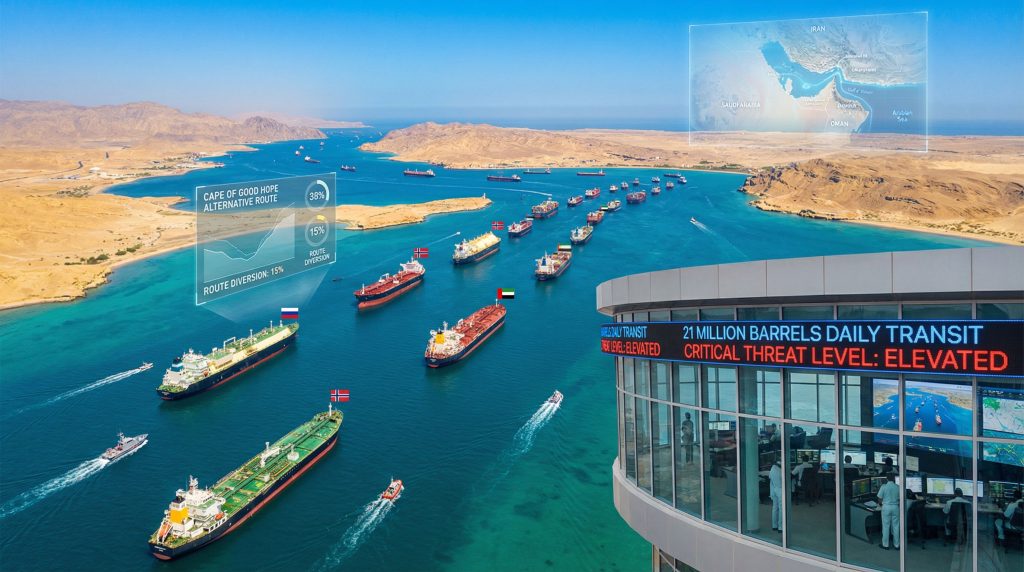
The Strait of Hormuz functions as a critical bottleneck for global energy markets, with approximately 21% of internationally traded petroleum liquids depending on this narrow passage. Under normal conditions, the strait facilitates transit for vessels carrying 21 million barrels of oil daily, representing roughly 30% of all seaborne oil trade.
Current crisis conditions have reduced transit capacity by 86% below baseline levels, creating immediate supply chain disruptions across global energy markets. For instance, this dramatic reduction stems from multiple factors including direct vessel targeting, insurance coverage cancellations, and precautionary routing adjustments by commercial operators. The US-China trade war impact on global markets has created additional vulnerabilities that compound these disruptions.
Market Response Patterns
Oil futures markets demonstrated immediate sensitivity to the developing crisis, with crude prices surging 13% as conflict escalation continued. Regional product markets showed particularly strong reactions:
- Asian oil product spreads strengthened significantly
- Naphtha prices spiked due to supply disruption concerns
- Gasoline markets surged on anticipated delivery delays
- Middle distillate prices rose across Asian trading hubs
President Trump's assessment that market impacts could have been more severe suggests government expectations for potential further escalation. His observation that oil price increases were constrained compared to worst-case scenarios indicates executive branch monitoring of strategic petroleum reserve deployment options. However, the Trump tariffs global impact continues to influence market dynamics alongside these regional tensions. Furthermore, the oil price rally amid tariffs demonstrates how multiple factors compound market volatility.
Alternative Routing Economics
Major shipping operators have implemented immediate operational adjustments to manage security risks, with Cape of Good Hope routing becoming the primary alternative for vessels avoiding Middle Eastern waters. This routing adjustment adds approximately 20-25 days to Asia-Europe transit times, significantly increasing fuel consumption, crew costs, and asset utilisation expenses.
The economic viability of Cape routing versus continued Strait of Hormuz transit depends on comparative risk assessments between additional voyage costs and insurance premium adjustments. Current operator decisions to absorb extended routing costs indicate that war risk insurance premiums and security concerns have exceeded the financial burden of alternative routing.
Insurance Industry Risk Management Responses
Marine insurance providers operate under reinsurer capacity constraints that create rapid response requirements during regional security crises. When reinsurance markets withdraw capacity for specific geographic areas, primary insurers must adjust coverage terms within compressed timeframes to maintain financial stability.
Skuld P&I's assessment reveals the underlying mechanism driving coverage cancellations: reinsurer appetite for war risk exposure contracts rapidly during crisis conditions, forcing immediate capacity withdrawals. Consequently, this market dynamic creates cascading effects where primary insurers must issue policy cancellations to align with reduced reinsurance support.
War Risk Coverage Cancellation Details
The 72-hour notice period for war risk cancellations reflects industry standards designed to provide policyholders minimal adjustment time while enabling insurers to limit exposure escalation. Coverage termination becomes effective at 00:00 GMT on March 5th, creating a narrow window for alternative arrangements.
| Coverage Component | Status | Geographic Scope |
|---|---|---|
| War Risk Extensions | Cancelled | Iranian Waters + 12nm Coastal Zone |
| Standard P&I Coverage | Maintained | All Areas |
| Mutual Protection | Preserved | Global Coverage |
| Freight/Demurrage Defence | Continued | Standard Terms |
NorthStandard's comprehensive cancellation notice encompasses multiple war risk extensions while preserving core maritime liability coverage. This segmentation allows vessels to maintain essential insurance protection for operational risks while eliminating coverage for conflict-related incidents.
Geographic Precision in Risk Assessment
Insurance cancellation notices employ precise coordinate-based geographic definitions to establish exclusion boundaries. NorthStandard's coverage termination applies to waters west of the line from Cape al-Ḥadd (22°42.5'N, 59°54.5'E) northeast to the Iran-Pakistan border (25°10.5'N, 61°37.5'E), enabling vessels to determine exact coverage status based on positioning data.
This coordinate-based approach allows commercial operators to calculate alternative routing options that maintain insurance protection while avoiding excluded waters. Such precision becomes critical for vessels with flexible routing capabilities seeking to balance security risks with maintained insurance coverage.
Commercial Shipping Operational Suspensions
Major container shipping operators have implemented immediate operational suspensions across the Strait of Hormuz, demonstrating coordinated industry response to elevated threat conditions. These decisions reflect risk assessments that prioritise crew safety and asset protection over schedule maintenance.
Maersk's comprehensive suspension encompasses both Hormuz transit operations and extended Red Sea routing adjustments. The company's decision to maintain Cape of Good Hope routing for Asia-Europe services indicates long-term operational planning that anticipates extended regional instability.
Container Shipping Response Matrix
| Operator | Suspension Scope | Alternative Measures | Service Impact |
|---|---|---|---|
| Maersk | Complete Strait cessation + Red Sea pause | Cape of Good Hope routing for ME11/MECL services | Schedule delays, routing adjustments |
| Hapag Lloyd | All Hormuz vessel transits | Alternative routing assessment | Suspension until further notice |
| MSC | Regional booking halt + safe shelter protocols | Vessel redirection to secure areas | All Middle East bookings suspended |
The coordinated nature of these suspensions indicates industry-wide risk assessment alignment rather than individual company decisions. Such synchronised responses suggest information sharing mechanisms between major operators and collective evaluation of threat intelligence.
Tanker Fleet Positioning Challenges
Approximately 700 vessels remain queued on both sides of the Hormuz chokepoint, creating logistical challenges for vessels committed to regional deliveries before suspension announcements. This vessel concentration requires coordination between port authorities, maritime security forces, and commercial operators to manage safe anchorage utilisation and emergency response capabilities.
Daily transit reductions of 86% below normal capacity create supply chain bottlenecks extending beyond immediate regional impacts. Vessels diverted to alternative routing must coordinate with destination ports for adjusted arrival schedules while managing extended voyage provisioning requirements.
Flag State Security Protocol Implementation
Norwegian Maritime Authority responses demonstrate how flag state responsibilities extend beyond vessel registration to active security coordination during regional crises. MARSEC Level 3 activation requires Norwegian-flagged vessels to implement enhanced security protocols regardless of vessel operator nationality or commercial considerations.
Flag state coordination mechanisms enable rapid information sharing between maritime authorities and vessel operators transiting affected waters. This relationship becomes particularly important when commercial operators require official guidance for insurance claims, route deviation approvals, and crew safety determinations.
International Regulatory Coordination
Maritime security responses require coordination between multiple flag states, port authorities, and international organisations to maintain effective threat assessment and response capabilities. The United Kingdom Maritime Trade Operations (UKMTO) advisory system provides continuous updates to vessels regardless of flag state, creating unified situational awareness across the international shipping community.
European Union Maritime Security Strategy activation protocols enable coordinated responses between member states while maintaining compatibility with NATO maritime security frameworks. This multilateral approach ensures that security responses remain consistent across different national jurisdictions operating in shared waterways.
The next major ASX story will hit our subscribers first
Geopolitical Implications for Regional Energy Security
Iran's strategic position controlling Strait of Hormuz access provides significant leverage over global energy markets during periods of regional tension. This geographic advantage enables influence over international oil prices and supply chain stability extending far beyond immediate regional boundaries.
Gulf Cooperation Council member states maintain collective security arrangements designed to coordinate responses to threats affecting shared maritime corridors. These frameworks become particularly relevant when infrastructure attacks target port facilities across multiple jurisdictions, as demonstrated by the Duqm port drone strike. The defence materials strategy has become increasingly important for nations dependent on secure supply chains through these vulnerable waterways.
Alternative Infrastructure Utilisation
Regional pipeline capacity offers limited alternatives to maritime transport for crude oil exports, with existing infrastructure unable to fully compensate for Strait of Hormuz closure. The Trans-Arabian Pipeline and UAE's strategic pipeline to Fujairah provide partial bypass capability but cannot match the volume capacity of unrestricted maritime transit.
Saudi Arabia's East-West Pipeline represents the most significant alternative routing option, though capacity limitations prevent full substitution for maritime exports. These infrastructure constraints explain why regional conflicts create immediate global market impacts despite existing alternative transport mechanisms.
Critical Infrastructure Vulnerability Assessment
Port facility targeting demonstrates expansion of hostile actions beyond vessel attacks to include shore-based infrastructure essential for regional energy exports. The Duqm port drone strike illustrates vulnerability of critical infrastructure to asymmetric attack methods that can disrupt operations without requiring major military capabilities.
UAE coastal facility security enhancements reflect recognition that port infrastructure represents high-value targets whose disruption creates cascading effects across regional supply chains. Enhanced protection measures must balance operational efficiency with security requirements while maintaining commercial viability.
Vessel Category Targeting Patterns
The March 1st attacks encompassed multiple vessel categories, indicating sophisticated targeting strategies rather than opportunistic incidents. Product tankers, crude carriers, and chemical vessels were all targeted, suggesting systematic efforts to disrupt different segments of the energy transport network.
This targeting diversity complicates defensive planning, as security measures must address threats across different vessel types with varying operational characteristics and security vulnerabilities. Chemical tankers present different risk profiles compared to crude carriers, requiring specialised protective approaches for each vessel category.
Emergency Response Protocol Development
Maritime authorities have implemented enhanced communication protocols enabling rapid information sharing between vessels, port authorities, and security forces operating in affected waters. These systems provide real-time situational updates essential for vessels making routing decisions under changing threat conditions.
Safe shelter area designations allow vessels already committed to regional transit to await improved security conditions rather than attempting potentially hazardous return voyages. Coordination of these shelter areas requires cooperation between multiple port authorities and maritime security organisations.
Search and Rescue Capability Enhancement
Elevated threat levels necessitate enhanced search and rescue coordination capabilities to respond to potential vessel incidents in affected waters. This includes positioning of rescue assets, coordination between military and civilian response capabilities, and establishment of communication protocols for emergency response activation.
International Maritime Security Construct (IMSC) frameworks provide multilateral coordination mechanisms for enhanced security operations during regional crises. Furthermore, Combined Maritime Forces (CMF) patrol intensification enables increased surveillance and response capabilities across affected waterways.
Long-term Maritime Security Policy Evolution
Current crisis responses will likely influence future maritime security policy development, particularly regarding enhanced threat assessment disclosure requirements and mandatory security evaluation protocols for vessels transiting high-risk areas.
Enhanced war risk disclosure requirements could mandate more detailed threat assessment sharing between insurers, vessel operators, and maritime authorities. Such requirements would improve collective situational awareness while potentially increasing administrative complexity for commercial operators.
Technology Integration Opportunities
Satellite monitoring system expansions offer potential for improved threat detection and vessel tracking capabilities across strategic waterways. Automated threat detection systems could provide more rapid response to developing incidents while reducing dependence on manual intelligence gathering and analysis.
Real-time risk assessment platforms could integrate multiple information sources including satellite imagery, vessel tracking data, and intelligence reports to provide continuously updated threat evaluations for specific routes and timing decisions.
Strategic Implications for Global Maritime Commerce
The March 2026 Strait of Hormuz crisis demonstrates the vulnerability of global supply chains to regional conflicts affecting strategic chokepoints. Current events highlight the interconnected nature of modern maritime commerce, where security disruptions in single waterways create worldwide economic impacts. The trade war oil markets analysis reveals how geopolitical tensions compound these vulnerabilities.
Investment strategies must account for the reality that maritime chokepoints represent single points of failure capable of disrupting global trade flows with minimal warning periods.
Energy security diversification efforts gain renewed importance as demonstrated supply chain vulnerabilities reveal the risks of concentrated routing through potentially contested waterways. Alternative transportation infrastructure development becomes a strategic priority for reducing dependence on vulnerable maritime passages.
Regional stability frameworks require strengthening to address the economic consequences of maritime security disruptions extending far beyond immediate conflict zones. International cooperation mechanisms must evolve to provide more effective crisis response coordination while maintaining commercial efficiency during stable periods.
The strait of Hormuz threat level raised to critical serves as a stark reminder of how quickly regional tensions can escalate to global economic disruption. However, the development of enhanced maritime security protocols provides frameworks for managing future crises. In addition, when the strait of Hormuz threat level raised to critical again in future scenarios, the lessons learned from this crisis will inform more effective response strategies.
Risk Disclosure: This analysis discusses ongoing geopolitical developments and maritime security risks that involve significant uncertainties. Future developments may differ materially from current assessments. Commercial and investment decisions should consider multiple scenario outcomes and consult current threat intelligence sources.
Looking to Navigate Geopolitical Market Volatility?
Discovery Alert's proprietary Discovery IQ model delivers real-time insights on ASX mineral discoveries, helping investors identify opportunities even during periods of global uncertainty and supply chain disruptions. Explore how major mineral discoveries have historically provided exceptional returns by visiting Discovery Alert's dedicated discoveries page, then begin your 14-day free trial to position yourself ahead of the market.