June 29, 2026
Maritime Security Frameworks and Energy Chokepoint Vulnerabilities
Global energy markets operate within complex regulatory frameworks that struggle to address modern chokepoint vulnerabilities. When Iran lays mines in Strait of Hormuz, the resulting disruption exposes fundamental gaps between international maritime law and contemporary security challenges. The current crisis demonstrates how traditional legal structures fail to anticipate asymmetric naval tactics that can paralyse global commerce without direct military confrontation. Furthermore, this situation provides critical insights for our comprehensive oil price rally analysis as geopolitical tensions reshape market dynamics.
When big ASX news breaks, our subscribers know first
Legal Frameworks Governing Strategic Waterway Access
United Nations Convention on the Law of the Sea Applications
The United Nations Convention on the Law of the Sea establishes critical precedents for navigation rights through strategic chokepoints. Article 38 guarantees transit passage rights through straits connecting areas of high seas, allowing commercial vessels to navigate without coastal state permission. However, these provisions assume conventional maritime operations rather than scenarios involving naval mining activities.
The Strait of Hormuz presents unique legal complexities due to its 33-kilometre width and overlapping territorial claims. Iran maintains a 12-nautical-mile territorial zone extending from its coastline, while Oman claims similar jurisdiction from its shores. These overlapping boundaries create ambiguous legal zones where mine deployment activities face different interpretations depending on precise geographic coordinates.
War Risk Classification and Insurance Market Response
Maritime insurance markets have rapidly adapted to mining threats through enhanced war-risk classifications. Lloyd's of London has updated its risk assessment protocols, with bunker fuel prices jumping 40% as shipping operations experience systematic constraints. Insurance premiums for vessels transiting threatened waters have increased by 200-300 basis points, costs that ultimately translate into higher shipping charges for petroleum exports.
The insurance industry's response reflects legal precedents established during the 1980s Tanker War. These historical incidents created the foundation for modern war-risk premium calculations and established operational protocols that continue to influence contemporary naval doctrine. Consequently, shipping companies are now reassessing their risk management strategies in light of current developments.
| Legal Framework | Jurisdiction | Mining Activity Classification | Enforcement Mechanism |
|---|---|---|---|
| UNCLOS Article 38 | International Waters | Navigation Right Violation | UN Security Council |
| Territorial Waters | 12-Mile Coastal Zone | Legitimate Defence Measure | Flag State Complaint |
| War Risk Insurance | Commercial Vessels | Insurable Peril | Premium Adjustment |
Strategic Reserve Coordination During Supply Emergencies
Global Reserve Capacity and Release Mechanisms
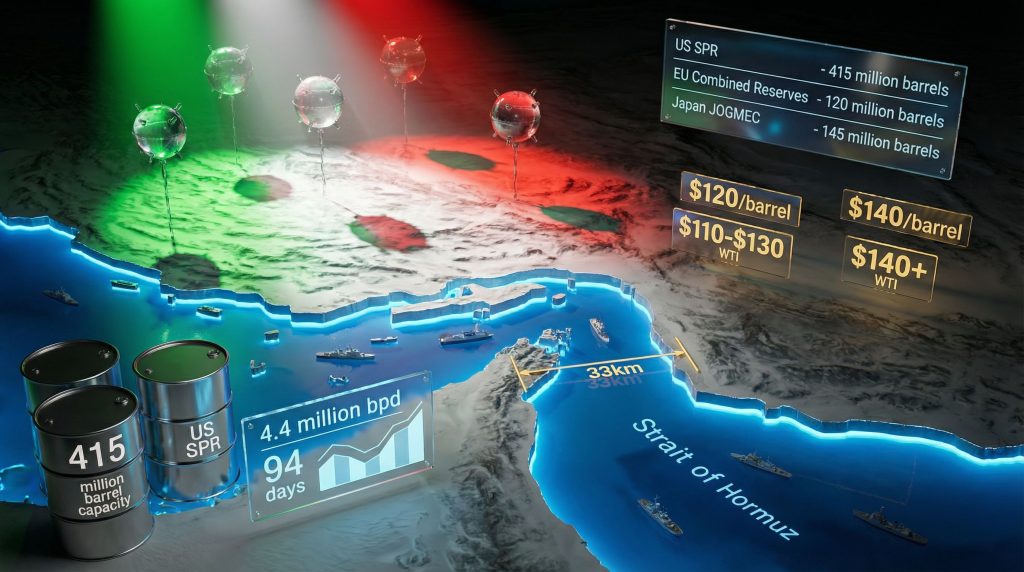
Strategic petroleum reserves function as market stabilisation instruments rather than permanent supply replacements. The United States maintains approximately 415 million barrels in Strategic Petroleum Reserve storage, representing the world's largest emergency stockpile by volume, though substantially below historical peaks of over 700 million barrels maintained around 2011.
Maximum sustainable daily release rates from the U.S. SPR reach approximately 4.4 million barrels per day under emergency conditions. This provides theoretical operational duration of 94 days at maximum drawdown rates. However, these volumes pale against the 20 million barrels per day that normally transit the Strait of Hormuz, highlighting mathematical limitations of reserve-based solutions.
International Energy Agency coordination protocols activate when supply disruptions exceed 7% of normal global consumption. Recent policy discussions indicate G7 nations are considering collective releases of up to 400 million barrels from combined national reserves. This demonstrates coordinated approaches to supply crisis management, particularly relevant for understanding OPEC production impact on global markets.
Presidential Authorization and Congressional Oversight
U.S. SPR release authority derives from the Energy Policy and Conservation Act, requiring presidential authorization for emergency drawdowns. The typical release process involves 48-72 hours from authorization to first barrel delivery into commercial markets. Congressional notification becomes mandatory for releases exceeding predetermined thresholds.
Reserve composition presents additional logistical challenges, as SPR crude varies in API gravity and sulfur content. Heavy, high-sulfur crude from certain storage locations cannot substitute efficiently for light, sweet crude in refineries optimised for specific feedstock qualities. This limitation significantly impacts practical release flexibility during crisis situations.
Economic Thresholds and Demand Destruction Mechanisms
Price Elasticity and Consumer Behaviour Modification
Federal Reserve economic modelling identifies approximately $120 per barrel as a modern recession trigger where sustained energy costs begin eroding consumer spending and economic momentum. Current WTI crude prices have surged past $110 per barrel, approaching levels that historically trigger significant demand responses across transportation and industrial sectors.
Oil demand exhibits short-run inelasticity with coefficients of approximately -0.1 to -0.2, meaning 10% price increases produce only 1-2% demand reduction in near-term periods. However, long-run elasticity measures reach -0.4 to -0.6, indicating extended high-price periods eventually trigger 4-6% demand reductions. Consumers adapt through efficiency improvements and behavioural changes over extended timeframes.
Transportation sectors account for 65-70% of petroleum demand in developed economies, exhibiting lower elasticity than industrial applications. Commuting and essential goods delivery cannot easily substitute alternatives short-term. Airline industry data shows early demand response signs, with carriers reducing scheduled flights and implementing fuel surcharges that fail to fully offset elevated operational costs.
For broader economic implications, our trade impact insights examine how supply disruptions intersect with existing trade tensions. Additionally, recent executive order insights highlight government efforts to enhance energy security through domestic production initiatives.
Sectoral Vulnerability Analysis
Transportation and Logistics Impact:
- Immediate cost pressures with limited substitution options
- Fuel surcharge implementation across trucking and shipping
- Consumer discretionary travel reduction within 3-6 months
Industrial and Power Generation Response:
- Medium-term fuel switching capabilities (weeks to months)
- Alternative energy source deployment acceleration
- Production cost pass-through to consumer pricing
Economic Growth Correlation:
- Petroleum demand elasticity of +1.0 relative to GDP growth
- Direct price elasticity reducing consumption per economic unit
- Indirect GDP reduction further decreasing petroleum demand
Naval Mine Warfare Capabilities and Countermeasures
Technical Assessment of Mining Systems
According to reports from CBS News, Iran maintains an estimated 5,000+ mine inventory with diverse deployment capabilities ranging from contact mines to influence-activated systems. The Strait of Hormuz geographic constraints, including shallow depths averaging 50-100 metres in central shipping lanes, provide tactical advantages for defensive mining operations while complicating countermeasure responses.
U.S. Navy mine countermeasure vessels require substantial response times to clear suspected mining areas. This is particularly challenging given the strait's narrow chokepoint geography. Modern mine countermeasure operations involve systematic sweeping protocols that can require weeks rather than days to establish secure shipping corridors through previously mined waters.
Technological Countermeasure Limitations
Contemporary mine countermeasure technology faces several operational constraints in chokepoint environments. Shallow water operations limit the effectiveness of traditional minesweeping equipment, while influence mines responding to magnetic or acoustic signatures require specialised detection and neutralisation procedures.
Commercial vessel protection relies primarily on routing modifications and enhanced lookout procedures rather than active countermeasures. International Maritime Organisation safety protocols emphasise avoidance rather than direct mine clearance for civilian shipping. This creates dependency on naval forces for waterway security, as detailed in Oil Price's analysis of supply risks.
Economic Scenario Planning and Policy Response Frameworks
Contained Disruption Scenario ($90-$110 WTI)
Limited SPR releases of 1-2 million barrels per day maintained for 30-60 day periods represent initial policy responses to moderate supply constraints. Enhanced diplomatic engagement protocols accompany these releases, focusing on coalition-building and conflict de-escalation rather than sustained market intervention.
Temporary fuel tax relief considerations emerge during contained disruption scenarios, though implementation faces Congressional approval requirements. Questions remain about effectiveness during genuine supply shortages rather than price manipulation scenarios.
Structural Shock Scenario ($110-$130 WTI)
Coordinated G7 reserve releases totalling 3-4 million barrels per day combined represent escalated policy responses to sustained supply disruption. Emergency transportation sector support programmes activate, including potential freight rate stabilisation and essential services fuel allocation systems.
Accelerated renewable energy deployment incentives accompany structural shock responses. However, meaningful capacity additions require months to years rather than weeks for implementation. Policy focus shifts toward longer-term energy security improvements alongside immediate crisis management, particularly important given current recession market analysis suggesting broader economic vulnerabilities.
Severe Disruption Scenario ($140+ WTI)
Maximum sustainable SPR drawdown rates activate alongside economic recession mitigation packages addressing broader economic impacts of sustained high energy costs. National security supply chain emergency protocols engage, potentially including defence production act applications to energy sector operations.
International coordination expands beyond reserve releases to encompass alternative supply route development and emergency refining capacity optimisation. Cape of Good Hope shipping route capacity becomes critical for maintaining global petroleum distribution systems during prolonged disruptions.
The next major ASX story will hit our subscribers first
Investment Risk Assessment and Market Psychology
Geopolitical Risk Evaluation Methodologies
Probability-weighted scenario analysis for portfolio allocation must incorporate multiple disruption pathways and duration assumptions. Current market psychology reflects immediate supply threat pricing rather than sustained disruption scenario planning. This creates potential volatility as actual supply impacts become apparent over time.
Correlation analysis between geopolitical events and energy price volatility indicates modern markets respond more rapidly but potentially less sustainably to supply threat announcements. Saudi Aramco production reductions of 5 million barrels per day during peak disruption periods demonstrate coordinated supply responses that amplify market psychology effects.
Hedging Strategies for Extended Disruption
Energy sector investment compliance requires enhanced sanctions compliance procedures and ESG considerations in geopolitically sensitive projects. Disclosure requirements for geopolitical risk exposure have expanded following recent supply chain disruptions across multiple commodity markets.
Risk Management Framework Components:
- Geographic diversification beyond Middle East exposure
- Alternative energy infrastructure investment weighting
- Supply chain resilience assessment for energy-dependent sectors
- Currency hedging for oil-importing economy exposures
Emergency Powers and Government Market Intervention
Legal Authorities for Crisis Response
Defence Production Act applications to energy sectors provide executive branch authorities for production prioritisation and resource allocation during national emergencies. International Emergency Economic Powers Act scope encompasses energy trade restrictions and strategic reserve management coordination with allied nations.
Federal price control mechanisms face economic effectiveness questions, as historical precedents demonstrate price controls during genuine shortages typically create allocation problems rather than affordability solutions. Congressional emergency legislation procedures enable rapid response capability but require bipartisan cooperation for implementation.
Inter-Agency Coordination Protocols
Department of Energy, Treasury, and State Department coordination protocols activate during energy emergencies, establishing unified command structures for domestic and international response coordination. Public-private partnership frameworks enable government-industry cooperation while maintaining market-based allocation mechanisms.
Emergency Response Hierarchy:
- Presidential emergency declaration and SPR authorisation
- Congressional notification and oversight activation
- International coordination through IEA emergency protocols
- Private sector engagement for logistical implementation
Market Participant Guidance and Policy Monitoring
Current regulatory frameworks assume disruptions lasting weeks rather than months, creating potential gaps in sustained crisis response capabilities. Extended chokepoint closures would require unprecedented coordination between strategic reserves, alternative supply routes, and demand management policies operating simultaneously.
Critical Monitoring Indicators:
- SPR release announcements and G7 coordination signals
- Maritime insurance regulation changes and war risk classifications
- Congressional hearing schedules on energy emergency authority expansions
- International Energy Agency emergency action threshold assessments
Regulatory Policy Insight: Market participants should prepare for potential regulatory framework evolution as current crisis exposes gaps between existing authorities and modern supply chain vulnerabilities. Enhanced maritime security cooperation agreements and critical infrastructure protection legislation updates may emerge from current disruption experiences.
Energy market participants must balance immediate crisis response with longer-term strategic positioning as regulatory frameworks adapt to contemporary security challenges. The current disruption provides valuable precedents for future policy development while highlighting the limitations of existing emergency response mechanisms in addressing systematic chokepoint vulnerabilities.
This analysis reflects current market conditions and regulatory frameworks as of March 2026. Energy market participants should consult qualified advisors for specific investment and compliance guidance appropriate to their particular circumstances.
Need Real-Time Market Intelligence During Energy Crises?
Discovery Alert's proprietary Discovery IQ model delivers instant notifications on significant ASX mineral discoveries, providing subscribers with actionable insights when geopolitical events reshape energy and commodity markets. Access comprehensive historic discovery returns and begin your 14-day free trial today to secure your market-leading advantage during volatile periods.