June 28, 2026
Understanding Maritime Security Frameworks in Critical Shipping Lanes
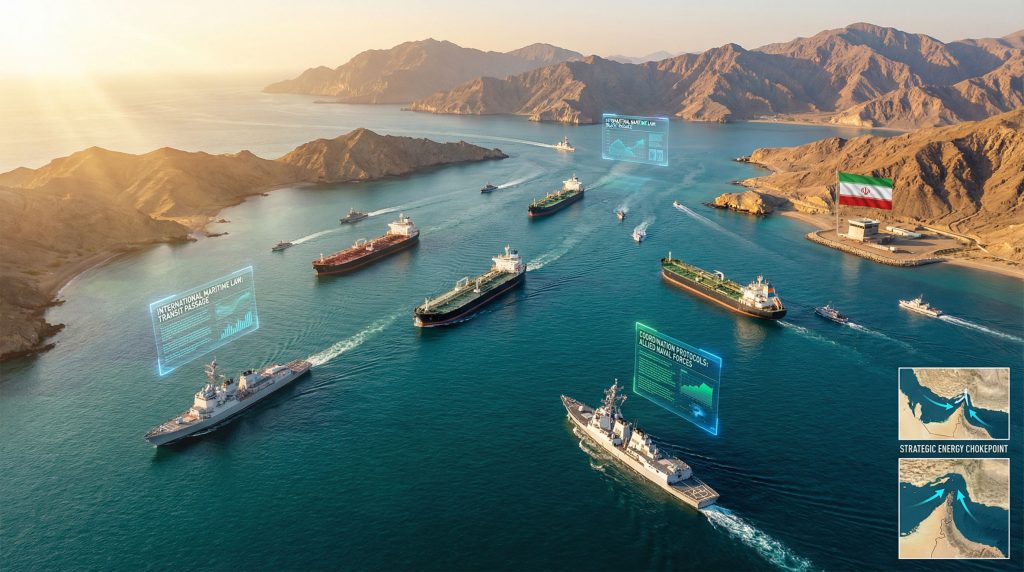
Energy markets operate within a complex web of maritime security policies that determine how global supply chains function during geopolitical crises. The Strait of Hormuz represents the most critical energy chokepoint globally, handling approximately 21% of global petroleum liquids and natural gas flows. This narrow waterway has become the focal point for understanding how naval escort policies intersect with energy security frameworks, particularly following recent Hormuz naval escort claim developments that have highlighted the delicate nature of communication protocols in this strategic region.
Maritime security frameworks governing critical shipping lanes operate through multiple layers of international law, bilateral agreements, and multilateral coordination mechanisms. The complexity of these systems becomes apparent when examining how different nations interpret their responsibilities under the United Nations Convention on the Law of the Sea (UNCLOS) regarding freedom of navigation versus territorial sovereignty.
Furthermore, the interconnected nature of global energy markets means that any disruption or miscommunication regarding escort operations can trigger immediate market responses. The recent volatility in crude oil prices demonstrates how sensitive these markets are to information regarding maritime security operations.
Legal Foundations of Naval Escort Operations
International maritime law provides the foundational framework for naval escort operations, though interpretation varies significantly among key stakeholders. UNCLOS Article 87 establishes freedom of navigation principles in international waters, while Article 21 grants coastal states regulatory authority within territorial limits extending 12 nautical miles from their baseline.
Naval escort operations must navigate these legal complexities while maintaining operational effectiveness. The distinction between innocent passage through territorial waters and transit passage through international straits creates different legal obligations for escort vessels. In the Strait of Hormuz, the narrowest point measures only 21 miles wide, meaning portions fall within both Iranian and Omani territorial waters.
Historical precedents from Operation Earnest Will (1987-1988) established important legal frameworks for escort missions. During this operation, the United States Navy escorted 11 Kuwaiti tankers reflagged under American registration, creating diplomatic immunity protections while operating in contested waters. This precedent demonstrates how legal mechanisms can provide operational flexibility within existing international law structures.
Policy Architecture for Energy Corridor Protection
Energy corridor protection policies operate through interconnected systems involving strategic petroleum reserves, emergency supply protocols, and international coordination mechanisms. The United States maintains approximately 714 million barrels in its Strategic Petroleum Reserve, designed to provide 90 days of import protection during supply disruptions.
In addition, International Energy Agency (IEA) coordination protocols require member nations to maintain 90 days of net oil import equivalent in emergency reserves. These requirements create policy triggers that activate during supply disruptions, establishing automatic response mechanisms when specific thresholds are breached.
The oil price rally analysis of recent market movements shows how quickly energy markets respond to supply security information, highlighting the importance of clear communication protocols.
| Emergency Response Mechanism | Activation Threshold | Response Timeline |
|---|---|---|
| Strategic Reserve Release | 7% supply disruption | 24-48 hours |
| IEA Coordination Protocol | 5% member nation impact | 72 hours |
| NATO Article 5 Consultation | Direct attack on member vessel | Immediate |
| Combined Maritime Forces | Threat level elevation | 12-24 hours |
When big ASX news breaks, our subscribers know first
Regulatory Challenges Defining Modern Naval Escort Programs
Modern naval escort programs face unprecedented regulatory challenges stemming from technological advancement, evolving threat landscapes, and changing international law interpretations. These challenges require sophisticated policy frameworks that balance operational effectiveness with legal compliance and diplomatic considerations.
Moreover, the current geopolitical climate, characterised by increasing tensions and trade war and oil markets dynamics, has created additional complexity in escort operation planning and execution.
Institutional Resource Allocation Requirements
Military asset deployment for escort missions requires complex authorization processes involving multiple government agencies and oversight bodies. The U.S. Congress maintains constitutional authority over military deployments through the War Powers Resolution, requiring presidential notification within 48 hours of military engagement and limiting operations to 60 days without congressional authorization.
Resource allocation frameworks must account for competing global commitments while maintaining escort capabilities. The U.S. Navy currently operates approximately 296 deployable vessels, with 60-70 ships typically deployed globally at any given time. Sustained escort operations require dedicating 8-12 vessels minimum for effective coverage, representing significant resource commitment.
Consequently, budget allocation mechanisms for escort operations involve multiple appropriations categories including operations and maintenance, military personnel, and procurement accounts. Extended escort missions can cost $50-100 million monthly depending on force structure and operational intensity, requiring supplemental appropriations for sustained operations.
Insurance and Risk Management Policy Frameworks
Maritime insurance markets operate through complex risk assessment frameworks that directly impact energy transportation costs during escort operations. War risk premiums for tanker operations in the Persian Gulf can increase from 0.025% of vessel value to 0.5-1.0% during heightened threat periods, representing millions of dollars in additional costs per voyage.
Lloyd's of London classification systems establish standardised risk categories that determine insurance availability and pricing. The Joint War Committee maintains a "Listed Areas" designation that triggers war risk insurance requirements. When areas like the Strait of Hormuz receive this designation, it automatically increases insurance costs and reduces available coverage options.
However, government-backed maritime insurance programmes provide alternative coverage mechanisms during market failures. The United States maintains war risk insurance programmes through the Maritime Administration, offering coverage when commercial insurance becomes unavailable or prohibitively expensive. These programmes require congressional appropriation and presidential activation during declared emergencies.
Energy Market Regulatory Responses to Supply Disruption Claims
Energy market regulations incorporate sophisticated mechanisms designed to respond rapidly to supply disruption claims while maintaining market stability. These systems operate through automated triggers, manual intervention protocols, and international coordination frameworks that activate based on specific threat assessments and supply impact calculations.
The recent Hormuz naval escort claim incident perfectly illustrates how rapidly these systems can activate and the profound impact of communication protocols on market stability.
Emergency Energy Policy Activation Triggers
Strategic Petroleum Reserve release criteria operate through quantitative assessment models that evaluate supply disruption magnitude, duration, and economic impact. The Department of Energy maintains three categories of release authority: test sales, exchange agreements, and emergency drawdowns. Emergency drawdowns require presidential authorisation and can release up to 4.4 million barrels daily for up to 90 days.
Price volatility intervention thresholds utilise complex algorithms incorporating futures market movements, physical supply indicators, and macroeconomic factors. When West Texas Intermediate crude futures experience daily movements exceeding 10% combined with supply disruption indicators, automatic review processes activate within federal agencies.
The Hormuz naval escort claim demonstrated these mechanisms in action when WTI crude futures dropped 14% following social media posts about escort operations, according to CNBC's coverage of the incident. This price movement, occurring within 30 minutes of the initial report, illustrates how quickly markets respond to supply security information and the importance of communication protocols in energy policy implementation.
Commodity Market Regulatory Responses
Futures market circuit breaker mechanisms provide automatic trading halts during extreme volatility events. The New York Mercantile Exchange implements three-tier halt system: 7% moves trigger 15-minute halts, 13% moves trigger 30-minute halts, and 20% moves halt trading until the next session. These mechanisms prevent cascade selling while allowing market adjustment to new information.
For instance, energy trading oversight intensifies during geopolitical crises through enhanced monitoring systems operated by the Commodity Futures Trading Commission. Position reporting requirements increase, with large traders required to provide daily position reports instead of weekly submissions during designated crisis periods.
Cross-border energy flow regulatory adjustments involve coordination between multiple national authorities and international organisations. Pipeline operators must obtain emergency authorisations for flow direction changes, while liquefied natural gas terminals require safety and security clearances for increased throughput operations.
Policy Precedents Shaping Current Naval Escort Decisions
Historical naval escort operations provide crucial policy precedents that inform current decision-making frameworks. These precedents establish legal boundaries, operational parameters, and diplomatic protocols that guide contemporary escort policy development.
Furthermore, the broader context of US-China trade war impact on global markets adds additional layers of complexity to current escort decision-making processes.
Historical Regulatory Frameworks for Maritime Protection
Operation Earnest Will created comprehensive policy structures that remain influential in current escort planning. This operation involved 127 convoy missions over 14 months, protecting 259 merchant vessel transits through the Persian Gulf. The legal framework developed during this period established precedents for vessel reflagging, neutral shipping protection, and rules of engagement in escort operations.
The policy structure required extensive interagency coordination involving the Department of Defense, State Department, Department of Transportation, and Treasury Department. This coordination model established information sharing protocols and decision-making hierarchies that continue to influence current escort policy frameworks.
Additionally, Combined Maritime Forces coordination models provide multilateral frameworks for maritime security operations. Established in 2002, this coalition includes 34 nations and operates through five task forces covering different geographic areas and mission sets. The legal and operational frameworks developed through CMF operations provide templates for rapid escort mission activation.
Multilateral Policy Coordination Mechanisms
G7 energy security policy alignment operates through regular ministerial meetings and crisis coordination protocols. These mechanisms enable rapid information sharing and coordinated response measures during energy supply disruptions. The G7 maintains emergency consultation protocols that can activate within 24 hours of significant supply threat emergence.
European Union energy supply diversification regulations create additional coordination requirements for escort operations affecting EU energy imports. The EU imports approximately 3 million barrels daily of crude oil through the Strait of Hormuz, representing 20% of total EU crude imports. Disruption to these flows triggers automatic consultation mechanisms under EU energy security regulations.
However, OPEC+ production adjustment policies interact with escort operations through complex market dynamics. When escort operations reduce transportation capacity, producing nations may implement compensatory production increases to maintain market stability. These adjustments require coordination between escort operation planners and international energy organisations to prevent market disruption.
Institutional Constraints Limiting Naval Escort Implementation
Military readiness requirements and deployment constraints significantly limit naval escort implementation capabilities. These constraints operate through force structure limitations, operational tempo restrictions, and competing global commitment requirements that restrict available assets for escort missions.
Military Readiness and Deployment Regulations
Fleet allocation requirements for global commitments create significant constraints on escort operation capability. The U.S. Navy maintains presence requirements in multiple theatres simultaneously, including Indo-Pacific operations, European deterrence missions, and Middle East security operations. These commitments typically require 40-50% of deployable fleet assets, limiting availability for additional escort missions.
Rules of engagement frameworks for escort missions require extensive legal and operational development before mission commencement. These frameworks must address scenarios including: hostile vessel approach, mining activities, aerial threats, and cyber attacks on escort vessels or protected merchants. Development and approval of comprehensive rules of engagement typically requires 30-60 days for complex escort missions.
Command structure protocols involve multiple organisational layers that can slow escort mission authorisation and execution. Escort operations typically require coordination between regional combatant commands, service component commands, task force commanders, and individual ship commanding officers. This command structure ensures proper authority but can delay rapid response capabilities.
Congressional Authorization and Oversight Requirements
War Powers Resolution implications create potential legal constraints for extended escort operations. While initial escort deployments may fall under existing presidential authorities, operations exceeding 60 days require specific congressional authorisation. This requirement can create uncertainty in escort planning for prolonged threats.
Defence appropriations committee oversight mechanisms require regular briefings and cost reporting for escort operations. Committees maintain authority to restrict or redirect funding for escort missions through annual appropriations processes and supplemental funding requirements. Extended operations costing more than $100 million typically trigger enhanced oversight requirements.
In addition, intelligence community assessment requirements involve multiple agencies providing threat analysis, operational planning support, and post-mission evaluation. The Defense Intelligence Agency, Central Intelligence Agency, and National Security Agency contribute specialised assessments that inform escort operation planning and execution decisions.
Economic Policy Tools Addressing Energy Supply Disruptions
Federal and international economic policy tools provide crucial mechanisms for addressing energy supply disruptions during escort operations. These tools operate through regulatory flexibility measures, price intervention mechanisms, and international coordination frameworks designed to maintain market stability and energy security.
The recent developments in tariffs impact on markets demonstrate how various economic policy tools can interact with energy security measures.
Federal Energy Emergency Response Regulations
Department of Energy emergency authority activation provides broad regulatory flexibility during energy supply crises. The Energy Policy and Conservation Act grants DOE authority to override state and local regulations, expedite infrastructure approvals, and mandate supply allocations during declared energy emergencies. These authorities require presidential activation and congressional notification within 48 hours.
Interstate energy transport regulatory flexibility enables rapid supply chain adjustments during disruptions. The Federal Energy Regulatory Commission can waive normal permitting requirements for pipeline operations, allowing flow reversals, capacity increases, and emergency interconnections between previously separate systems. These emergency authorities can activate within 24 hours of formal request submission.
Price gouging prevention policy frameworks operate through federal and state mechanisms that monitor pricing during supply disruptions. The Federal Trade Commission increases market surveillance during energy emergencies, investigating price increases exceeding normal market fundamentals. State-level price gouging laws typically activate automatically during declared emergencies, with penalties ranging from $1,000 to $25,000 per violation.
International Economic Coordination Mechanisms
World Trade Organization trade disruption response protocols provide frameworks for managing economic impacts of supply disruptions. WTO agreements include security exceptions that allow trade restrictions during national security emergencies, but require notification and justification to prevent protectionist abuse. These mechanisms balance security requirements with international trade obligations.
International Monetary Fund financial stability assessment frameworks monitor economic impacts of energy supply disruptions on global financial systems. IMF surveillance includes quarterly assessments of energy price impacts on member nation economies, with enhanced monitoring during supply crisis periods. These assessments inform coordinated policy responses and financial support mechanisms.
Consequently, World Bank energy infrastructure resilience programmes provide financing and technical assistance for energy security improvements. Current programmes include $2.3 billion in energy security lending and $850 million in technical assistance for supply chain diversification projects. These programmes support long-term policy objectives while addressing immediate disruption impacts.
The next major ASX story will hit our subscribers first
Regional Security Policy Influences on Global Energy Markets
Regional security policies in key energy-producing areas create cascading effects throughout global energy markets. These policies operate through collective security arrangements, sanctions regimes, and maritime cooperation agreements that directly impact energy transportation and pricing mechanisms.
The emergence of a multipolar global economy has further complicated regional security arrangements and their impact on global energy markets.
Middle East Regional Security Architecture
Gulf Cooperation Council collective security policy frameworks establish coordinated response mechanisms for energy infrastructure protection. The GCC Peninsula Shield Force includes 40,000 personnel across six member nations, with specific responsibilities for protecting energy facilities and transportation infrastructure. These forces operate under integrated command structures that can coordinate with international escort operations.
Iran sanctions regime enforcement mechanisms create complex compliance requirements for energy transportation operations. Current sanctions affect approximately 1.5 million barrels daily of Iranian crude exports, requiring extensive documentation and verification procedures for vessels transiting regional waters. Escort operations must account for sanctions compliance requirements that can delay mission execution.
Regional maritime security cooperation agreements include information sharing protocols, joint training exercises, and coordinated patrol operations. The Regional Maritime Security Construct includes Bahrain, Kuwait, Saudi Arabia, UAE, and United Kingdom, providing 24/7 maritime domain awareness throughout the Persian Gulf. These arrangements enhance escort operation effectiveness through improved intelligence and coordination capabilities.
Allied Nation Energy Security Coordination
NATO energy security policy integration operates through Article 5 collective defence provisions and specialised energy security committees. NATO's Energy Security Centre of Excellence provides policy analysis, crisis planning, and capability development support for member nations. Energy infrastructure attacks can trigger Article 5 consultations, potentially expanding escort operations into collective defence missions.
Indo-Pacific maritime security partnerships create alternative frameworks for energy transportation protection in that region. The Quadrilateral Security Dialogue includes energy security cooperation among United States, Australia, India, and Japan, with combined energy imports exceeding 15 million barrels daily through regional shipping lanes. These partnerships provide escort operation models applicable to other regions.
Transatlantic energy supply chain protection protocols involve both NATO and bilateral agreements addressing energy infrastructure vulnerabilities. The United States and European Union maintain energy security consultations that coordinate policy responses to supply disruptions affecting both regions. These mechanisms ensure aligned approaches to escort operations and supply chain protection.
Long-Term Policy Implications and Future Frameworks
Emerging challenges in maritime energy security require evolution of existing policy frameworks to address technological advancement, changing threat landscapes, and shifting global energy patterns. These developments necessitate comprehensive policy adaptation while maintaining operational effectiveness.
Energy Transition Policy Acceleration Mechanisms
Renewable energy deployment regulatory fast-tracking receives enhanced priority during traditional energy supply disruptions. Federal agencies can expedite environmental reviews, grid interconnection approvals, and construction permits for renewable projects during declared energy emergencies. These mechanisms reduce typical project timelines from 3-5 years to 12-18 months for priority installations.
Critical mineral supply chain diversification policies address dependencies that affect both traditional and renewable energy systems. The Department of Defense maintains a Critical Minerals List including 50 materials essential for energy and defence applications. Supply chain disruptions affecting these materials trigger enhanced mining investment incentives and alternative supply source development programmes.
Energy independence legislative framework development includes provisions for reduced import dependency and enhanced domestic production capabilities. Recent legislation targets energy import reductions of 40% by 2030 through combined domestic production increases and demand reduction measures. These frameworks reduce long-term requirements for escort operations while maintaining short-term protection capabilities.
Maritime Security Policy Evolution Requirements
Next-generation naval escort capability development incorporates autonomous systems, enhanced surveillance technology, and improved threat detection capabilities. The Navy's Distributed Maritime Operations concept includes unmanned surface vessels for escort missions, potentially reducing human risk while maintaining protection effectiveness. Initial deployment of these systems is planned for 2027-2029.
Autonomous vessel protection system regulations require new legal frameworks addressing liability, rules of engagement, and international law compliance for unmanned escort operations. Current international maritime law does not adequately address autonomous vessel operations, requiring new treaty development or existing treaty interpretation updates.
Space-based maritime surveillance policy frameworks provide enhanced domain awareness for escort operations through satellite monitoring and communication systems. The Space Force maintains dedicated maritime surveillance satellites providing real-time tracking of surface vessels throughout global shipping lanes. Integration of space-based systems with escort operations requires new command and control protocols.
Institutional Learning and Policy Adaptation Mechanisms
Crisis response policy refinement processes incorporate lessons learned from escort operations and supply disruption management. The Department of Energy maintains after-action review protocols that evaluate policy effectiveness and identify improvement opportunities. These reviews inform policy updates and training programme development for future crisis response.
Inter-agency coordination improvement protocols address communication gaps and decision-making delays identified during escort operations. Recent policy updates include standardised information sharing systems, pre-positioned liaison officers, and streamlined authorisation procedures to reduce response times during future crises.
Similarly, international cooperation framework enhancement strategies focus on expanding multilateral participation in escort operations and burden-sharing arrangements. Current initiatives include ally capability development programmes, shared cost mechanisms, and integrated command structures that distribute escort responsibilities among partner nations while maintaining operational effectiveness.
What Are the Regulatory Preparedness Requirements for Future Disruptions?
Early warning system policy integration combines intelligence assessment, market monitoring, and threat analysis to provide advance notice of potential supply disruptions. These systems generate risk assessments updated every 12 hours during elevated threat periods, enabling proactive escort deployment and supply chain adjustments before disruptions occur.
Rapid response authorisation streamlining reduces bureaucratic delays during crisis situations through pre-approved operational plans and delegated authority structures. These mechanisms enable escort operation activation within 6-12 hours of threat emergence, compared to 24-72 hours required under previous authorisation procedures.
Multi-domain security policy coordination requirements address evolving threat landscapes that combine maritime, cyber, and space-based challenges to energy transportation systems. Future escort operations must account for cyber attacks on navigation systems, satellite communication disruption, and information warfare targeting energy markets and transportation coordination.
The recent Hormuz naval escort claim incident, as reported by Al Jazeera, underscores the critical importance of accurate communication protocols and the potential for single social media posts to trigger significant market volatility. This case study demonstrates the need for robust verification procedures and coordinated messaging strategies in future crisis management.
Disclaimer: This analysis is based on publicly available information and policy frameworks current as of publication date. Energy market conditions and security policies change rapidly during crisis periods. Readers should consult current government sources and qualified professionals for up-to-date information regarding specific situations and investment decisions.
Looking to Capitalise on Energy Market Volatility?
Discovery Alert's proprietary Discovery IQ model delivers real-time notifications on significant ASX mineral discoveries, helping investors identify actionable opportunities in commodities and energy-related stocks ahead of the broader market. With geopolitical tensions continuously affecting global energy markets, having immediate access to discovery alerts can provide the competitive edge needed to navigate volatile commodity markets successfully. Begin your 14-day free trial today to position yourself ahead of market movements.