June 6, 2026
Maritime security incidents in global chokepoints reveal fundamental vulnerabilities in the interconnected energy and shipping networks that underpin modern economic systems. When commercial vessels face hostile actions in strategically critical waterways, the resulting disruptions cascade through commodity markets, supply chains, and geopolitical relationships in ways that extend far beyond immediate shipping delays. Understanding these dynamics becomes essential as energy security trends increasingly operate under elevated security risks and complex international tensions.
Geographic Positioning and Strategic Importance of Maritime Chokepoints
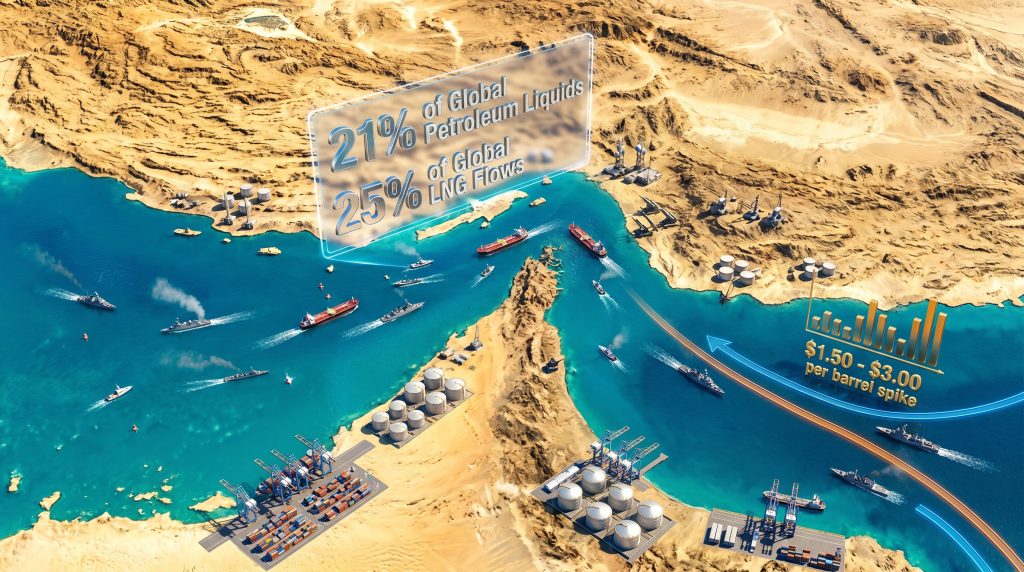
The world's most critical energy transit corridor represents a narrow passage connecting the Persian Gulf to the Arabian Sea, facilitating approximately 20% of global petroleum liquids and liquefied natural gas supplies according to recent market analysis. This concentration of energy throughput creates systematic vulnerability where single incidents can trigger immediate global market responses.
The 21-mile-wide passage between Iran and Oman handles daily transit of 15-20 commercial vessels carrying between 17-20 million barrels of crude oil and refined products. This traffic density, combined with the lack of economically viable alternative routes, creates conditions where even temporary disruptions generate significant price volatility across international energy markets.
Recent security incidents demonstrate this vulnerability pattern clearly. When gunfire attacks in the Strait of Hormuz targeted container ships in April 2026, Brent crude futures surged $1.59 per barrel (1.6% increase) to $100.07, while West Texas Intermediate gained $1.51 per barrel (1.7% increase) to $91.18 within hours of the reported incidents.
Economic Vulnerability Assessment
The concentration of Gulf energy exports through a single maritime corridor creates asymmetric dependencies affecting global economic stability. Asia-Pacific energy importers face particularly acute exposure, with regional economies dependent on consistent energy flows to maintain industrial production and economic growth.
Alternative routing through the Cape of Good Hope adds approximately $500,000 to $2 million per journey in additional shipping costs, representing significant expense increases that ultimately affect energy pricing for end consumers. These detour economics explain why traders price in substantial risk premiums whenever chokepoint security incidents occur.
Current inventory conditions amplify vulnerability to supply disruptions. Crude oil inventory fell by 4.5 million barrels in the week preceding the April 2026 incidents, while gasoline and distillate stocks also declined, creating market conditions where buffer capacity remains limited and traders respond aggressively to potential supply interruption scenarios.
When big ASX news breaks, our subscribers know first
Market Response Mechanisms to Security Incidents
Oil futures markets demonstrate remarkably swift response patterns to maritime security events, with price discovery occurring within minutes of incident reporting. The April 2026 gunfire attacks in the Strait of Hormuz produced synchronized increases across major benchmarks, indicating that global energy trading systems price in chokepoint risks through immediate repricing mechanisms.
Immediate Price Surge Patterns
The documented price responses reflect sophisticated risk assessment by commodity traders who understand that chokepoint disruptions can escalate rapidly. Both Brent and WTI contracts rose approximately 3% on Tuesday preceding the Wednesday gunfire incidents, suggesting that market participants were already pricing in elevated geopolitical risks before the specific security events occurred.
These price movements occur through several distinct mechanisms:
• Risk premium calculations incorporating probability assessments of extended disruptions
• Hedge fund positioning taking long positions ahead of anticipated volatility
• Commercial hedging activity by refiners and energy companies protecting against supply cost increases
• Speculative trading amplifying price movements through momentum-based strategies
The 200-300% increase in trading volumes during crisis periods reflects this concentrated market activity, with institutional investors rapidly repositioning portfolios to account for changed risk scenarios.
Historical Precedent Analysis
Previous maritime conflicts provide context for current market behaviour patterns. During the Tanker Wars of the 1980s, sustained attacks on commercial shipping produced persistent risk premiums of 5-15% above baseline energy pricing, with these premiums persisting for months even after active hostilities ceased.
Lloyd's of London marine insurance data indicates that war risk premiums increase by 0.5-2.0% of cargo value during active maritime conflicts, with these costs ultimately passed through to energy consumers via higher transportation expenses embedded in delivered energy prices.
Iranian Strategic Calculations and Maritime Control
Iran's approach to chokepoint control reflects sophisticated understanding of economic leverage and diplomatic pressure points. The imposition of shipping restrictions serves dual strategic purposes: retaliation against foreign military actions and response to economic sanctions targeting Iranian port facilities.
Economic Pressure Point Exploitation
The sequence of Iranian actions reveals calculated escalation tied to specific foreign policy objectives. Initial restrictions represented retaliation for US-Israeli bombardment of Iranian facilities, followed by additional measures responding to US blockade of Iranian ports. This dual causality demonstrates Iranian use of chokepoint control as both defensive and offensive policy tool.
By targeting container ships rather than exclusively focusing on energy tankers, Iranian naval forces affect broader supply chain networks carrying manufactured goods, electronics, and consumer products. This targeting strategy maximises economic disruption while avoiding direct attacks on energy infrastructure that might prompt more severe military responses.
Regional Power Projection
The capability to simultaneously target multiple container ships during the April 2026 incidents demonstrates operational sophistication and sustained monitoring of commercial shipping patterns. Iranian Revolutionary Guard Corps (IRGC) speedboat formations and coastal missile systems provide tactical options for escalating pressure on international commerce without requiring direct military confrontation.
Iranian control over the Strait represents geographic advantage that cannot be easily countered through military deployment alone. The narrow waterway configuration favours defensive forces with knowledge of local conditions and pre-positioned assets over foreign naval forces operating in unfamiliar waters.
Container Ship Attacks and Supply Chain Amplification
Attacks on container shipping extend disruption impacts beyond energy markets into global manufacturing and retail supply chains. Modern just-in-time inventory systems create vulnerability to shipping delays that can affect production schedules and consumer goods availability across multiple economic sectors.
Supply Chain Disruption Modelling
Container ships carry diverse cargo including:
• Electronic components for technology manufacturing
• Automotive parts for assembly plants
• Pharmaceutical supplies requiring temperature-controlled transport
• Textile materials for apparel production
• Industrial machinery components
The concentration of Asian manufacturing exports through Middle Eastern shipping routes means that Strait of Hormuz disruptions affect global production networks extending from consumer electronics to heavy industrial equipment. European and Far East consumers scrambling to secure oil supplies also compete for alternative shipping capacity, driving up transportation costs across multiple commodity categories.
Insurance and Shipping Cost Implications
War risk insurance premiums represent immediate cost increases passed through supply chains to end consumers. Marine insurers adjust rates based on demonstrated attack patterns, with gunfire incidents against commercial vessels triggering automatic premium adjustments under standard maritime insurance policies.
Enhanced security protocols required during elevated threat periods include:
• Naval escort arrangements coordinated through Combined Maritime Forces
• Alternative routing through longer but safer shipping lanes
• Enhanced crew safety training and emergency response procedures
• Communication system upgrades for real-time threat monitoring
These security measures add operational costs that shipping companies incorporate into freight rates, ultimately affecting consumer prices for imported goods across multiple product categories.
Emergency Response Strategies and Market Stabilisation
Strategic petroleum reserve deployments represent primary policy tools for managing energy supply disruptions during chokepoint crises. International Energy Agency coordination allows member nations to release emergency stocks in volumes calculated to offset potential supply shortfalls and stabilise market pricing.
Strategic Reserve Utilisation
Current strategic petroleum reserve levels provide 60-90 day supply coverage for major consuming nations, though actual deployment decisions depend on crisis duration and severity assessments. The timing of reserve releases requires careful coordination to maximise market impact while preserving adequate emergency stocks for potential escalation scenarios.
| Country | Reserve Capacity (Days) | Release Authority | Maximum Daily Release |
|---|---|---|---|
| United States | 90+ days | Presidential directive | 4.4 million barrels |
| Japan | 88 days | METI coordination | 1.2 million barrels |
| South Korea | 96 days | Government approval | 0.8 million barrels |
| China | 85+ days | State Council | 2.1 million barrels |
Alternative Supply Route Activation
Pipeline capacity maximisation provides partial compensation for maritime supply disruptions. The Trans-Arabian Pipeline and Kirkuk-Ceyhan system can increase throughput by approximately 2-3 million barrels per day during emergency conditions, though this capacity cannot fully replace Strait of Hormuz transit volumes.
Regional production increases from Saudi Arabia and UAE spare capacity offer additional supply options, with Gulf producers capable of adding 1-2 million barrels per day to global markets within 30-60 days of decision implementation.
Diplomatic Intervention and Crisis Resolution Dynamics
Ceasefire negotiations during maritime security crises involve complex multilateral coordination addressing both immediate shipping safety and broader regional conflict resolution. The indefinite extension of ceasefire with Iran announced by the Trump administration demonstrates how chokepoint security directly influences diplomatic timing and negotiation pressure.
Ceasefire Extension Dynamics
The unilateral announcement of ceasefire extension, occurring hours before its expiry, indicates that maritime security incidents create diplomatic urgency requiring rapid policy responses. The absence of immediate comment from Iran's most senior leaders suggests that ceasefire terms remain actively contested despite shipping disruption pressures.
Multilateral mediation frameworks involving Pakistani and Qatari diplomatic roles provide essential communication channels during crisis periods when direct US-Iran communication remains limited. These intermediary nations offer neutral venues for negotiating shipping security protocols while broader conflict resolution proceeds.
International Coalition Responses
Naval protection forces coordinated through Combined Maritime Forces represent operational response to commercial shipping threats. These coalition arrangements involve:
• Escort scheduling optimisation for high-value cargo shipments
• Real-time intelligence sharing on threat assessment and vessel tracking
• Emergency response protocols for attacked or threatened commercial vessels
• Coordination with flag state authorities for incident investigation and response
The effectiveness of these protection measures depends on sustained international cooperation and burden-sharing arrangements that distribute operational costs among coalition participants.
The next major ASX story will hit our subscribers first
Long-Term Energy Architecture Evolution
Persistent chokepoint vulnerabilities accelerate structural changes in global energy infrastructure and supply chain design. Investment patterns reflect recognition that traditional energy transit routes face elevated and potentially permanent security risks requiring alternative system development.
Supply Chain Diversification Acceleration
Alternative route development initiatives include:
• Arctic shipping lane investments reducing dependence on traditional chokepoints
• Mediterranean energy terminal expansion providing European supply alternatives
• Caribbean trans-shipment facilities serving Western Hemisphere markets
• Overland pipeline extensions connecting production regions to multiple export terminals
Regional energy hub expansion creates supply redundancy that reduces systematic vulnerability to single chokepoint disruption. These infrastructure investments require multi-year development timelines but provide permanent alternatives to traditional shipping routes.
Energy Security Policy Adaptations
National energy security policies increasingly emphasise reserve capacity expansion and import source diversification. Strategic stockpile increase mandates reflect government recognition that chokepoint risks represent persistent rather than temporary security challenges.
Renewable energy transition acceleration gains additional policy support as energy independence motivation supplements environmental policy objectives. Investment in domestic renewable generation capacity reduces dependency on imported energy supplies vulnerable to maritime disruption.
Investment Positioning for Chokepoint Risk Scenarios
Energy sector investment opportunities reflect market recognition of persistent chokepoint vulnerabilities and infrastructure adaptation requirements. Portfolio strategies increasingly incorporate geographic diversification and volatility hedging instruments designed to protect against supply disruption scenarios that align with investment positioning strategies.
Energy Sector Opportunity Mapping
Non-Middle East production advantages create investment premiums for energy assets located outside chokepoint-dependent regions. North American shale production, North Sea offshore fields, and South American conventional resources benefit from perceived supply security advantages.
Transportation infrastructure investments in pipelines, storage terminals, and alternative shipping routes offer exposure to the structural adaptation occurring in global energy systems. These infrastructure assets provide essential services regardless of specific chokepoint security conditions.
Alternative energy acceleration reflects both policy support and market demand for energy independence solutions. Renewable technology adoption rates increase when traditional energy supplies face persistent security risks and price volatility.
Risk Mitigation Portfolio Strategies
Effective portfolio strategies for chokepoint risk scenarios include:
• Geographic diversification balancing regional energy exposure across multiple supply basins
• Volatility hedging instruments using options and futures contracts to protect against price spikes
• Safe haven asset allocation incorporating gold as an inflation hedge and treasury bonds for systematic risk protection
• Infrastructure investment exposure through MLPs and energy infrastructure funds
Price volatility acceptance requires adjustment to new normal trading ranges where energy prices exhibit greater fluctuation around higher baseline levels reflecting persistent risk premiums, influenced by oil price rally dynamics.
Technology Solutions for Maritime Security Enhancement
Advanced surveillance and communication technologies provide essential tools for monitoring maritime chokepoints and coordinating emergency responses to security incidents. Investment in these systems reflects recognition that technology solutions can partially compensate for geographic vulnerabilities in critical shipping routes.
Surveillance System Integration
Modern maritime security monitoring incorporates:
• Satellite tracking capabilities providing real-time vessel positioning and movement analysis
• AI-powered threat detection using pattern recognition to identify anomalous vessel behaviour
• Blockchain cargo verification creating transparent supply chain documentation resistant to tampering
• Automated distress signal systems enabling immediate emergency response coordination
These technological capabilities enhance early warning systems and reduce response times during security incidents, though they cannot eliminate underlying geographic vulnerabilities in critical chokepoints.
Emergency Communication Protocols
Multi-national command structures coordinate coalition response to maritime security threats through standardised communication protocols and shared intelligence platforms. These systems enable rapid information sharing and resource deployment during crisis periods.
Civilian vessel protection requires coordination between commercial shipping companies, naval forces, and port authorities to optimise escort scheduling and route selection based on current threat assessments.
Strategic Planning for Persistent Vulnerabilities
Recognition that chokepoint vulnerabilities represent permanent features of global energy architecture requires development of comprehensive contingency planning and international cooperation mechanisms. Market participants and policy makers must adapt expectations and strategies to account for elevated baseline risk levels, particularly considering Trump administration policies affecting regional stability.
Scenario-Based Contingency Development
Effective contingency planning addresses multiple disruption scenarios:
• Temporary closure (1-7 days) requiring immediate reserve deployment and alternative routing
• Extended disruption (1-4 weeks) necessitating production increases and demand reduction measures
• Sustained conflict (1-6 months) requiring fundamental supply chain restructuring and diplomatic resolution
• Permanent closure scenarios demanding complete infrastructure alternative development
Each scenario requires different response mechanisms and resource commitments, with advance planning essential for rapid implementation during crisis periods.
International Cooperation Enhancement
Burden-sharing mechanisms distribute the costs of maritime security protection and emergency response across consuming nations based on benefit received and capacity to contribute. These arrangements require ongoing negotiation and adjustment as security threats evolve and coalition membership changes.
Technology investment acceleration in security monitoring and emergency response capabilities represents collective investment in chokepoint security that benefits all participants in global energy trade.
The persistent vulnerability of critical maritime chokepoints to gunfire attacks in the Strait of Hormuz requires fundamental adaptation in energy system design, investment strategies, and international cooperation frameworks. Market participants who recognise these structural changes and position appropriately for elevated baseline risk will be better prepared for the energy security challenges that define contemporary global trade relationships. Moreover, understanding how US tensions with Iran affect shipping security helps investors prepare for continuing volatility in energy markets.
Looking to Capitalise on Energy Security Opportunities?
Discovery Alert's proprietary Discovery IQ model delivers real-time alerts on significant mineral discoveries that benefit from energy transition dynamics and geopolitical supply chain shifts, instantly empowering subscribers to identify actionable opportunities ahead of the broader market. Understand why major mineral discoveries can lead to significant market returns by exploring Discovery Alert's dedicated discoveries page, showcasing historic examples of exceptional outcomes from companies positioned in strategic resources sectors.